Eighty-nine percent of smartphone owners check their device within fifteen minutes of waking, according to a 2023 IDC/Deloitte-aligned mobile behavior study; the average gap between eyelids opening and thumb swiping is now under three minutes for users under 35. Marcus Aurelius woke to no notifications, yet he diagnosed this exact failure mode in the second century. Meditations, Book V, opens not with strategy or empire but with a rehearsal for resistance: ‘At dawn, when you have trouble getting out of bed, tell yourself: I have to go to work — as a human being.’ The emperor understood that the first cognitive act of the day sets the operating system for all subsequent acts. Today that operating system is set by Instagram’s algorithm before the user has chosen a single thought of their own.
This Substack is reader-supported. To receive new posts and support my work, consider becoming a free or paid subscriber.
The Stoic Architecture of the First Hour
Aurelius did not treat morning discipline as a productivity hack; he treated it as the boundary between the ruling faculty and the world’s demands. The Greek term he uses for this internal governor is hegemonikon — the commanding self that decides what enters and what is refused. In Book II.1 he writes: ‘Say to yourself at the start of the day, I shall meet with meddling, ungrateful, violent, treacherous, envious, and unsociable people.’ This is not pessimism; it is pre-loading — deciding the day’s interpretive frame before external stimuli arrive and do it for you. The modern smartphone reverses this order entirely: the first input of the day is now selected by advertising-optimized ranking systems, not by the self. A 2024 Common Sense Media survey found that 78% of adults describe their first app opened as either social media or email — both engineered, per their own design documents, to maximize session length rather than deliberation. Aurelius’s hour of self-address has been replaced by an hour of algorithmic address.
If Marcus Aurelius could command an empire and still guard his first waking hour from intrusion, imagine what you’ll reclaim once you see the full Stoic architecture for building a mind no notification can hijack.
Join the readers who refuse to let the first hour of their day be governed by anyone else’s agenda.
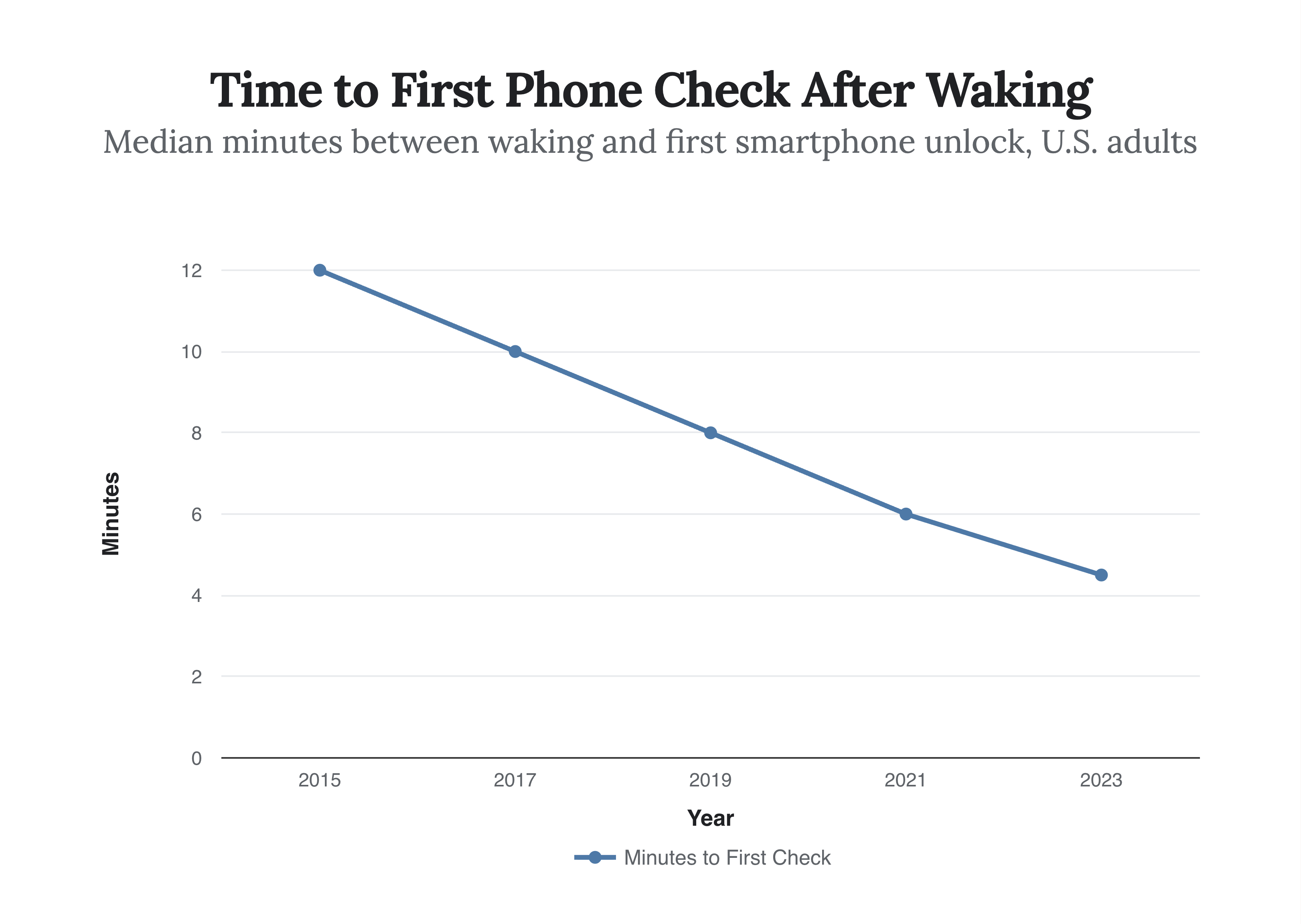
The compression of the ‘wake-to-check’ window has accelerated measurably over the past decade. Deloitte’s Global Mobile Consumer Survey tracked the metric from 2015 through 2023 and found the median time-to-first-check falling from roughly 12 minutes to under 5. RescueTime data from 2023 shows the average person unlocks their phone 58 times per day, with the highest-frequency cluster occurring between 6:00 and 8:00 a.m. — precisely the window Aurelius reserved for what he called prosoche, or attention to one’s own governing principle. The consequence is not merely distraction but sequencing loss: the mind’s first interpretive act of the day is now outsourced to whichever platform loads fastest. This matters because Stoic practice, and increasingly cognitive science, treats morning framing as load-bearing for the rest of the day’s emotional regulation — a 2022 Journal of Behavioral Medicine study linked early smartphone engagement to a 24% higher self-reported anxiety score by midday, independent of total screen time.
Aurelius kept no journal for an audience; Meditations was addressed to himself, written to reclaim the interior before the Senate, the frontier, and the plague of Rome could claim it first. He never faced a device engineered by variable-reward psychology to make refusal difficult. If the ruling emperor of the known world needed a daily rehearsal to protect one hour of unmediated thought, what claim does the average person have to skip that rehearsal entirely — and what, precisely, occupies the governing faculty in the four minutes and thirty seconds before the mind belongs to itself?