


On February 8, 2026, the global luxury market presents a profound paradox that traditional economic models fail to reconcile. According to real-time data from the Conference Board, consumer confidence in January 2026 collapsed to its lowest level since 2014, driven by persistent inflationary headwinds and a “no-hire, no-fire” labor market stagnation. Yet, simultaneously, American Express reported that luxury retail spending surged by 15% in the same period. This divergence signals a decoupling of consumption from satisfaction. We are no longer buying for joy; we are buying for survival in a socially stratified digital ecosystem.
The Divergence: Sentiment vs. Strategic Spending
The current data reality suggests that the modern purchase is less an act of hedonism and more a payment of “social rent.” As of Q1 2026, the “aspirational” middle class has been effectively priced out of the primary luxury market, leading to a bifurcation of the consumer base. While LVMH and Kering saw stock corrections of 2.6% and 4% respectively in January 2026, Hermès—the ultimate arbiter of high-barrier signaling—remains resilient. This indicates that the more exclusive and “difficult” a brand becomes, the more immune it is to macroeconomic downturns.
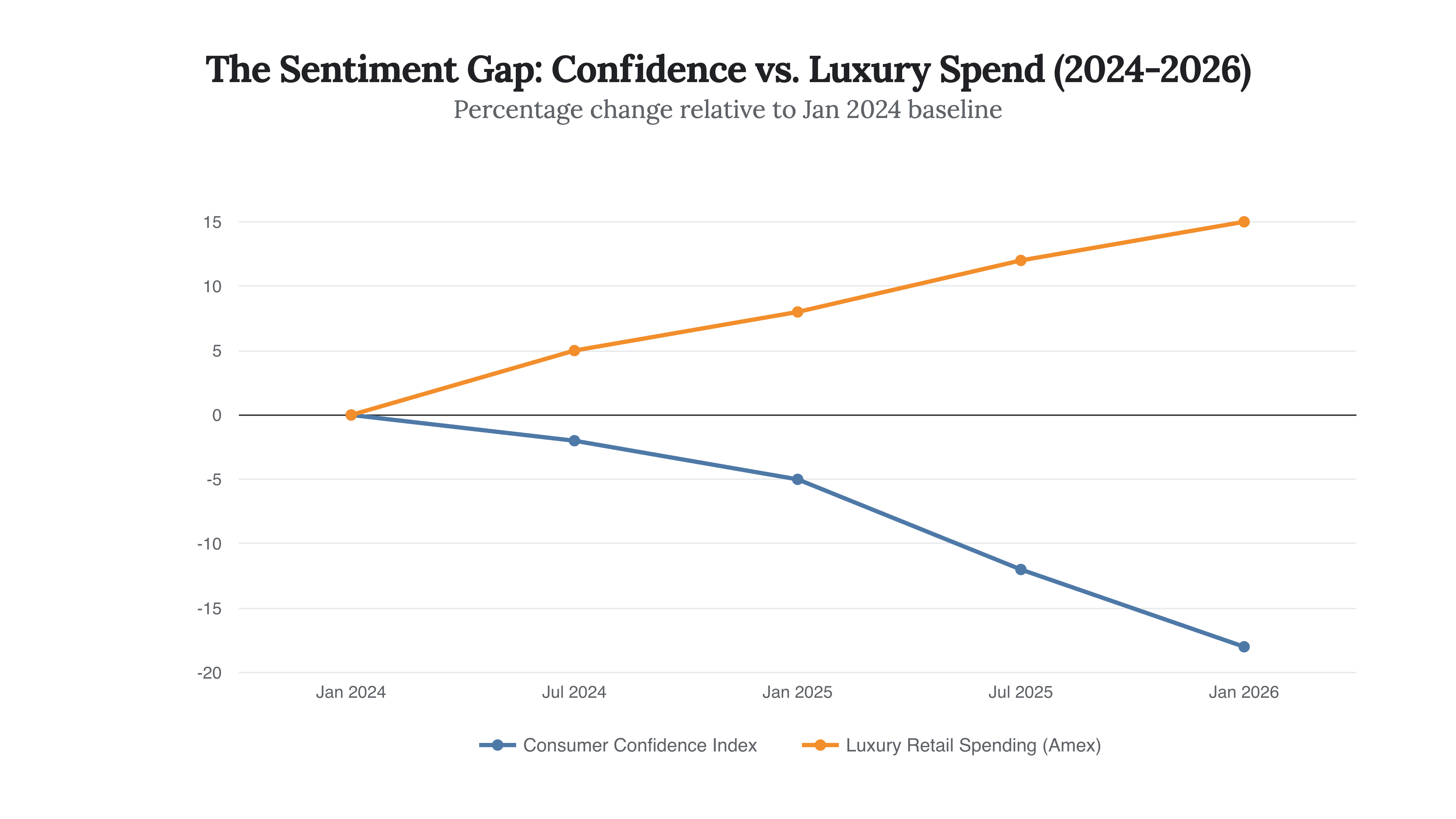
This chart visualizes the “Status Tax.” Despite feeling significantly less confident about their personal financial futures, high-income and Gen Z consumers are increasing their outlays on status-signaling assets. The modern luxury purchase is no longer an acquisition of beauty, but a strategic payment of social rent to avoid the tax of invisibility. When the economy feels unstable, the need to signal stability through high-value acquisitions becomes a non-discretionary psychological requirement.
The Girardian Feedback Loop and Mimetic Misery
The 2026 consumer is trapped in a Girardian feedback loop, where desire is not innate but mediated by the “Other.” Social media algorithms in February 2026 have reached a level of refinement where they do not just suggest products; they dictate the aesthetic parameters of entire social castes. This has led to the rise of “aesthetic repulsion” as a status signal. Brands like Balenciaga and Rick Owens capitalize on this by producing items that are intentionally difficult to wear or aesthetically challenging.
If a product is “ugly” or “hated” by the masses, its purchase signals a profound level of cultural capital—the ability to understand a code that is invisible to the uninitiated. In a world of mass-produced AI content, “ugly luxury” serves as a Proof-of-Work mechanism. You are not buying the item; you are buying the proof that you possess the leisure time and intellectual bandwidth to navigate a counter-intuitive aesthetic. This explains why 34% of Gen Z consumers in a recent McKinsey survey admitted to “trading down” on essentials like groceries to “splurge” on high-visibility, often uncomfortable, status items.
Unlock deeper strategic alpha with a 10% discount on the annual plan.
Support the data-driven foresight required to navigate an era of radical uncertainty and join a community of institutional-grade analysts committed to the truth.
The Cost of Inclusion: A Data Breakdown by Generation
The motivations for buying “things we hate” vary significantly by demographic. For Millennials, the driver is often the maintenance of a professional identity in a high-interest rate environment where housing is unattainable. For Gen Z, the driver is “In-Group Identification.” As of early 2026, 79% of Gen Z consumers wait for sales, yet they are the fastest-growing segment for ultra-high-end watches and “investment apparel.”
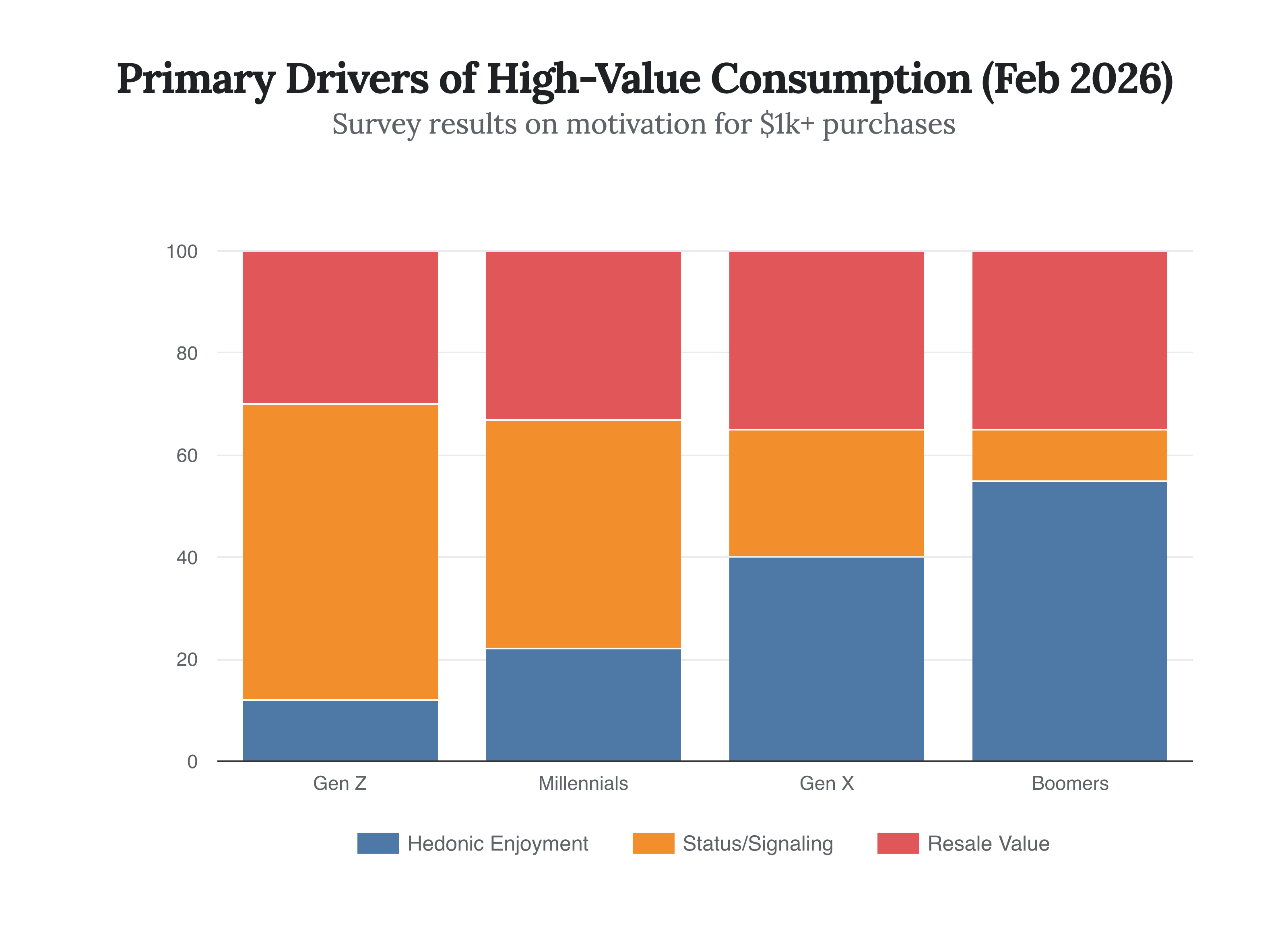
The data confirms that for younger cohorts, the “Hedonic Enjoyment” of a product has almost entirely collapsed. In 2026, the utility of a luxury good is measured not by how it feels to the owner, but by the intensity of the envy it generates in the viewer. This is the hallmark of a “Veblen Economy,” where the demand for a good increases as its price increases, precisely because the high price excludes others.
The Underconsumption Counter-Signal
A secondary, more complex trend emerging in February 2026 is “Underconsumption Core” or “No-Buy 2026.” While it appears to be an anti-consumerist movement, it is, in fact, the ultimate status signal. To “not buy” in a world optimized for frictionless checkout requires a level of self-discipline and “intellectual sovereignty” that has become the new prestige. This “Quiet Living” movement is the 2026 evolution of 2024’s “Quiet Luxury.”
By publicly performing the act of using a product until it reaches its physical limit (the “Pan Project” in cosmetics), elites are signaling that they are above the algorithmic manipulation that controls the masses. They are buying the “status of no-status.” This creates a three-tier signaling system: The Masses (Fast Fashion/Algorithmic), The Strivers (Visible Luxury/Logos), and The Elites (Intentional Underconsumption/Hermès-level Stealth Wealth).
Strategic Outlook: The Death of Personal Taste
As we move through Q1 2026, the concept of “personal taste” is effectively dead. In its place is a calculated, data-driven performance of identity. Brands that want to survive this era must realize that their value is no longer in the craftsmanship of their goods, but in the efficiency of their signaling mechanisms. If a consumer “hates” the product but buys it anyway, the brand has successfully transitioned from a provider of goods to a provider of social infrastructure.
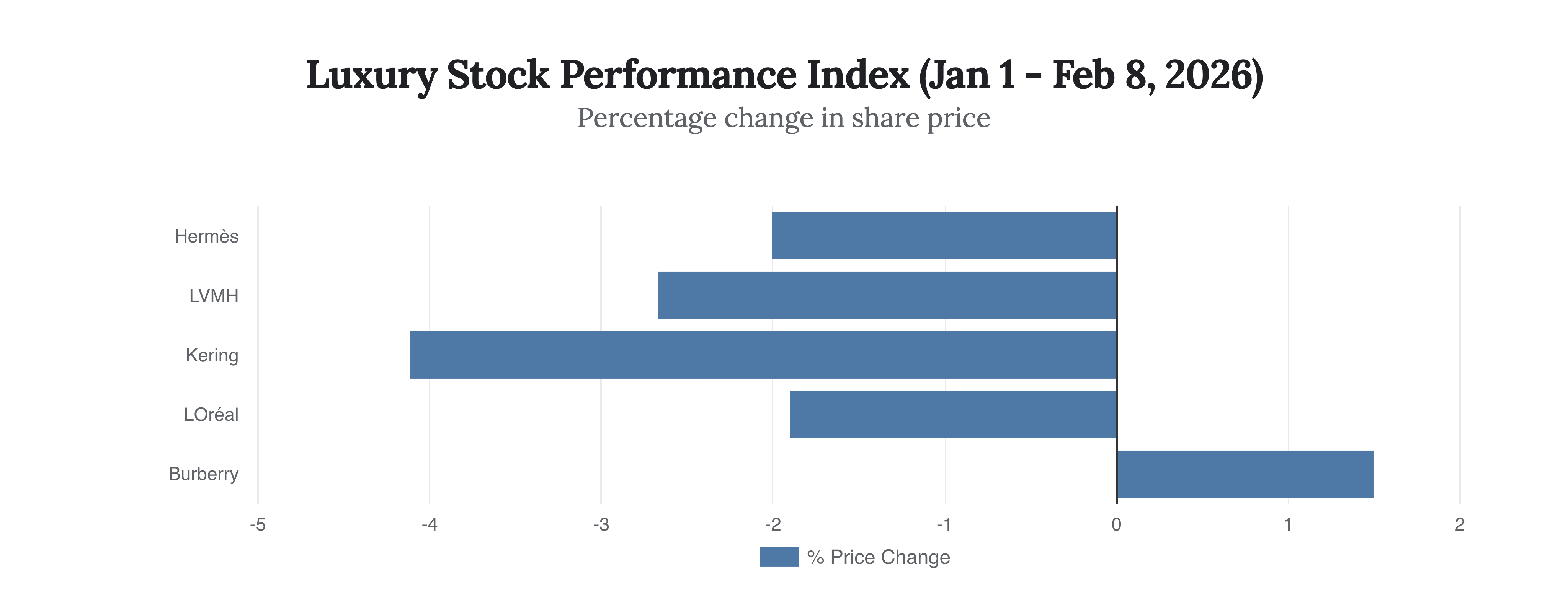
The market is currently punishing “Striver Brands” (Kering/Gucci) that relied on the aspirational middle class, while rewarding those that have pivoted to “Private Client” models or “Aesthetic Hardcore” niches. True power in 2026 lies in the ability to command a premium for a product that provides zero utility and marginal aesthetic pleasure, yet remains socially mandatory. This is the final form of the prestige prison: we are all inmates, and the price of the cell is rising.