



It is Monday, December 8, 2025, and the air in Zurich’s financial district is noticeably thinner. According to a breaking report from the Swiss newspaper SonntagsBlick, UBS—the colossus formed from the shotgun marriage with Credit Suisse—is contemplating a fresh wave of reducing its workforce by another 10,000 positions by 2027. This figure arrives not as a start, but as a brutal continuation: it comes on top of the nearly 15,000 jobs that have already evaporated since the merger began.
For the last two years, the narrative has been one of “synergies” and “integration.” But the data emerging this week paints a starker picture. We are no longer witnessing the mere removal of duplicate roles; we are watching the systematic dismantling of a workforce to finance a $13 billion savings target. The “superbank” is emerging, but it is being carved out of its own personnel.
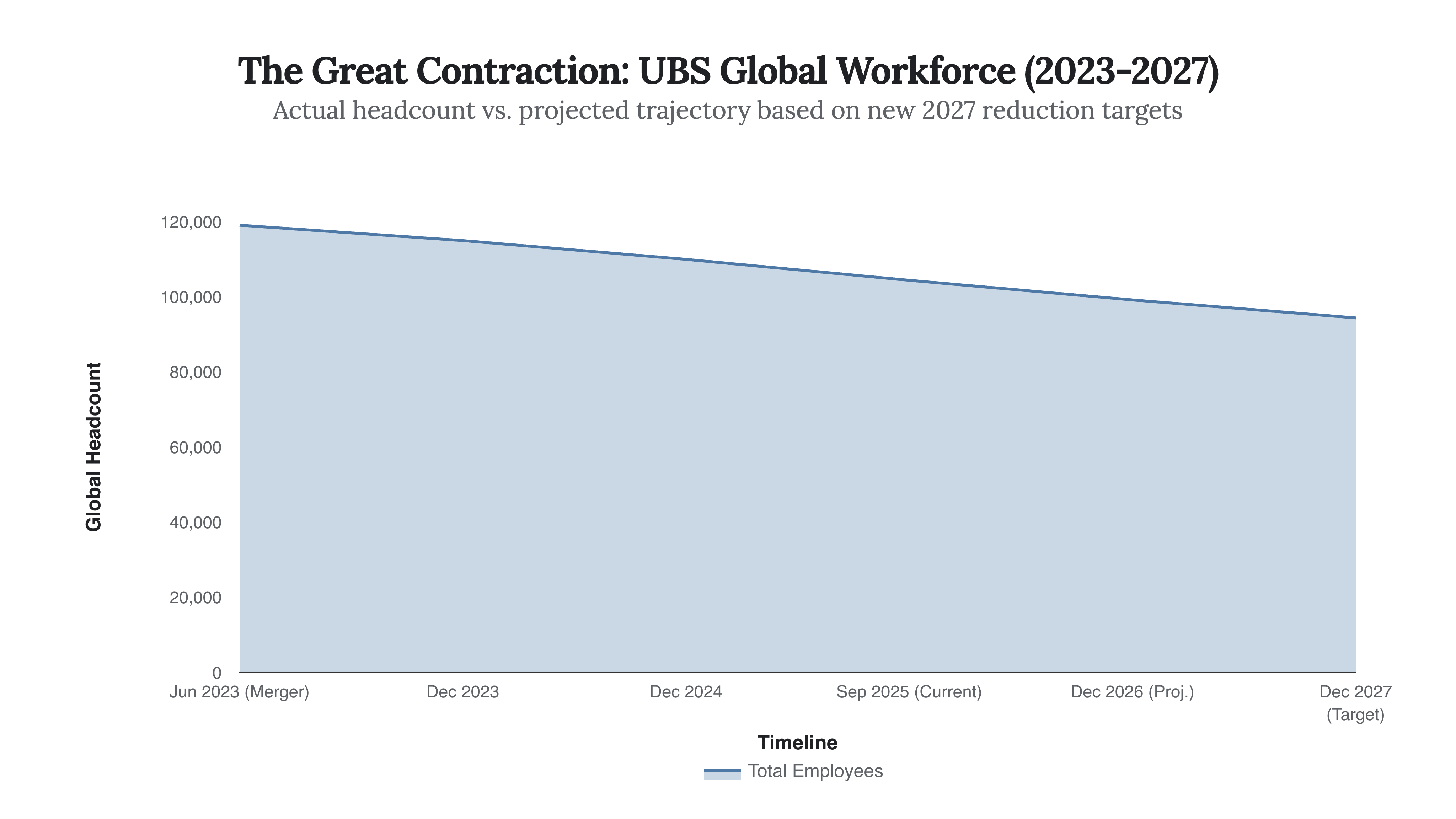
The chart above visualizes the scale of this contraction. From a post-merger peak of nearly 120,000 employees in mid-2023, the bank has shed staff at a relentless clip. As of September 2025, the headcount stood at 104,427. If the reported plan to cut another 10,000 roles materializes, UBS will have effectively removed a population the size of a small Swiss canton from its payroll in under four years.
The Price of Efficiency
Why the acceleration? The answer lies in the harsh mathematics of the merger. When UBS acquired Credit Suisse, it didn’t just buy assets; it bought an operational labyrinth. To justify the acquisition to shareholders, UBS leadership committed to a staggering $13 billion in annual cost savings by 2026.
We are now seeing the direct correlation between those savings and the exit door. The initial cuts—the “low-hanging fruit” of duplicate HR teams and overlapping IT support—are largely complete. Now, the bank is entering what analysts call the “structural consolidation” phase. This is where the cuts cut deep.
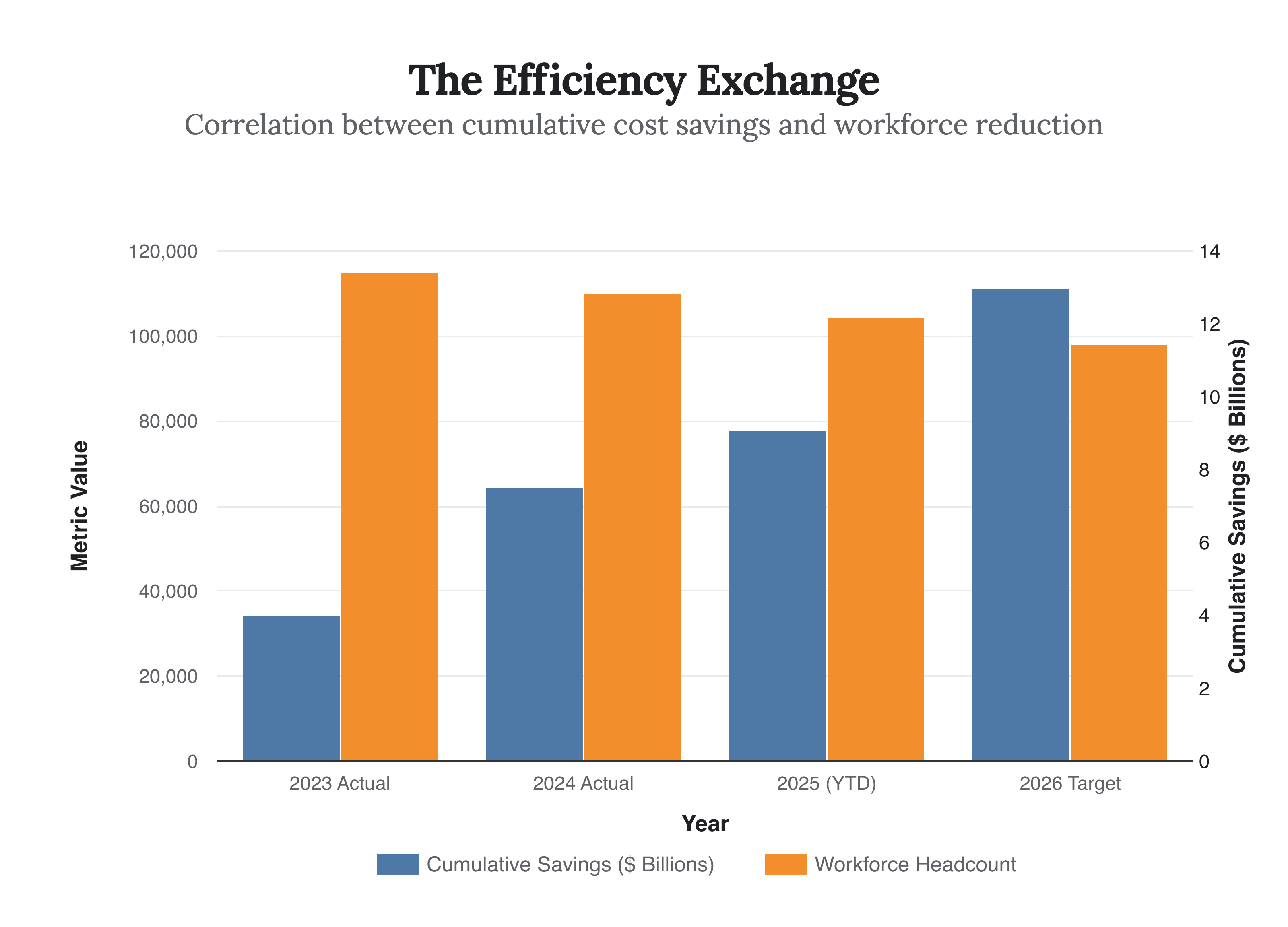
As the data indicates, the bank has already secured approximately 70% of its savings target ($9.1 billion), but the final 30% is often the hardest to extract. This “last mile” of efficiency is driving the need for deeper, more painful reductions. The bank is reportedly shifting from a steady drip of departures to potential larger waves.
“The role reductions will take place over the course of several years and will be mostly achieved through natural attrition, early retirement, internal mobility and inhousing of external roles.” — UBS Statement to SonntagsBlick, Dec 7, 2025
While the official language emphasizes “natural attrition,” the numbers suggest a more aggressive posture. In recent quarters, UBS has reduced its headcount by an average of 1,250 roles every three months. However, reports indicate this pace could nearly double to 2,000 cuts per quarter as the bank races to meet its 2026 deadline. The “meritocracy” of the new UBS is rigorous, and it leaves little room for redundancy.
The Human Component
The reduction isn’t just a Switzerland story; it is global. While roughly 3,000 cuts were earmarked for the Swiss home market—a politically sensitive number—the bulk of the new 10,000 figure is expected to fall on international units and back-office functions that are being digitized or consolidated.
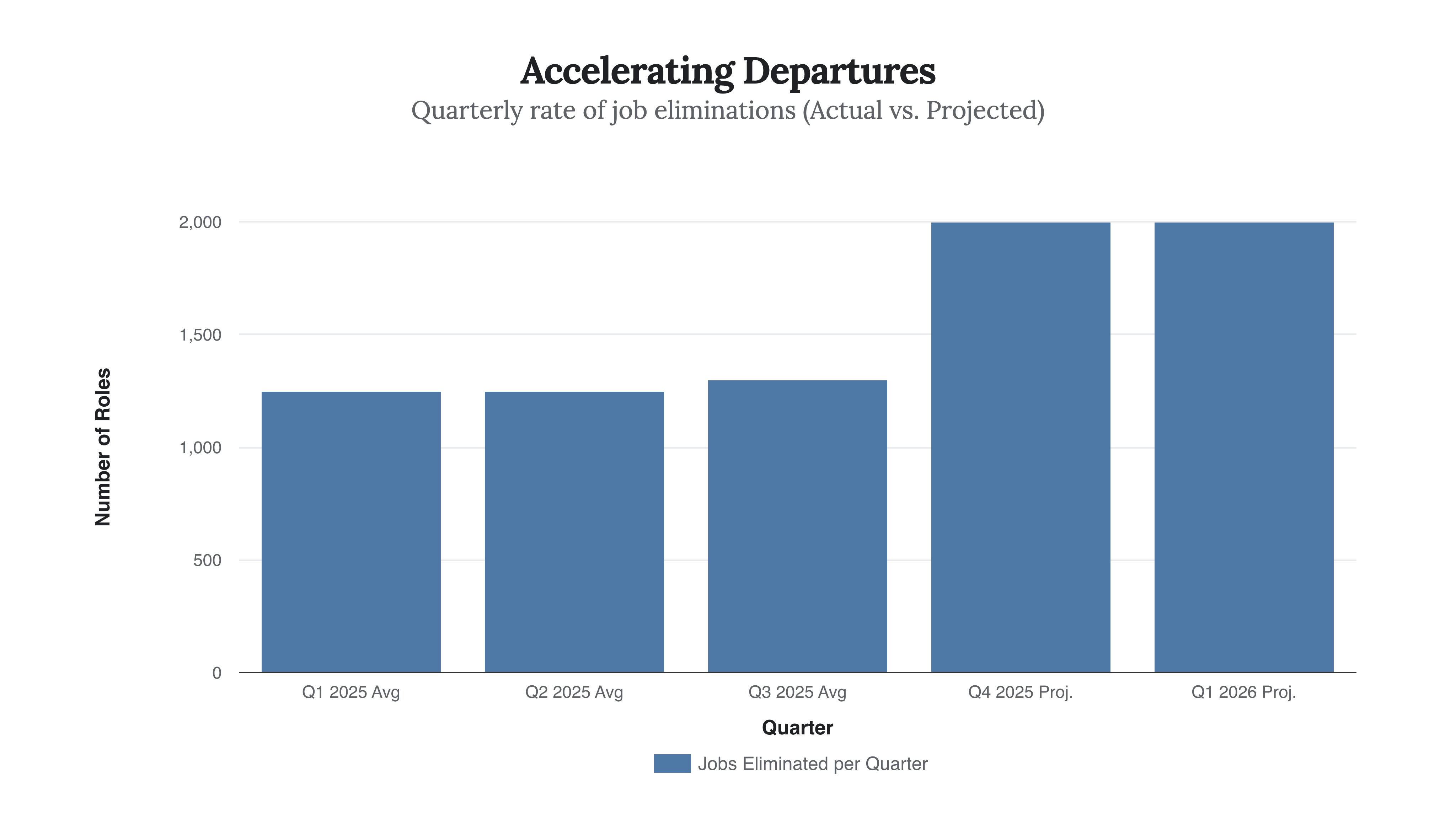
This projected acceleration (shown in the final chart) marks a turning point. The initial post-merger chaos has subsided, replaced by a calculated, methodical restructuring. The “Ghost of Credit Suisse” is being exorcised from the balance sheet, but the cost is a workforce that lives in perpetual uncertainty.
The $13 billion savings target will almost certainly be met. The question that remains is what kind of culture will be left in the building when the cutting finally stops.
Brutal but unsurprising breakdown. The "last 30%" observation is spot-on, those final efficiency gains always involve real structural pain, not just duplicate back office functions. What's wild is the pace shift from 1,250 to potentially 2,000 cuts per quarter heading into the deadline. Feels like they're front-loading the worst of it before 2026 so they can show sharehloders a clean story when the dust settles.