


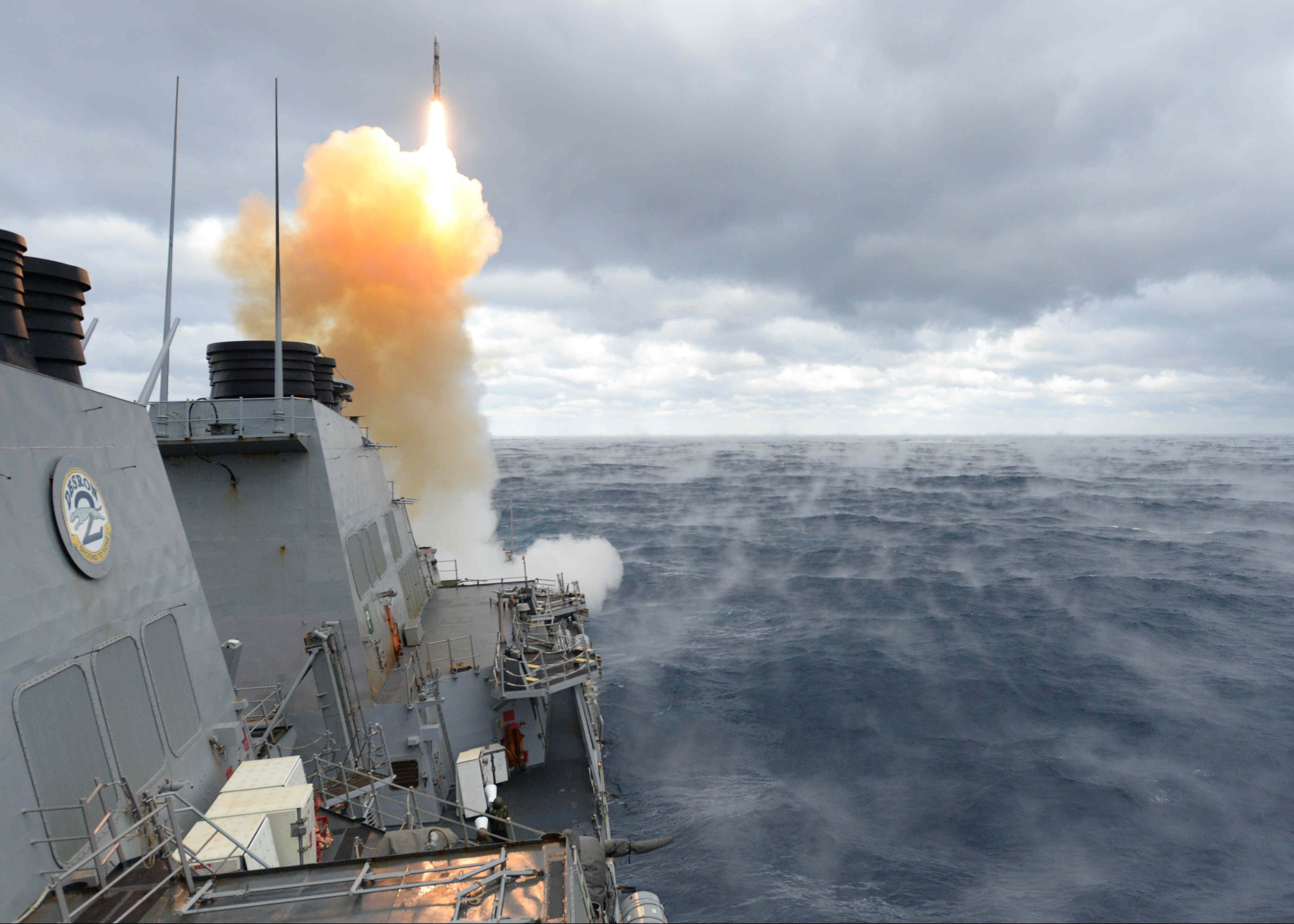
It is a number so small it looks like a typo: Three. That is the total number of battle force ships guaranteed in the US Navy’s base budget for Fiscal Year 2026. For an organization defined by its “Iron Mountains”—the massive carriers and destroyers that project American power—this figure represents a seismic tremor. The world’s most powerful fleet has effectively paused its traditional growth engine to bet the farm on a different kind of warfare.
The money hasn’t disappeared; it has migrated. As we settle into 2026, the financial currents reveal a definitive pivot from the age of the hull to the era of the drone. This is the year of the “Hellscape” strategy—a calculated gamble to defend the Taiwan Strait not with heavy tonnage, but with thousands of autonomous systems. While the Navy has pushed 16 traditional ships into the precarious “Reconciliation” funding bucket—making their existence politically optional—it has poured a staggering $13.2 billion into unmanned systems and autonomy. The message is clear: the future is expendable, autonomous, and swarming.
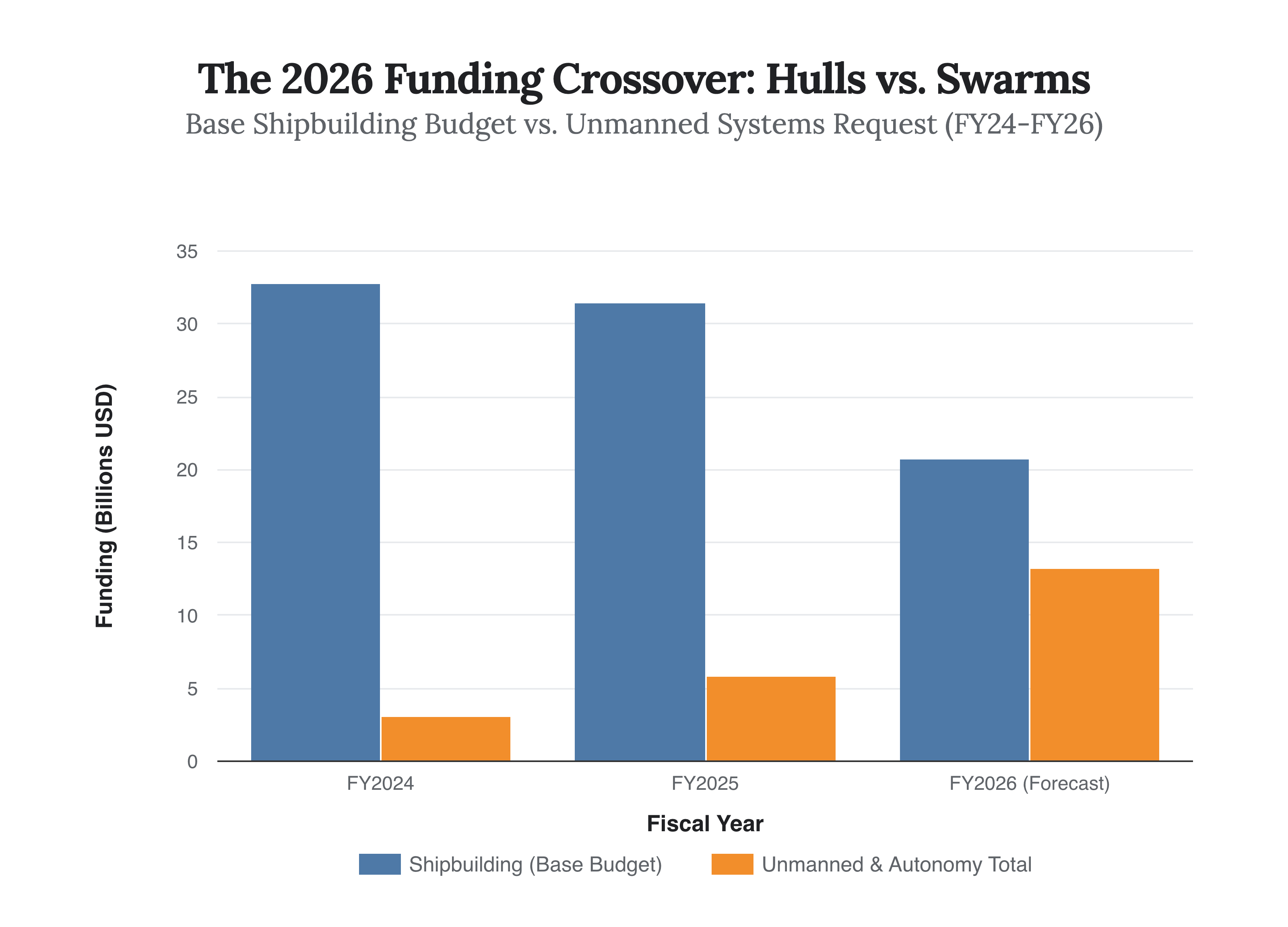
The chart above visualizes the violence of this pivot. While the base budget for traditional shipbuilding has plummeted to ~$20.8 billion—a figure that barely sustains the industrial base—funding for the unmanned portfolio has nearly quadrupled in just two years. We are witnessing the “un-manning” of the budget.
“The program is going to be inherently fluid... smashing [systems] all together at a pace that is really more akin to commercial software tempos.” — Capt. Alex Campbell, Defense Innovation Unit
The “Hellscape” Receipt: Where the Money Goes
The term “Hellscape” was coined to describe a defensive strategy that saturates the Taiwan Strait with loitering munitions and attack drones, creating a zone so lethal that no manned vessel could survive it. In 2026, this is no longer just a concept; it is a line item. The $13.2 billion allocation is not evenly spread. The data shows a massive prioritization of aerial dominance and the “central brain” software required to coordinate the swarm.
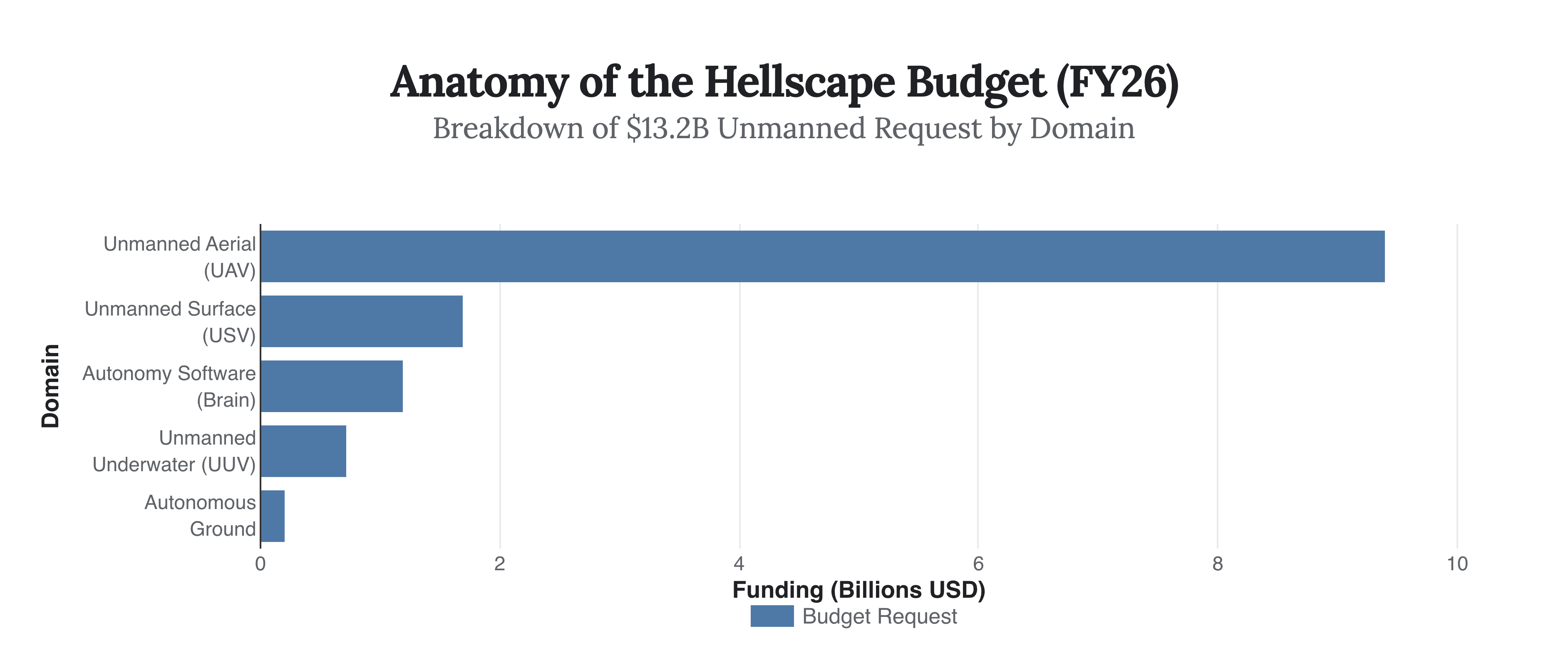
Note the dominance of the aerial domain ($9.4 billion), which includes investments in the MQ-25 Stingray and the “Replicator” initiative’s drone swarms. Equally significant is the $1.2 billion for Autonomy Software. The Navy is acknowledging that hardware is useless without the AI “conductors” capable of orchestrating thousands of independent units. This is a shift from buying steel to buying code.
The Phantom Fleet
The most controversial aspect of the 2026 forecast is the sheer risk the Navy has accepted regarding its traditional fleet. By moving the funding for 16 ships—including two Arleigh Burke-class destroyers and a Virginia-class submarine—into the “Reconciliation” bill, the Navy has essentially designated them as “nice to have” rather than “mission critical.” If the political winds shift and the reconciliation bill fails or is trimmed, the Navy will secure only the three hulls in the base budget.
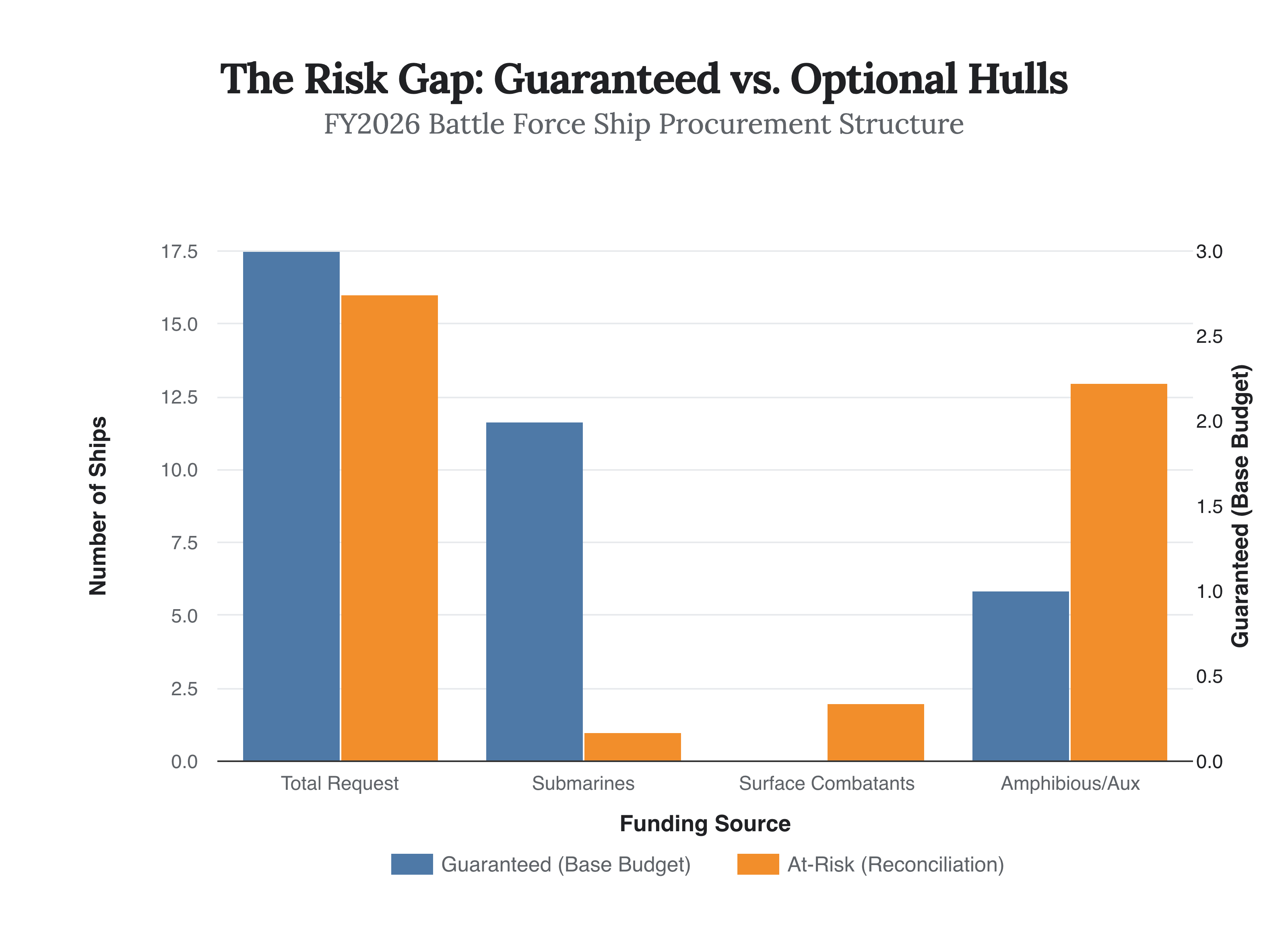
The visual above highlights the precariousness of the situation. The “Guaranteed” fleet is negligible. The “At-Risk” fleet contains the bulk of the Navy’s replacement capacity. This structure suggests the Navy is willing to cannibalize its own long-term shipbuilding health to ensure the immediate solvency of its drone programs.
“We need to fail and adapt... We don’t send a human being to do something dangerous that a machine can do better, faster, and more cheaply.” — Adm. Sam Paparo, Commander, U.S. Pacific Fleet
The Human Cost of Autonomy
This budget pivot is not merely an accounting trick; it is a philosophical redefinition of the sailor’s role. For centuries, naval power was measured by the number of souls at sea. In 2026, the metric has changed to the number of nodes in a network.
The data tells us that the US Navy is preparing for a conflict where attrition is high and the cost of losing a manned vessel is politically and strategically unbearable. By shifting capital from hulls to drones, they are building a force designed to be spent. The 3-ship base budget is a warning sign that the era of the capital ship as the sole currency of naval power is ending. In 2026, the Navy isn’t just buying fewer ships; it is buying a different kind of war.