

In a geopolitical pivot that has sent shockwaves through the semiconductor industry, the United States officially approved the export of Nvidia’s H200 AI chips to China this week—with a catch. Under the new “revenue-sharing” framework announced December 9, 2025, Nvidia can sell its second-most powerful processor to approved Chinese clients, provided a 25% fee is paid directly to the U.S. Treasury. This decision marks a sharp departure from the “total denial” strategy of previous years, replacing improved blockades with a model that seeks to monetize China’s inevitable demand for compute power.
The timing was anything but coincidental. On the very same morning the White House announced the new export protocol, the Department of Justice unveiled “Operation Gatekeeper,” a massive enforcement action that dismantled a smuggling ring responsible for funneling $160 million worth of restricted H100 and H200 chips into mainland China. The message from Washington is clear: the black market is closed, but the toll road is open.
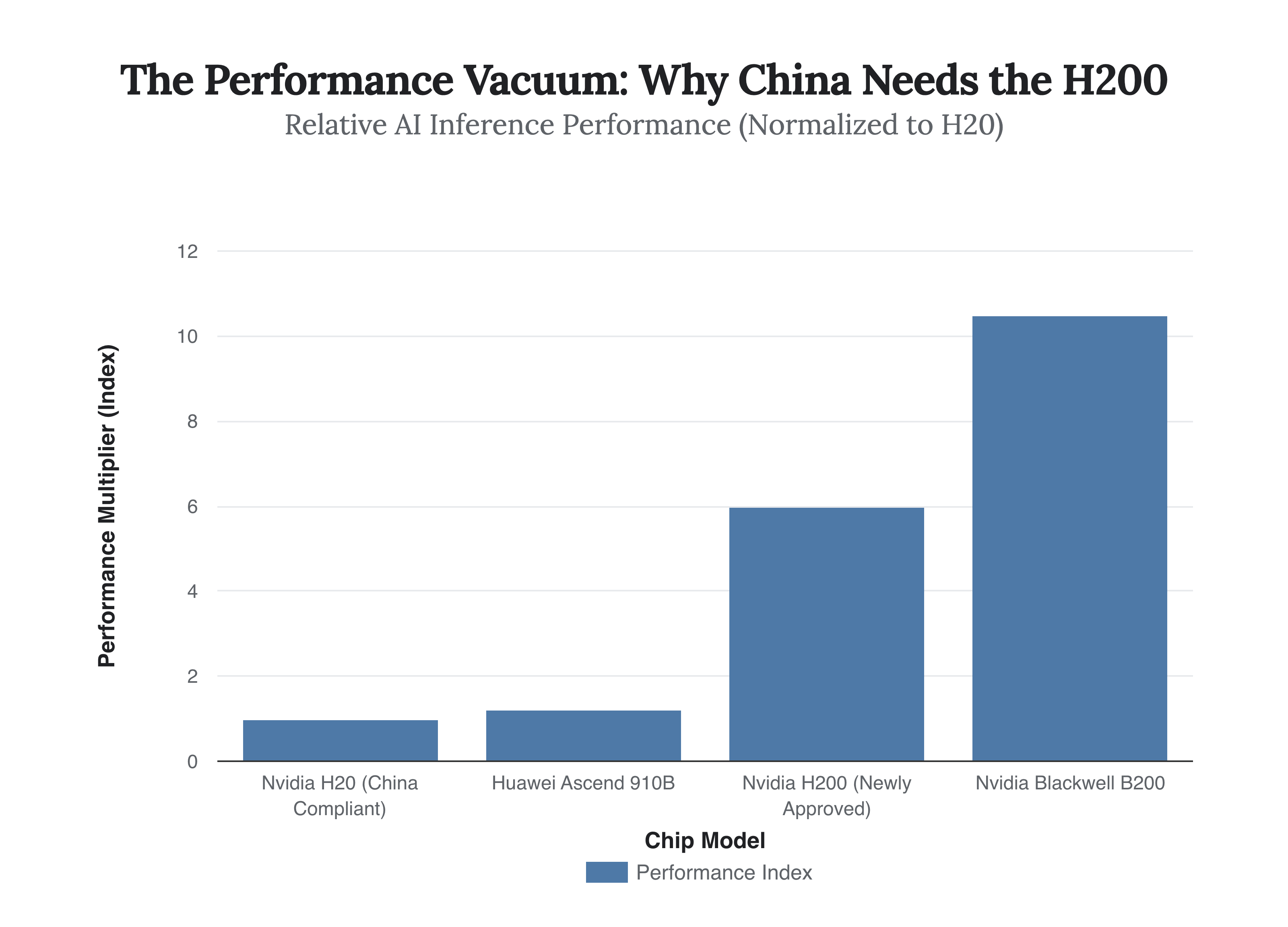
The chart above illustrates the technological desperation that fueled the smuggling networks in the first place. The H20—Nvidia’s previous “China-compliant” offering—was artificially crippled to meet export controls, offering only a fraction of the power of its Western counterparts. With the H200 offering a staggering 6x performance increase over the H20, Chinese tech giants like ByteDance and Alibaba were left with a stark choice: rely on slightly faster domestic chips from Huawei, or pay exorbitant premiums to smugglers for Nvidia’s silicon.
“The H200 is six times ahead of the China-destined H20 in performance. For Chinese firms, this isn’t just an upgrade; it’s the difference between staying competitive in LLM training and falling a generation behind.”
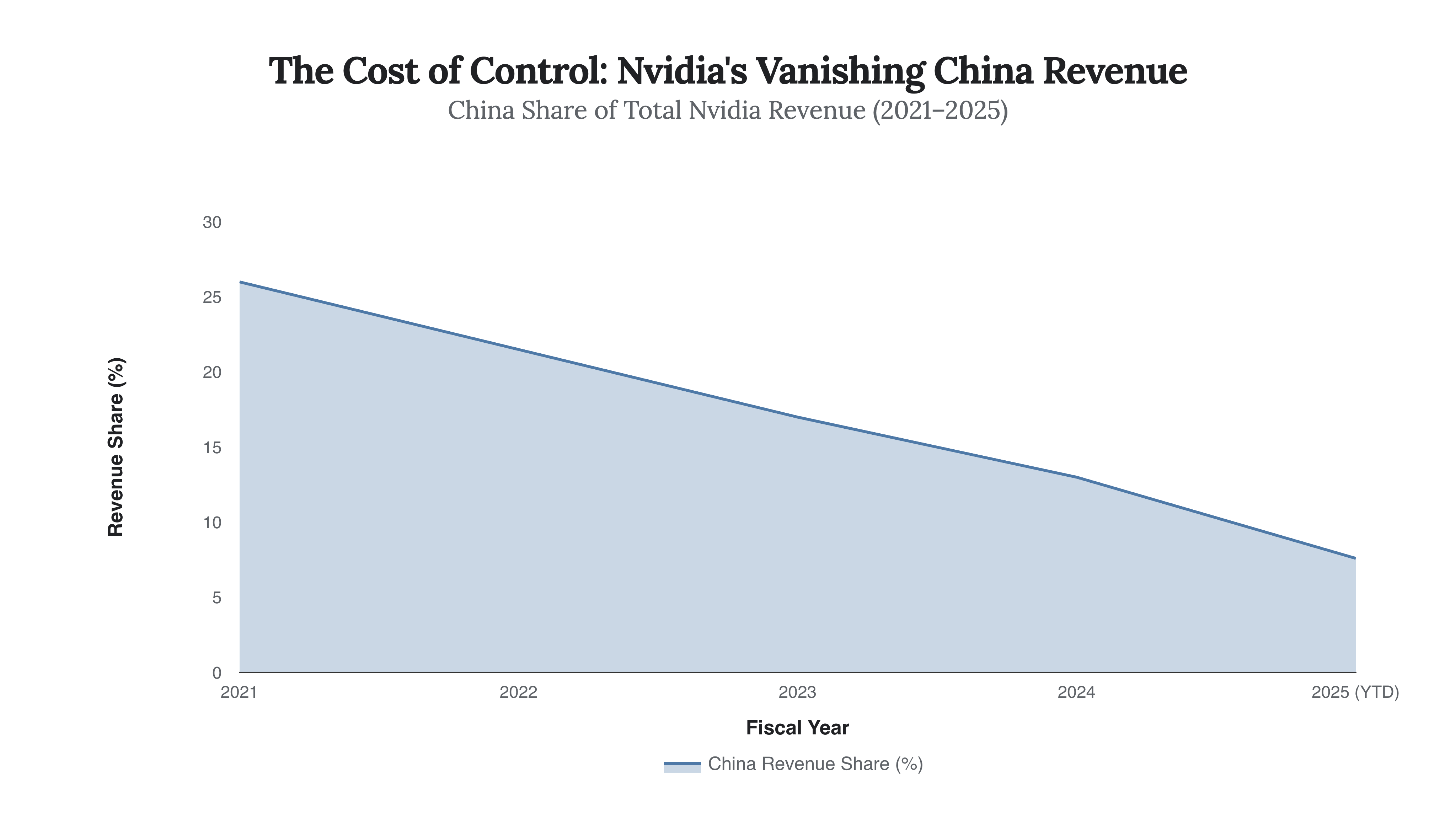
For Nvidia, the policy shift comes just in time to arrest a frightening decline in what was once its most lucrative market. In 2021, China accounted for over a quarter of Nvidia’s total revenue. By late 2025, that figure had collapsed to under 8%, as uncertainty and domestic substitution took hold. In the third quarter of 2025 alone, sales of the H20 chip reportedly flatlined to near zero as customers anticipated either a crackdown or a breakthrough.
The sudden approval of the H200 changes the calculus for everyone involved. By legalizing the trade but attaching a 25% tariff, the U.S. government effectively undercuts the black market. During the peak of the restrictions in 2024, smuggled H100 and H200 units were trading in Shenzhen’s Huaqiangbei electronics markets for upwards of $400,000—nearly ten times the MSRP. The new “taxed” legal price, while higher than the U.S. list price, is dramatically lower than the smuggler’s markup.
However, the “approved” status of the H200 does not guarantee a return to the golden age of sales. The approval is conditional, requiring end-user verification to prevent the chips from aiding military applications. Furthermore, the 25% fee acts as a direct subsidy from Chinese tech companies to the U.S. Treasury, a bitter pill that Beijing may struggle to swallow despite the technological necessity.
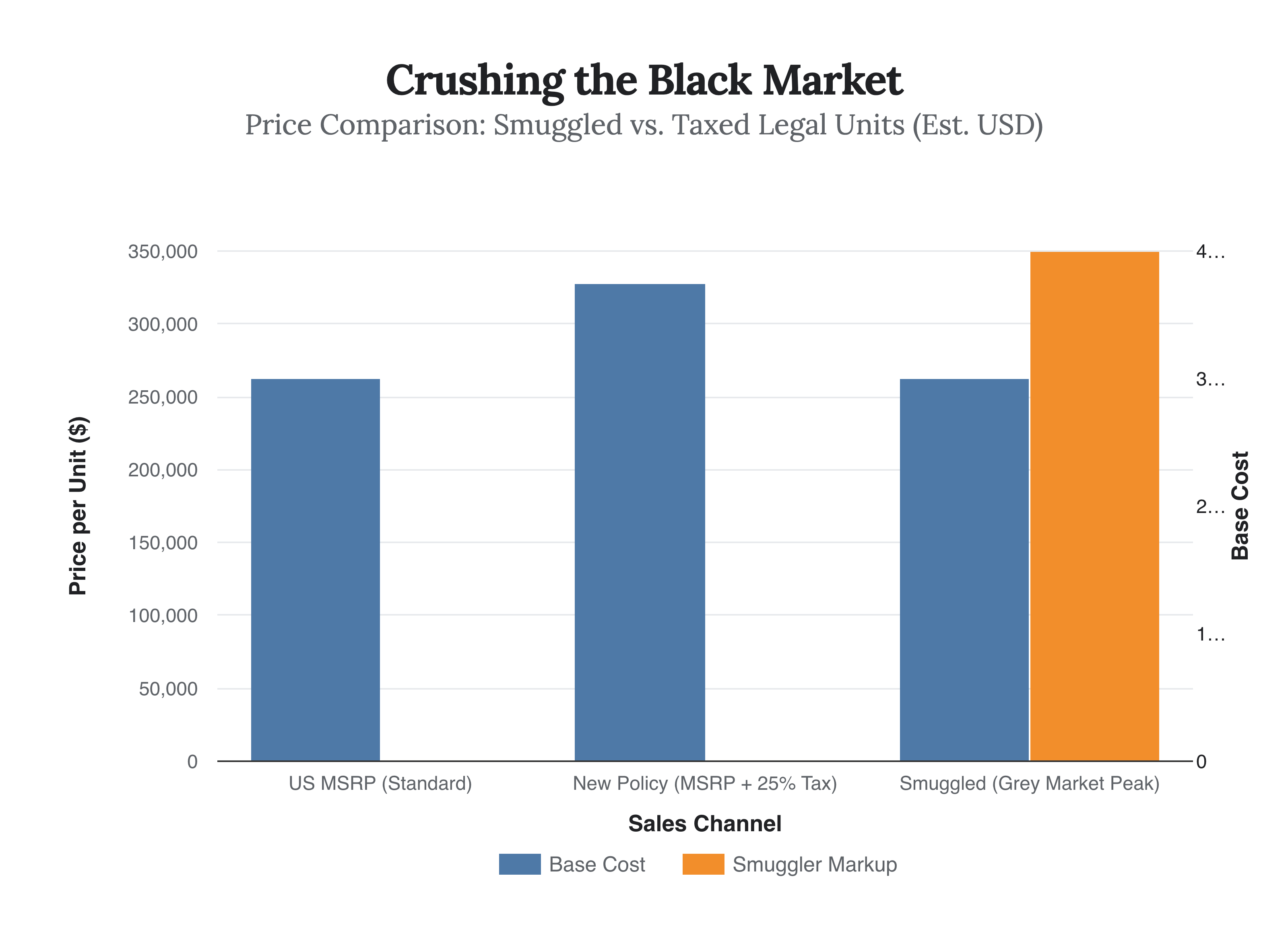
The chart above highlights the economic logic behind the policy. By offering a legal route at roughly $37,500 (including the tax), the U.S. has rendered the $300,000+ black market rates unsustainable. The $160 million smuggling ring busted in Operation Gatekeeper thrived on that arbitrage; the new policy effectively evaporates their profit margin.
Ultimately, this is a calculated gamble by Washington: allow China to buy yesterday’s cutting-edge technology to maintain American market dominance, while using the proceeds to fund the development of tomorrow’s Blackwell and Rubin chips that remain strictly out of China’s reach.