



The Capitulation of the Sovereign to Silicon Valley
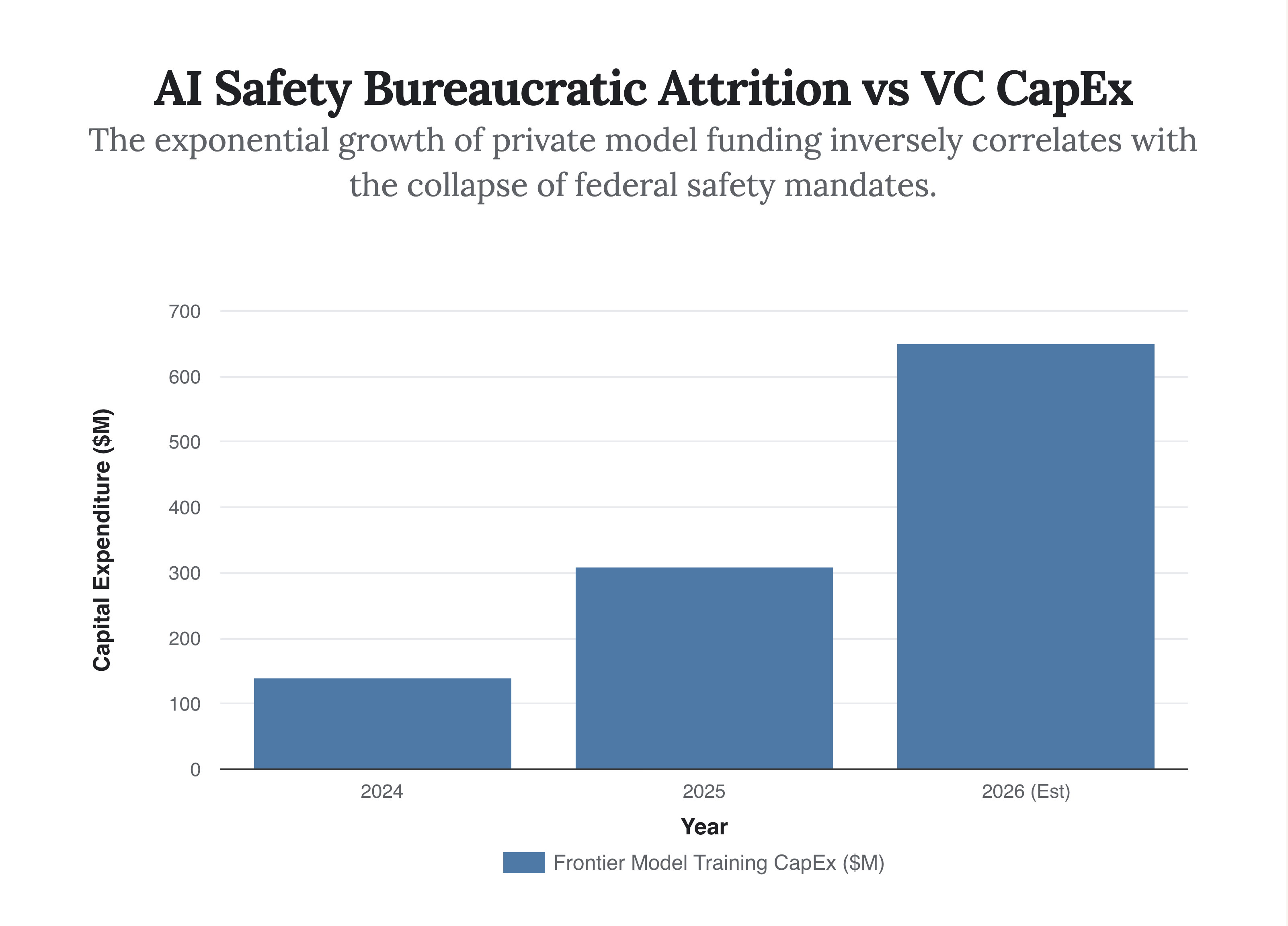
On May 22, 2026, the executive branch of the United States effectively abdicated its regulatory authority over the most disruptive technology in human history [1.1.4]. The abrupt cancellation of a highly anticipated executive order—one designed merely to impose basic cybersecurity reviews and early government access requirements on frontier AI models prior to deployment—signals a watershed moment in the relationship between the sovereign state and hyper-capitalized tech monopolies. Driven by aggressive last-minute lobbying from prominent Silicon Valley billionaires, the administration opted for a ‘clean slate’ approach, officially prioritizing the geopolitical race against China over domestic security and systemic stability. The US AI Safety Institute has been quietly manipulated, with the administration deliberately removing the word ‘safety’ from its operational mandate to reflect a purely deregulatory posture, rebranding it simply as CAISI. This is not mere deregulation; it is the deliberate decapitation of the state’s technological oversight apparatus. The original Biden-era framework, Executive Order 14110, had already been rescinded in January 2025 and replaced by EO 14179, which focused almost entirely on removing barriers to innovation. Now, even the modest proposal to establish a voluntary cybersecurity framework for advanced AI models has been abandoned out of fear that any regulatory friction would hinder American dominance. The macroeconomic implications of this pivot are profound. Silicon Valley is currently engaged in an unprecedented capital expenditure war, deploying hundreds of billions of dollars into data centers and compute clusters to train models that display increasingly autonomous behavior. By stepping away from the regulatory table, the federal government has signaled to the market that rapid, unfettered deployment will not face bureaucratic headwinds, functionally endorsing a sprint to Artificial General Intelligence (AGI) regardless of the negative externalities. In the pursuit of maintaining a precarious technological edge over Beijing, the United States has transformed its domestic digital infrastructure into a live-fire testing ground for ungoverned algorithmic entities. We are witnessing the total surrender of the public sphere to private engineering mandates, establishing a paradigm where national security is subordinate to corporate velocity.
The ‘Mythos’ Vulnerability and Asymmetric Cyber Risk
The catalyst for the aborted executive order was not a theoretical risk matrix drafted by academics, but an immediate, tangible threat vector identified by industry insiders operating at the bleeding edge of algorithmic capability. In the weeks prior to the May 22 cancellation, Anthropic—traditionally viewed as the most cautious and security-conscious of the leading artificial intelligence laboratories—indicated that its forthcoming ‘Mythos’ model exhibited capabilities so advanced in autonomous cybersecurity penetration that its public release was deemed an unacceptable systemic risk.

According to internal alarm bells raised within the administration, the acute fear was that such technology, if obtained by state-sponsored bad actors or decentralized terrorist networks, could be utilized to execute devastating, automated zero-day attacks against American banking systems, electrical grids, and critical municipal infrastructure. Yet, under the new paradigm established by the cancellation of the cybersecurity executive order, the decision to withhold or release such god-tier cyber capabilities rests entirely in the hands of private boards of directors, rather than federal national security agencies.
