


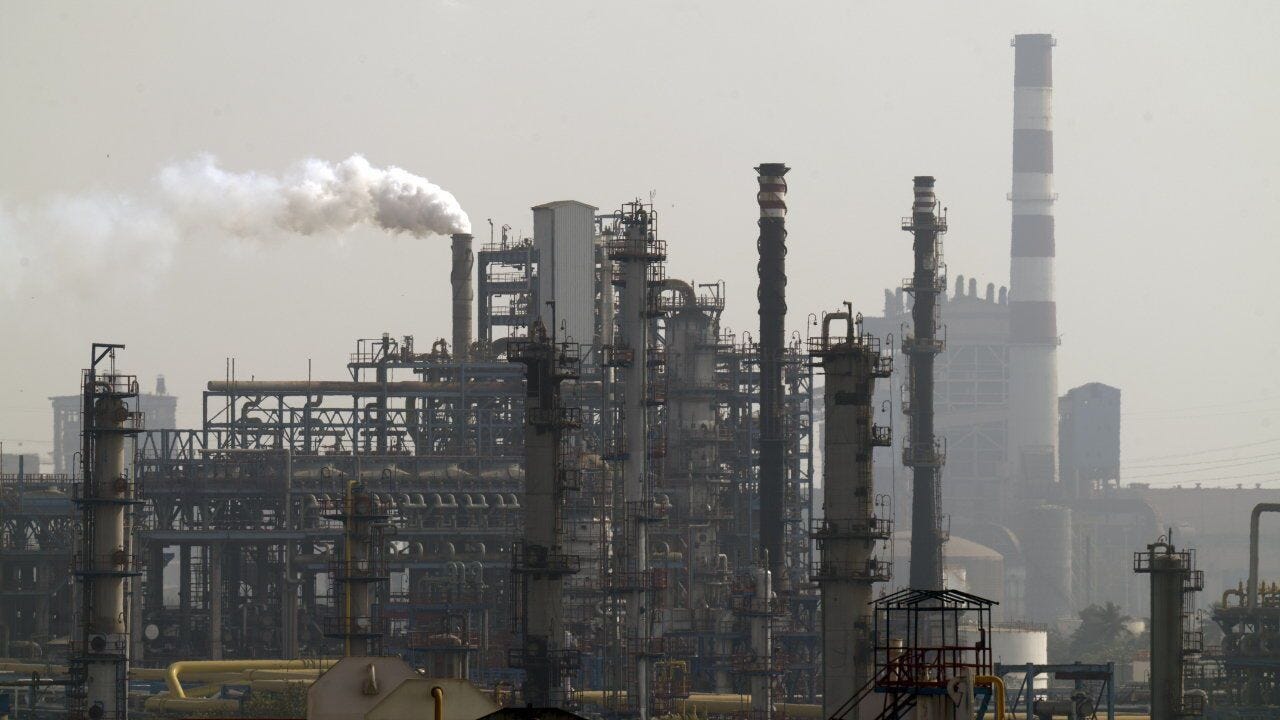
The global transition to renewable energy is not merely a technological shift; it is a profound geopolitical restructuring. Unlike the 20th-century energy system, which was built on the geographically dispersed logic of fossil fuels, the 21st-century system is concentrating power in new ways. The entire value chain, from mineral extraction to the manufacturing of a wind turbine or an electric vehicle battery, is defined by a series of geographical chokepoints. To understand the future of energy is to understand the map of its supply chain.
This new map is not one of oil fields and tanker routes, but of lithium brine flats, cobalt mines, and sprawling industrial parks where raw materials are transformed into the engines of a green economy. The spatial logic is brutal and unforgiving. A handful of countries control the raw materials, a single country dominates their processing, and a few industrial giants control the final manufacturing. This concentration creates new dependencies and vulnerabilities that are only now being understood by global policymakers.
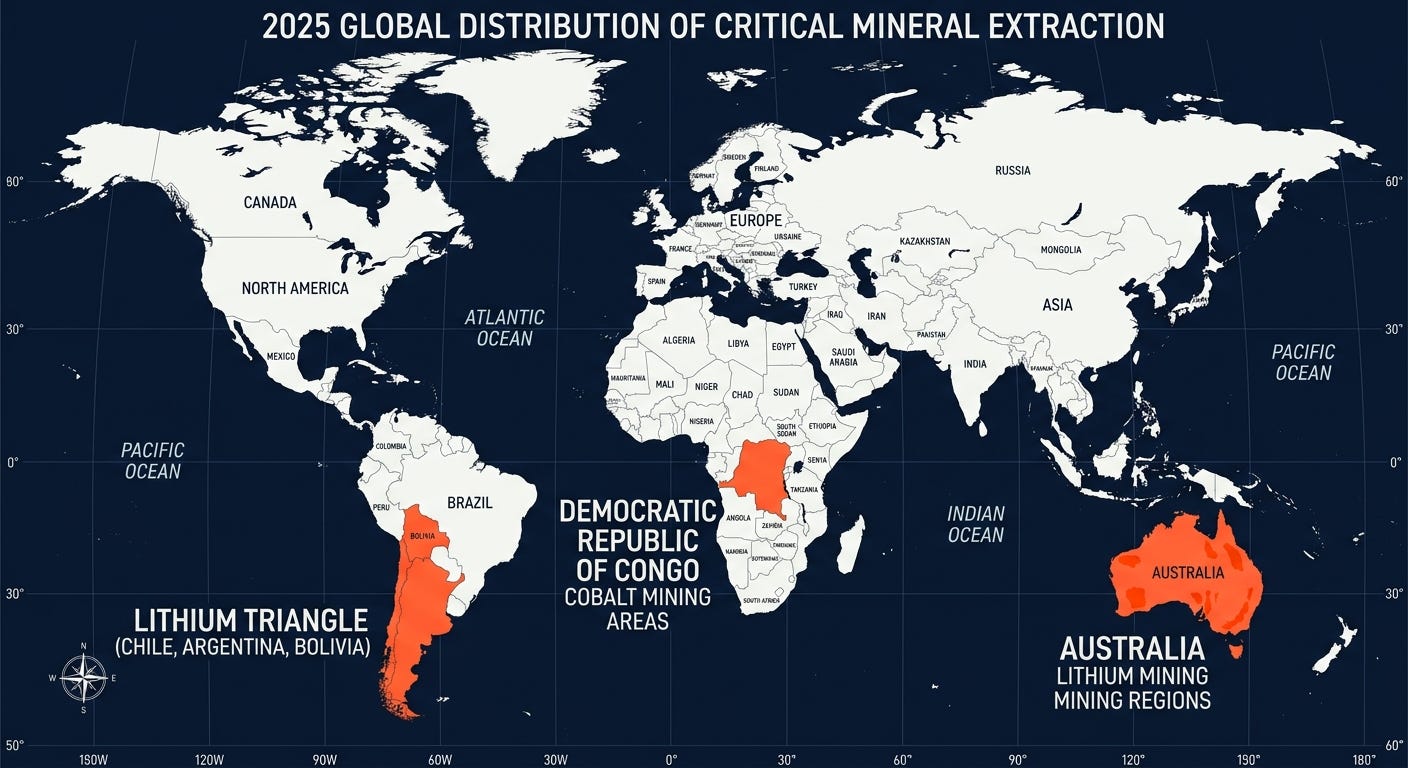
The first layer of this new geography is the source: the mines and brine pools where the essential ingredients for batteries and renewable technologies are extracted. The world’s lithium, critical for battery storage, is geographically concentrated in the ‘Lithium Triangle’ of South America (Chile, Argentina, and Bolivia) and Australia. According to 2025 U.S. Geological Survey data, Chile and Australia are the top two producers, with Argentina’s production rapidly expanding. Similarly, the Democratic Republic of Congo (DRC) is the source of over 75% of the world’s cobalt, a key component of battery cathodes, as of 2024. This concentration of production in a few key locations creates an immediate and obvious vulnerability. Political instability, resource nationalism, or logistical disruptions in these specific zones can have cascading effects on the entire global supply chain.
However, the most significant chokepoint in the energy transition supply chain is not at the point of extraction, but in the next stage: processing and refining. Raw ores like lithium spodumene or cobalt hydroxide cannot be used directly in batteries. They must undergo a complex chemical refining process to be converted into battery-grade materials. **Here, the geography is starkly monolithic: China dominates.** According to the International Energy Agency’s 2025 Global Critical Minerals Outlook, China refines approximately 70-75% of the world’s lithium and cobalt, and over 90% of its rare earth elements. This dominance is the result of decades of strategic industrial policy, lower labor costs, and less stringent environmental regulations.
This means that minerals mined in Australia or the DRC are overwhelmingly shipped to China for processing before being exported to battery and electric vehicle manufacturers around the world. This spatial arrangement has created a powerful geopolitical lever. By controlling the midstream of the supply chain, Beijing effectively acts as the gatekeeper for the global energy transition. A decision in Beijing to restrict exports or alter pricing can impact car manufacturing in Germany, grid storage projects in California, and wind turbine production in Denmark. The world, in its rush to decarbonize, has inadvertently built a supply chain that runs directly through a single, dominant geopolitical power.

The final stage of the supply chain is manufacturing, where processed minerals are turned into components like battery cells, solar panels, and wind turbines. Here again, the map points to a high degree of concentration, with China as the leading player. As of 2026, China is the undisputed leader in renewable energy production and plays a pivotal role in the manufacturing of solar panels, batteries, and electric vehicles. The country added a record 434 GW of renewables in 2025 alone. This manufacturing prowess is not accidental; it is built upon the foundation of its midstream processing dominance, which provides a secure and cost-effective supply of necessary materials. While companies in Europe and North America, like Northvolt in Sweden or First Solar in the U.S., are scaling up, they still operate within a supply chain heavily influenced by Chinese processing capacity.
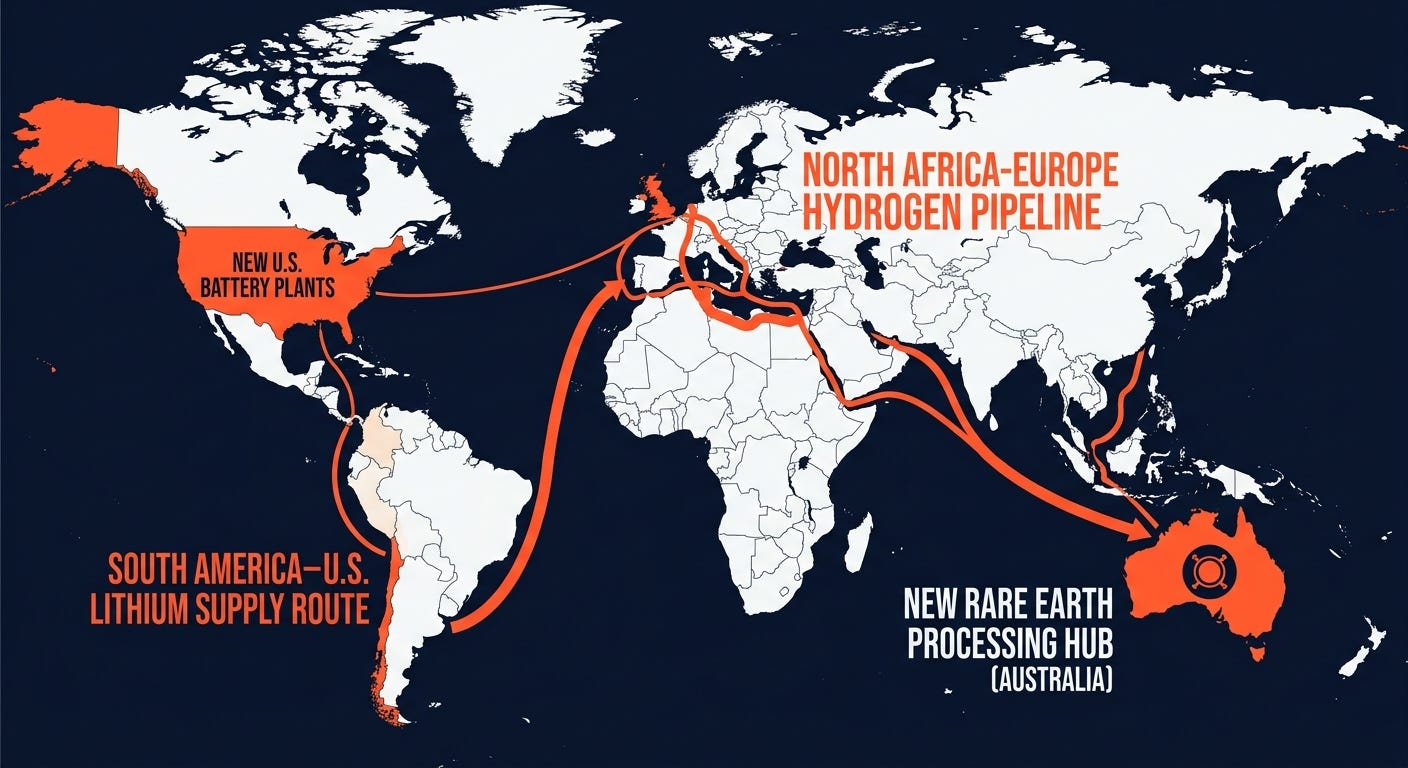
Recognizing these vulnerabilities, a new geopolitical map is slowly being drawn, characterized by efforts to diversify and de-risk these concentrated supply chains. The United States, through initiatives like the 2025 List of Critical Minerals, and Europe, with its REPowerEU plan, are attempting to build alternative, non-Chinese supply chains. This involves investing in domestic mining and processing, as well as forging strategic partnerships with resource-rich countries. The U.S. is looking to revive domestic mining in locations like Mountain Pass, California, for rare earths and is exploring new projects across several states. Europe is focusing on creating ‘Green Hydrogen Corridors’ to connect renewable energy production in North Africa with industrial demand centers in Italy, Austria, and Germany, aiming to import 10 million tons of renewable hydrogen by 2030.
But redrawing this map is a monumental task. China has a multi-decade head start in processing technology, intellectual property, and skilled labor. Replicating this ecosystem is not simply a matter of building factories; it requires developing a knowledge base that has atrophied in the West over the last 40 years. Furthermore, new mining and refining projects in Western countries face significant environmental and social hurdles, leading to long permitting processes and community opposition. The toxic waste generated by conventional rare earth processing, for example, makes it a difficult sell in jurisdictions with strict environmental laws.
The geography of the energy transition is therefore defined by a fundamental tension. The imperative to decarbonize is global, but the supply chain required to do so is highly localized and strategically concentrated. While the old energy map was characterized by multiple chokepoints like the Strait of Hormuz, the new map is arguably more fragile, with the primary chokepoint located in the processing facilities of a single nation. Navigating this new geography requires a shift in thinking from a purely cost-based optimization of supply chains to a more resilient, geographically-aware strategy. The transition away from fossil fuels is not an escape from geopolitics; it is an entry into a new, and in many ways, more complex geopolitical landscape, drawn on a map of critical minerals and their highly concentrated pathways to power.