



We are operating in a market failure of human connection. While headlines obsess over interest rates and supply chains, a more insidious deficit is eroding the foundation of the global economy. We are in the midst of an “Empathy Recession”—a measurable, systemic decline in our capacity to understand and share the feelings of others within our professional and civic systems. This is not a soft-skills crisis; it is a hard-cost liquidity crunch.
The data is unambiguous and alarming. Recent intelligence from late 2024 reveals that workplace incivility alone is draining the U.S. economy of approximately $2.7 billion every single day in lost productivity and absenteeism. Simultaneously, charitable giving—the purest economic proxy for societal compassion—has failed to keep pace with inflation for two consecutive years, signaling a contraction in our “social currency.”
This briefing deconstructs the Empathy Recession not as a cultural complaint, but as a strategic risk vector. We will analyze the widening disconnect between leadership perception and workforce reality, the “blind spot” threatening the adoption of AI innovation, and why the United States has become a statistical outlier in the geometry of polarization.
The Macroeconomics of Indifference
For decades, empathy was treated as an intangible asset—nice to have, but off the balance sheet. That era is over. The “tax” on indifference has now been quantified, and it is aggressive. When social cohesion fractures, transaction costs rise. Trust is the lubricant of commerce; without it, every interaction requires more friction, more verification, and more cost.
The most immediate indicator of this recession is the sharp divergence between economic activity and philanthropic participation. While the S&P 500 rallies, the “real” value of charitable giving is shrinking, suggesting that as wealth accumulates, the propensity to share it is hitting a structural wall.
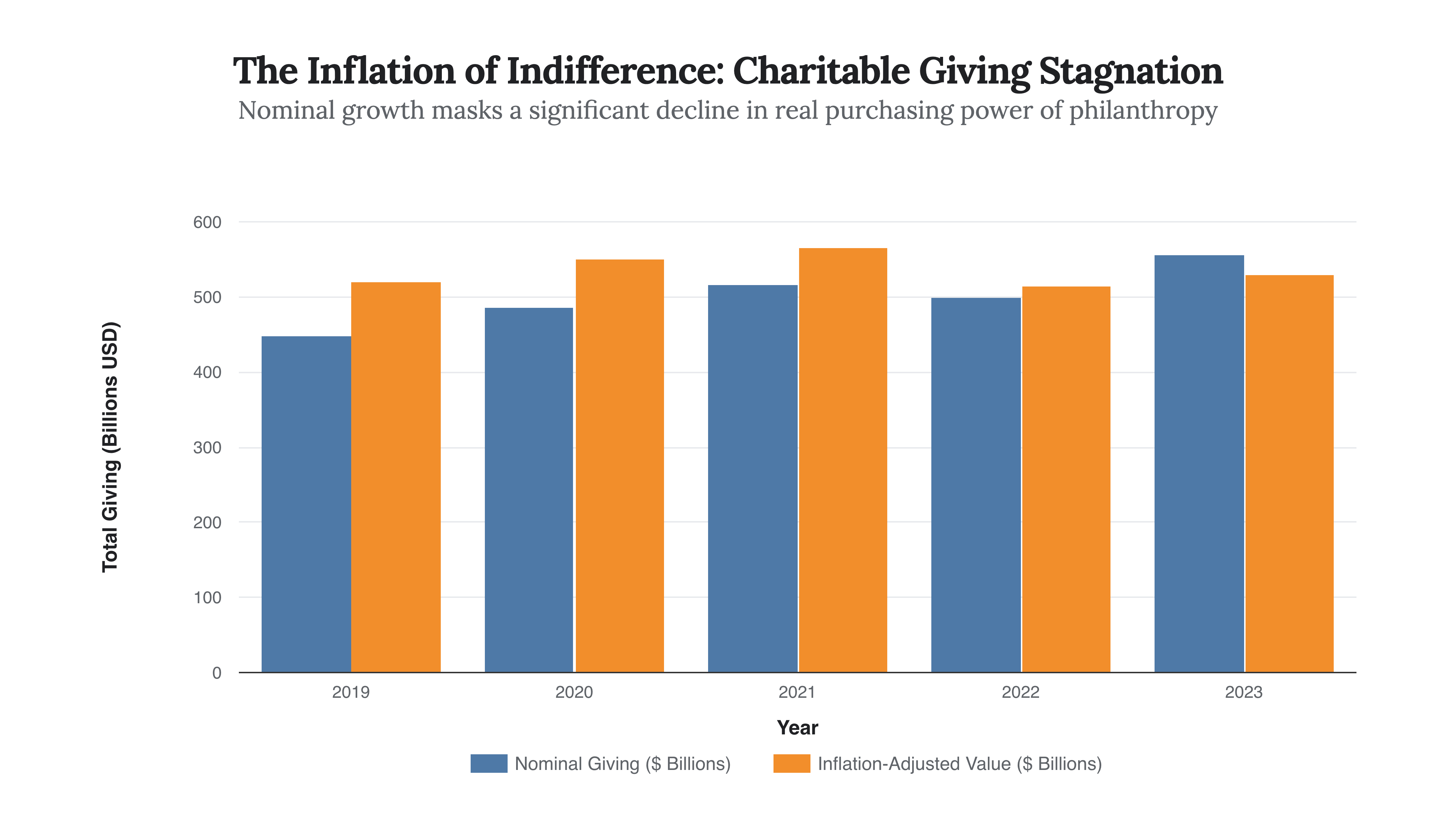
This chart reveals a “hollow growth” phenomenon. While the nominal dollars (bars) appear to recover in 2023, the inflation-adjusted reality (line) shows a persistent deficit from the 2021 peak. The strategic implication is clear: the effort to contribute is being outpaced by the cost of existence. In a hyperconnected world, we are feeling the pinch of “compassion inflation”—it costs more, energetically and financially, to make the same impact, leading to donor fatigue and withdrawal.
The $2.7 Billion Daily Burn Rate
The Empathy Recession is most acute—and most expensive—within the corporation. The Society for Human Resource Management (SHRM) released startling figures in late 2024 quantifying the cost of incivility. This encompasses everything from rude emails and exclusion to active hostility. The aggregate cost is not just in turnover, but in the micro-fractures of daily productivity.
Deconstructing the Toxicity Tax
When empathy exits the room, toxicity enters. The result is a “cognitive tax” on employees who must navigate hostile environments rather than focusing on innovation. The data suggests that for every act of incivility, the ripple effect on productivity lasts far longer than the incident itself.
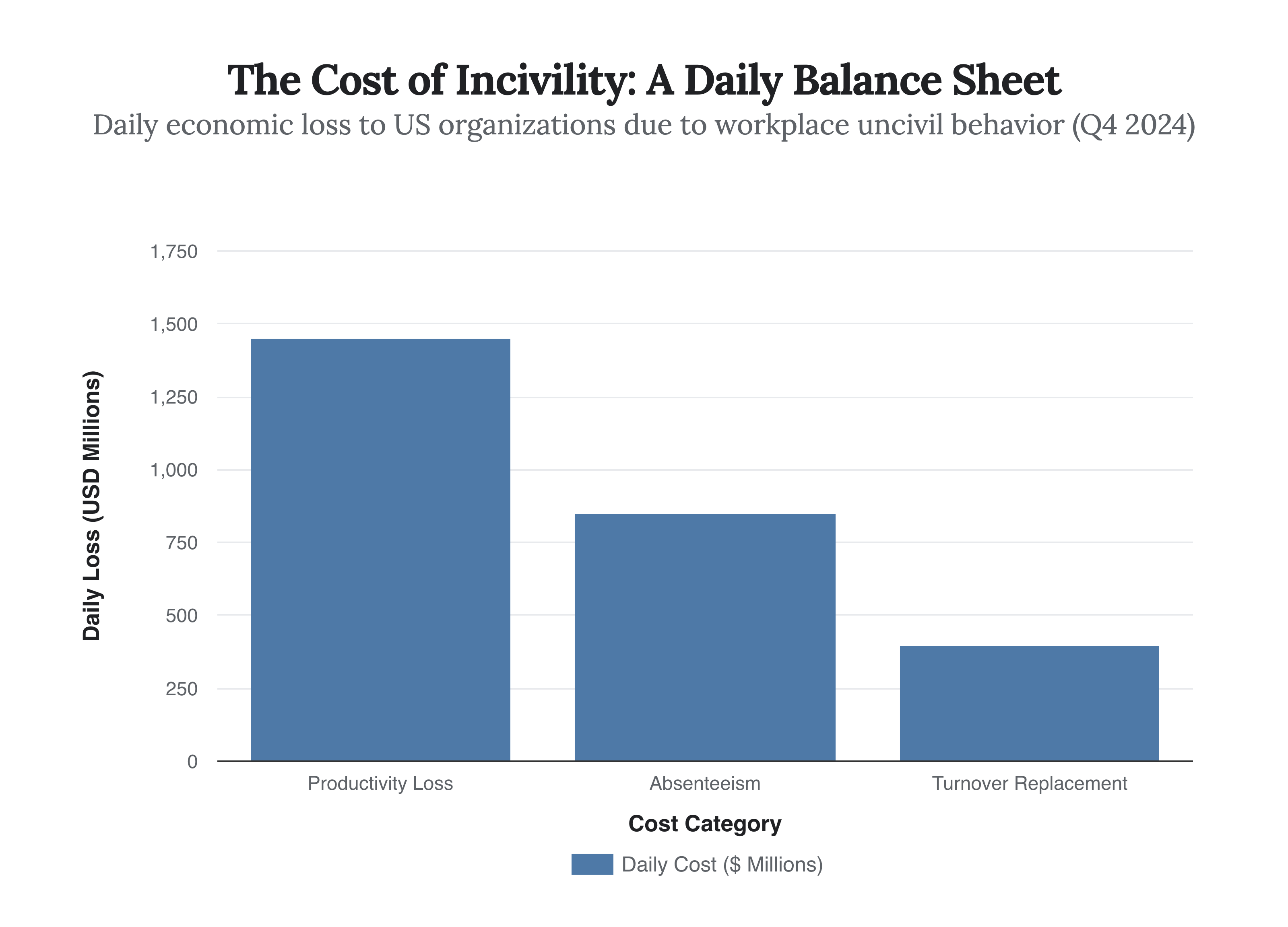
Strategic leaders must view this $2.7 billion daily loss as a preventable operational leakage. Companies with high “empathy liquidity”—where psychological safety allows for rapid conflict resolution—effectively operate with a lower cost of capital than their toxic competitors. They retain institutional knowledge and execute faster because their internal friction is lower.
“Fostering civility in the workplace is not just about politeness – it is a strategic business imperative. Companies that prioritize civility are more likely to attract and retain top talent, foster innovation, and achieve long-term success.” — Johnny C. Taylor Jr., CEO of SHRM
The Great Perception Gap
One of the primary drivers of this recession is the disconnect between the C-suite’s self-image and the workforce’s reality. Data from the 2024 State of Workplace Empathy study highlights a dangerous delusion: executives overwhelmingly believe they are leading with compassion, while their employees see a landscape of indifference. This “empathy gap” is a leading indicator of future unionization efforts, strikes, and silent quitting.
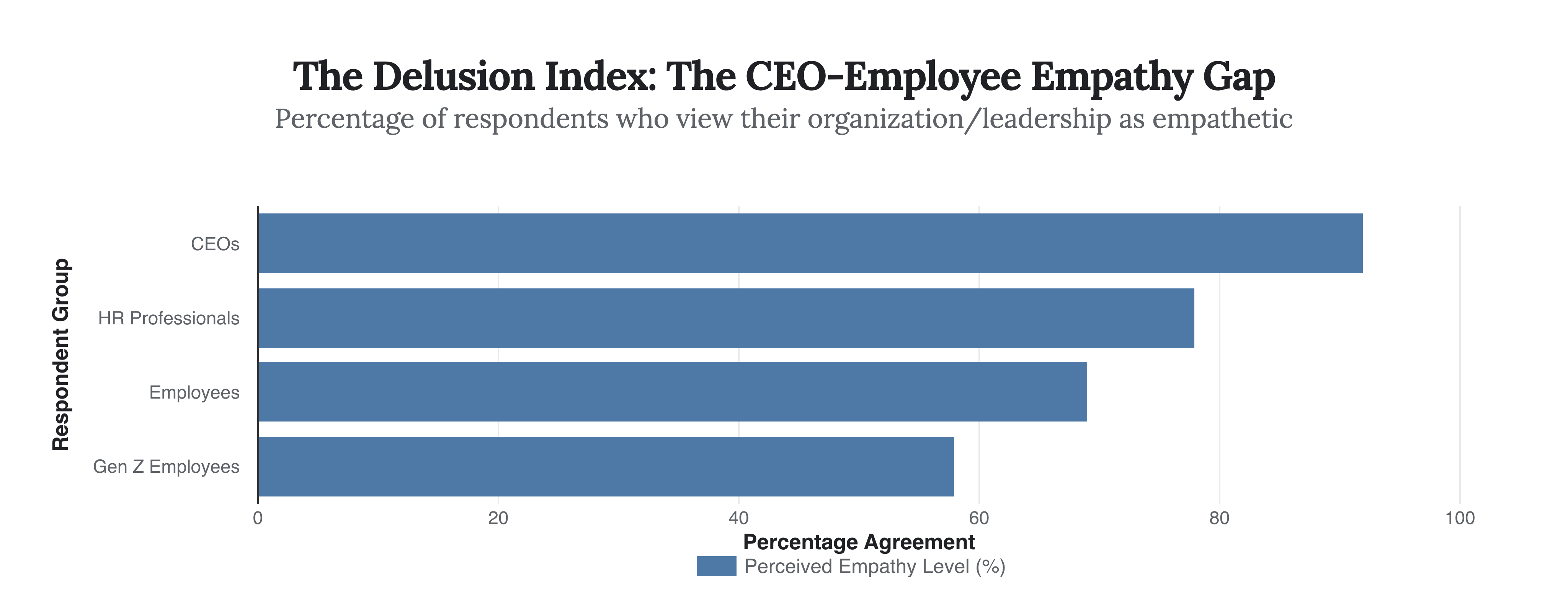
The danger lies in the 23-point gap between CEOs and the average employee (and the even wider 34-point gap with Gen Z). This is not just a morale issue; it is an information asymmetry problem. CEOs are making strategic decisions based on a perceived reality that does not exist on the factory floor or in the Slack channels. When leaders overestimate their empathetic standing, they underestimate the risk of attrition. 2024 data indicates that unempathetic organizations risk over $180 billion annually in avoidable turnover costs.
The Polarization Outlier: A Geopolitical Risk
The Empathy Recession is not evenly distributed globally. The United States has become a statistical outlier in “affective polarization”—the tendency to view opposing political groups not just as wrong, but as existential enemies. This is distinct from ideological disagreement; it is an emotional severing of the social contract.
While other Western democracies have seen polarization stabilize or even decline, the U.S. trend line is unique. This poses a specific risk to multinational corporations headquartered in the U.S., as domestic culture wars increasingly disrupt global operations and brand neutrality becomes impossible.
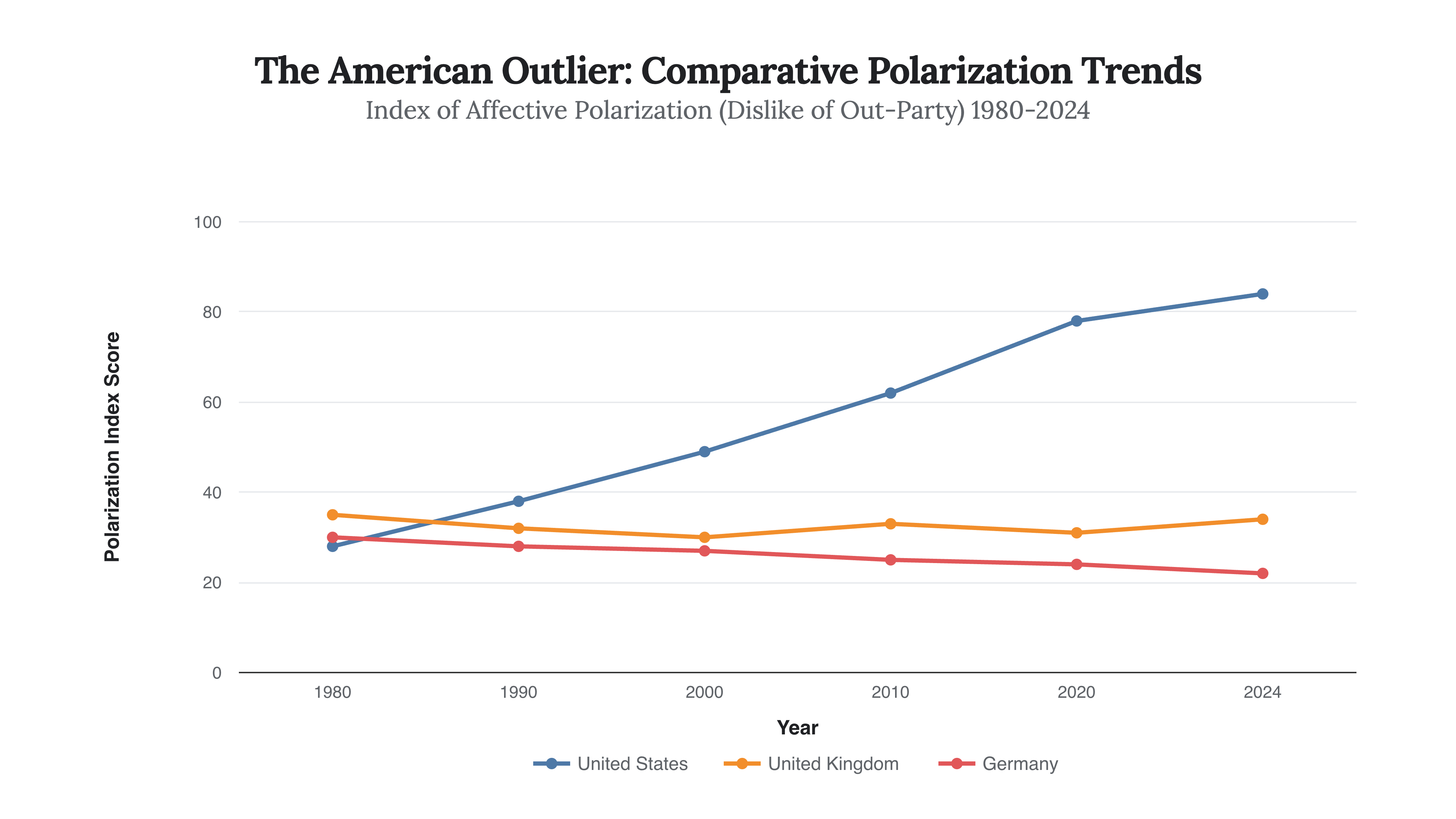
This chart illustrates why the U.S. market is uniquely fragile. In the UK and Germany, political disagreement has not metastasized into affective hatred to the same degree. For investors, this signals that U.S.-based instability is a chronic condition, not a cyclical one. The loss of empathy across political lines effectively paralyzes legislative solutions to economic problems, creating a perpetual state of policy gridlock.
The Innovation Trust Trap
Perhaps the most critical future implication of the Empathy Recession is its impact on technological adoption. As we stand on the precipice of the AI revolution, public trust in the institutions deploying these technologies is at historic lows. The 2024 Edelman Trust Barometer describes this as “Innovation in Peril.”
When empathy is low, suspicion is high. If the public perceives that businesses are deploying AI solely for efficiency (profit) without empathy for the human cost (displacement), the resistance will be fierce. We are already seeing this in the “tech-lash” regulatory waves. The “Trust Gap” between business competence and ethical innovation is the new bottleneck.
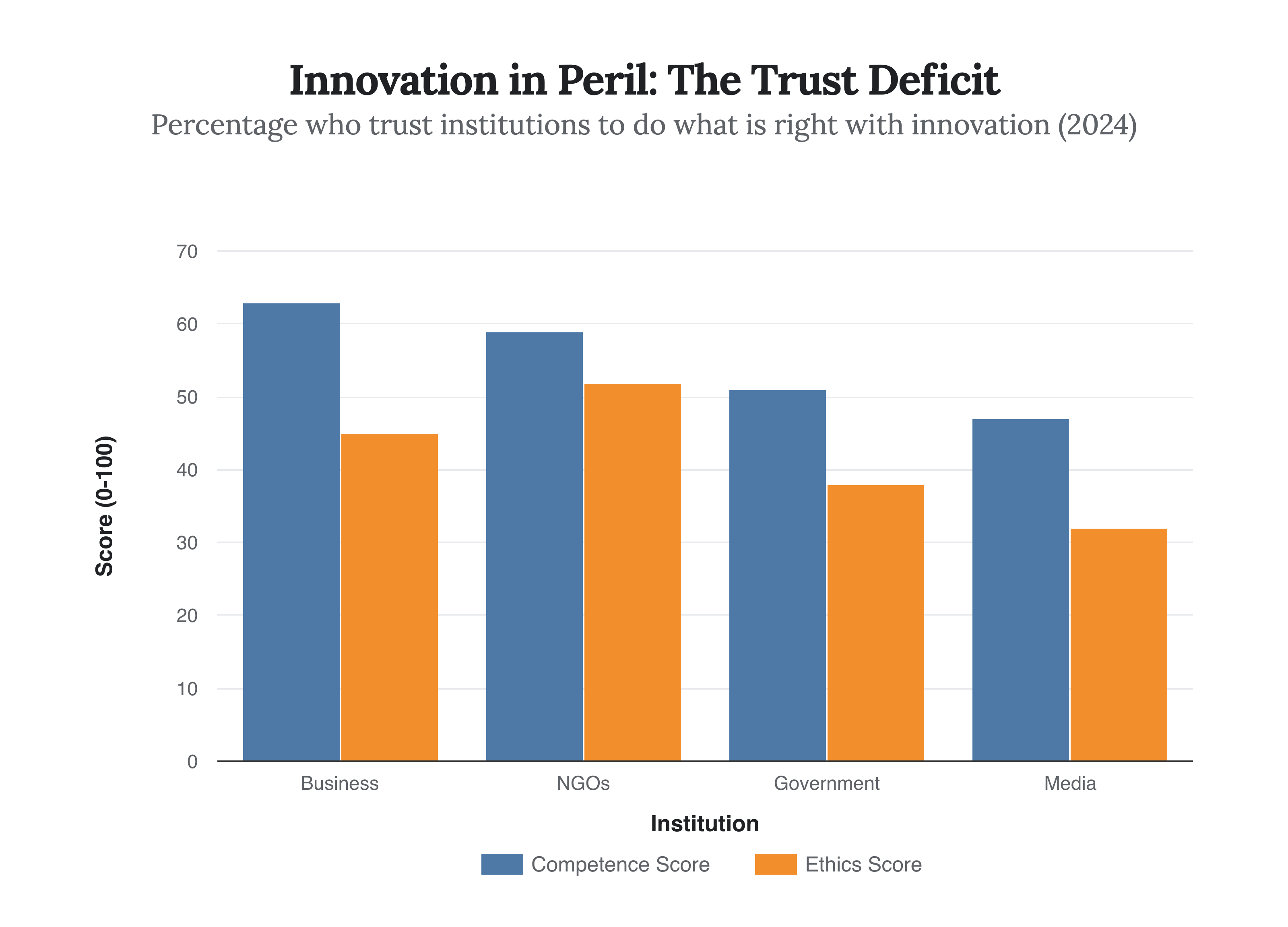
The gap between “Competence” (Can they do it?) and “Ethics” (Will they do it right?) is the kill zone for new products. Business scores high on competence (63) but fails on ethics (45). In an environment devoid of empathy, competence is viewed as dangerous. To bridge this, companies must demonstrate “Algorithmic Empathy”—building systems that demonstrably account for human welfare.
The Paradox of Youth: A Rebound?
It would be a failure of analysis to ignore a counter-intuitive signal in the data. While institutional empathy is crashing, individual capacity among the youth may be recovering. Contrary to the narrative of the “narcissistic generation,” updated longitudinal data suggests that after a plummet from 2000-2009, empathy levels in college students have begun to rebound post-2015.
“Young people are not uniformly less empathetic than their forebears; instead, the empathy of youth today ebbs and flows, much like the societal currents they are part of. The post-2008 increase in empathy... offers a more optimistic view.” — Dr. Sara Konrath, Researcher
This creates a “Supply/Demand Mismatch.” We have a rising generation of talent that values and possesses empathy (Supply), entering a corporate and political system that has structurally eliminated it (Demand). This friction is the root cause of the current unprecedented levels of workplace dissatisfaction and the “anti-ambition” trend.
Strategic Forecast & Data-Backed Predictions
The Empathy Recession is not a permanent state, but a correction is not guaranteed. Based on the current trajectory of the data, we project the following shifts over the next 36 months:
The Rise of “Empathy Arbitrage”: Organizations that can empirically prove high internal trust and civility will trade at a premium. Investors will begin to look at “Turnover Cost Ratios” as a standard ESG metric. Expect a “Glassdoor Premium” where high-empathy firms secure talent for 10-15% less cash compensation than toxic competitors.
The AI Alignment Crisis: Companies that roll out AI customer service agents without programming for “affective computing” (empathy simulation) will see customer churn spike. The “Uncanny Valley” will not be about how real the face looks, but how cold the interaction feels.
The “Chief Culture Officer” with Teeth: The HR function will bifurcate. Administrative tasks will be automated, while the strategic role of maintaining “Civility Indices” will become a Board-level concern, directly tied to the Risk Committee.
Concluding Insight
The Empathy Recession is a solvency crisis of the human spirit, but its costs are paid in cold hard cash. The $2.7 billion daily tax on the US economy is a choice, not an inevitability. For the strategist, the move is clear: stop treating empathy as a soft virtue and start managing it as a hard asset. In a hyperconnected world where everyone can broadcast their dissatisfaction, indifference is the most expensive risk you can take.
The single most important strategic insight: In a high-friction economy, empathy is the only scalable form of efficiency that cannot be commoditized by AI.