



Jeremy Bentham designed the Panopticon in the 18th century as a prison where a single watchman could observe all inmates without them knowing whether they were being watched. The architectural genius lay not in constant observation, but in the threat of it. The inmate, assuming they were always visible, became their own jailer, regulating their behavior to align with the rules. Fast forward to 2025, and the physical tower has been replaced by a distributed, algorithmic omniscience. The modern office is no longer a place you go; it is a software stack you log into, where every keystroke, mouse movement, and sentiment is recorded, analyzed, and scored.
This is the Digital Panopticon. But unlike Foucault’s disciplined subject who internalized order, the modern digital worker has learned to game the system. Current intelligence suggests we have reached a critical tipping point: the tools deployed to ensure productivity are actively destroying it. With 70% of large enterprises now deploying active monitoring and 85% of leaders suffering from “productivity paranoia,” we have inadvertently built an infrastructure that optimizes for compliance rather than creation.
This briefing dissects the data behind this surveillance boom, exposes the massive financial drain of “performative work,” and argues that the current trajectory of workplace analytics is leading to a strategic collapse in genuine innovation.
The Scale of the Eye: From Niche Security to Omnipresent Analytics
The global shift to hybrid work triggered a fundamental crisis in management theory: If I cannot see them, how do I know they are working? The market’s answer was an explosion in “Bossware”—employee monitoring software that has evolved from simple time-tracking to invasive behavioral analytics. In 2024, the global market for these tools was valued at approximately $1.6 billion, but the demand signals a far more aggressive growth trajectory, with projections hitting $3.42 billion by 2030.
The adoption curves are vertical. In 2019, employee monitoring was largely the domain of call centers and high-security clean rooms. Today, it is standard operating procedure for the Fortune 500.
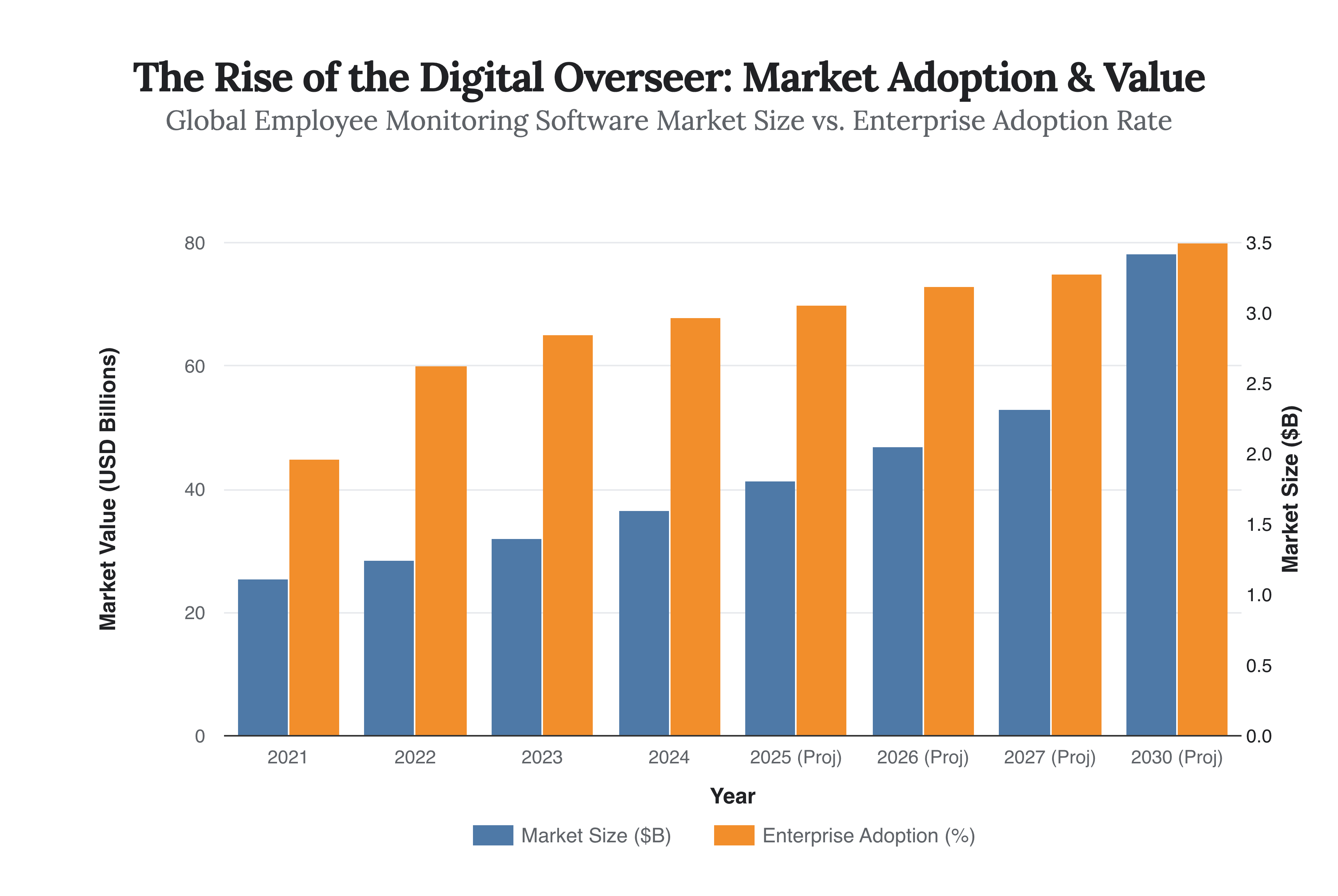
The chart above reveals a correlation that should alarm any strategist: as adoption nears saturation (approaching 80% by 2030), the market value accelerates. This indicates that companies are not just buying more software, but more expensive, sophisticated software. We are moving from simple “clock-in” apps to AI-driven sentiment analysis and predictive behavioral modeling.
The Productivity Paranoia Gap
The driver of this investment is not data, but insecurity. Microsoft’s Work Trend Index identified a massive psychological chasm between workers and management, coined as “Productivity Paranoia.” While objective metrics (emails sent, code committed, meetings attended) have risen, leadership confidence has collapsed.
This disconnect is the engine of the Digital Panopticon. Leaders are replacing trust with telemetry. However, the data reveals a stark irony: the more leaders measure, the less they trust.
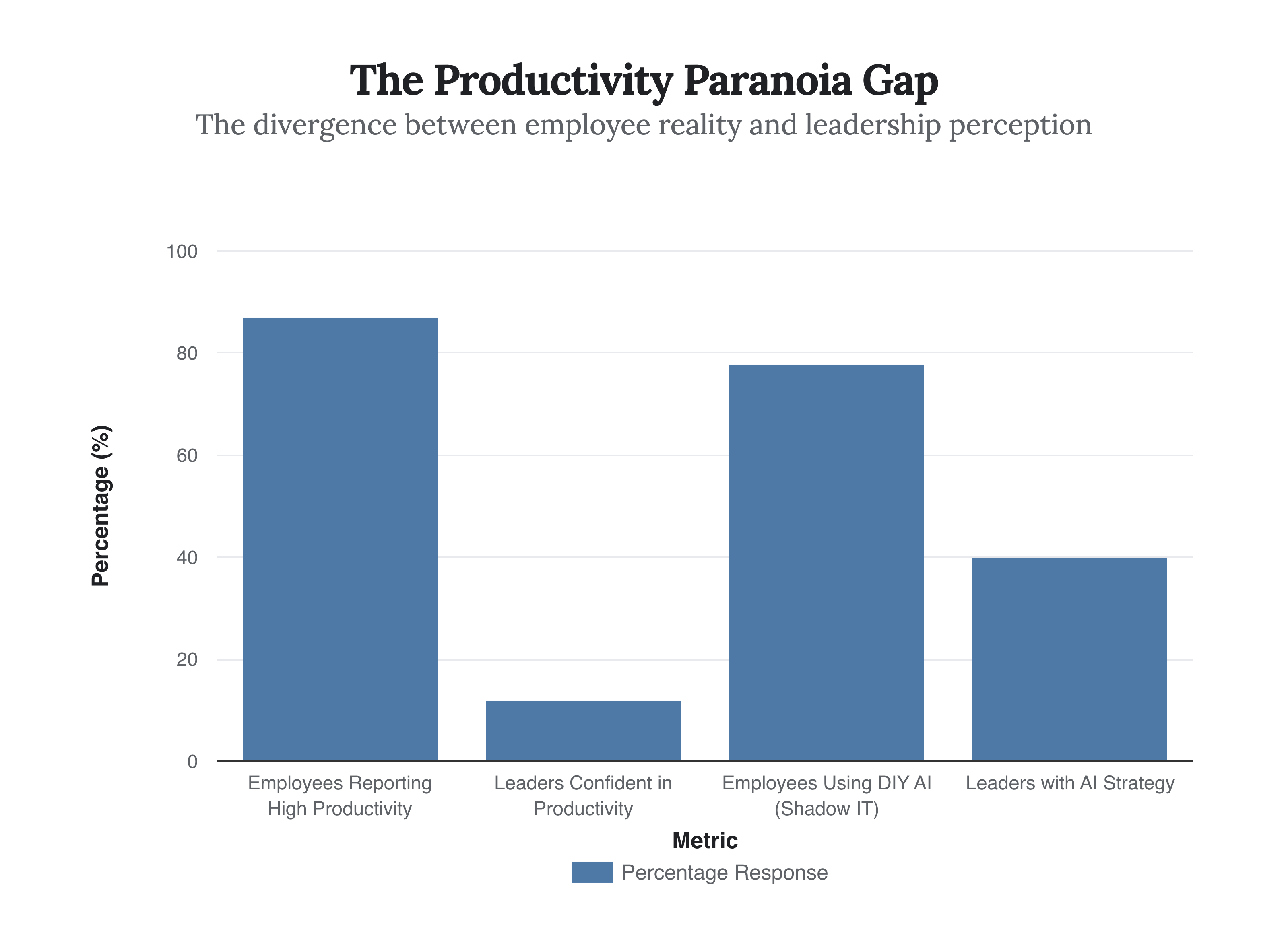
This 75-point gap between employee self-reporting (87%) and leader confidence (12%) helps explain the proliferation of intrusive tools. Managers are attempting to close this “trust gap” with data points. Yet, the tools they select often focus on
