


The Feature We Engineered Out
In the pursuit of frictionless efficiency, the modern global economy has inadvertently triggered a catastrophic error in human capital development. We have treated suffering—defined here as resistance, friction, and acute challenge—as a bug to be patched out of the human experience. The data suggests this is a strategic miscalculation of the highest order.
New intelligence reveals that the systemic removal of hardship is not merely a social or psychological issue; it is a macroeconomic crisis. The OECD estimates that mental ill-health now absorbs approximately 4% of GDP across member countries—a staggered global cost of roughly $4.2 trillion annually. This is the “Fragility Tax”: the price we pay for atrophied resilience mechanisms.
This briefing challenges the prevailing narrative that comfort equals progress. By analyzing post-traumatic growth (PTG) rates, corporate performance during recessions, and the burgeoning “voluntary hardship” economy, we demonstrate that suffering is a critical evolutionary feature. For leaders and investors, the next alpha will not come from removing friction, but from strategically reintroducing it.
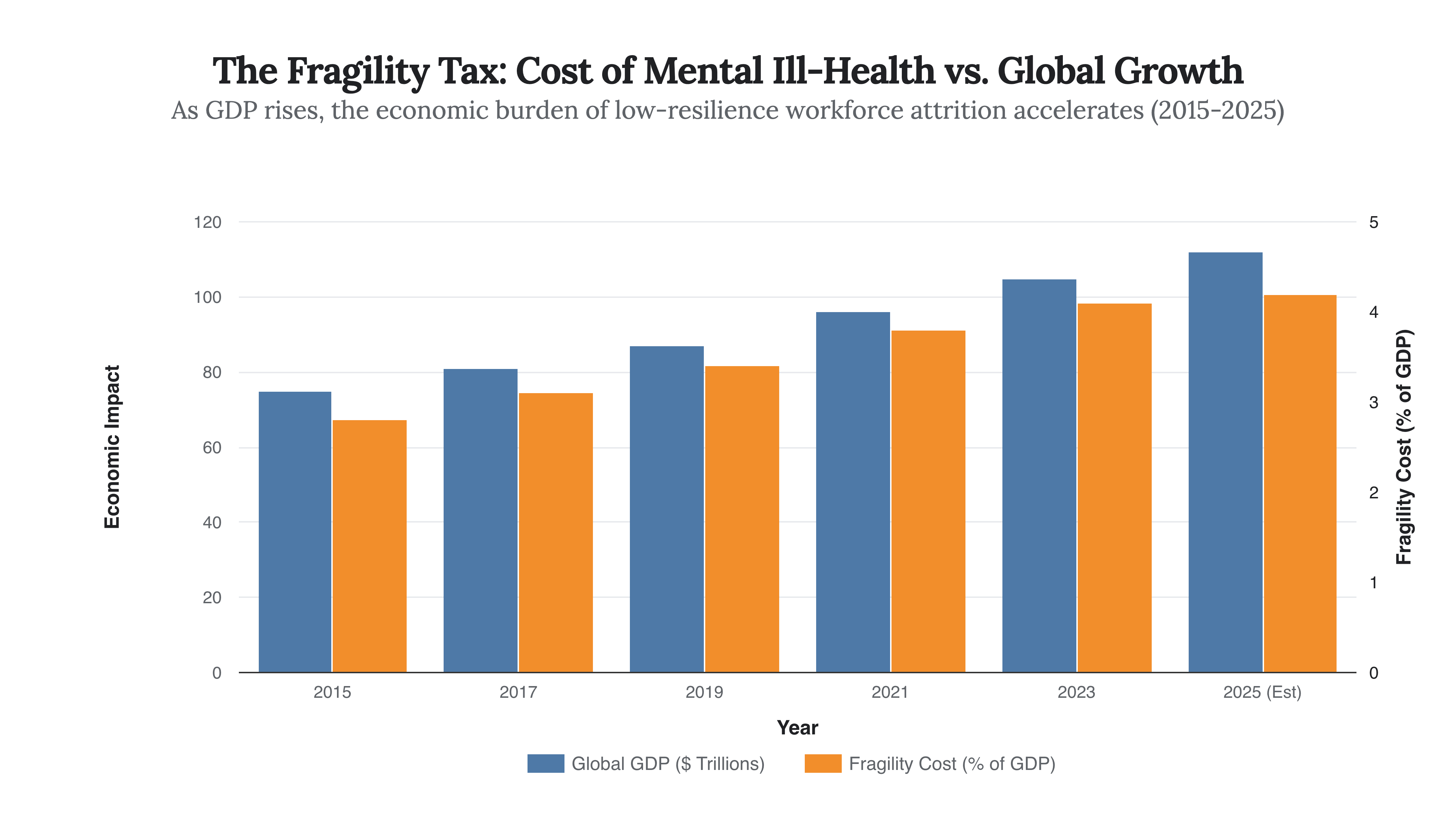
The chart above visualizes the diverging trajectories. While global wealth increases, an increasing percentage of that wealth is being recaptured by the costs of lost productivity, turnover, and healthcare associated with low resilience. We are getting richer, but we are becoming exponentially more expensive to maintain.
The Crisis Premium: Validating the ‘Hormesis’ Strategy
In biology, hormesis is the phenomenon where low-dose stress stimulates beneficial adaptive responses. In business, this principle is quantifiable. Historical data from the 2008 recession and preliminary data from the post-2020 volatility period confirms that organizations that “lean into” suffering—voluntarily increasing R&D and innovation spend during downturns—capture a massive long-term premium.
McKinsey & Company data indicates that organizations that maintained or increased their innovation focus during the 2009 crisis outperformed the market average by 30% in the subsequent years. This is the “Crisis Premium.” It suggests that economic hardship acts as a filter, removing the fragile and concentrating resources in the antifragile.
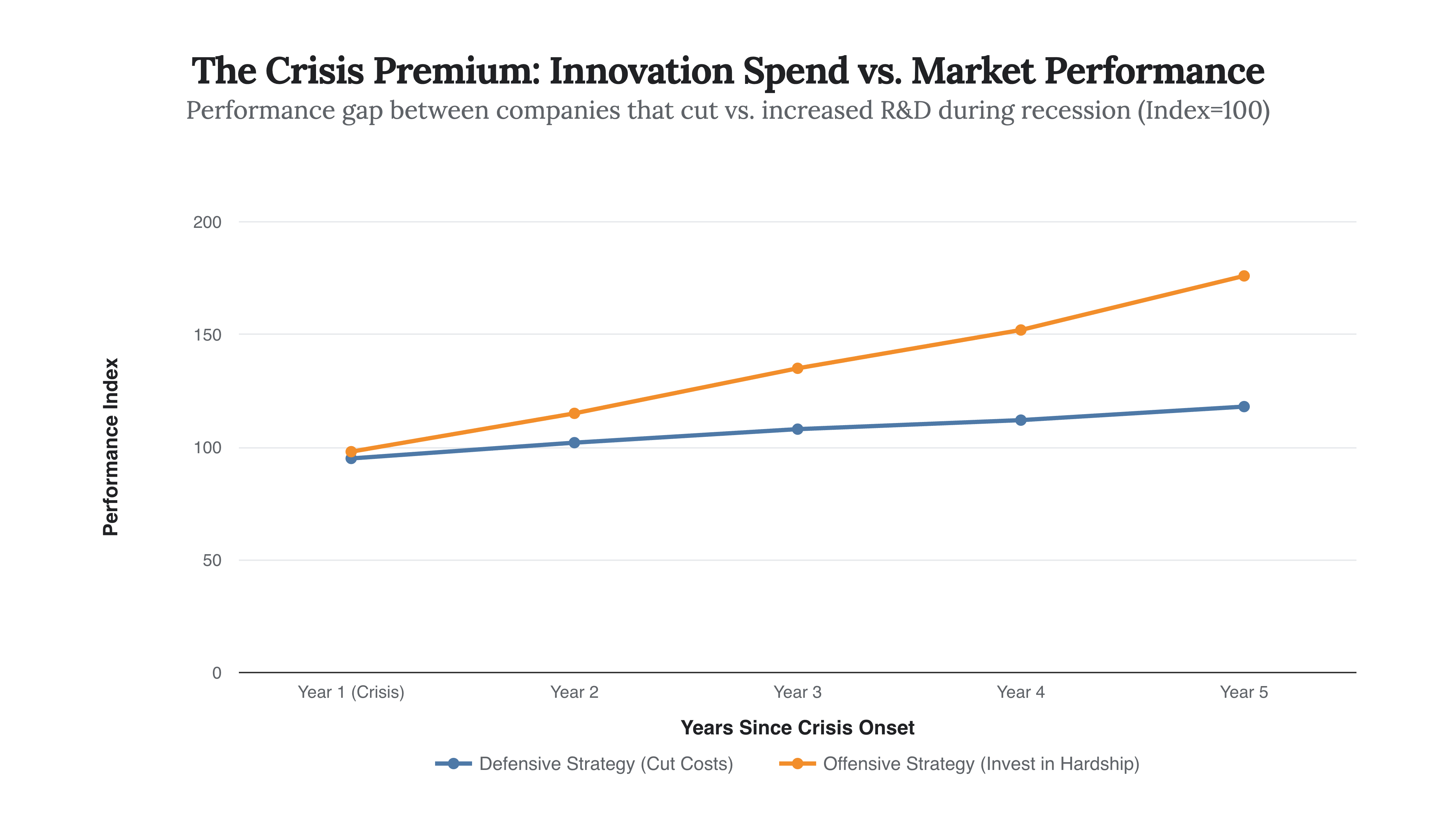
This 30% gap is not luck; it is the structural reward for high “Adversity Quotient” (AQ). Companies that view hardship as a signal to hibernate atrophy; those that view it as a signal to train grow. The strategic implication is that stability is a depreciating asset, while capacity for suffering is an appreciating one.
The Conversion Deficit: Trauma without Growth
The human capacity for resilience is statistically significant but currently underutilized. Roughly 70% of the global population will experience a potentially traumatic event in their lifetime. However, the conversion of this trauma into “Post-Traumatic Growth” (PTG)—defined as positive psychological change experienced as a result of adversity—is inconsistent.
Current data indicates a profound “Conversion Deficit.” While 70% are exposed to the “stimulus” of hardship, only a fraction (estimated between 4% and 15% depending on the severity) successfully convert this into measurable growth traits like increased personal strength or new possibilities. The majority remain in a state of neutrality or decline (PTSD).
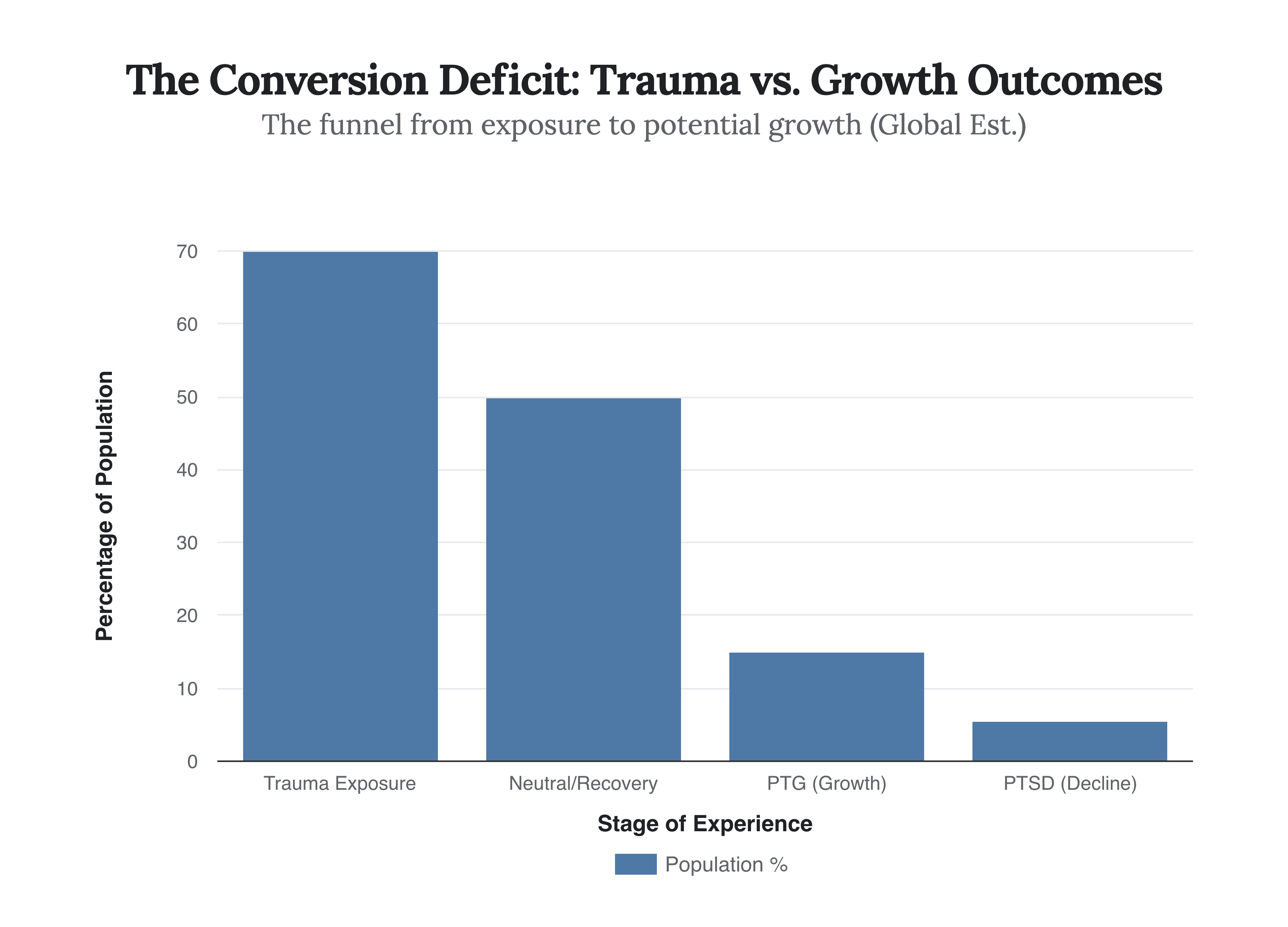
For the strategist, this chart represents a massive inefficiency in human capital. We have a workforce that is constantly exposed to stressors but lacks the framework to convert that stress into strength. The “Lost 50%” who return to baseline without growth represent trillions in unrealized human potential.
The Rise of the Voluntary Hardship Economy
Recognizing this deficit, a new market sector has emerged: Voluntary Hardship. High-performing individuals are instinctively realizing that the comfort of modern life is toxic to their performance. They are now paying a premium to reintroduce the friction that technology removed.
The market for “cold plunge” tubs alone—a proxy for voluntary physical suffering—is projected to reach $550 million by 2025, growing at a CAGR of over 12%. When combined with the ultramarathon market, obstacle course racing, and extreme wellness tourism, we are witnessing the financialization of resilience. The elite are outsourcing comfort to buy back struggle.
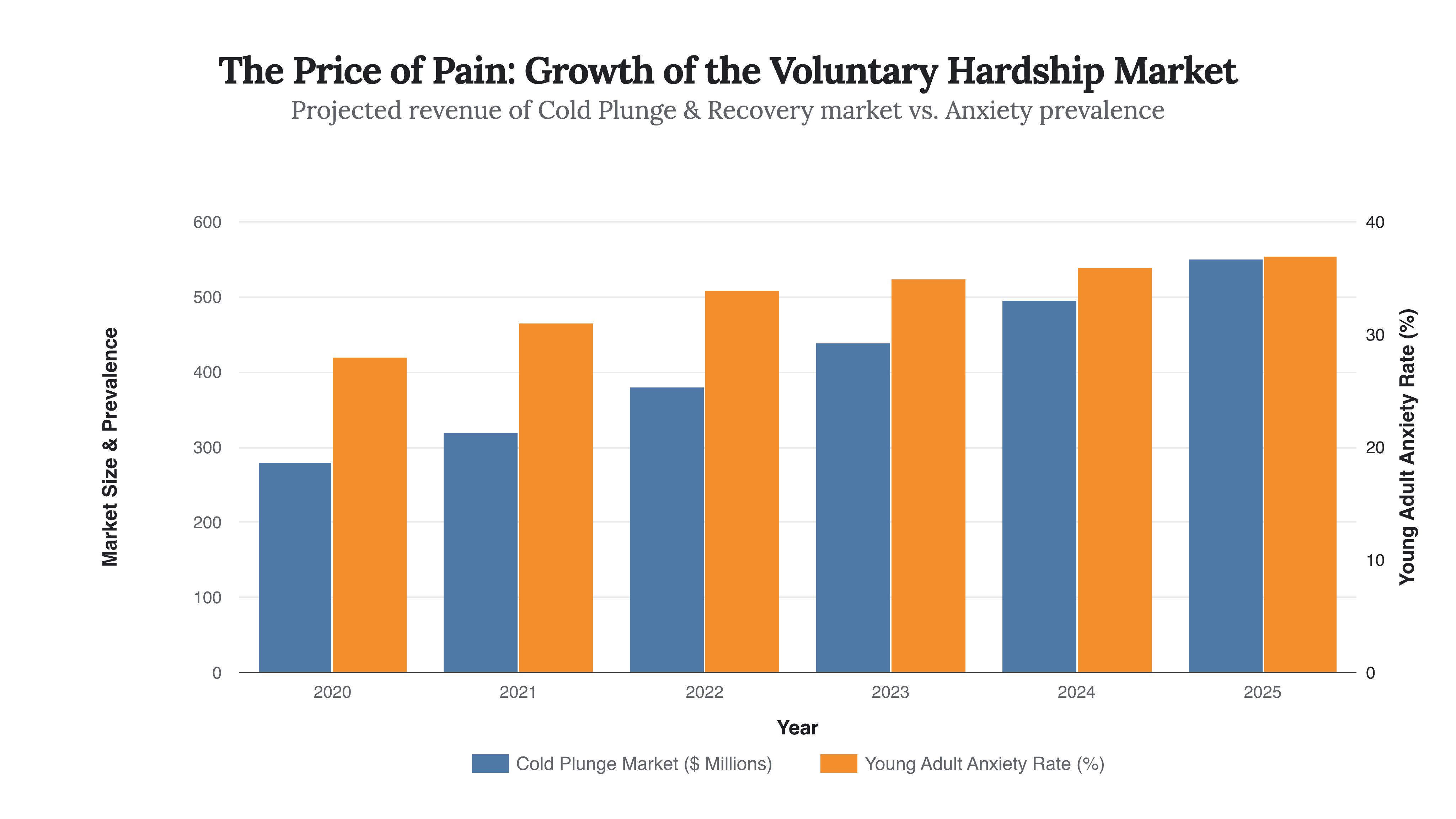
This correlation is vital. As anxiety (fragility) rises, the market demand for controlled suffering (resilience training) rises in tandem. The market is attempting to correct the biological error of the comfort crisis.
Strategic Foresight: The ‘Resilience Arbitrage’
So what? The data points to a widening divide between the “Comfort Class” and the “Resilient Class.” The $4.2 trillion fragility tax will not be borne equally. It will disproportionately punish organizations that optimize for employee comfort over employee capacity.
“We have removed the load-bearing walls of human character in the name of safety, only to find the roof collapsing under the weight of anxiety.”
Predictions for 2025-2030:
The Chief Resilience Officer (CRO): This role will evolve from business continuity (IT systems) to human capital strategy. Companies will begin tracking “Adversity Quotient” (AQ) alongside IQ and EQ in executive hiring.
Friction as a Benefit: Top-tier development programs will pivot from “perks” (free food, massages) to “challenges” (mandatory sabbaticals in difficult environments, high-stakes rotations). Retention will be higher in high-friction environments because they offer the meaning that comfort lacks.
The Fragility Discount: Investors will begin to discount the valuations of companies with low-resilience cultures, viewing them as liability-prone during market volatility.
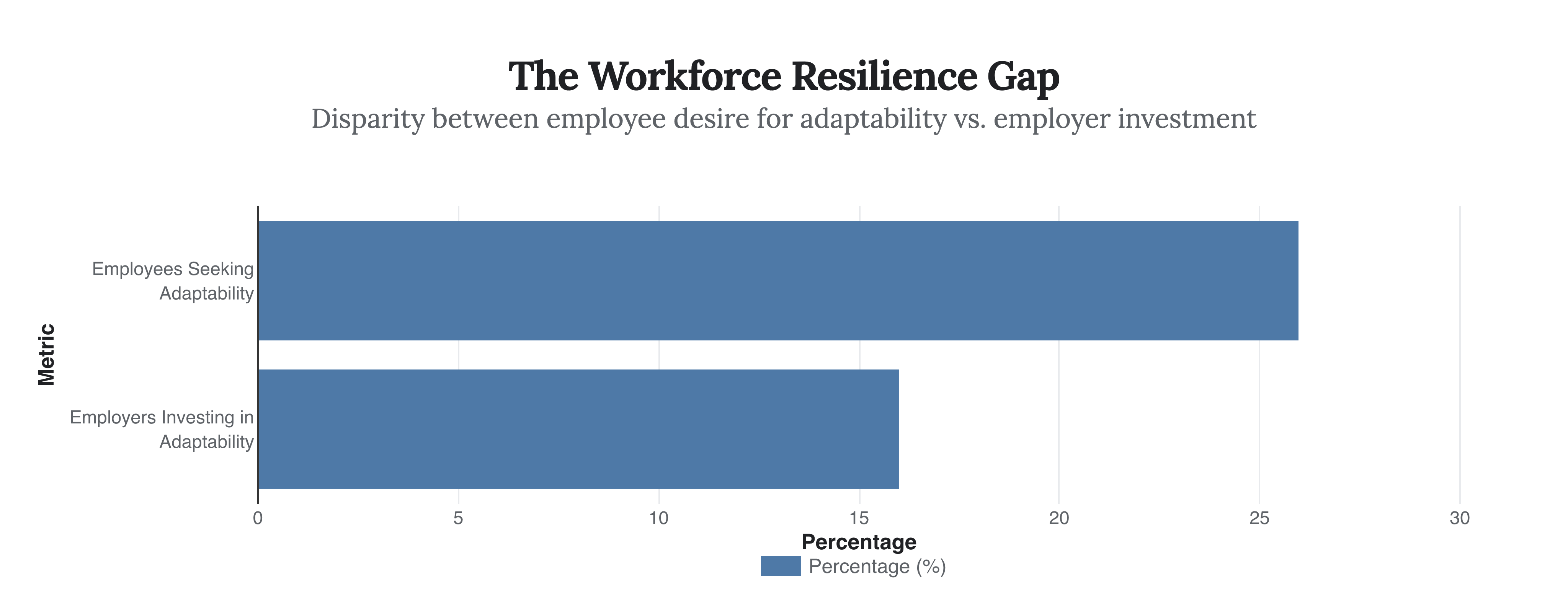
The gap above highlights the immediate opportunity. 26% of the workforce actively craves the tools to adapt (to suffer well and grow), yet only 16% of employers are investing in these frameworks. Closing this 10% gap is the lowest-hanging fruit for immediate ROI in human capital.
Concluding Insight
Suffering is not a failure of the system; it is the fuel of the system. The $4.2 trillion tax we pay for mental fragility is a self-inflicted wound caused by our refusal to accept that human beings, like muscles, require resistance to maintain structural integrity. The future belongs to those who stop trying to eliminate hardship and start designing for it.
Strategic Imperative: Stop optimizing for comfort. Start optimizing for the conversion of stress into strength.
Considering the many hardships of my life as an adult, I must be one of the most resilient people in the West.
The core argument is not that suffering is good or should be inflicted, but that avoiding all friction weakens both people and institutions. The data suggests growth depends on how stress is framed, supported, and converted, not on misery itself. Comfort without challenge produces fragility. Challenge with meaning produces resilience. That distinction is where strategy, ethics, and human dignity intersect.