


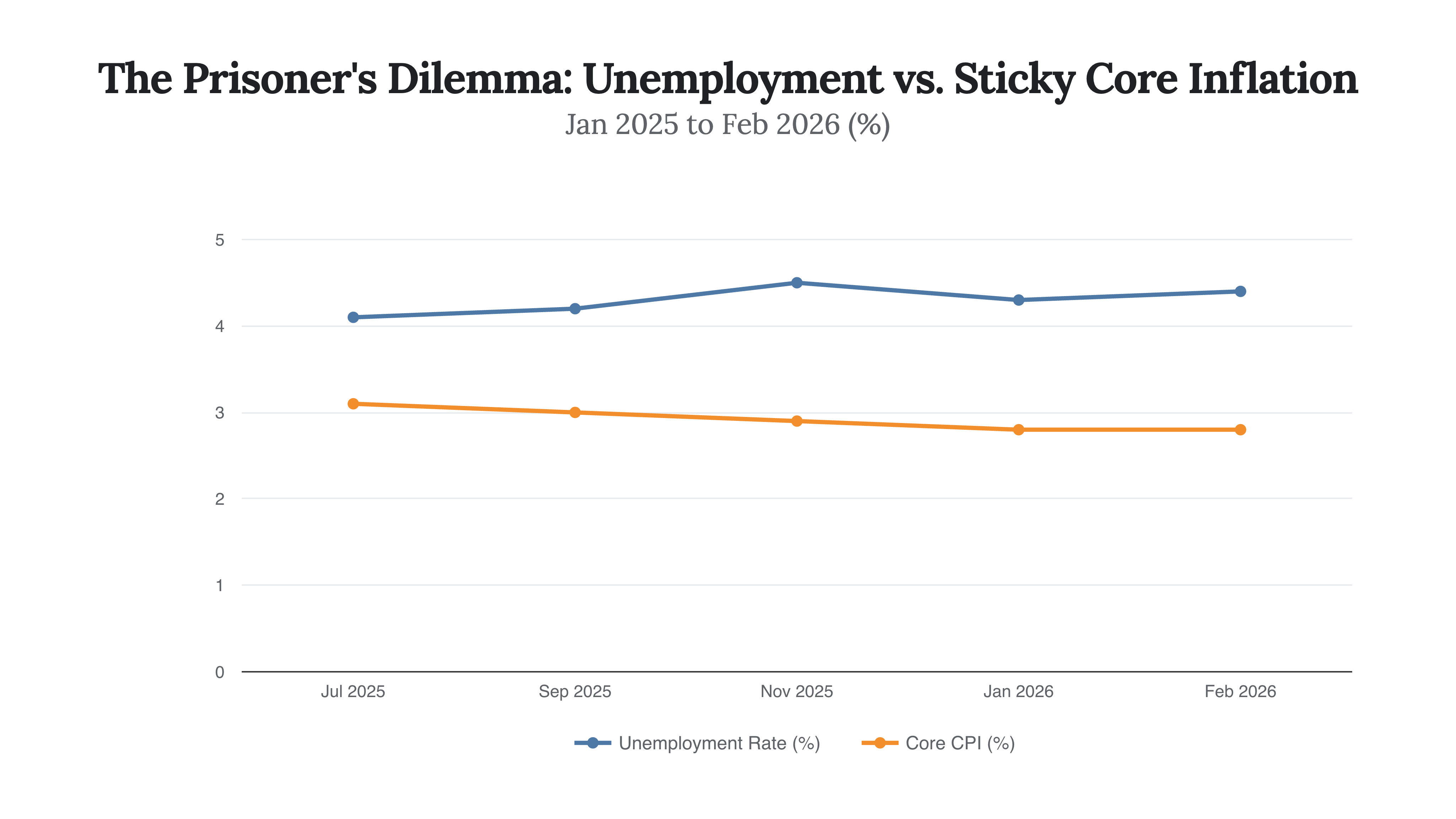
On March 12, 2026, the Department of Labor released a statistical paradox that fundamentally redefines our understanding of macroeconomic stabilization. Initial jobless claims for the week ending March 7 dropped to a microscopic 213,000, aggressively undershooting the consensus forecast of 215,000 and settling firmly below historical averages. Continuing jobless claims, a reliable proxy for the velocity of hiring, fell simultaneously to 1.850 million. Yet, this optical display of labor resilience directly contradicts the structural hemorrhage revealed just days prior: the U.S. economy unexpectedly lost 92,000 nonfarm payrolls in February 2026, driving the headline unemployment rate up to 4.4%. We are not witnessing a healthy labor market; we are observing a system frozen in fear.
The Low-Hire, Low-Fire Nash Equilibrium
To decode this divergence, we must analyze the data through the rigorous framework of Game Theory. The principal players in this matrix—corporate employers, the Federal Reserve, and American labor—are locked in a behavioral standoff governed by profound information asymmetry. On one side, companies face compounding exogenous shocks: the imposition of a sweeping 10% to 15% global tariff framework, the sudden geopolitical destabilization of the U.S.-Israeli conflict with Iran, and the ensuing 25% spike in oil prices over a two-week period. In a traditional zero-sum environment, the dominant strategy for any rational corporate actor facing this cocktail of margin-compressing risk is to immediately initiate mass layoffs.
However, the psychological trauma of the 2021-2023 labor shortages has completely rewired the corporate payoff matrix. The immediate cost of carrying surplus payroll is now perceived as fundamentally lower than the catastrophic replacement cost of re-acquiring talent during a future recovery, making labor hoarding the optimal defensive posture. This is a classic Nash Equilibrium: no single firm has the incentive to deviate from the strategy of “low-hire, low-fire” because preemptively shedding workers exposes them to devastating operational vulnerabilities if their competitors hold the line. Consequently, the labor market has devolved into a frictionless void—employers refuse to terminate existing staff, but the door to new entrants has been welded shut.
Sector Attrition and the Asymmetry of AI Integration
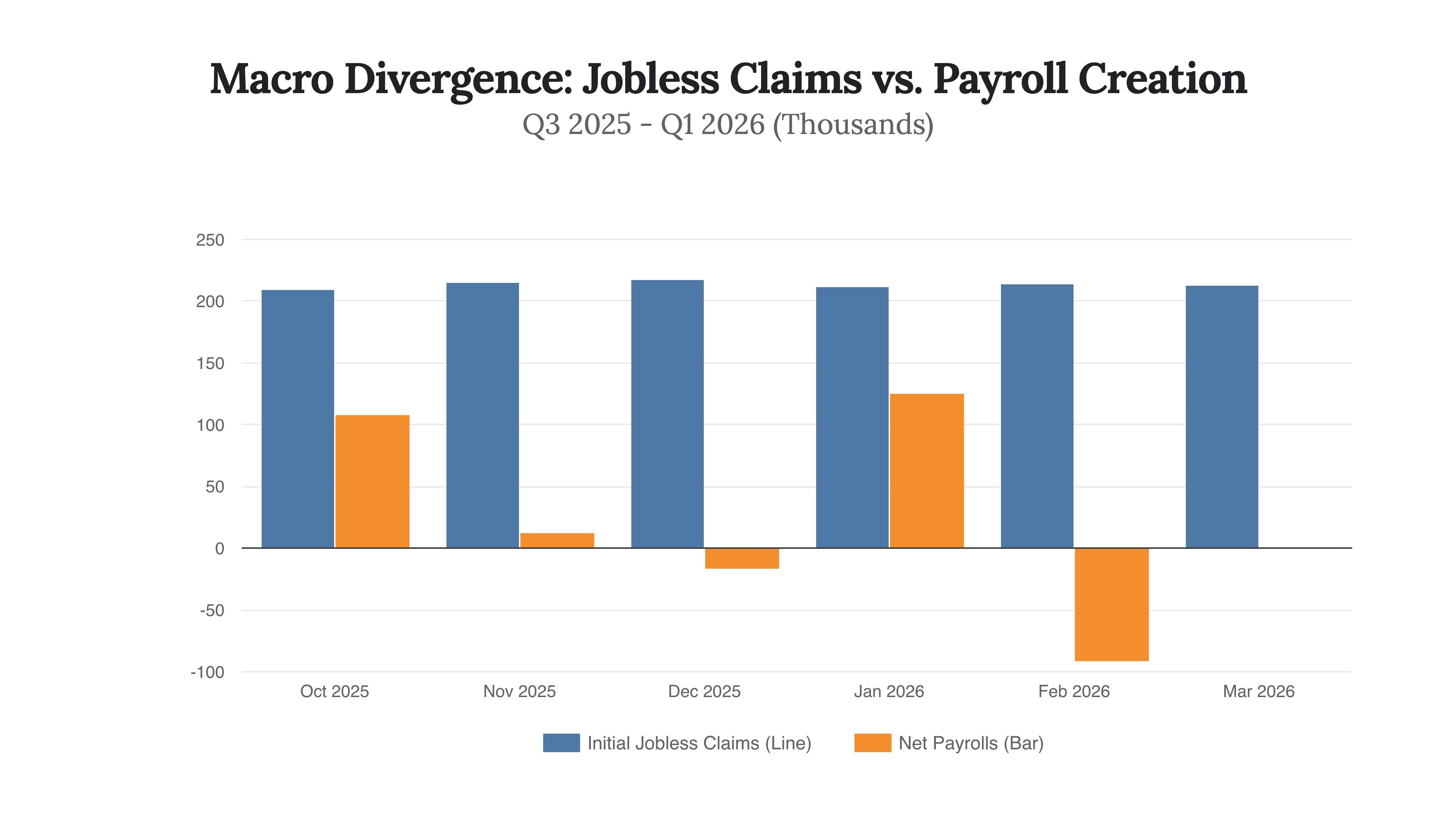
Peeling back the aggregate data reveals a highly asymmetrical decay across specific industrial sectors. The 92,000 payroll contraction in February was not a uniform bleed; it was hyper-concentrated. The healthcare sector suffered a catastrophic 28,000 job loss, driven largely by 37,000 losses in physician offices due to organized strike activity. The information and telecommunications sector shed 11,000 roles, while transportation and warehousing lost another 11,000. Furthermore, federal government employment continued its structural contraction, dropping by 10,000 jobs in February, bringing the total decline to 330,000 (an 11% reduction) since the October 2024 peak.
Beyond union activity and government downsizing, the private sector is paralyzed by the information asymmetry of Artificial Intelligence. Capital allocators are actively delaying headcount expansion because the ultimate productivity yield of enterprise AI integration remains an unknown variable. Why hire a ten-person logistics team today when an impending AI deployment might reduce the required headcount to three within six months? This technological hesitation acts as a massive non-zero-sum inhibitor, systematically destroying entry-level job creation while preserving senior legacy roles, ultimately pushing recent college graduates into prolonged periods of invisible joblessness that never register on initial claims data.
Unlock deeper strategic alpha with a 10% discount on the annual plan.
Support the data-driven foresight required to navigate an era of radical uncertainty and join a community of institutional-grade analysts committed to the truth.
Geopolitical Shocks and the Zero-Sum Energy Tax
The macroeconomic matrix is no longer isolated from geopolitical cross-contamination. The expansion of trade friction via a 10% to 15% global tariff has immediately forced logistics and manufacturing players into a defensive crouch. But the true external disruptor is the Middle Eastern theater. The direct involvement in the Iranian conflict is acting as an aggressive, unlegislated tax on the global supply chain. When energy prices surge by a quarter in less than fourteen days, the consumer discretionary sector is instantly compromised.
In Game Theory, a sudden external price shock shifts the game from a cooperative expansion model to a brutal Zero-Sum struggle for margin survival. Corporations cannot pass 100% of these new energy and tariff costs to the consumer without obliterating demand. Therefore, they absorb the cost by halting all future capital expenditure and hiring. The intersection of a 4.4% unemployment rate and soaring headline energy inflation leaves the U.S. consumer absorbing the ultimate penalty of geopolitical friction, effectively subsidizing corporate margin preservation with their own stagnant wages.
The Central Bank Prisoner’s Dilemma
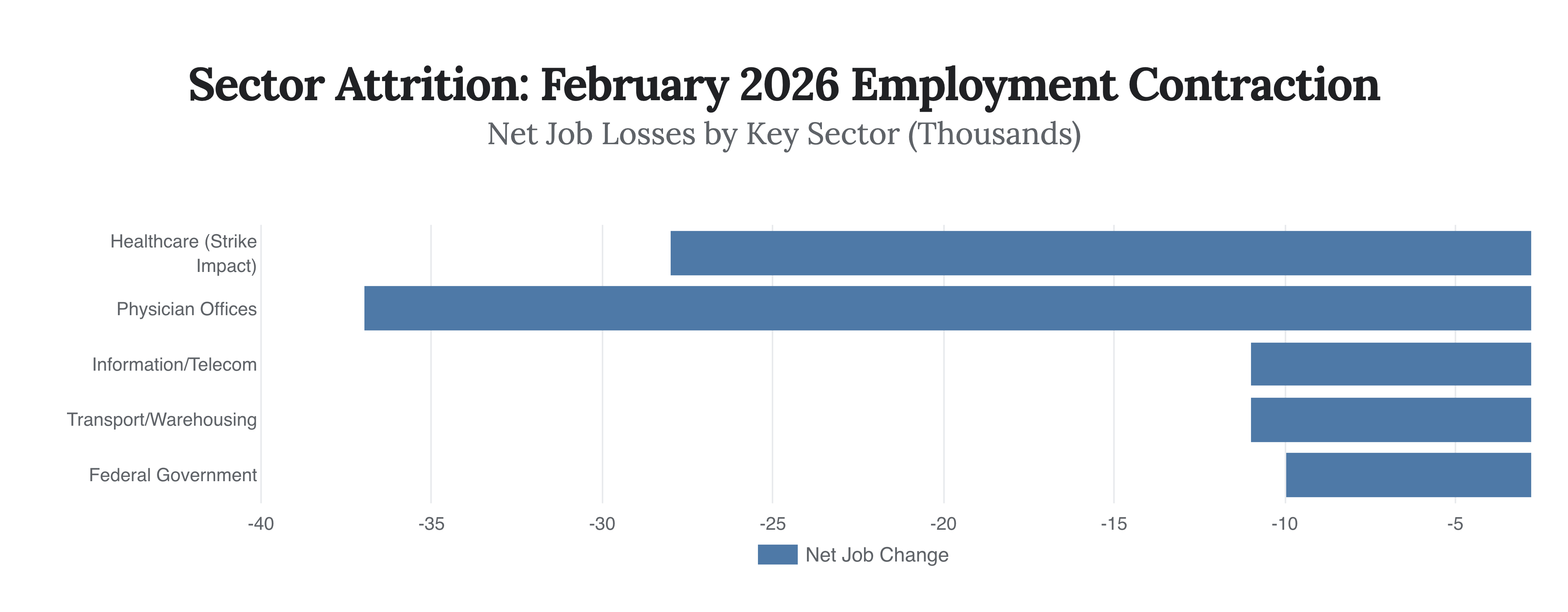
Through this analytical lens, the Federal Reserve is currently trapped in a vicious, high-stakes Prisoner’s Dilemma. Historically, a net loss of 92,000 monthly jobs and an unemployment rate accelerating toward 4.5% would be a screaming mandate for immediate, aggressive monetary easing. The incentive structure of dual-mandate central banking demands a rate cut to restore employment liquidity. However, the inflation data outright forbids it. With the February 2026 headline inflation stubbornly fixed at 2.4% and core CPI anchored at a dangerously persistent 2.8%, the Fed cannot execute a dovish pivot without risking a catastrophic, energy-driven secondary inflation spike.
They are forced to maintain a hawkish, “higher for longer” posture, deliberately sacrificing labor market mobility to ensure inflation remains contained. For derivative traders and bond market operators, the current 213,000 initial jobless claims figure provides the exact statistical cover the Fed needs to delay any summer 2026 rate cuts. If companies aren’t firing in mass, the Fed feels no urgency to rescue them. This policy paralysis has actively pushed the VIX volatility index past 15.2, as markets frantically re-price the sustained cost of capital. The Federal Reserve has recognized that breaking the inflation feedback loop requires credible threats of prolonged economic pain, making systemic labor stagnation an intended feature of their policy, not a bug.
Strategic Positioning for Capital Allocators
The visual correlation across the macroeconomic board is brutal. As energy volatility accelerates and tariff barriers rise, payroll expansion collapses into negative territory. Yet, the initial claims data proves that the foundational corporate layer is not yet breaking—it is merely holding its breath. For institutional operators and high-agency capital allocators, the actionable intelligence is unambiguous. A low-fire environment prevents an immediate deflationary recession, but a low-hire environment guarantees structurally stagnant aggregate demand throughout the remainder of 2026.
The dominant strategy must shift from anticipating a rapid central bank rescue to pricing in sustained, grinding friction. Positioning for extended high interest rates is imperative. Utilizing short-term interest rate futures to bet against near-term easing, executing defensive strategies in long-duration bond price indices, and pivoting equity exposure away from labor-intensive sectors toward automation and energy are the mathematically sound moves. The U.S. labor market is not stabilizing; it is calcifying under the immense weight of global war risk and monetary exhaustion. Adjust your portfolios to survive the freeze.