


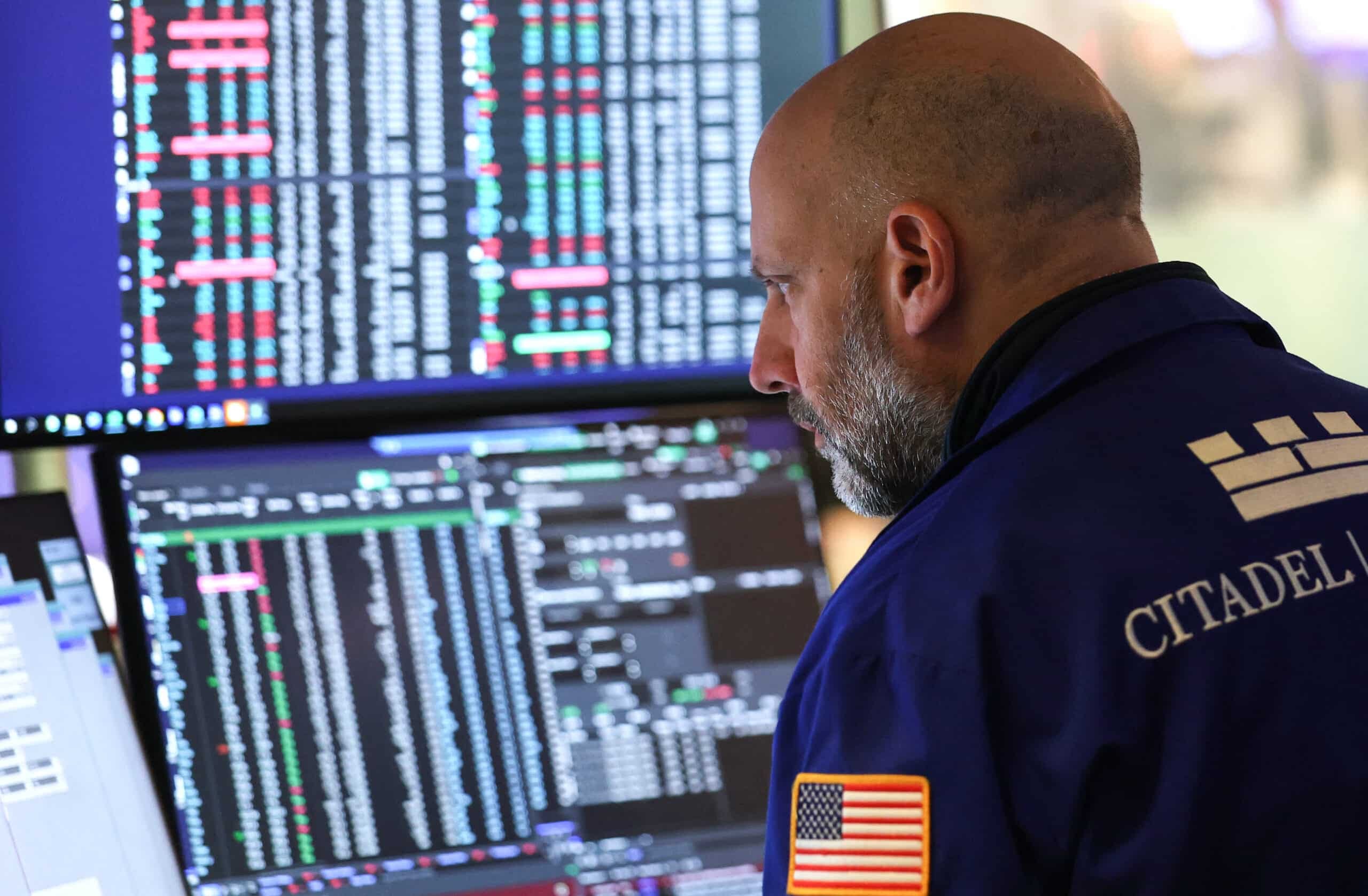
If you walk onto the trading floor of the New York Stock Exchange in January 2026, the scene might initially confuse you. The chaotic shouting matches of the 1990s are gone, replaced by a hum of focused intensity. To the casual observer, the floor looks like a museum exhibit populated by people in blue jackets staring at screens. But this calm surface hides a stunning statistic that defies the narrative of an automated world: Floor brokers currently control over 46% of the volume in the NYSE Closing Auction, the single most liquid event of the trading day.
As we settle into 2026, the debate between human intuition and artificial intelligence has reached a fever pitch. Yet, in the heart of the financial district, a counter-intuitive reality has emerged. While AI-driven algorithms are flooding the market with noise—generating a record-breaking 1.2 trillion order messages daily—the final price discovery of the day is increasingly reliant on human judgment. The “D-Order” (Designated Order), a tool available exclusively to floor brokers, has become the market’s preferred weapon for navigating the closing bell.
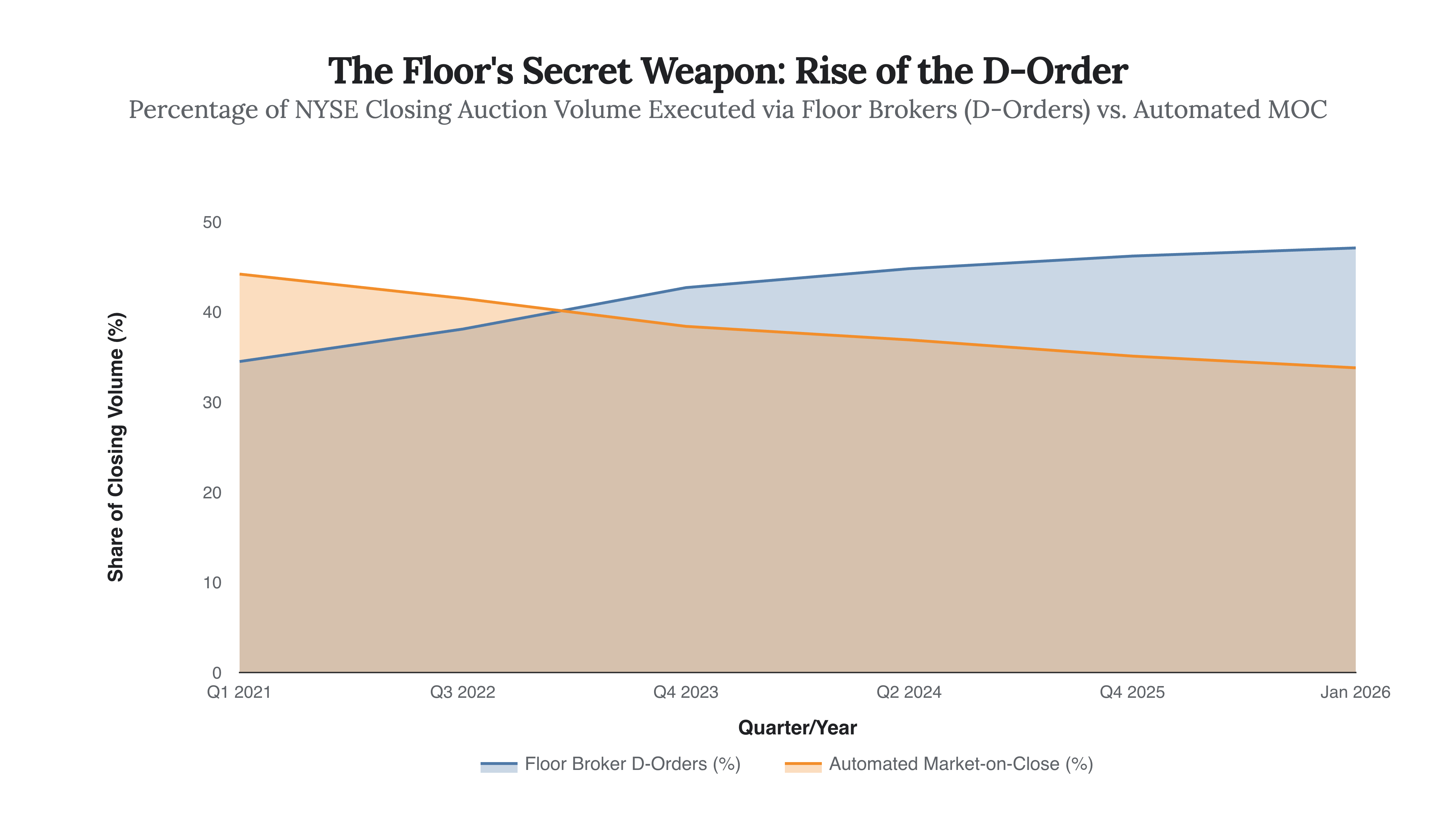
The chart above reveals a silent takeover. Since 2021, the market share of automated Market-on-Close (MOC) orders has steadily declined, while D-Orders—which allow floor brokers to exercise discretion on price and timing up until 3:59:50 PM—have surged. In an era where milliseconds define success for algorithms, the human ability to wait, watch, and react in the final seconds has proven superior.
The 1.2 Trillion Message Problem
To understand why the floor remains relevant, one must grasp the sheer scale of digital noise. In 2021, a volatile trading day might see 350 billion order messages. Today, driven by generative AI trading strategies, that number has exploded.
“When I first took this job four years ago... a volatile day in our market saw about 350 billion incoming order messages. This past April, a peak day for us was 1.2 trillion messages.” — Lynn Martin, NYSE President (Late 2025)
This exponential growth in message traffic often results in “phantom liquidity”—orders that vanish the moment they are interacted with. In this environment, the physical trading floor acts as a filter. Institutional investors, terrified of predatory algorithms sniffing out their large block trades, are routing their most sensitive orders to humans who can legally “hide” interest until the closing seconds.
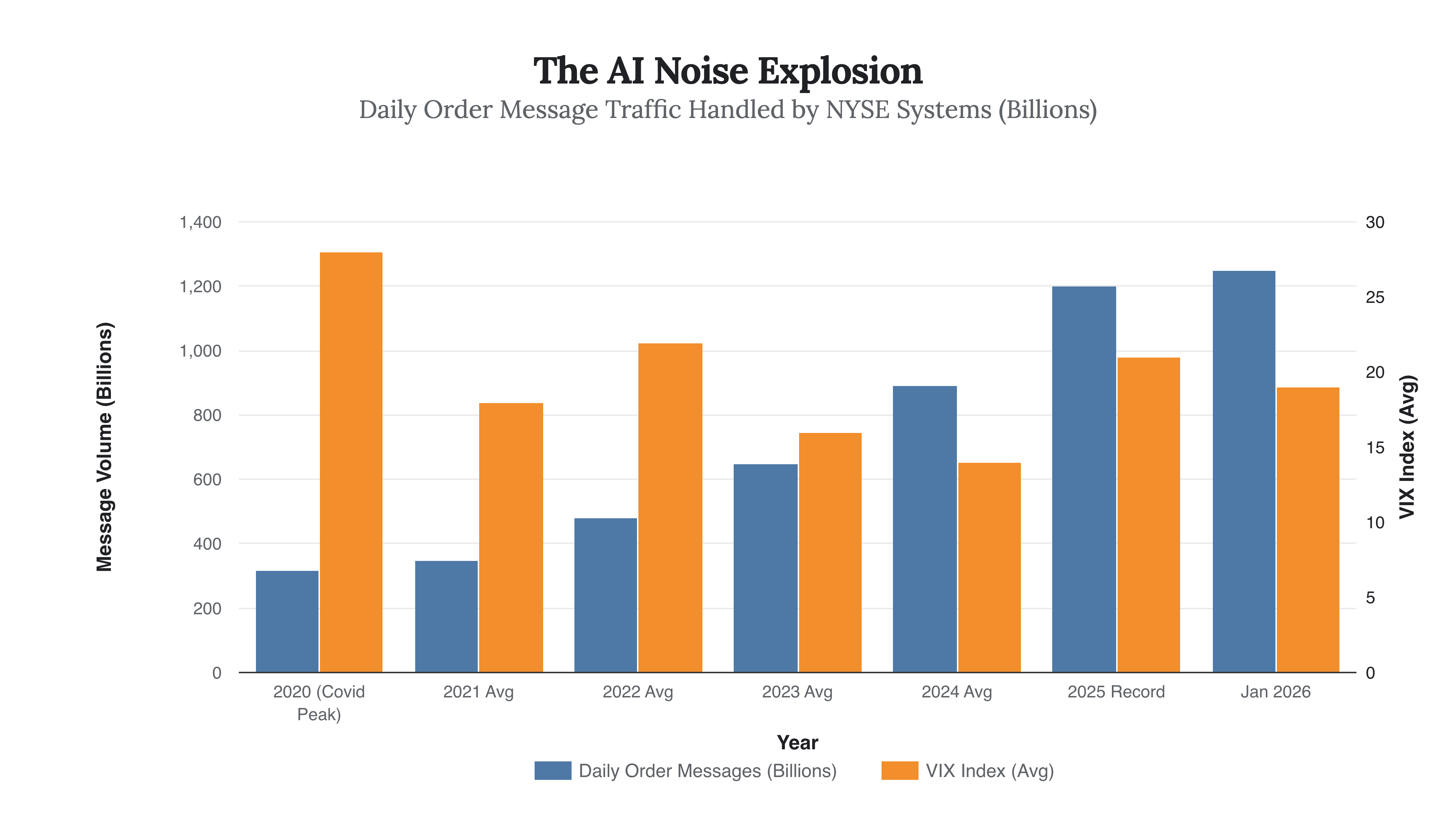
The data highlights a paradox: as volatility stabilizes (the orange line), the volume of electronic chatter (the blue bars) continues to skyrocket. This divergence suggests that much of the new “activity” is machine-to-machine noise, making the trusted execution of a floor broker more valuable, not less.
The “Human Premium” on Pricing
Critics often dismiss the floor as expensive theater. However, recent academic analysis validates the premium paid for human intervention. A study analyzing the period when the NYSE floor was temporarily closed due to COVID-19 found that pricing errors increased by 2-6% in the absence of floor brokers. Without the “human check” on the closing auction, the market became less efficient, costing investors millions.
In January 2026, the floor is no longer about speed; it is about the “Last Look.” With the Closing Auction now accounting for over 10% of total daily consolidated volume—a record high—the traders standing at the posts are effectively the gatekeepers of the day’s final price.
“The floor facilitates the transfer of information in a way that electronic trading cannot... clients can give brokers some latitude to work on their behalf, reacting to imbalances that an algorithm might misread.” — Dominik Roesch, Associate Professor of Finance
The Future is Hybrid
The resilience of the NYSE trading floor suggests that the future of finance is not purely digital, but stubbornly hybrid. As we move deeper into 2026, we are seeing the integration of tokenized securities and 24/7 trading cycles, yet the 4:00 PM closing bell remains the anchor. The floor broker has evolved from a frantic auctioneer into a strategic pilot, navigating a storm of AI-generated data to land the plane safely.
The next time you see the trading floor on television, do not look at it as a relic of the past. Recognize it as the control room for the only 15 minutes of the day where humans still beat the machines.