



The United States economy has defied gravity once again, but the landing path looks increasingly turbulent. In a delayed release that arrived only this morning—held up by the 43-day government shutdown that paralyzed Washington earlier this quarter—the Bureau of Economic Analysis (BEA) reported that US Gross Domestic Product (GDP) expanded at an annualized rate of 4.3% in the third quarter of 2025. This figure didn’t just beat the consensus forecast of 3.3%; it shattered expectations of a cooling economy and marked the fastest pace of expansion in two years.
On the surface, this is a victory lap for the post-recession recovery following the sharp contraction in early 2025. However, the topline number masks a precarious reality. While stock market gains have fueled a spending spree among the wealthy, critical sectors of the real economy—most notably housing and physical infrastructure—are contracting at alarming rates. The data paints a portrait of a fractured economic engine: one firing on all cylinders for the digital class, while grinding to a halt for everyone else.
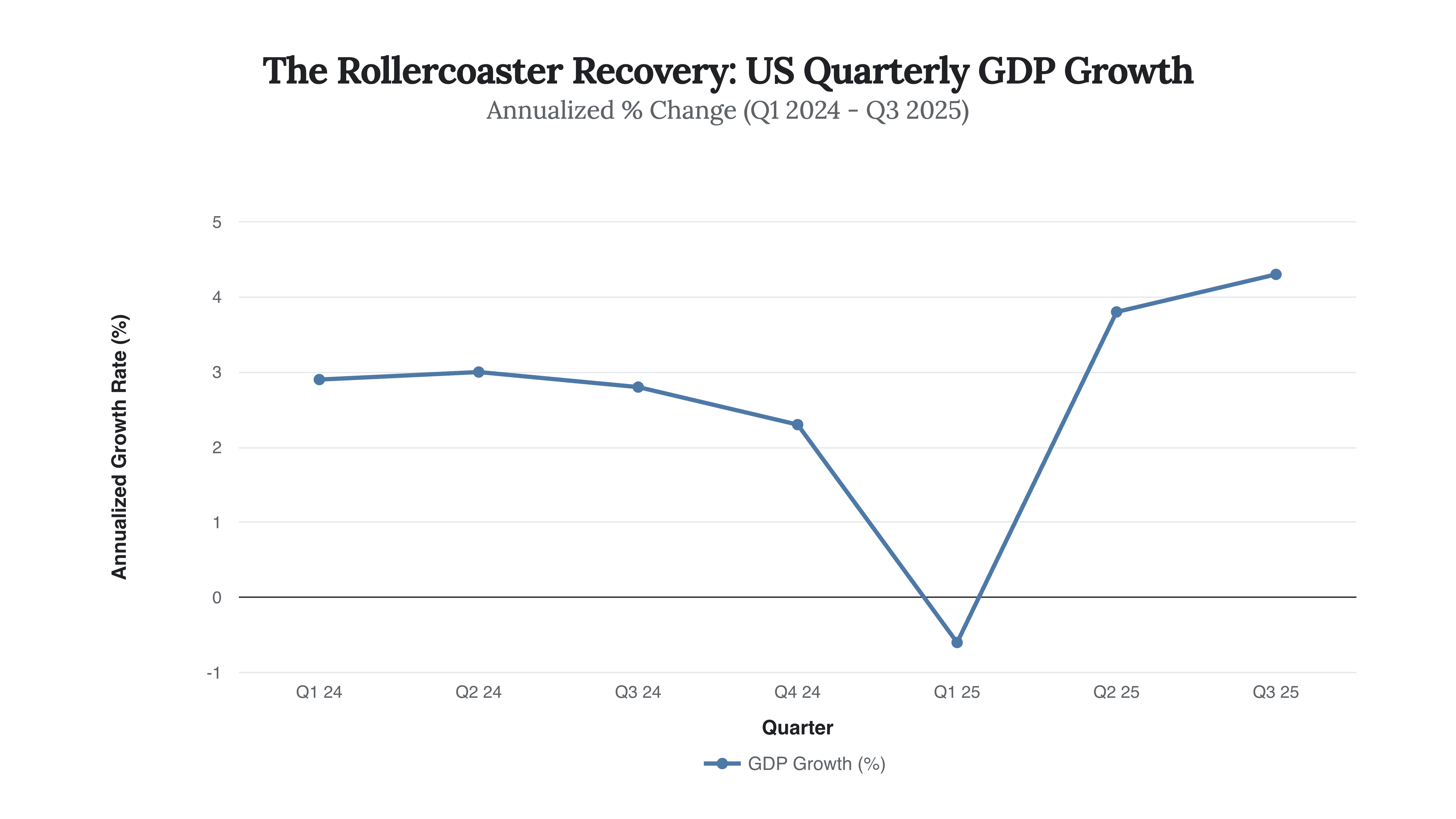
As the chart above illustrates, the US economy has endured significant volatility over the last 18 months. After the tariff-induced contraction of 0.6% in the first quarter of 2025—a reaction to the new administration’s sweeping trade levies—growth has rebounded violently. This volatility suggests an economy reacting to policy shocks rather than organic stability.
The Wealth Effect vs. The Reality Check
The primary driver of this 4.3% surge was a blistering 3.5% increase in consumer spending. However, the composition of this spending reveals the widening “K-shaped” divide. The data shows that consumption was led by high-end services, international travel, and luxury goods—spending fueled largely by the recent stock market boom. This “wealth effect” has insulated high-income households from the rising cost of living, allowing them to power the headline GDP figure almost single-handedly.
“If the economy keeps producing at this level, then there isn’t as much need to worry about a slowing economy... but inflation could return as the greatest concern.”
In stark contrast, the foundations of the American Dream are crumbling. While the wealthy spend, the housing market is effectively frozen. Residential investment collapsed by 5.1% in the third quarter, marking its fourth consecutive quarterly decline. High interest rates and inflated construction costs have made new housing projects unviable, locking millions out of the market.
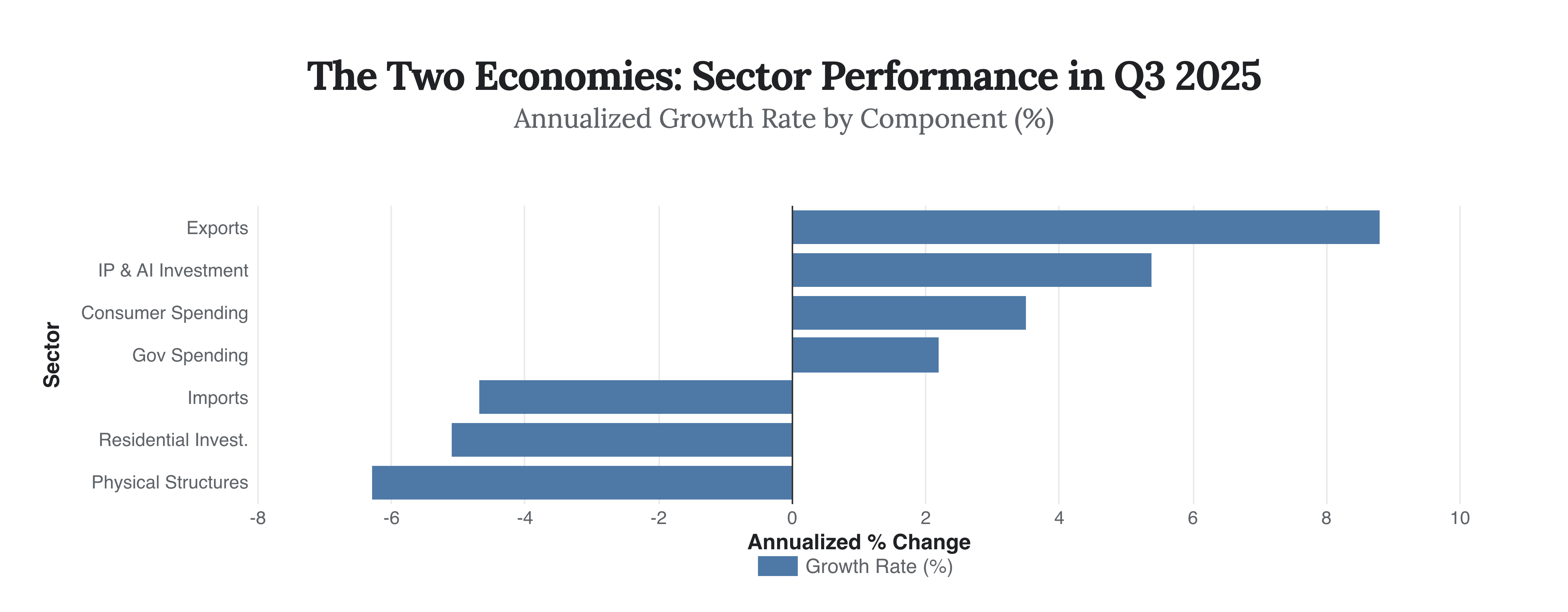
The divergence is even more visible in business investment. As the chart above highlights, investment in Intellectual Property (IP)—which includes software and Artificial Intelligence development—surged by 5.4%. Meanwhile, investment in physical structures (factories, offices, and retail space) plunged by 6.3%. Capital is fleeing the physical world for the digital one, further concentrating economic gains in the tech hubs while traditional industrial construction stalls.
The Trade Paradox
One of the most surprising contributors to the Q3 figure was net exports. Exports rebounded sharply, growing 8.8%, while imports fell by 4.7%. While this boosts the GDP calculation (since imports are subtracted), the drop in imports is a warning sign. It suggests that American businesses are pulling back on inventory and foreign goods in anticipation of further tariff escalations or slowing domestic demand for physical products.
“Much of the consumer spending acceleration resulted from a rush to buy electric vehicles before the September 30 expiration of tax credits.”
This temporary rush, combined with the delayed government spending from the shutdown resolution, may have artificially inflated the Q3 numbers. With the Core PCE inflation index creeping back up to 2.9%—well above the Fed’s target—policymakers are now in a bind. They cannot cut rates to save the housing market without risking a resurgence of inflation, yet they cannot hike rates without crushing the few remaining engines of growth.
Conclusion
The 4.3% GDP growth figure for the third quarter is a stunning statistic, but it is a fragile victory. It represents an economy being pulled apart: explosive growth in digital investment and luxury consumption masking a deep recession in housing and physical infrastructure. As we head into 2026, the question is not whether the US economy is growing, but who exactly is it growing for?