


Today in Paris, the mood at the Organisation for Economic Co-operation and Development (OECD) headquarters was one of cautious relief tempered by a sharp new anxiety. Secretary-General Mathias Cormann presented the latest Economic Outlook, revealing a global economy that has defied the gravest predictions of recession but now faces a more insidious threat. The headline figure—a projected 3.1% global GDP growth for 2026—suggests stability. Yet, beneath this headline lies a fractured landscape where a single variable threatens to unravel the recovery: an intensifying trade war that OECD economists warn could shave nearly 0.5% off global output if supply chain stresses escalate.
The new report, released this morning, paints a picture of a world economy operating at two distinct speeds. While the United States and India continue to drive expansion, the Eurozone remains dangerously close to stagnation. Cormann’s presentation highlighted that while inflation has largely been tamed in advanced economies, the “last mile” of price stability is being complicated by renewed protectionism. The data suggests that the era of synchronized global growth is over, replaced by a fragmented reality where policy decisions in Washington and weather events in Southeast Asia ripple almost instantly through global markets.
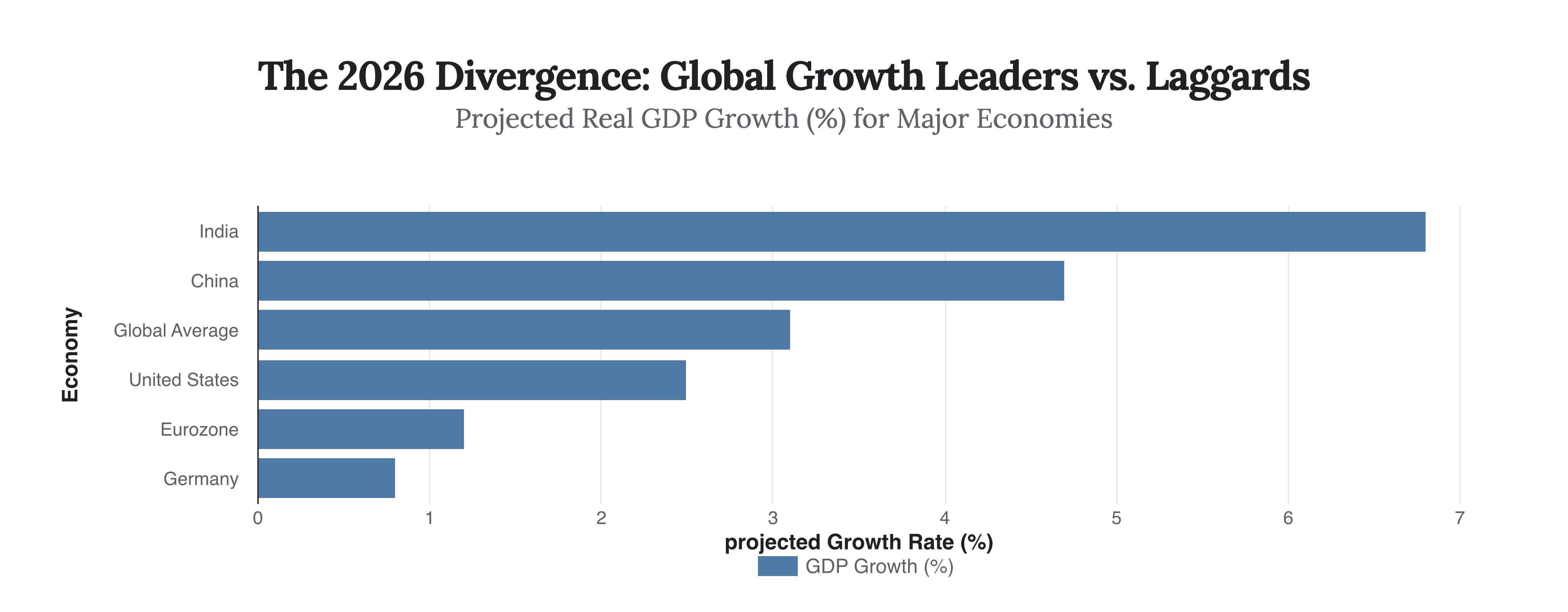
The chart above underscores the stark divergence in economic fortunes projected for 2026. India has solidified its position as the world’s fastest-growing major economy with a robust 6.8% forecast, significantly outpacing China at 4.7%. In stark contrast, the Eurozone is expected to grow by a mere 1.2%, dragged down by a sluggish German economy grappling with industrial headwinds. This imbalance creates a precarious dynamic for policymakers: while emerging markets need capital to fuel their expansion, advanced economies are still navigating the tightrope of high interest rates to keep inflation in check.
“Protectionist policies are intensifying global uncertainty. We are seeing a shift where trade barriers are no longer just political tools—they are becoming tangible drags on GDP, capable of reversing the hard-won gains of the post-pandemic recovery.”
One of the most alarming findings in today’s outlook is the tangible cost of non-economic risks. The report explicitly links a $3 billion economic loss in Southeast Asia to recent flooding, a stark reminder that climate volatility is now a macroeconomic variable. When combined with the “indecision tax” of trade policy uncertainty, these factors create a drag that traditional fiscal stimulus cannot easily fix.
The OECD estimates that if trade tensions continue to escalate—specifically regarding U.S. tariff actions and retaliatory measures—the baseline growth of 3.1% could easily slip below 2.7%, wiping out hundreds of billions of dollars in value.
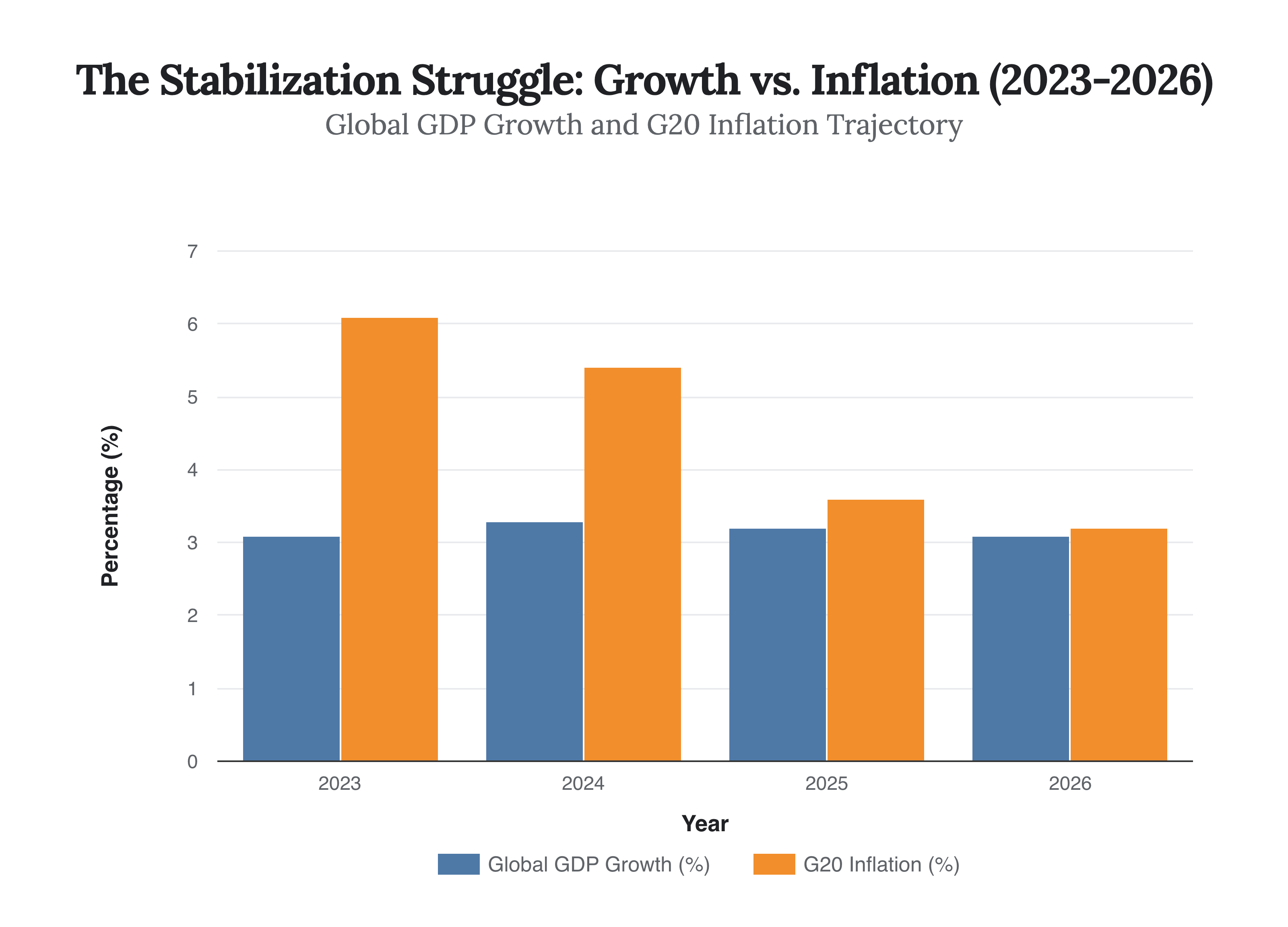
As the trend lines illustrate, the global economy has entered a phase of cooling inflation but plateauing growth. The dramatic fall in G20 inflation—from a high of 6.1% in 2023 to a projected 3.2% in 2026—is a victory for central banks. However, the GDP line remains stubbornly flat, hovering around the 3.1-3.3% mark. This “soft landing” is fragile. The OECD warns that the lack of upward momentum in growth, despite falling inflation, indicates structural weaknesses. Productivity remains low, and business investment is being held back by the very uncertainty Cormann highlighted.
“The global economy has shifted from a period of resilient growth to a more uncertain path. Policy uncertainty is weakening trade and investment, diminishing consumer confidence, and curbing the prospects that matter most for long-term prosperity.”
Ultimately, the 2026 outlook presented in Paris serves as a reality check. The numbers are not catastrophic, but they are complacent. A 3.1% growth rate is sufficient to keep the global engine running, but it is insufficient to absorb the dual shocks of a climate crisis and a trade war. The data suggests that without a coordinated effort to lower trade barriers and accelerate green infrastructure investment, the world economy risks drifting into a prolonged period of low-growth stagnation, where the next crisis could be the one that breaks the resilience we have taken for granted.