


For nearly three years, the official stance from Kyiv was absolute: no peace without full territorial integrity. But in the dying weeks of 2025, the geopolitical tectonic plates shifted. A revised peace framework—whittled down to 20 pragmatic points from an earlier 28-point draft—has emerged from the corridors of the Mariinskyi Palace. While the headlines focus on President Zelenskyy’s diplomatic overtures to the incoming US administration, the real story is driven by a number that has been quietly rising in the background: 38%.
That is the percentage of Ukrainians who, as of December 2024, expressed readiness to accept territorial concessions in exchange for peace and independence. It is a figure that would have been unthinkable just two years ago. This rising tide of pragmatism, born of exhaustion and a brutal reality on the front lines, has created the political space for Zelenskyy’s most significant strategic pivot since the invasion began: a proposal to bring Ukraine under the “NATO umbrella” immediately, even if that protection initially covers only the territory Kyiv currently controls.
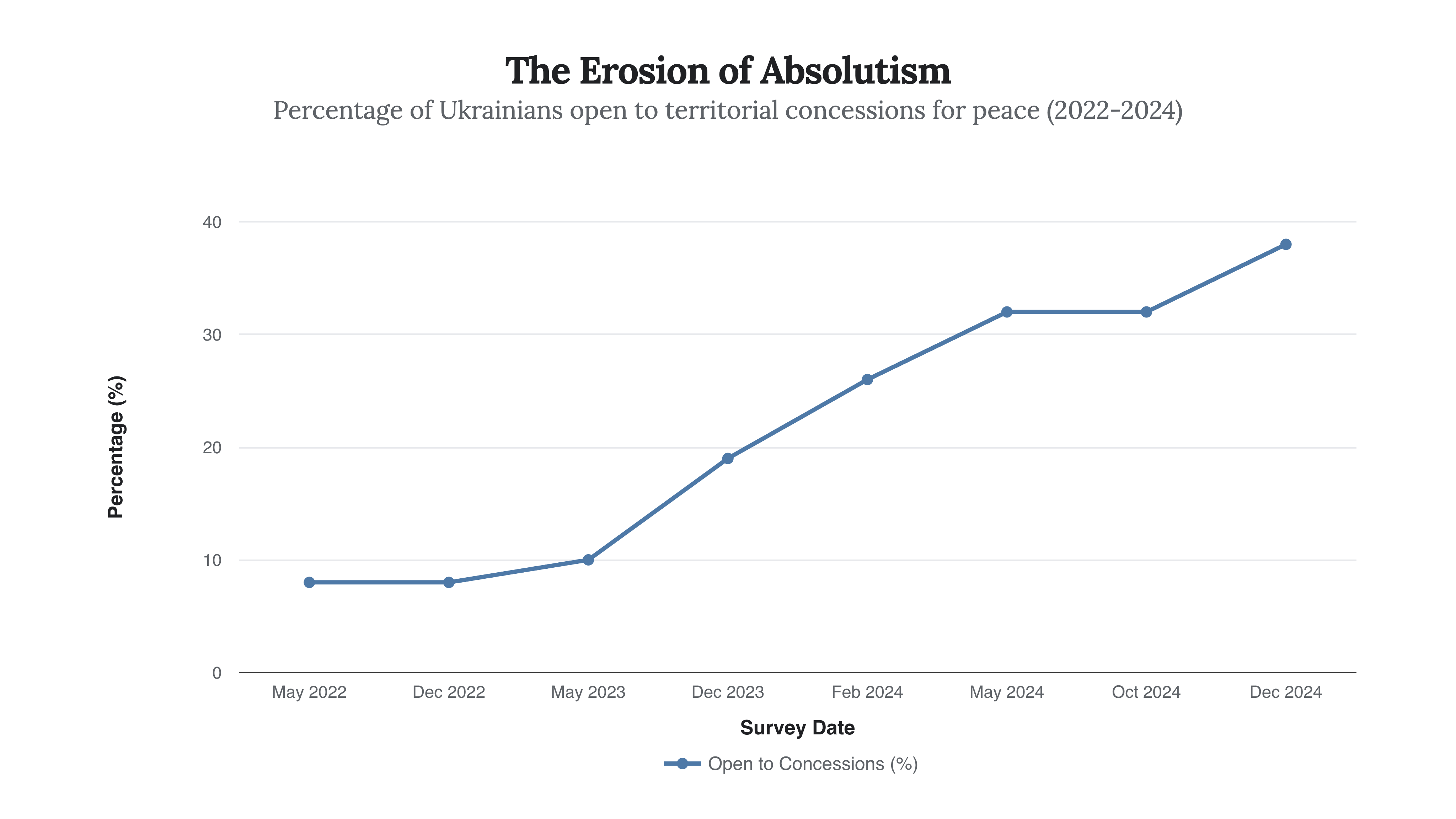
The chart above reveals the slow but undeniable erosion of the “victory at all costs” sentiment. In December 2022, only 8% of the population entertained the idea of trading land for peace. By the end of 2024, that minority had swelled to nearly 40%. This shift isn’t merely a statistic; it is a mandate for a “hot phase” ceasefire that prioritizes the survival of the state over the immediate reclamation of the 18% of Ukraine currently under Russian occupation.
“If we want to stop the hot stage of the war, we should take under the NATO umbrella the territory of Ukraine that we have under our control. That’s what we need to do fast.”
This admission, made by Zelenskyy in late November, underpins the revised 20-point plan submitted to Washington. The plan strips away what insiders called “anti-Ukrainian” concessions found in earlier drafts but introduces a heavy reliance on binding Western security guarantees—specifically, an Article 5-style protection that would deter future aggression. It is a gamble that trades the immediacy of territorial wholeness for the permanence of state security.
However, this diplomatic flexibility was not chosen in a vacuum. It was forced by a catastrophic year on the battlefield. While 2023 was defined by a stalemate, 2024 saw the Russian war machine reawaken with devastating efficiency. Leveraging a manpower advantage and a relentless production of guided aerial bombs, Russian forces accelerated their advance significantly in the second half of the year.
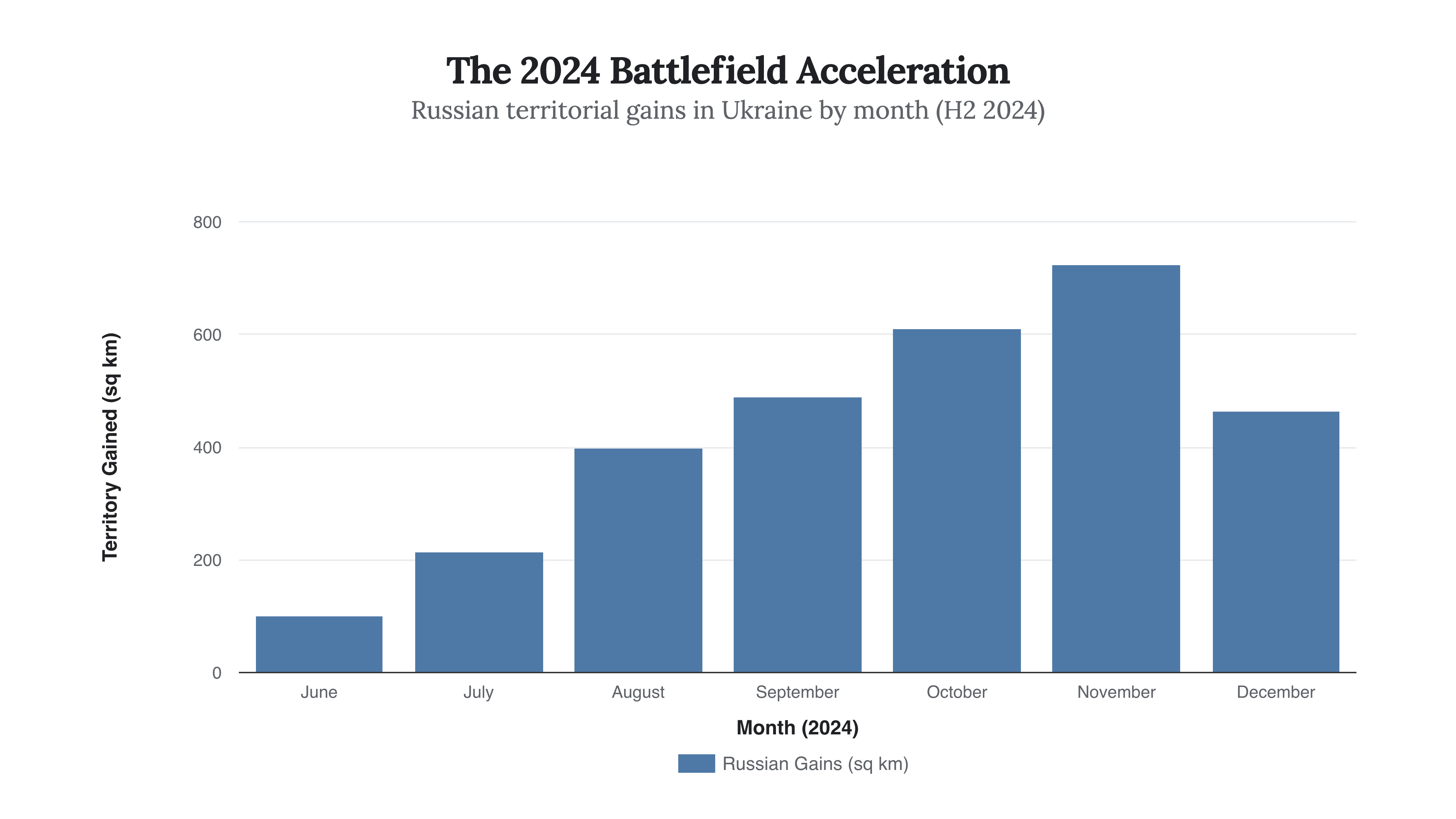
The acceleration shown here is stark. In the entirety of 2023, Russia gained a net total of roughly 487 square kilometers. In contrast, during just the single month of November 2024, they seized 725 square kilometers—a pace reminiscent of the invasion’s early weeks. The revised peace plan is an acknowledgement that the current rate of attrition is unsustainable without a dramatic change in the equation, such as direct NATO involvement or a ceasefire that freezes the lines before key logistics hubs like Pokrovsk are lost.
Compounding the military pressure was a precipitous drop in external support. Estimates suggest that military aid dropped from an annual average of over $48 billion in previous years to approximately $37.8 billion in 2024, with a notable “air pocket” of delayed deliveries in the summer. This scarcity of resources directly correlates with the spike in territorial losses seen in the chart above, creating a feedback loop that the revised peace plan aims to break.
“We have no legal right to recognize the occupied territory as territory of Russia... But we need to save the people first.”
The revised plan creates a “diplomatic waiting room” for the occupied territories—Crimea, Donetsk, Luhansk, Zaporizhzhia, and Kherson. By separating the military defense of free Ukraine from the diplomatic recovery of occupied Ukraine, Zelenskyy attempts to align his strategy with the “peace through strength” doctrine favored by the incoming US administration.
Ultimately, the revised peace plan is less a wishlist and more a survival strategy. It reflects a maturing of the Ukrainian position that mirrors the hardening of the public’s resolve to end the bloodshed. The war has moved from a battle for every inch of soil to a battle for the existence of a viable, protected future.