


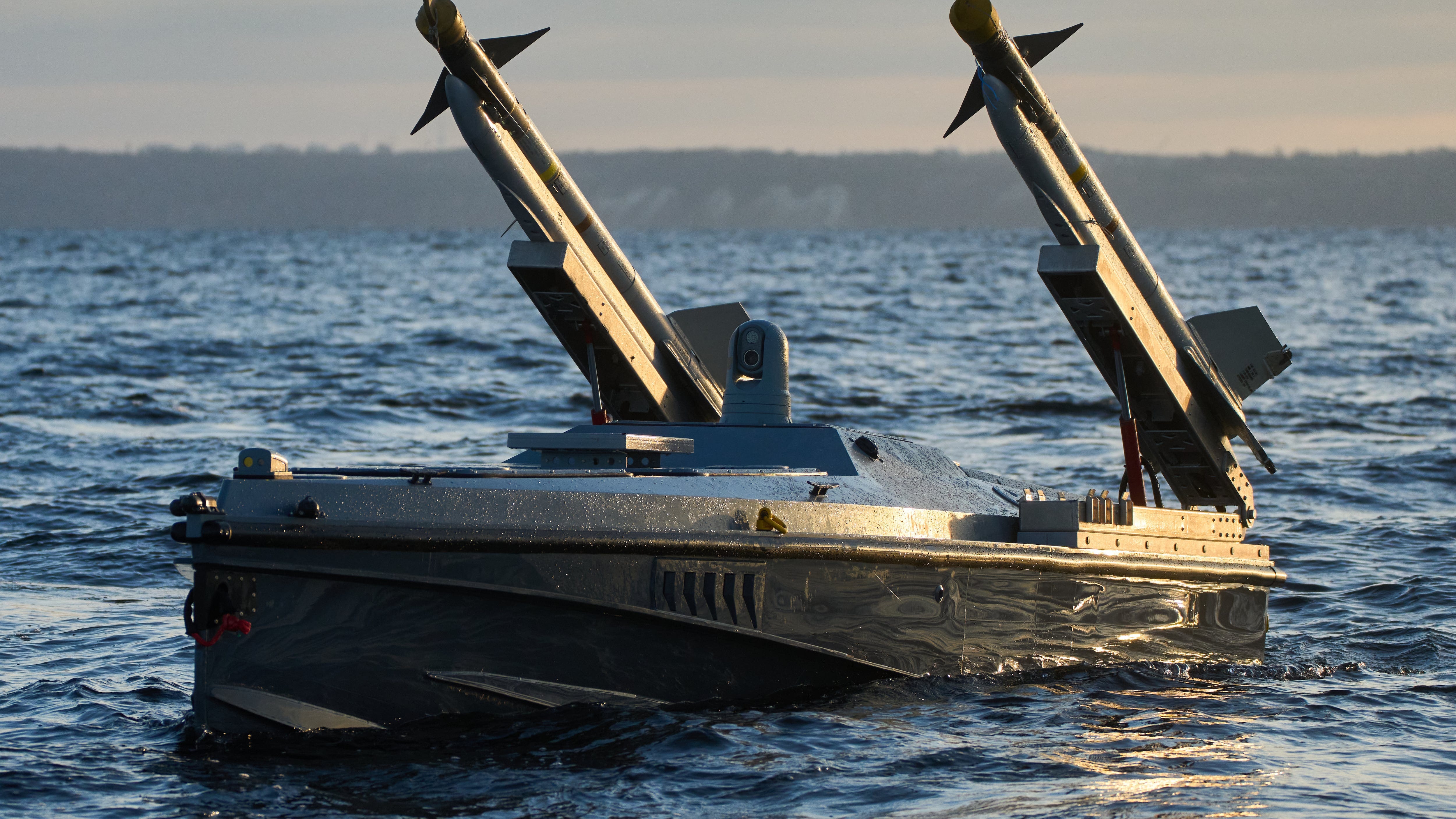
On November 28, 2025, the nature of the war in the Black Sea shifted again. Two Russian “shadow fleet” tankers, the Kairos and the Virat, were struck by Ukrainian Sea Baby drones while en route to Novorossiysk. Unlike previous attacks that targeted warships, this strike went after Russia’s economic lifeline. It was a precise, calculated blow using a weapon that costs less than a luxury car to disable vessels carrying tens of millions of dollars in crude oil.
This latest escalation highlights the brutal arithmetic that has come to define the naval theater. Ukraine, a nation with effectively no conventional navy, has utilized a fleet of remotely operated sea drones to corner the Russian Black Sea Fleet. The defining metric of this campaign is not tonnage, but leverage. With a production cost of roughly $273,000, a single Magura V5 drone represents an asymmetric threat that conventional navies are ill-equipped to counter financially or tactically.
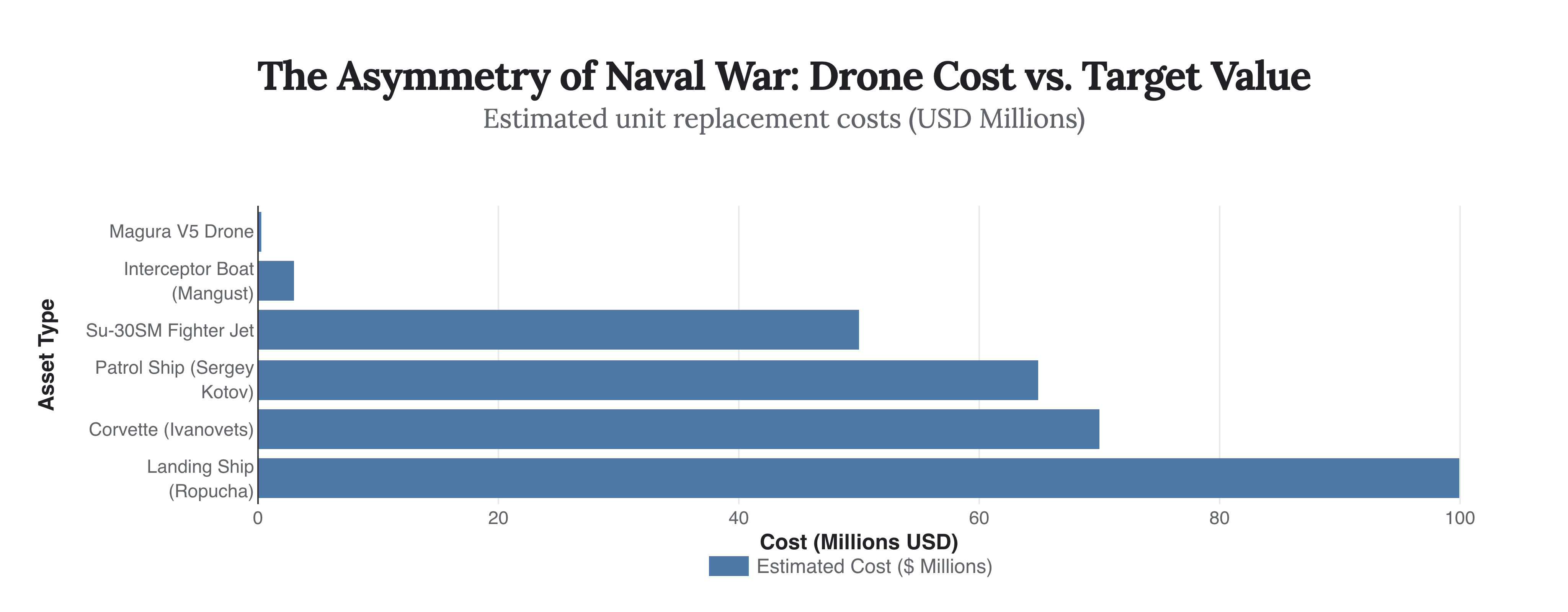
The chart above illustrates the financial impossibility facing the Russian command. To destroy a $65 million patrol ship like the Sergey Kotov, Ukraine can afford to lose dozens, if not hundreds, of Magura drones and still come out ahead financially. This cost-exchange ratio has forced the Russian fleet to retreat from its historic headquarters in Sevastopol to the relative safety of Novorossiysk, hundreds of miles to the east.
But the innovation did not stop at surface ships. In May 2025, the conflict saw a historic first: a Magura V7 sea drone, equipped with modified R-73 air-to-air missiles, shot down two Russian Su-30SM fighter jets. The adaptation of a surface drone into a mobile air-defense platform—capable of destroying a $50 million aircraft—demonstrates the rapid evolutionary cycle of Ukrainian naval technology.
“The sea space has gradually been occupied by naval drones. Now powerful ships hide in protected ports.” — General Valerii Zaluzhnyi
The strategic victory in the Black Sea is not just about sinking warships; it is about securing the sea lanes. Following Russia’s withdrawal from the Black Sea Grain Initiative in July 2023, many predicted the collapse of Ukrainian agriculture exports. Instead, the drone campaign pushed Russian warships back far enough to create a unilateral “humanitarian corridor.”
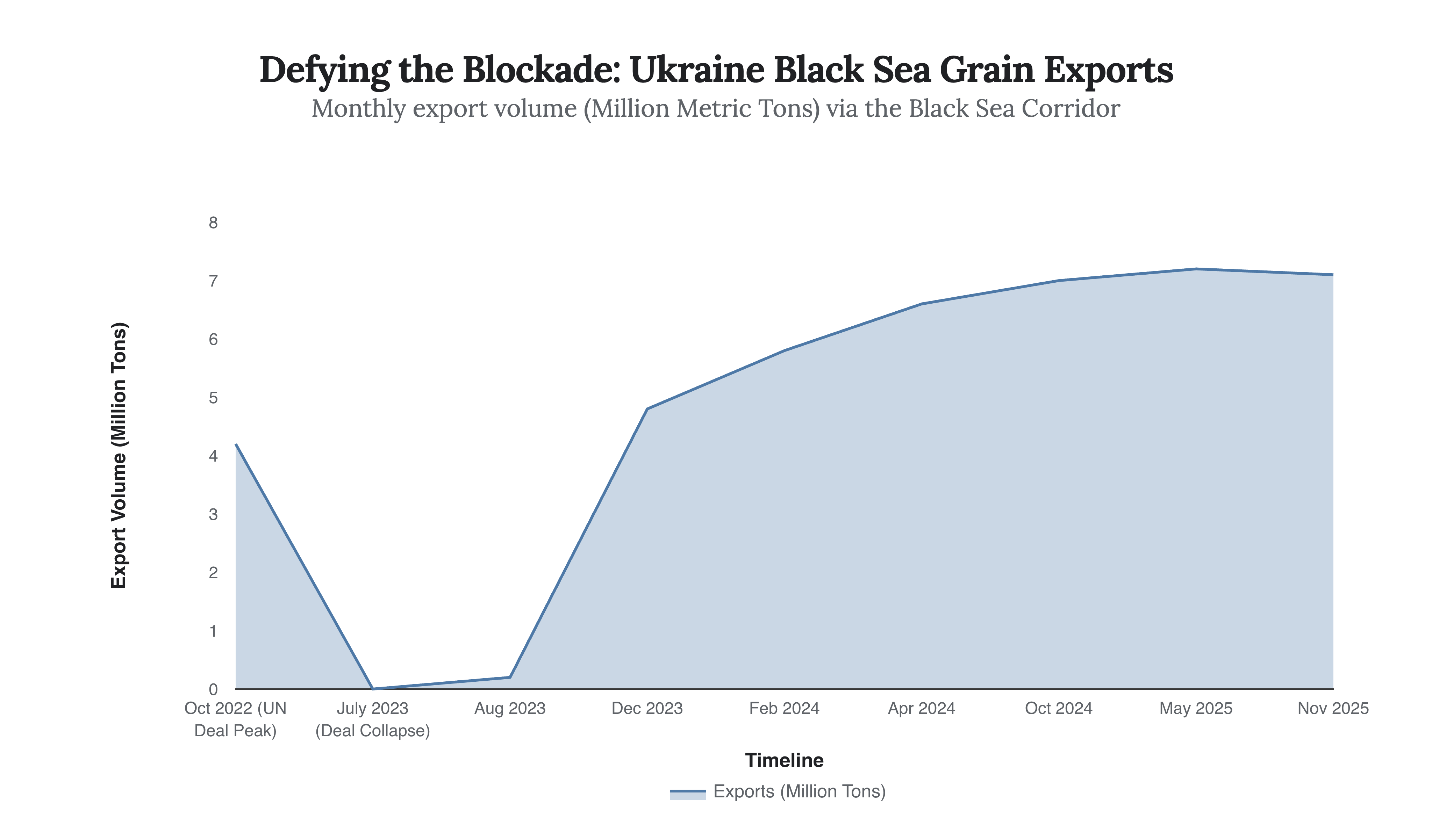
As the data shows, the “drone corridor” has not only replaced the UN-brokered deal but surpassed it. By April 2024, exports hit a record 6.6 million tons, a figure that has stabilized throughout 2025. This economic resilience is the direct dividend of the naval drone campaign. By denying Russia sea control, Ukraine restored its access to global markets.
The targets have now evolved. The November 2025 strikes on the Kairos and Virat signal a new phase: economic attrition. These tankers, part of the “shadow fleet” used to bypass oil sanctions, were hit in open waters. This proves that no Russian maritime asset—military or commercial—is safe within range of the Sea Baby drones.
“Our ultimate goal is complete absence of military ships of the so-called Russian Federation in the Azov and Black Sea regions.” — Captain Dmytro Pletenchuk, Ukrainian Navy Spokesperson
The implications extend far beyond the Black Sea. Naval powers worldwide are watching a $273,000 drone rewrite the rules of engagement. The era of the untouchable capital ship is over; the era of the swarm has begun.