


In a courtroom roughly 2,000 miles from the Honduran capital of Tegucigalpa, a legal battle is unfolding that serves as the canary in the coal mine for the future of the nation-state. The number that matters isn’t a stock price or an election margin—it is $10.775 billion. This is the amount Honduras Próspera Inc., the developer of a semi-autonomous “charter city” on the island of Roatán, is claiming in damages against the Honduran government. To put that figure in perspective, it represents nearly one-third of Honduras’s entire annual GDP.
This lawsuit is not merely a contract dispute; it is the first major skirmish in the era of “enclave warfare.” For decades, Special Economic Zones (SEZs) were quiet industrial parks offering tax breaks to factories. Today, they are mutating into autonomous city-states—private jurisdictions that treat law not as a mandate, but as a service product. As wealth and talent migrate to these high-tech castles, the friction between the old world of sovereign nations and the new world of charter cities is sparking a fire that money alone cannot extinguish.
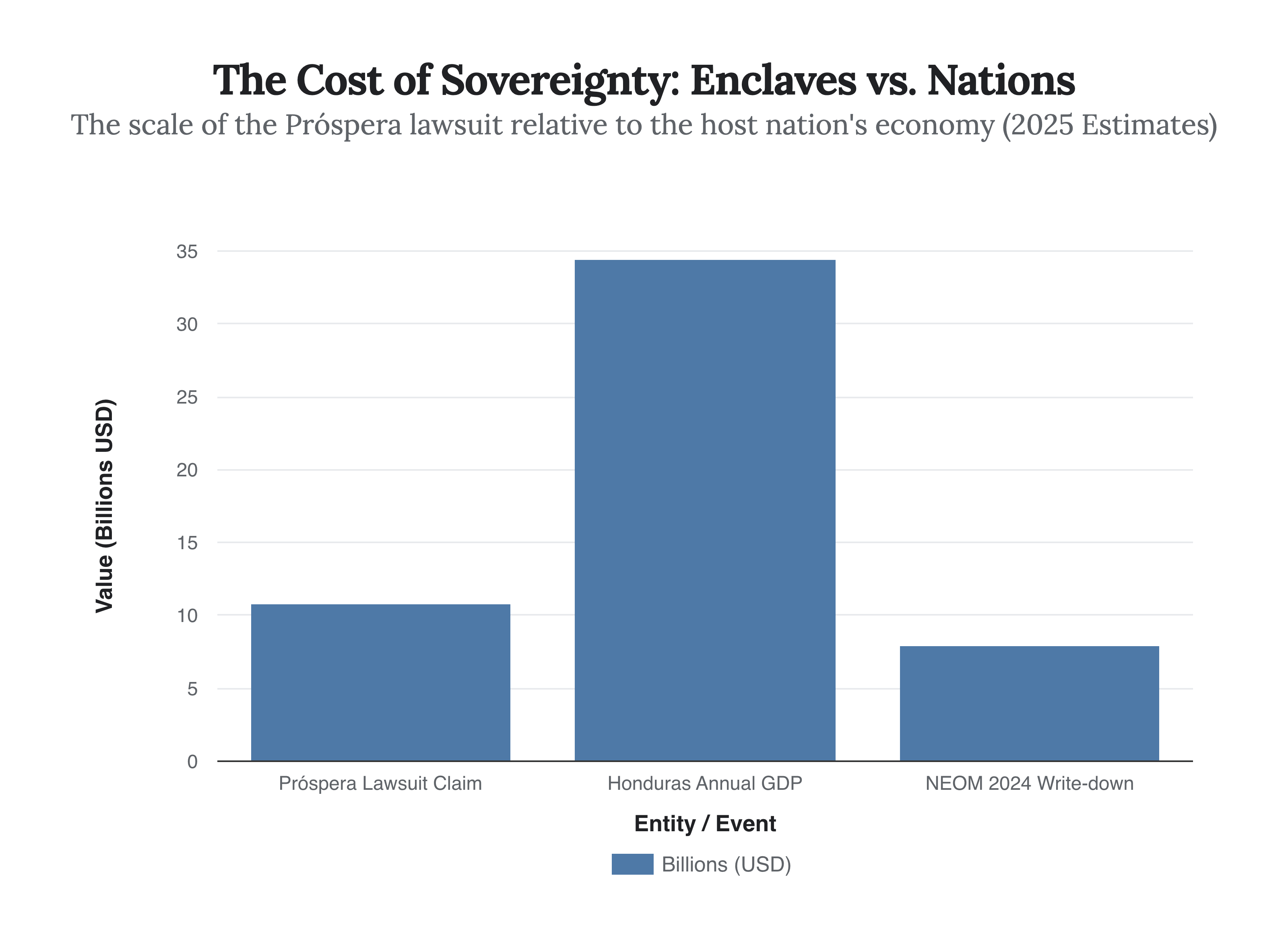
The chart above illustrates the stark asymmetry of this new conflict. A single private development company can now wield a legal claim equivalent to 31% of its host nation’s economic output. This is the “unbundling” of sovereignty in real terms: the state sold the rights to govern, and buying them back is proving ruinously expensive.
The Rise of “Law as a Service”
The Próspera model represents the cutting edge of the “Startup City” movement. By using a legal framework known as ZEDEs (Zones for Employment and Economic Development), these zones offer a “plug-in” legal system—often based on English Common Law—that operates independently of the host country’s civil courts. It is the ultimate product for the cognitive elite: a jurisdiction with low taxes, high-tech regulation, and corporate governance.
However, the political winds shifted. The current Honduran administration viewed these zones as a violation of national sovereignty and moved to repeal the ZEDE laws. The result is the massive arbitration claim now pending—a warning shot to any developing nation thinking of “importing” better governance by outsourcing it.
“Sovereignty is no longer a monopoly. It is a bundle of rights being sliced, diced, and sold to the highest bidder. But as Honduras shows, the transaction costs of reversal are astronomical.”
The Reality Check: Shrinking Castles
While Western private cities fight for their legal existence, the state-led versions in the East are facing a different foe: physics and finance. Saudi Arabia’s NEOM, the crown jewel of the new city-state era, promised a 170-kilometer linear city called “The Line.” It was to be the ultimate high-wall, high-wealth sanctuary.
Recent data from 2024 and 2025 reveals a dramatic “right-sizing” of these ambitions. Confronted with the realities of funding a $1.5 trillion gigaproject, officials have scaled back the 2030 completion target from 170km to just 2.4 kilometers. The population goal has plummeted from 1.5 million to fewer than 300,000. Even the castles of the neomedieval age must eventually balance the books.
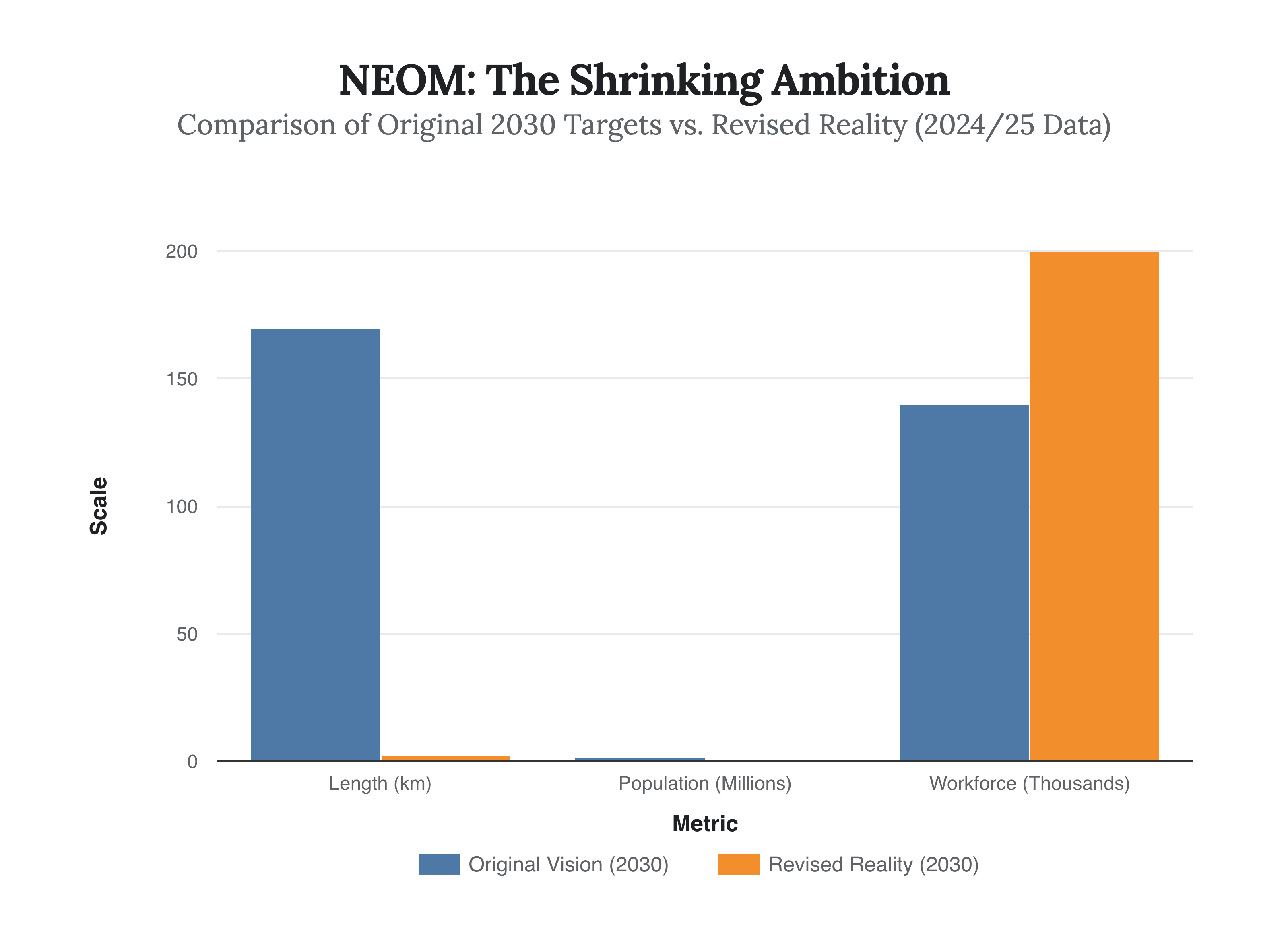
Despite the physical scaling back, the financial commitment remains immense. The construction workforce has actually increased to over 200,000, creating a temporary city in the desert just to build the permanent one. This is the paradox of the charter city revival: even when they fail to meet their wildest marketing promises, they mobilize capital and labor on a scale that dwarfs traditional urban development.
Voting with Their Feet
If these cities are the product, who is buying? The answer lies in the migration patterns of High-Net-Worth Individuals (HNWIs). We are witnessing a historic “brain drain”—not from poor countries to rich ones, but from failing legacy states to efficient city-state nodes.
According to Henley & Partners’ 2025 projections, the United Kingdom—once the gold standard of stability—is set to lose a world-leading 16,500 millionaires in a single year. Where are they going? The United Arab Emirates, the world’s most successful “holding company” of city-states, is projecting a net inflow of nearly 10,000 wealthy migrants. Singapore, despite a slight slowdown, continues to be a primary vault for Asian wealth.
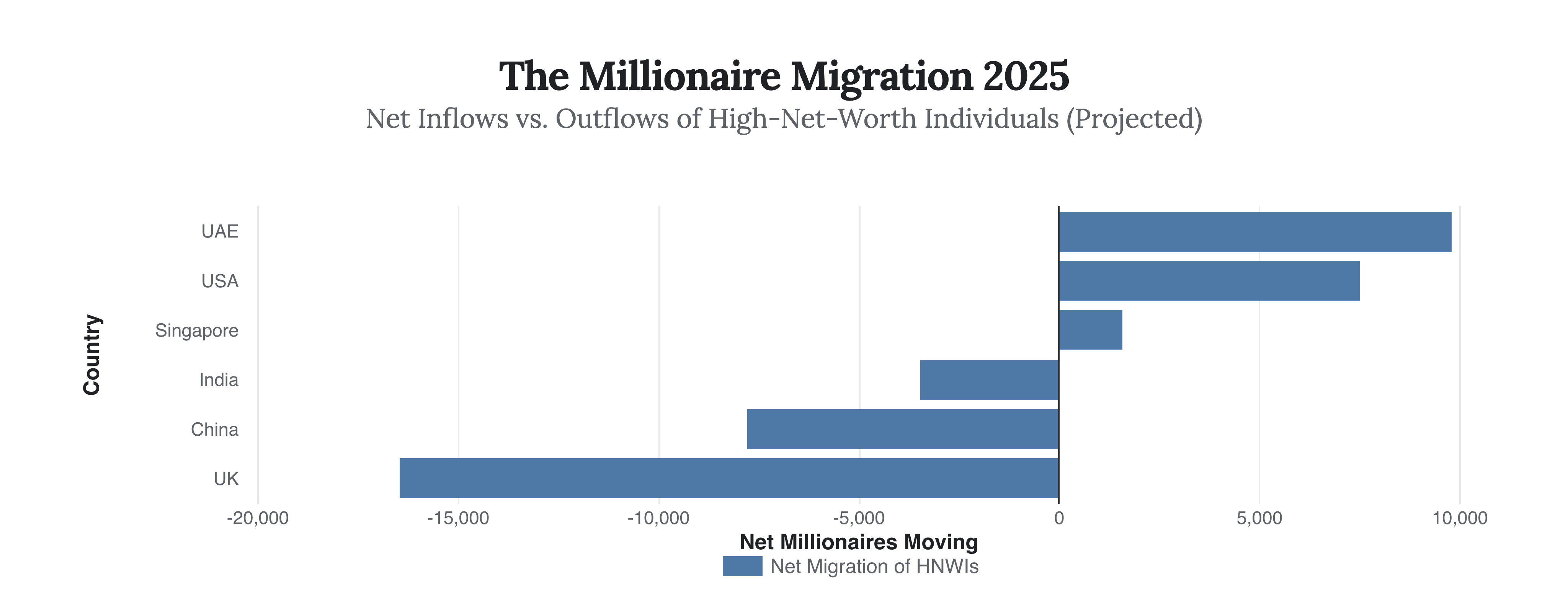
This chart reveals the ruthless efficiency of the market for governance. Capital is fleeing jurisdictions perceived as unstable, high-tax, or unsafe (the “Losing” bars) and flowing into the “Gaining” nodes that offer security, tax neutrality, and predictability. The “Singapore-ification” of the world is not just a metaphor; it is a demographic reality.
The Future: A Fragmented World
The rise of the charter city is not a fad; it is a structural shift in how human beings organize themselves. From the 5,400+ Special Economic Zones mapping the globe to the private arbitration courts replacing public justice, the trend is clear. We are moving toward a world of “neomedieval” castles—highly fortified, autonomous nodes of immense wealth connected by digital networks, surrounded by a hinterland of traditional nation-states struggling to keep up.
The risks are real. As the Próspera case demonstrates, the host organism can reject the transplant, leading to legal and political chaos. As NEOM shows, the cost of building utopia is often higher than the revenue it generates. Yet, the money continues to flow. In a world where state capacity is declining, the market for private governance is the only growth industry that matters.