



We are witnessing the industrial-scale manufacturing of what Friedrich Nietzsche called the “Last Man.” In Thus Spoke Zarathustra, Nietzsche prophesied a time when humanity would blink and say, “We have invented happiness”—a happiness defined by the total absence of risk, pain, and struggle. Today, we call this the “Frictionless Economy.” It is a system designed to strip every ounce of resistance from our daily lives, from how we order food to how we make strategic decisions.
But this comfort comes at a staggering price. The data suggests that by removing the friction necessary for human development, we are eroding the very capability that drives innovation and leadership: Willpower. This is not a philosophical metaphor; it is a measurable economic and biological reality. Current intelligence indicates that the global cost of this “spiritual entropy”—manifested as employee disengagement and burnout—has reached $8.9 trillion annually, or roughly 9% of global GDP. We are not just tired; we are becoming incapable of the “Will to Power” that defines human agency.
The Architecture of the Last Man: The Passive Pivot
Nietzsche’s “Last Man” is characterized by a desire for security above all else. In the digital age, this manifests as the outsourcing of agency. We have traded the burden of choice for the comfort of algorithmic determinism. The modern digital ecosystem is designed to minimize active participation in favor of passive consumption.
Recent behavioral data reveals a critical tipping point. Ten years ago, digital platforms were tools of creation and connection. Today, they are engines of sedation. The ratio of “active participation” (posting, debating, creating) to “passive consumption” (scrolling, watching, lurking) has inverted. This “Passive Pivot” is the behavioral signature of the Tired Soul.
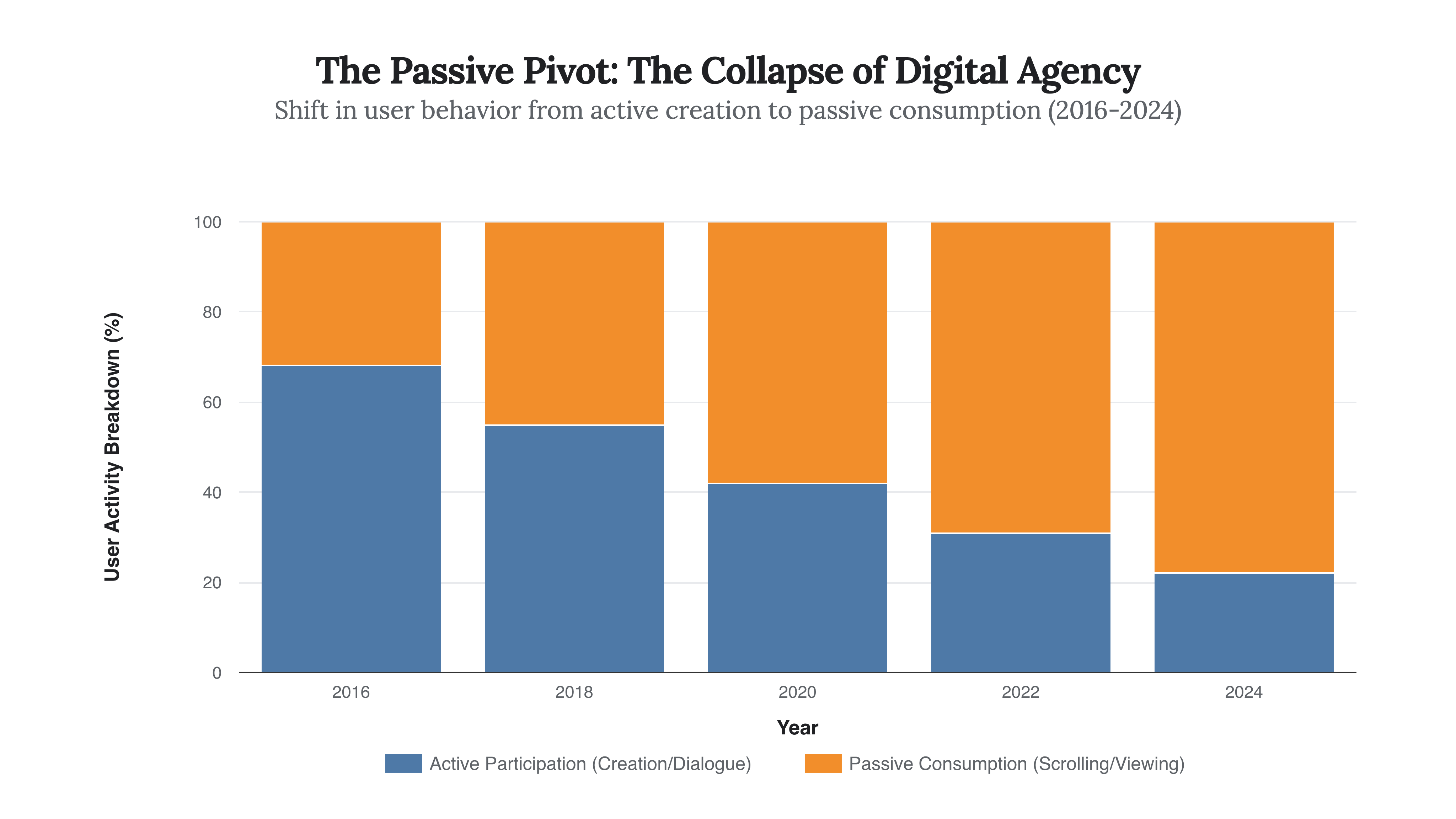
This chart is not merely a metric of social media usage; it is a proxy for human agency. When 78% of digital interaction is passive, the “muscle” of volition atrophies. We are training a workforce to receive the world rather than act upon it. This aligns perfectly with Nietzsche’s warning: “No shepherd and one herd! Everybody wants the same, everybody is the same.” The algorithm is the shepherd, and we are happily grazing.
The Biological Price of Ease: A Physical Atrophy
If the soul is tired, the body follows. Nietzsche famously linked physiology to philosophy, arguing that a strong will requires a strong constitution. The modern data supports this link with alarming clarity. We are not just psychologically more passive; we are physically diminishing.
Two key biomarkers—testosterone levels and grip strength—have shown a consistent, secular decline over the last 50 years. Grip strength, a reliable proxy for overall vitality and mortality, has plummeted. A millennial male today has approximately 20% less grip strength than his counterpart in 1985. This physical decline mirrors the psychological retreat from difficulty.
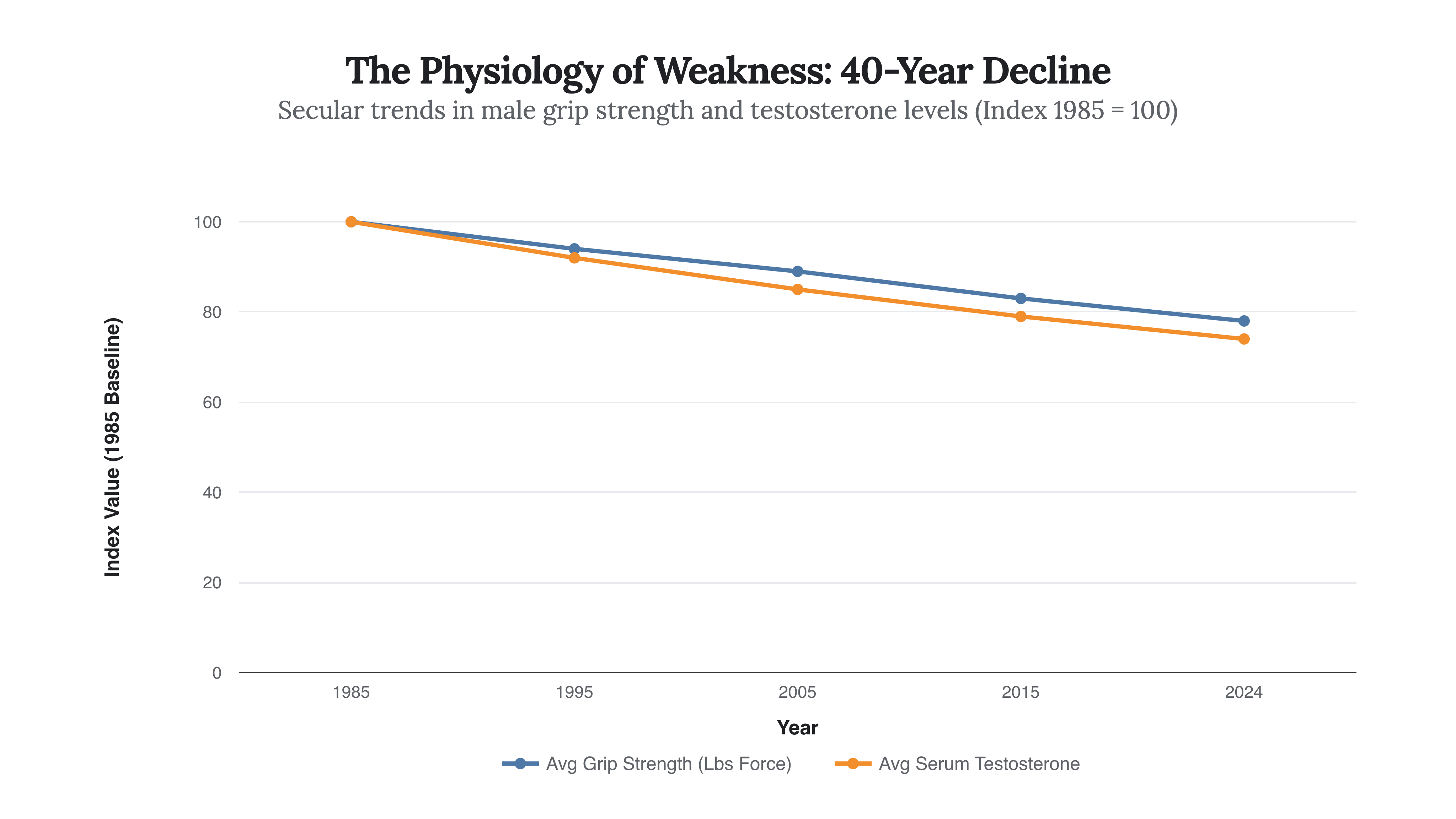
The correlation here is strategic, not just medical. A population with declining physical resilience and hormonal drive is less likely to take risks, less likely to tolerate discomfort, and more likely to seek the safety of the “Last Man.” This biological fatigue creates a feedback loop with the “Frictionless Economy”: weak bodies demand easy solutions, and easy solutions further weaken the body.
The Economics of Outsourced Agency
The market has responded to this “Tired Soul” by productizing comfort. We are seeing a massive divergence between the “Convenience Economy” (services that do things for you) and the “Capability Economy” (tools that help you do things yourself). The growth rates of on-demand delivery, concierge services, and AI agents vastly outpace the growth of DIY sectors or skill-building education.
The strategic implication is that we are building an economy that monetizes helplessness. Every time we outsource a task—from cooking dinner to writing an email—we pay a premium to avoid friction. But friction is the crucible of character.
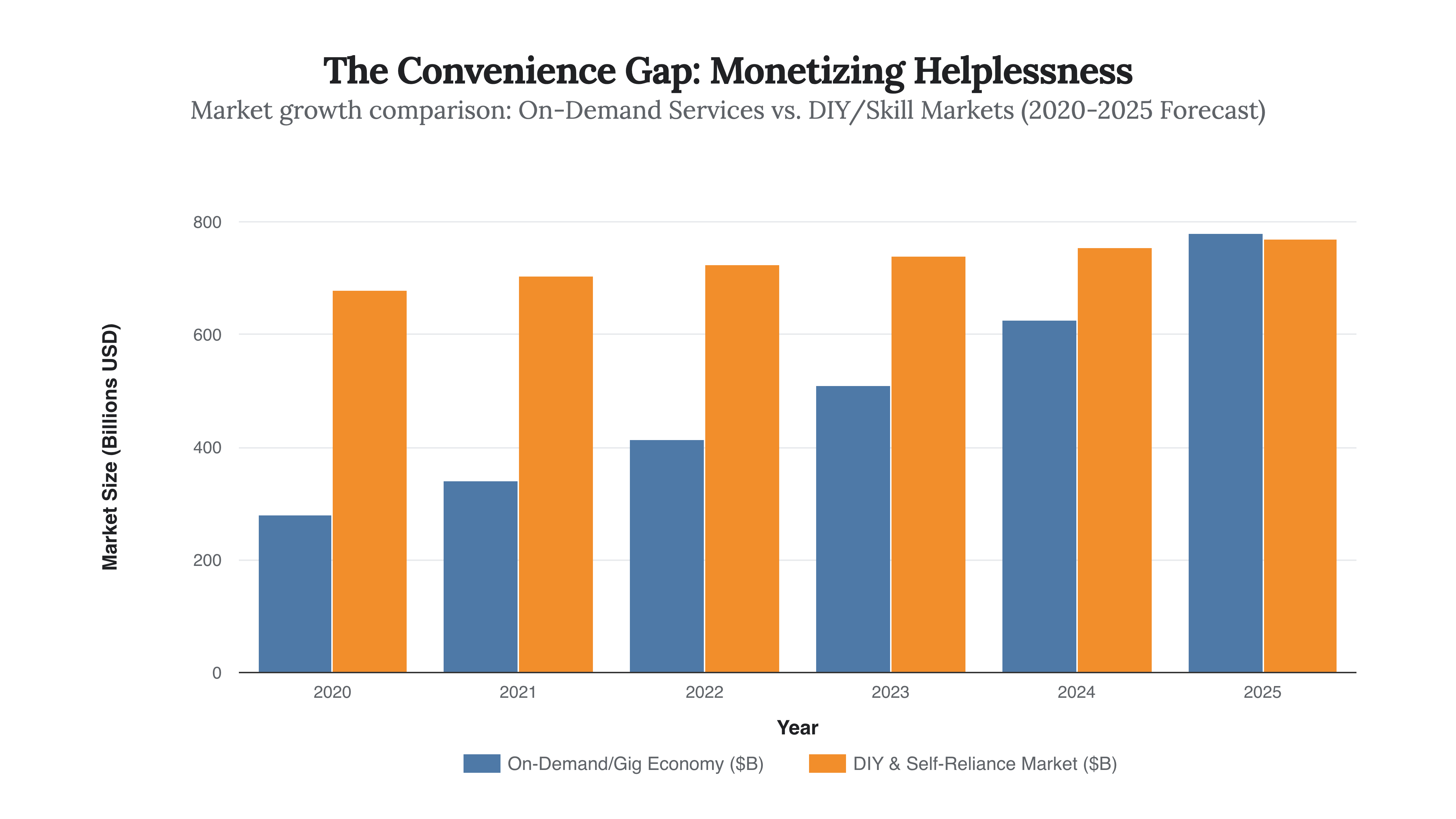
As the chart illustrates, the “Convenience Economy” is on a trajectory to eclipse the self-reliance market. We are literally buying our own atrophy. The result is a workforce that is highly efficient at consumption but increasingly fragile in production. When difficulty arises—as it always does in business and geopolitics—the “Last Man” has no reserve of will to draw upon.
The $8.9 Trillion Cost of the Tired Soul
So, what is the cost of this Nietzschean nightmare? It is not theoretical. The 2024 State of the Global Workplace report estimates the cost of disengaged employees at $8.9 trillion. This is the price tag of low agency. When employees lack the “Will to Power”—the drive to overcome resistance and impose their vision on the world—they retreat into “Quiet Quitting,” which is simply the modern corporate term for the Last Man’s apathy.
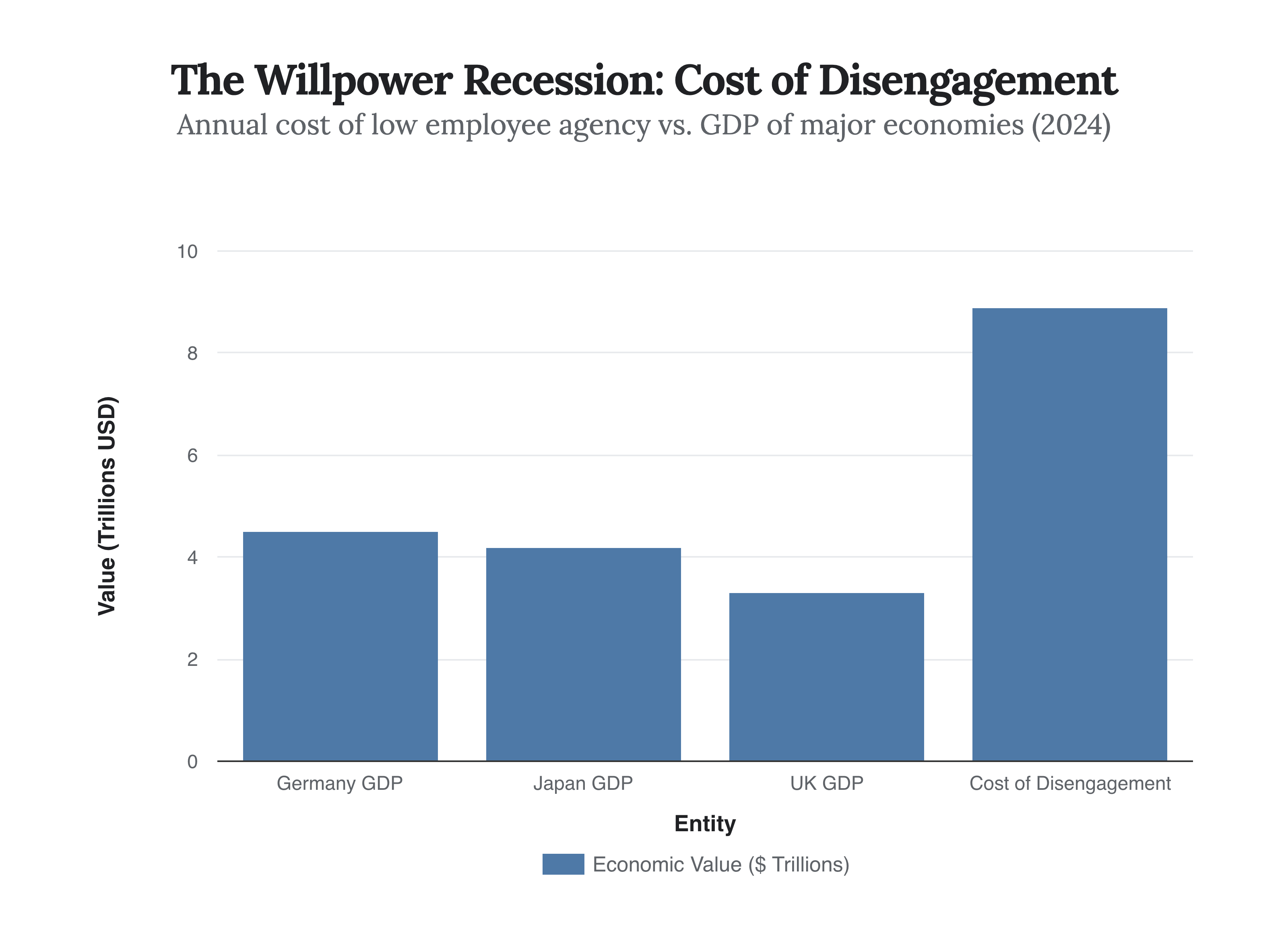
This is the “blind spot” in modern strategy. We invest billions in AI and automation to increase efficiency, but we are losing trillions to the psychological collapse of the human operator. A workforce of “Last Men” cannot innovate, because innovation requires the courage to be wrong, to struggle, and to stand apart from the herd.
Algorithmic Fatigue: The Executive Crisis
Even at the executive level, the “Tired Soul” is manifesting as “Algorithmic Fatigue.” The assumption that more data leads to better decisions has proven false. Instead, the deluge of algorithmic insights has created a state of persistent cognitive load, leading executives to outsource critical judgment to the machine.
“We are social animals who tend to value the security and acceptance of their communities more than they might value their own autonomy. Add AI to the mix and the result is a dangerous feedback loop... AI robs people of the opportunity to practice the process of making thoughtful and defensible decisions on their own.” — Dr. Joe Arvai, Psychologist, University of Southern California
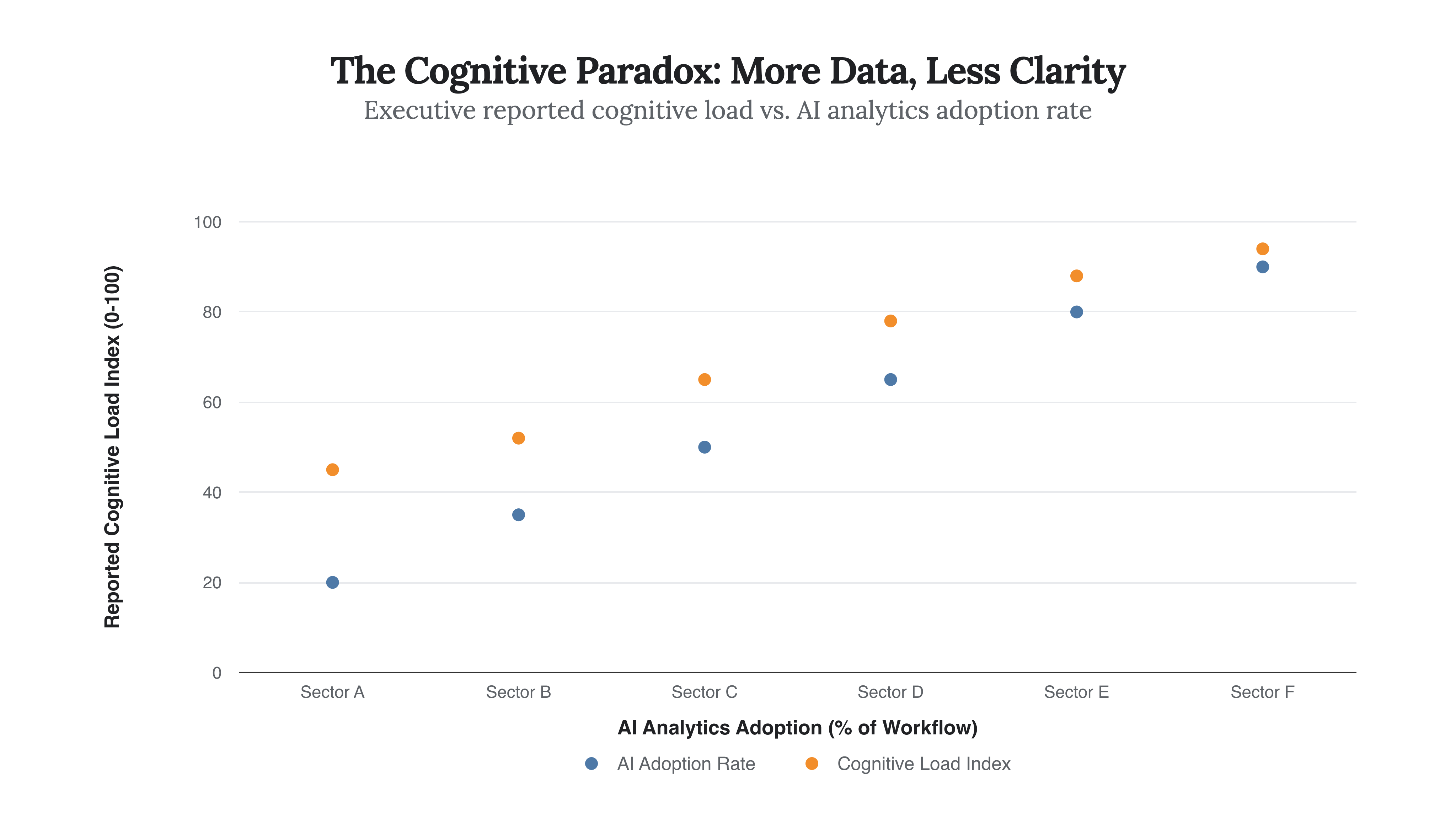
The scatter plot reveals a disturbing correlation: as we adopt more tools to “simplify” decision-making, the cognitive burden actually increases, leading to burnout. The machine offers answers, but it cannot offer meaning. The executive is left with the fatigue of processing, without the satisfaction of creating.
Strategic Foresight: Reclaiming the Will
The trajectory is clear. The modern world, driven by the Frictionless Economy, is producing a surplus of “Last Men”—risk-averse, physically diminished, and psychologically dependent on external validation and algorithmic guidance. This presents a massive strategic risk for nations and corporations, but an asymmetric opportunity for the few who resist.
We are entering a period of “Willpower Asymmetry.” The future belongs to the “Friction-Creators”—those who deliberately reintroduce struggle, risk, and agency into their organizations and lives. The winners of the next decade will not be the most efficient; they will be the most resilient.
The single most critical strategic imperative is to reject the seduction of the frictionless life and deliberately cultivate resistance; only in the friction of the ‘Will to Power’ can we escape the apathy of the Last Man.
Around 80–90 percent of society has always been passive — seeking security, waiting for the elites to tell them what to do, and then complaining or resenting the fact that their lives feel unsatisfying.
No living organism can survive without friction and resistance.