



We have long treated Plato’s Allegory of the Cave as a warning—a philosophical cautionary tale about prisoners mistaking shadows on a wall for reality. For centuries, it served as a metaphor for ignorance versus enlightenment. But in 2025, the metaphor has collapsed. We are no longer prisoners forced into the cave; we are voluntary architects of it. And for the first time in human history, the economic and temporal value of the ‘shadows’ has begun to eclipse the value of the physical world that casts them.
This is not a treatise on ‘screen time addiction’ or a rehash of the Social Dilemma. This is a hard-nosed strategic look at an Ontological Flip. We have reached a statistical tipping point where the ‘Simulation’—defined here as screen-mediated existence—commands more capital, more hours, and more cognitive trust than Base Reality. The prisoners aren’t just watching the wall; they are buying the wall, betting on the shadows, and actively paying to avoid the exit.
The Chronological Cave: The 60% Threshold
The most immediate proof of the Cave’s materialization is chronological. For the emerging dominant economic cohort (Gen Z and the leading edge of Alpha), the ‘digital overlay’ is no longer a distraction from life; it is life. Recent data indicates that the average member of this cohort now spends upwards of 9 hours per day engaged with screens. When adjusted for a standard 8-hour sleep cycle, this results in a startling reality: approximately 56-60% of their waking existence is processed through a digital lens.
Projected over an 80-year lifespan, this equates to roughly 44 years spent staring at a backlit surface. The ‘Real World’ has been relegated to a second-screen experience, a logistical layer that merely supports the primary digital existence.
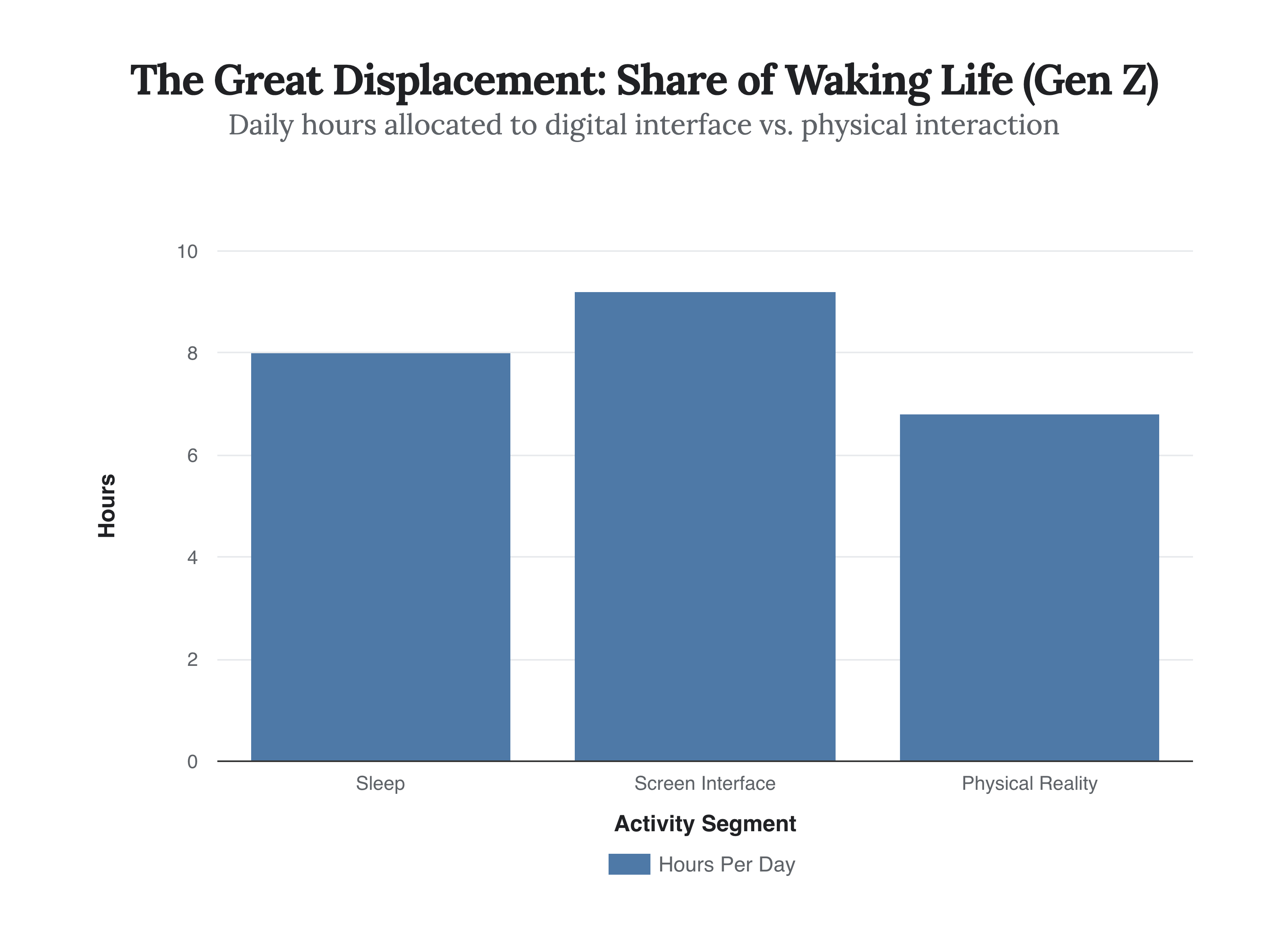
This 60% threshold is critical because it represents the point of no return for attention economics. When the majority of waking attention is captured by the interface, the interface becomes the primary marketplace. Physical reality becomes a ‘cost center’—inconvenient, uncurated, and low-resolution—while the digital environment becomes the ‘profit center’ of human experience.
The Valuation of Shadows: Why Virtual Skins Outpace Real Luxury
For investors, the signal is flashing red in the valuation of ‘fake’ goods. While the traditional Personal Luxury Goods market (handbags, watches, fashion) is struggling with a forecasted growth rate of just 2-4% for 2024-2025, the Virtual Goods Market—comprising skins, in-game assets, and digital fashion—is exploding at a CAGR of roughly 20%, with some projections placing it near $80 billion in 2024 and racing toward $300 billion by the early 2030s.
Why? Because in a world where you spend 60% of your time in the Cave, a digital shirt seen by thousands of avatars is objectively more ‘valuable’ than a cotton shirt seen by ten coworkers. The shadow has become the asset.
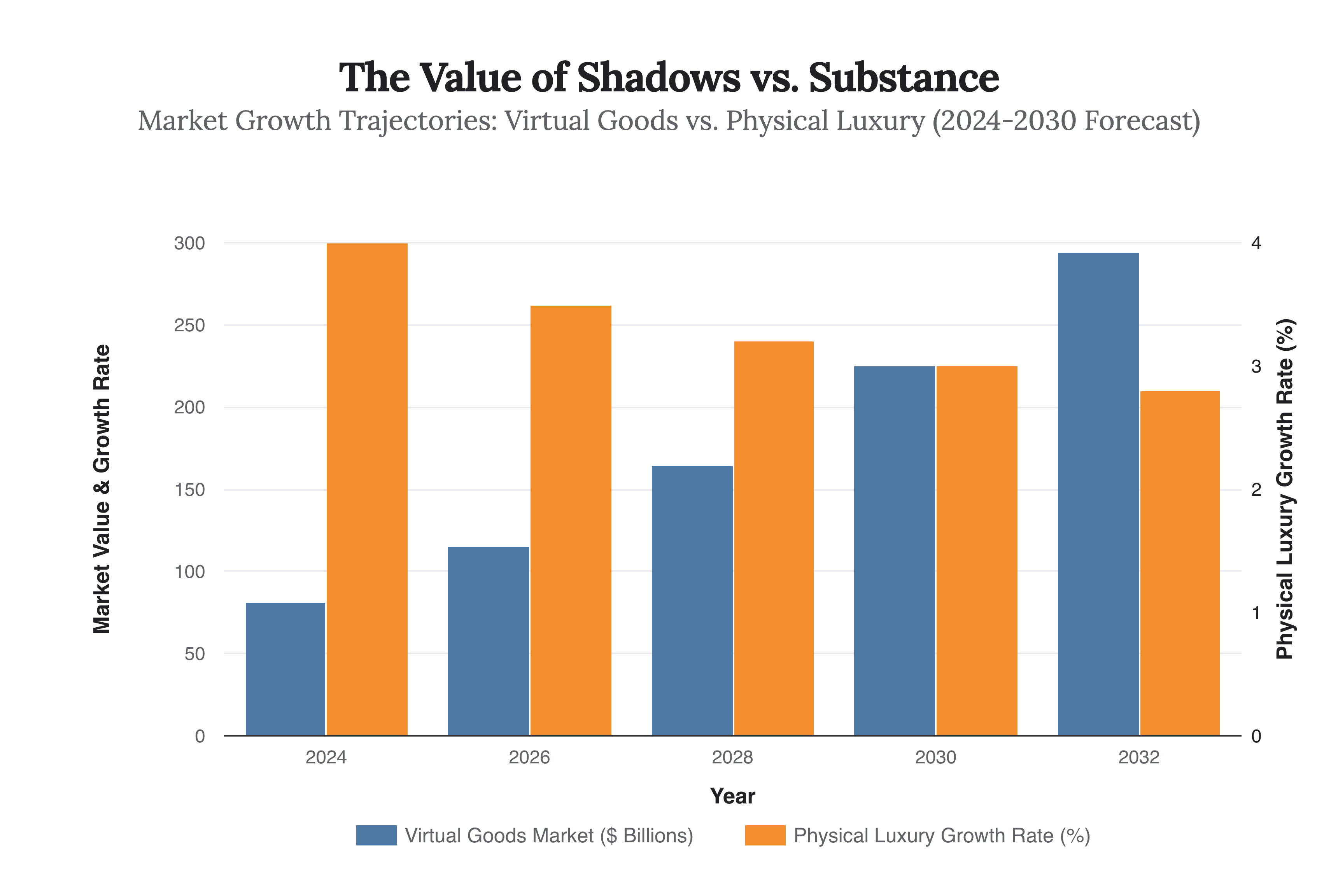
This divergence explains the frantic pivot of legacy luxury brands into the metaverse and gaming. They realize that for the next generation of consumers, a product that cannot be displayed in the Cave essentially does not exist. We are witnessing the financialization of the allegory: the prisoners are bidding up the price of the shadows, while the objects casting them depreciate.
The Algorithmic Puppeteers: The Death of Serendipity
Plato’s prisoners saw shadows cast by puppeteers behind a fire. In our version, the puppeteers are algorithms, and the fire is Generative AI. The most disturbing statistic to emerge from recent network analysis is the composition of internet traffic. In 2024, nearly 50% of all internet traffic is non-human (bots, scrapers, and AI agents). Furthermore, on platforms like TikTok, the ‘For You’ feed—an algorithmically curated reality—accounts for the vast majority of consumption time compared to content from users actually followed.
This creates a ‘Hermetically Sealed Cave.’ The prisoner no longer sees a reflection of the outside world; they see a reflection of their own engagement history, magnified and distorted by an AI maximizing for retention. The reality they perceive is not just a shadow; it is a personalized shadow, designed specifically to prevent them from turning their head.
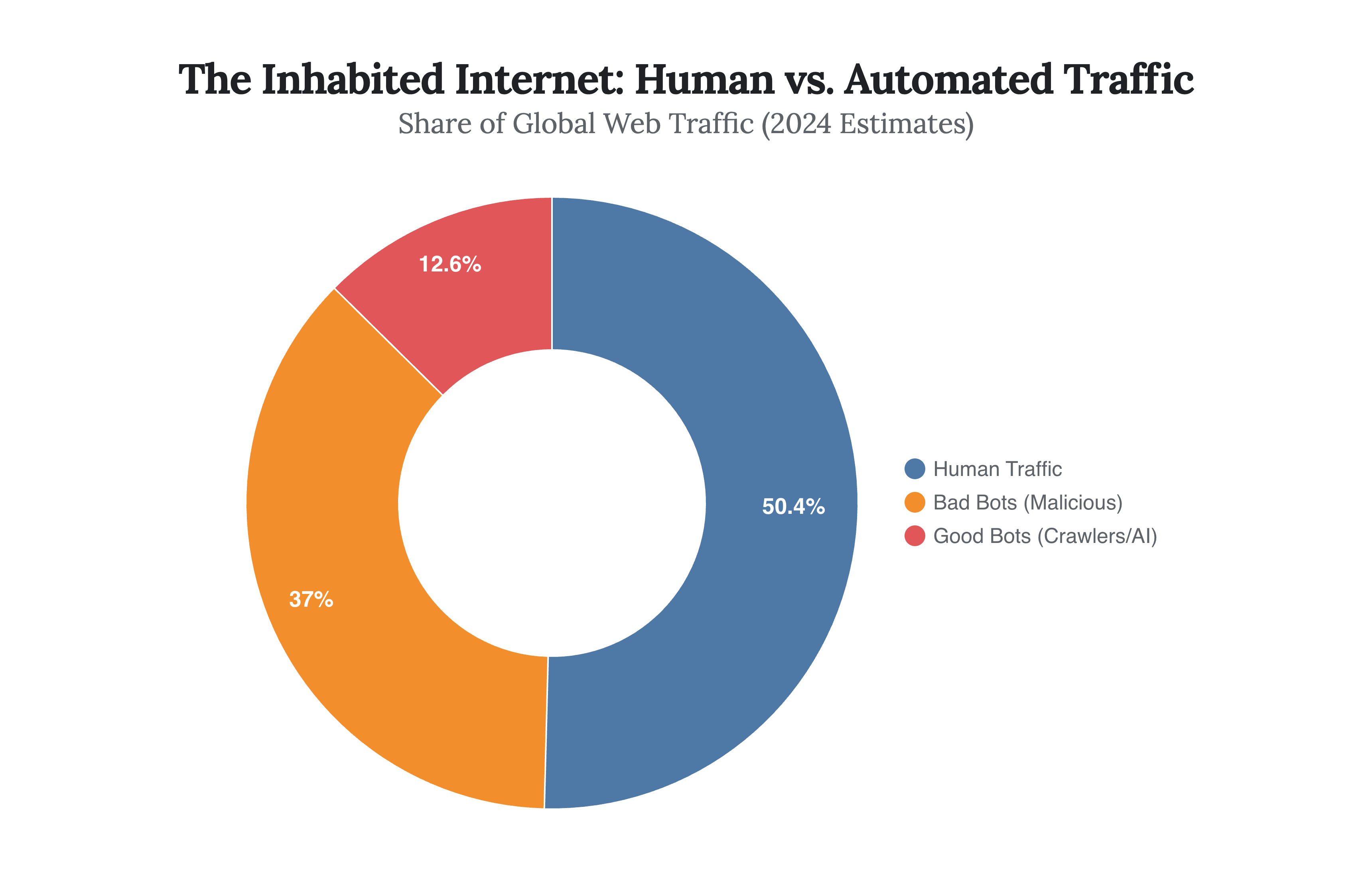
This automated curation creates what strategists call ‘Epistemic Closure.’ If 50% of the traffic and 90% of the content recommendations are machine-generated, the human user is no longer exploring a network; they are inhabiting a
