


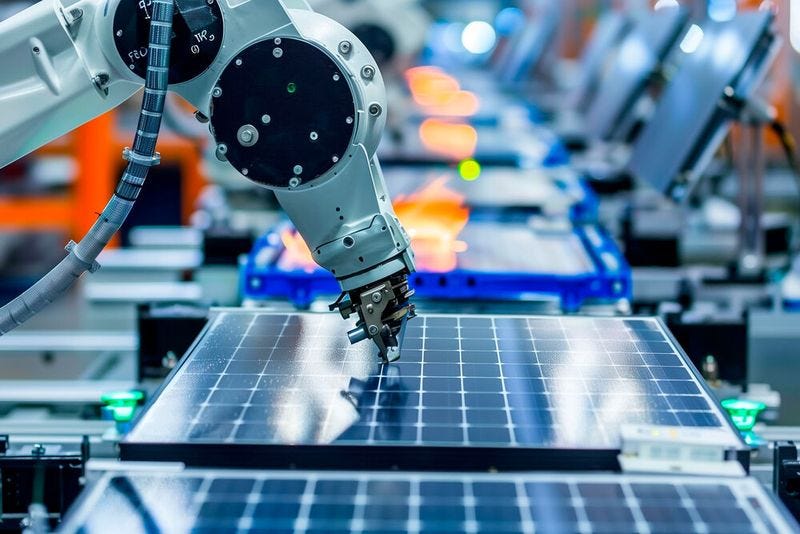
In 2024, global corporate investment in artificial intelligence and optimization technologies hit a staggering $252.3 billion. The promise was explicit: a friction-free future where algorithms handle the drudgery, leaving humans free to innovate. Yet, the data tells a radically different story. Instead of liberating us, this relentless drive for efficiency has birthed a new, invisible tax on human potential. We are not improving life; we are merely increasing the velocity of its administrative burden.
We have entered the era of “The Cult of Optimization.” It is a belief system that treats every second of latency—whether in a supply chain, a software deployment, or a human night’s sleep—as a defect to be eliminated. But as we scrape away the buffers that allow for rest, thought, and resilience, we are discovering that friction was never the enemy. It was the structural integrity holding the system together.
This briefing analyzes the hidden costs of this regime: from the 58% of work hours lost to the tools designed to save them, to the biological backlash of “quantified self” markets, to the stalling engine of genuine innovation.
The Macro Mirage: The $252 Billion Disconnect
The central dogma of the modern economy is that capital investment in technology equals productivity growth. For decades, this held true. But in the mid-2020s, this correlation has broken. We are witnessing a “Great Decoupling” between the capital poured into optimization tools and the actual output of the labor force.
While private investment in generative AI surged 44.5% year-over-year in 2024, labor productivity across OECD nations crawled at a near-stagnant 0.6%. The chart below illustrates this widening jaw: a massive injection of capital resulting in a flatline of realized value. The system is consuming energy not to produce more, but simply to maintain its increased speed.
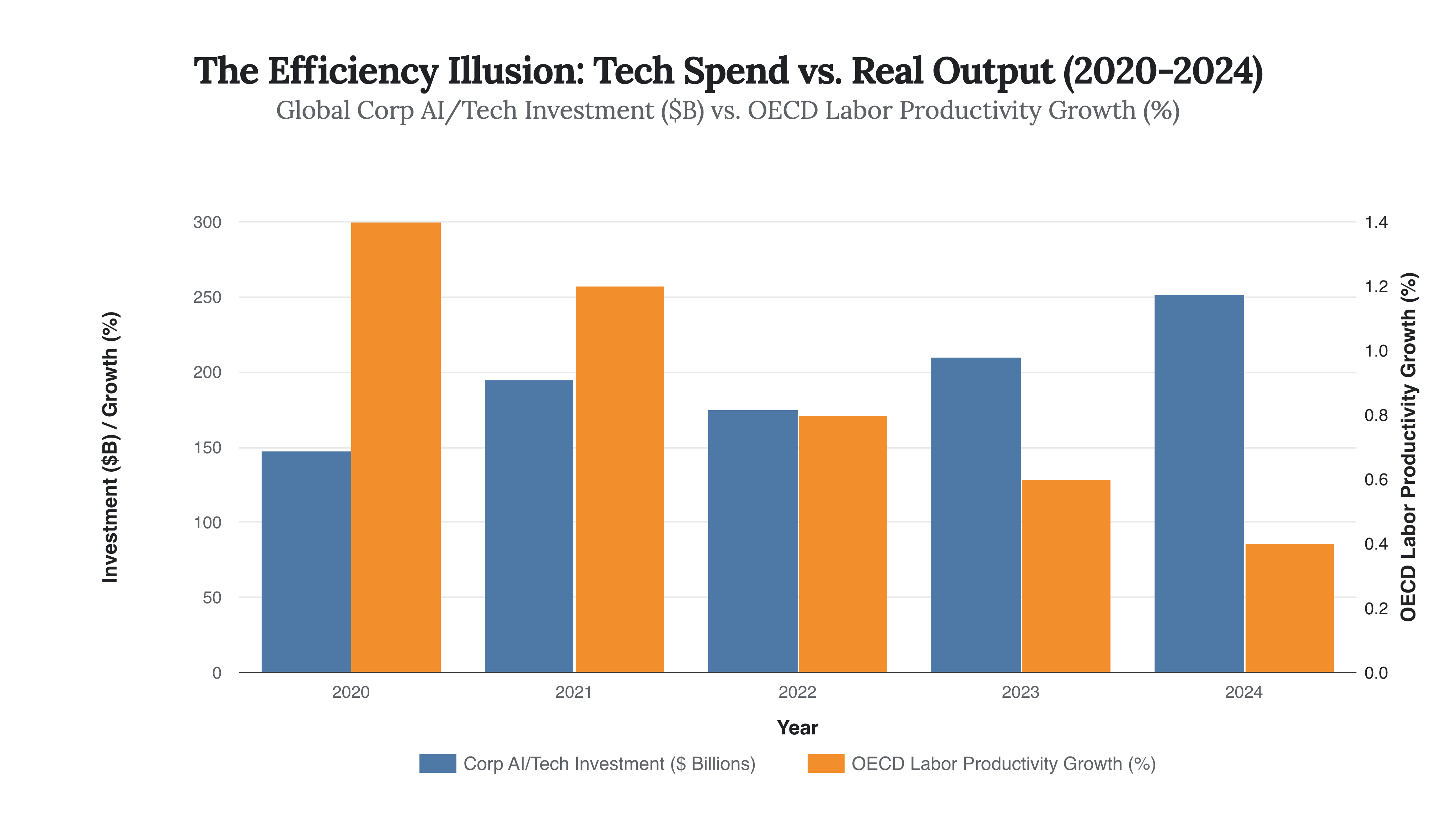
This data suggests that the marginal utility of our optimization tools has turned negative. We have reached a point where the effort required to manage our efficiency tools exceeds the time they save. This is the Optimization Tax.
The 58% Friction Trap: Work About Work
If we aren’t producing more, what are we doing? The answer lies in the “meta-work” layer. Asana’s 2024 Anatomy of Work index reveals a startling statistic: knowledge workers now spend approximately 58% of their day on “work about work”—coordinating, status checking, and managing the software that manages the work.
This is the Friction Trap. In our attempt to optimize communication and tracking, we have atomized attention. The tools designed to streamline collaboration have instead created a fragmented landscape where the act of talking about doing the work has replaced the work itself. Only 27% of time is spent on the skilled craft the employee was hired to perform.
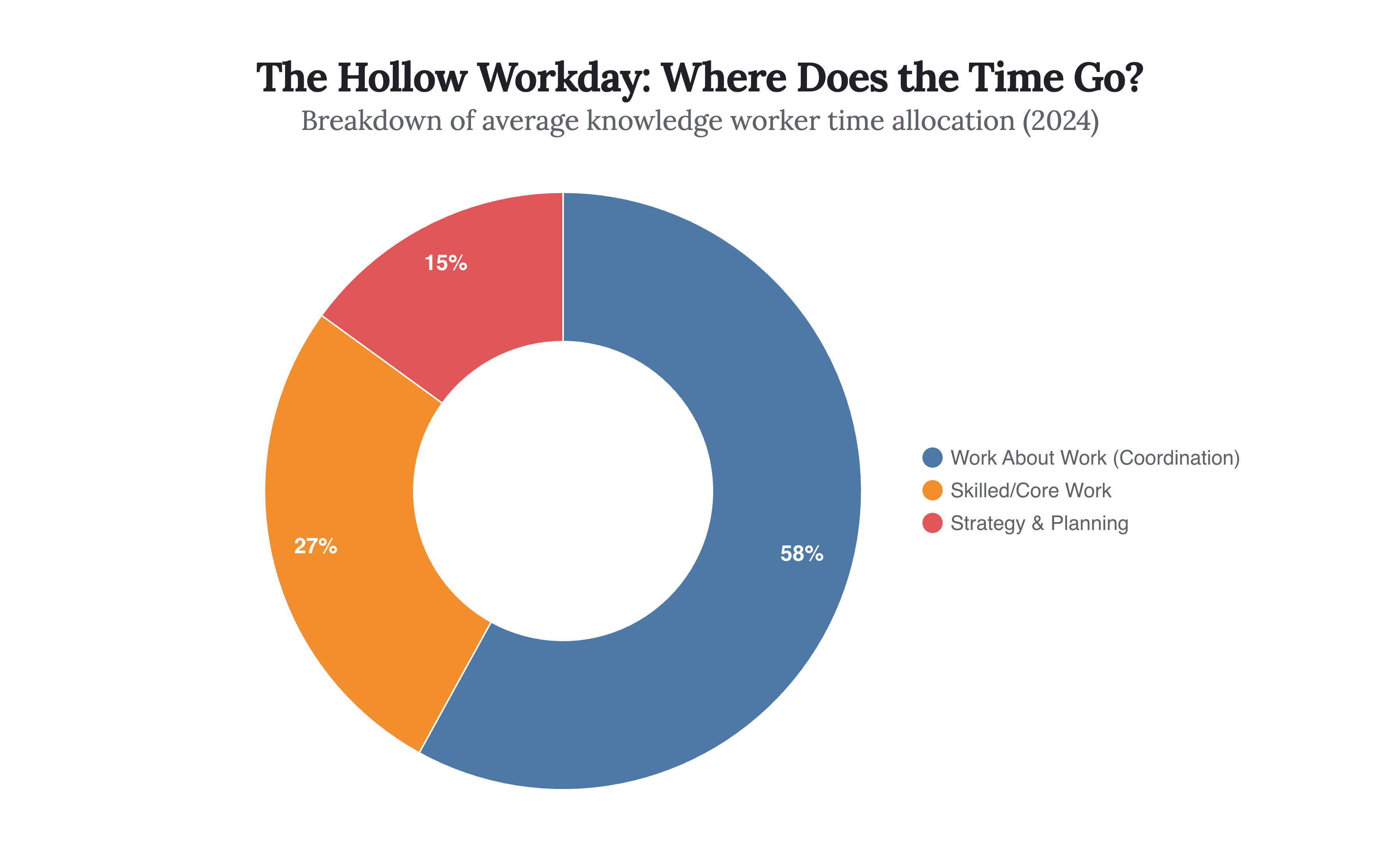
This 58% figure represents a massive arbitrage opportunity for competitors who dare to be “inefficient”—those who reduce coordination overhead by accepting slower, but deeper, workflows. The companies winning in the next decade will be those that dismantle this administrative layer, not those that automate it.
The Biological Limit: The Cost of 1,200 Switches
The human brain is not a parallel processor; it is a serial processor with a switching cost. The “Cult of Optimization” ignores this biological reality. The average knowledge worker now toggles between applications over 1,200 times per day. This is not multitasking; it is micro-fracturing.
Research indicates that it takes approximately 23 minutes to fully regain deep focus after a significant interruption. Yet, in the optimized workplace, the average time between interruptions has collapsed. We are creating a workforce that is permanently in the “ramp-up” phase of cognition, never reaching peak mental velocity. The cost is not just lost time; it is a measurable decline in cognitive capacity and a spike in error rates.
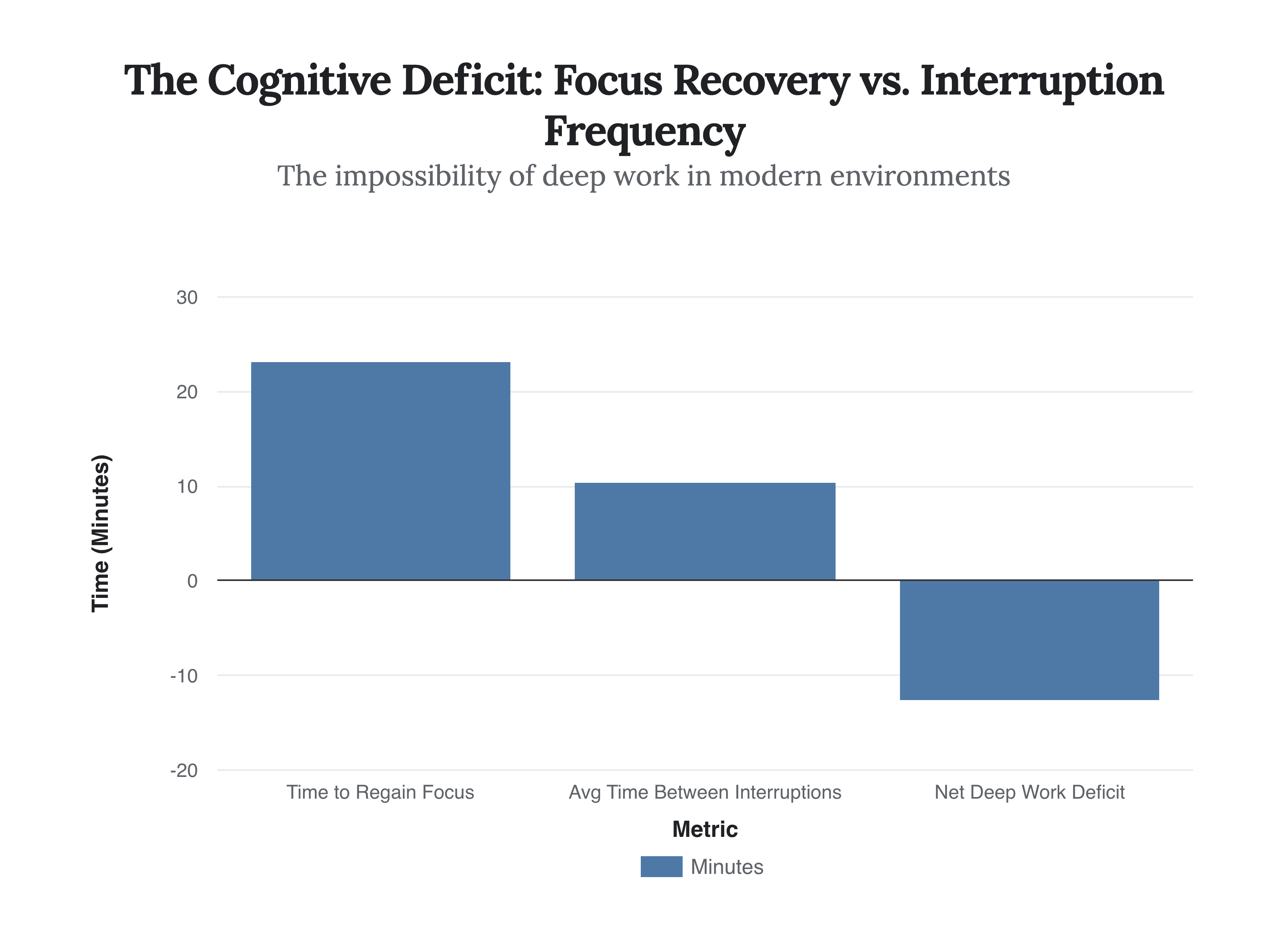
The gap between the 23-minute recovery time and the 10-minute interruption interval creates a “Deep Work Deficit” that no amount of caffeine or nootropics can bridge. This deficit is the primary driver of the burnout epidemic, which saw 82% of white-collar workers reporting exhaustion in 2024.
The Monetization of Biological Optimization
Rather than fixing the environment, the market has responded by trying to optimize the human to fit the machine. The “Biohacking” and sleep technology market is projected to surge from $24.5 billion in 2024 to nearly $111 billion by 2034. We are now paying to optimize the very biological functions—sleep, recovery, focus—that the work environment is destroying.
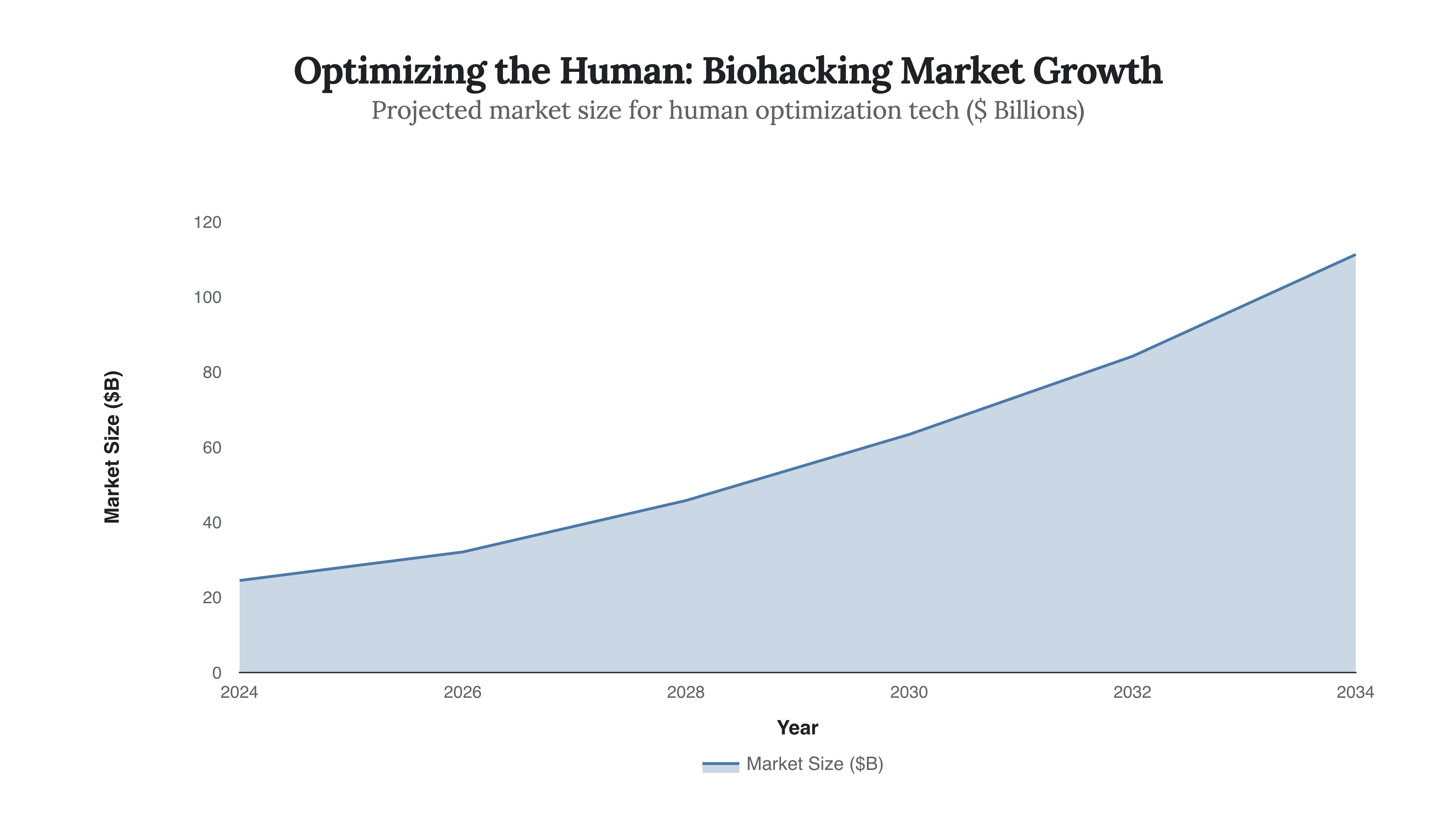
This is the ultimate irony of the Cult of Optimization: we create a system that breaks human biology, then create a secondary market to patch it up, counting both as GDP growth.
The Innovation Plateau: Eroom’s Law
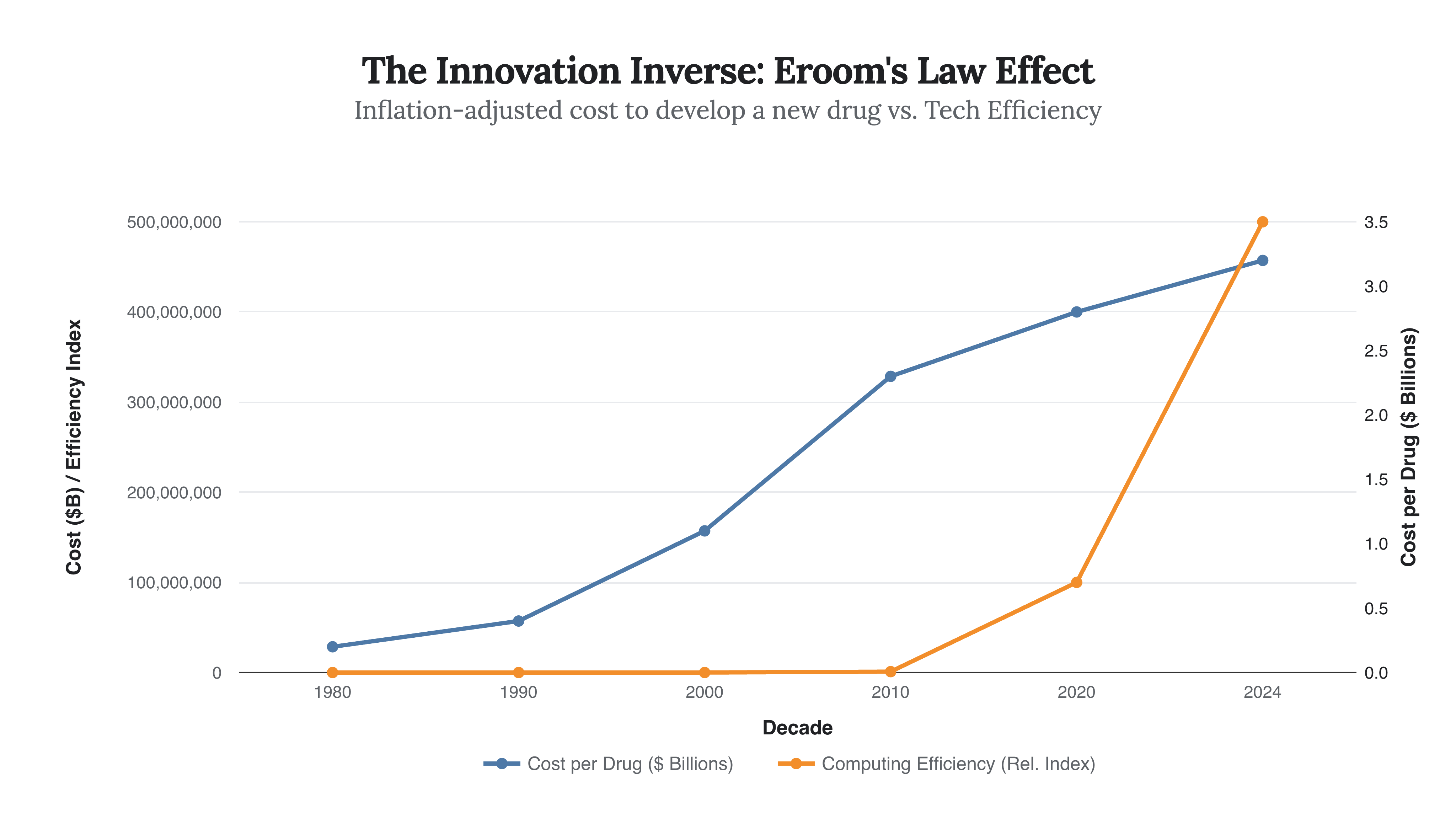
If optimization improves life, we should see it in our most critical sectors, such as pharmaceutical R&D. Instead, we see the opposite: Eroom’s Law (Moore’s Law backwards). Despite massive improvements in computational screening, AI, and process optimization, the cost of discovering a new drug roughly doubles every nine years.
This trend proves that efficiency in the process does not guarantee efficiency in the outcome. In fact, the hyper-optimization of research—focusing on “safe” bets, metric-driven milestones, and quarterly ROI—may be actively killing the serendipitous, inefficient exploration required for true breakthroughs.
Strategic Foresight: The Return of Slack
The data points to a critical strategic pivot. The winners of the next cycle will not be the “Fastest” or the most “Optimized,” but the most Resilient. The cult of optimization has created a fragile global system—”Just-in-Time” everything means we are one disruption away from “Nothing-at-All.”
Predictions for 2025-2030:
The Rise of “Slow-Stack” Companies: Organizations will emerge that explicitly market their inefficiency—their refusal to use automated support, their commitment to deep work blocks—as a premium value proposition.
The Context-Switching Tax: Enterprise software pricing will begin to factor in “cognitive load.” Tools that demonstrate a reduction in toggling will command a premium over those that merely offer more features.
Regulatory “Right to Disconnect”: Following trends in Europe, we will see a global push for legislation that views after-hours digital notifications as a form of uncompensated labor and health hazard.
Concluding Insight
We have confused motion with progress. By optimizing every second, we have lost the hours. The path forward requires a deliberate reintroduction of friction—buffer times, unmeasured hours, and inefficient wanderings—where the actual value of human life and innovation resides. We must stop trying to speed up the machine and start questioning where it is taking us.
The single most important takeaway is that efficiency without “slack” is not optimization; it is a fragility trap that turns minor disruptions into systemic failures.
“We are drowning in information, while starving for wisdom. The world henceforth will be run by synthesizers, people able to put together the right information at the right time.” — E.O. Wilson