



The most valuable commodity in the modern economy is no longer oil, data, or even attention. It is apathy.
For the last decade, the prevailing logic of Silicon Valley and global supply chains has been the ruthless elimination of friction. We optimized for the “one-click” buy, the same-day delivery, and the algorithmic feed that populates before you even articulate a query. But as we enter late 2025, a startling realization is dawning on strategists and behavioral economists alike: convenience has mutated from a service feature into a governance structure. It is no longer about satisfying desire; it is about preempting it.
The latest intelligence is unambiguous. The “Click to Cancel” regulatory backlash in the US and EU is not merely a consumer protection skirmish; it is the first shot in a war against Weaponized Inconvenience. We are witnessing the industrial-scale monetization of human inertia. With the global subscription economy hurtling toward $1.5 trillion and nearly 40% of e-commerce revenue now derived from “unplanned” impulse decisions, the strategic landscape has shifted. We have moved from an economy of active choice to an economy of passive acceptance.
This briefing deconstructs the “Quiet Tyranny of Convenience.” We will analyze how the removal of friction has rewired the dopamine loops of consumption, created a trillion-dollar blind spot in corporate optimization, and why “friction” itself is destined to become the ultimate luxury good of the next decade.
The Economics of Autopilot: Monetizing the Path of Least Resistance
To understand the magnitude of this shift, we must look at the “Impulse Pivot.” Historically, consumption was a function of intent. A consumer identified a need, searched for a solution, and transacted. Today, that linear journey has been collapsed into a singularity. Algorithms do not wait for intent; they predict it and present the solution before the problem is fully formed in the consumer’s mind.
Recent data from 2024 and 2025 indicates a massive structural shift in how value is captured. We are seeing the rise of the “Zero-Friction” premium, where the primary driver of revenue is not product superiority, but the sheer speed of dopamine delivery.
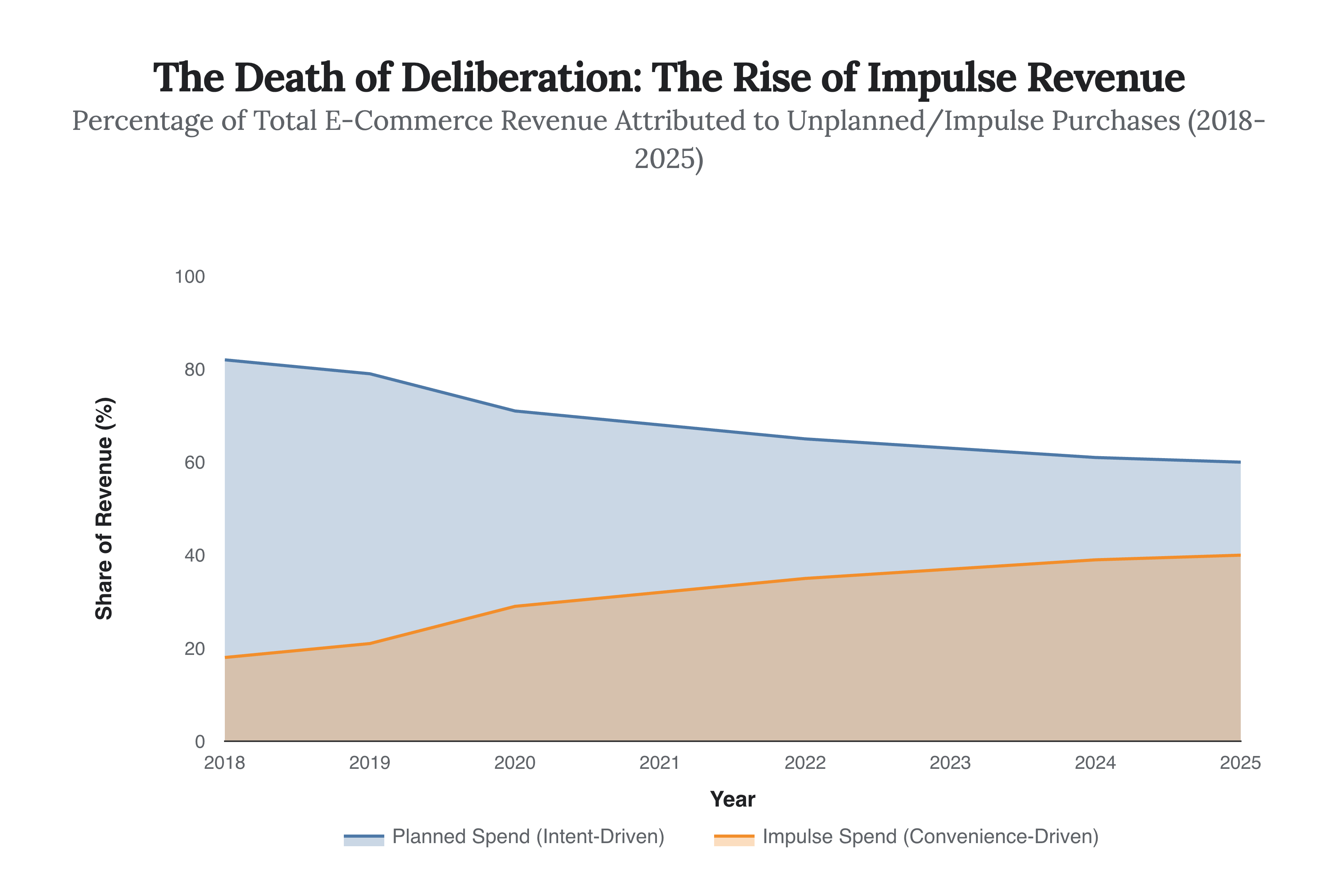
The chart above reveals a staggering reality: 40% of online revenue is now effectively accidental. It is the result of “Buy Now” buttons, social commerce integration, and predictive logistics removing the milliseconds of pause required for second-guessing. For investors and operators, this signals a dangerous fragility. Revenue built on impulse is revenue built on a lack of self-control, not brand loyalty. It is a mile wide and an inch deep.
The Subscription Black Hole
Nowhere is the tyranny of convenience more evident than in the subscription economy. The business model has shifted from “winning the customer every day” to “winning the customer once and banking on their forgetfulness.” This is the Inertia Tax.
Our analysis of consumer financial data exposes a massive gap between
