


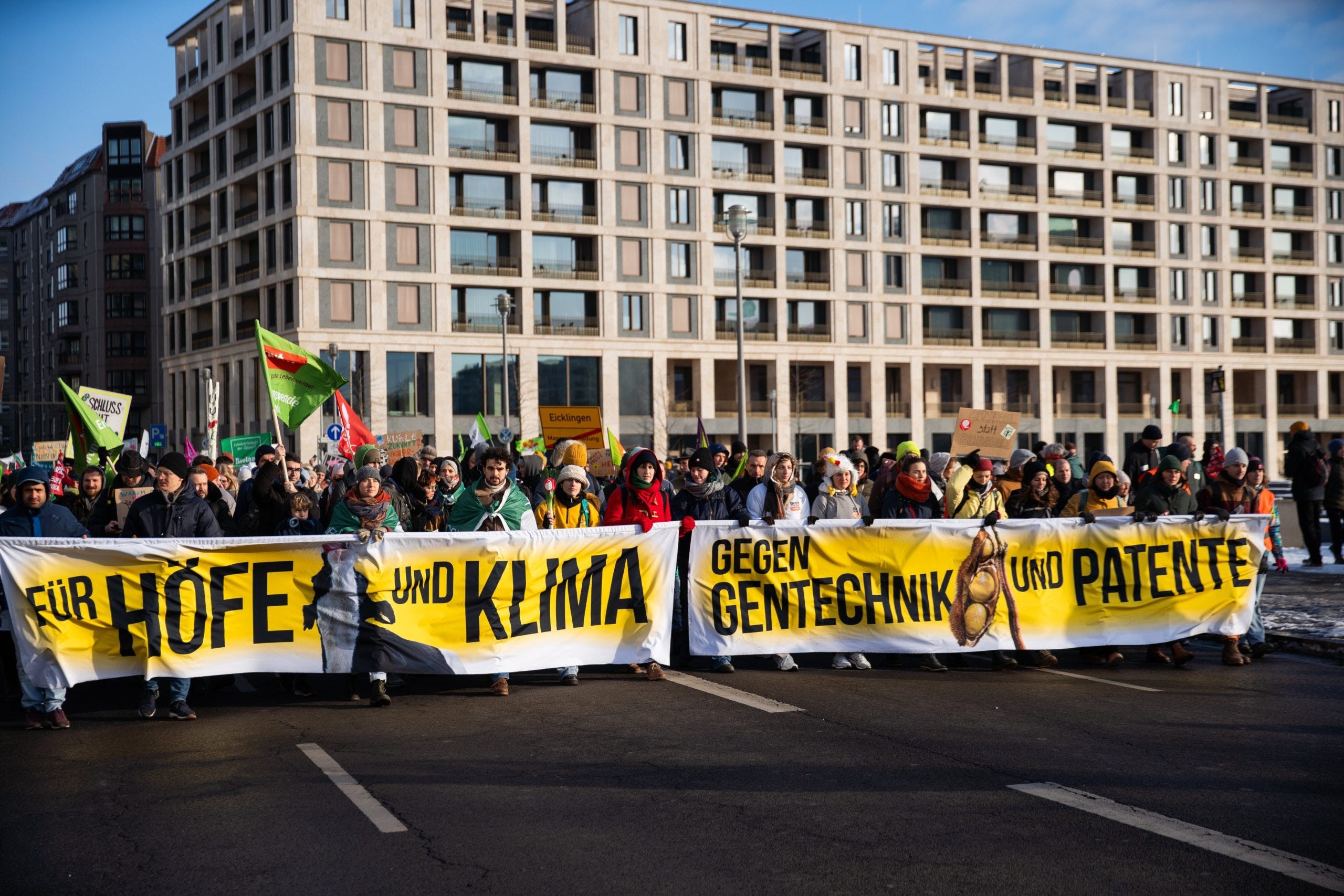
On Thursday, December 18, the European Quarter of Brussels did not smell of waffles or chocolate. It smelled of burning rubber, manure, and tear gas. In what police described as a “turbulent” siege, nearly 1,000 tractors gridlocked the capital, ripping up street signs and setting fires in Place du Luxembourg. While the images of black smoke billowing against the glass facades of EU institutions made global headlines, the true story of this revolt isn’t about traffic jams. It is about a single, terrifying number that has pushed Europe’s agricultural sector to the brink.
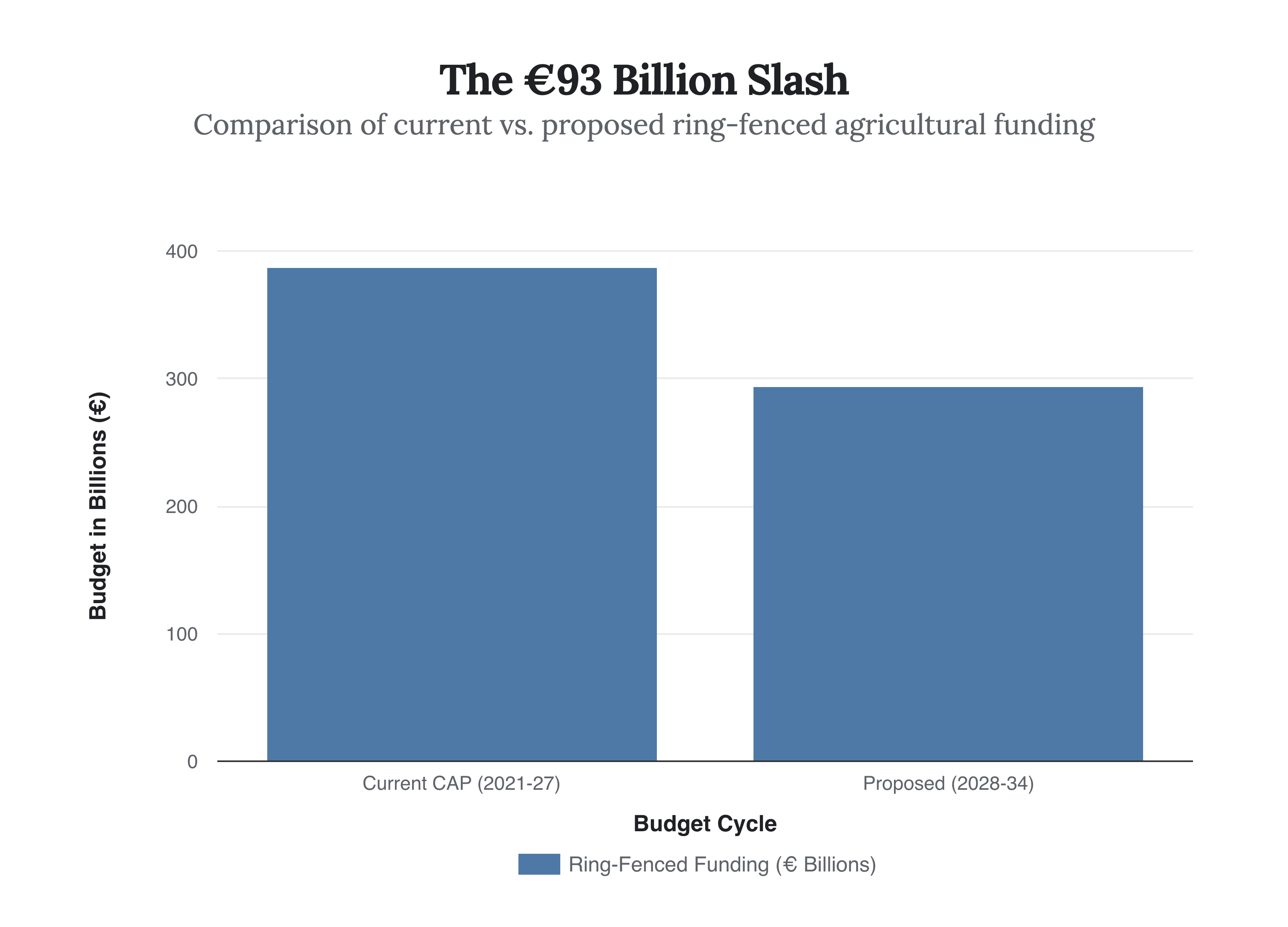
Beneath the fury over the EU-Mercosur trade deal lies a deeper, existential threat: a proposal to slash the Common Agricultural Policy (CAP) budget by roughly €93 billion in the next financial cycle. For the 10,000 farmers who descended on Brussels from as far as Poland and Spain, this isn’t just a protest; it is a last stand against a policy shift they claim will wipe out the continent’s small producers.
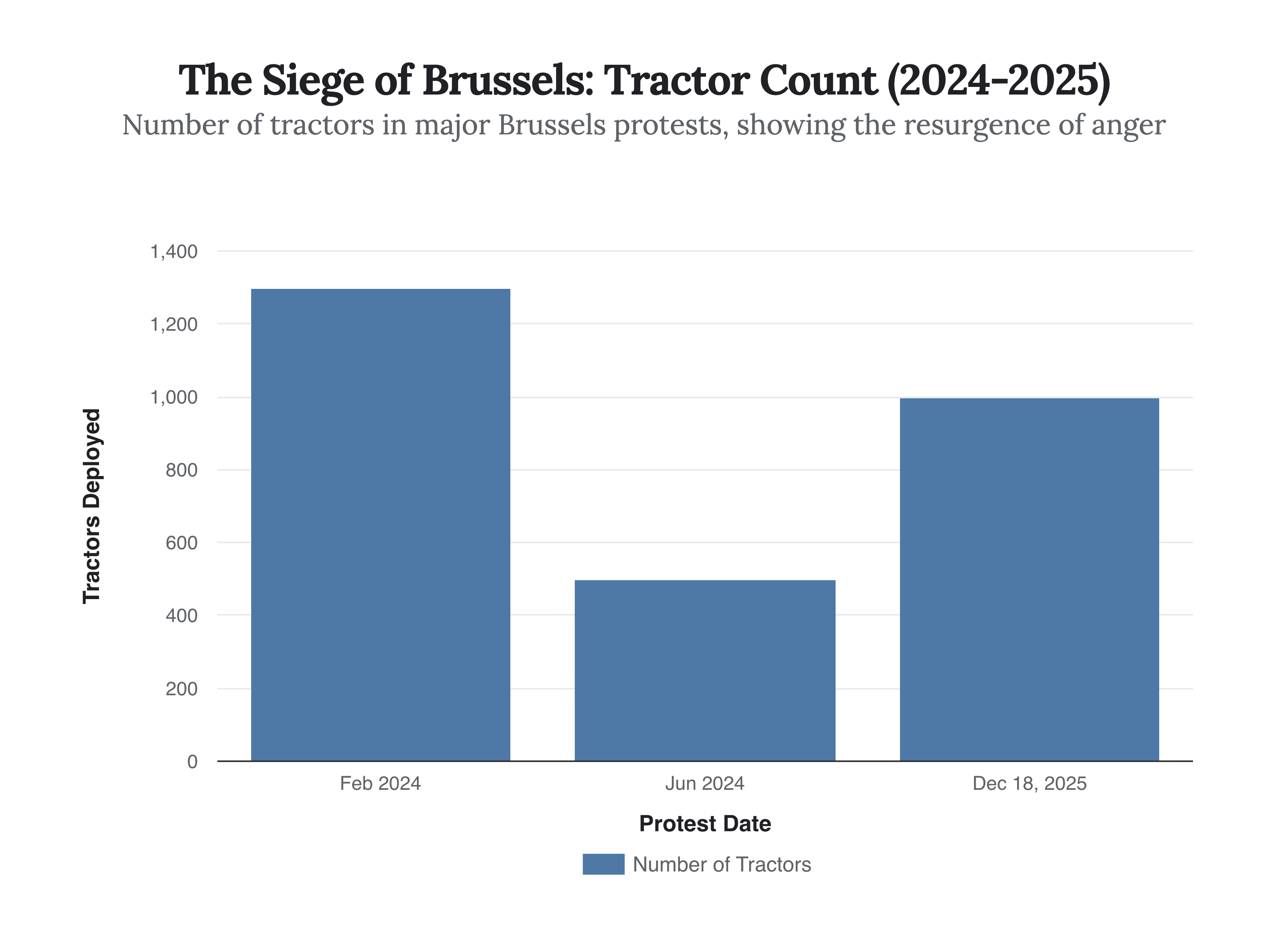
The intensity of the farmer movements has oscillated throughout the last two years, but the turnout on December 18 marked a significant resurgence. After a quieter summer, the mobilization of 1,000 heavy machines signals that the concessions won in early 2024—such as the withdrawal of certain pesticide laws—were seen as insufficient plasters on a gaping wound.
The Double Punch: Trade Deals and Budget Cuts
The immediate trigger for last week’s chaos was the looming EU-Mercosur trade agreement. The deal, which aims to create a free-trade zone between Europe and South American nations including Brazil and Argentina, has been in negotiation for twenty-five years. Farmers fear it will open the floodgates to cheap imports that do not meet Europe’s strict environmental standards.
The numbers explain their fear. The agreement would grant a low-tariff quota for 99,000 tonnes of beef and a duty-free quota for 180,000 tonnes of poultry. While the European Commission argues this represents a fraction of total EU production, for a sector already operating on razor-thin margins, it feels like a death sentence. The pressure worked, at least temporarily: the signing of the deal, expected this past weekend, has been postponed to January.
“We will not die in silence. The dictatorship starts here.” — Sign displayed by a protester in Place du Luxembourg
However, the trade deal is only half the story. The “silent killer” driving the tractors is the European Commission’s proposal for the 2028-2034 Multiannual Financial Framework. The plan suggests merging the CAP into a broader fund and cutting the ring-fenced support for farmers from its current €387 billion to approximately €294 billion. This represents a nominal decrease of roughly 24%, a figure that would be even more devastating when adjusted for inflation.
This proposed cut strikes at the heart of the EU’s farming stability. Direct payments have historically been the lifeline that keeps smaller operations afloat during volatile market cycles. By threatening to erode this safety net, the EU is inadvertently accelerating a trend that has already reshaped the countryside: the industrialization of agriculture.
Go Big or Go Bust
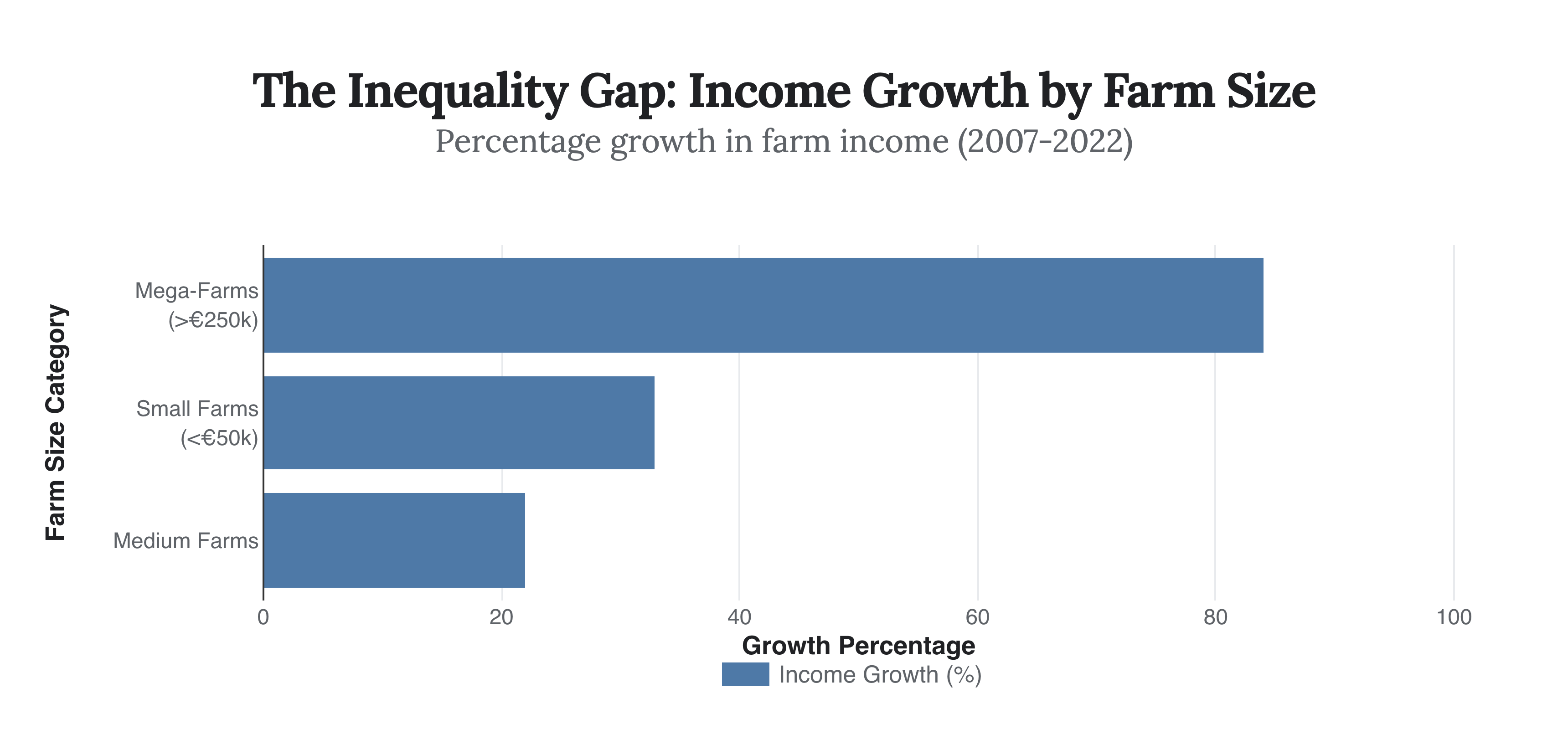
The anger in Brussels is also fueled by a widening inequality gap. While the agricultural sector as a whole has faced rising costs, the pain is not shared equally. Data reveals a stark divergence in the fortunes of mega-farms versus small family holdings. Between 2007 and 2022, income for the largest “mega-farms” (those with over €250,000 in output) surged by 84%, while small-scale farms saw much more modest gains, often failing to keep pace with inflation.
The result of this economic Darwinism is the rapid disappearance of the small European farm. In the last decade alone, the number of farms smaller than 30 hectares has plummeted by a quarter. The protesters in Brussels argue that the combination of the Mercosur deal and the new budget cuts will finalize this extinction, leaving Europe’s food security in the hands of a few industrial giants and foreign importers.
“They can produce meat, milk and sugar much more cheaply than we can, under far less strict rules. Our health could be endangered... It is a big problem.” — Sabina Vandeweyer, Belgian dairy farmer
As the smoke clears over Brussels, the standoff remains unresolved. The postponement of the Mercosur signing is a temporary victory for the farmers, but the budgetary battle for 2028-2034 is just beginning. The siege of December 18 proved that Europe’s farmers still possess the power to paralyze capitals. The question for 2026 is whether Brussels will listen to the message behind the mayhem, or if this winter of discontent is merely the prelude to a longer, hotter spring.
The “stark divergence of the mega vs the small” seems to portray the Future Realism coming in multiple areas. The question of how to preserve the small farmers from the “Economic Darwinism” of the industrial giants will be interesting to watch.