

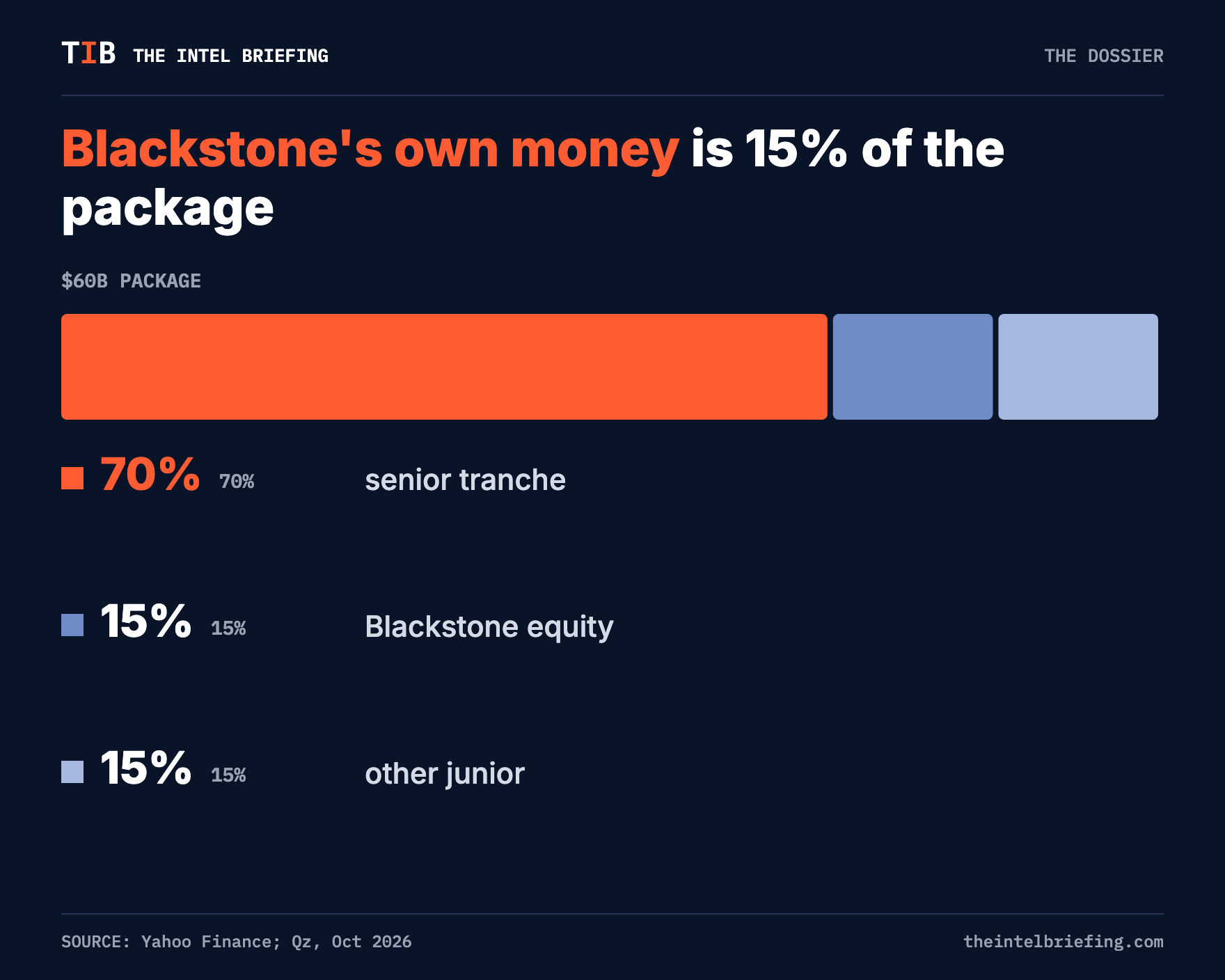
Bottom line up front. The $60 billion package behind Anthropic’s chip leases is thin at the bottom: $42 billion senior-secured, $18 billion junior, with Blackstone putting in $9 billion, or 15% of the stack as first-money equity on our arithmetic (TIB estimate). Above that sits a lease obligation the prospectus says is largely non-cancelable: $161.2 billion of Broadcom-related equipment leases, of which $125.2 billion is a five-year TPU commitment. We judge it almost certain (90%, confidence MODERATE) that Broadcom reports no impairment or credit-loss charge tied to customer financing in its fiscal Q4 2026 results, because the quarter that ends 1 Nov 2026 is one in which rent is being paid out of newly raised money, not out of margin. The question this Dossier prices is not whether the structure survives the quarter, but who absorbs the first dollar of loss if contracted rent outruns revenue in 2027.
Why now
The trigger is a two-week sequence of documents, not a market move.
Broadcom’s Form 10-Q, filed 10 September 2026, describes a customer-financing facility without naming the customer, saying the customer may issue notes “under certain circumstances and if needed,” solely for lease obligations. On 28–29 September, Anthropic’s draft prospectus leaked to Reuters, putting $518 billion of compute commitments, about 80% non-cancelable, on the record against $4.6 billion of 2025 revenue and $20.28 billion of year-end cash.
On 1 October, Reuters tied the two together: the facility is up to $42 billion, for Anthropic, to lease chips Broadcom helps design. On 2 October, Bloomberg reported the syndication of $60 billion of fresh financing.
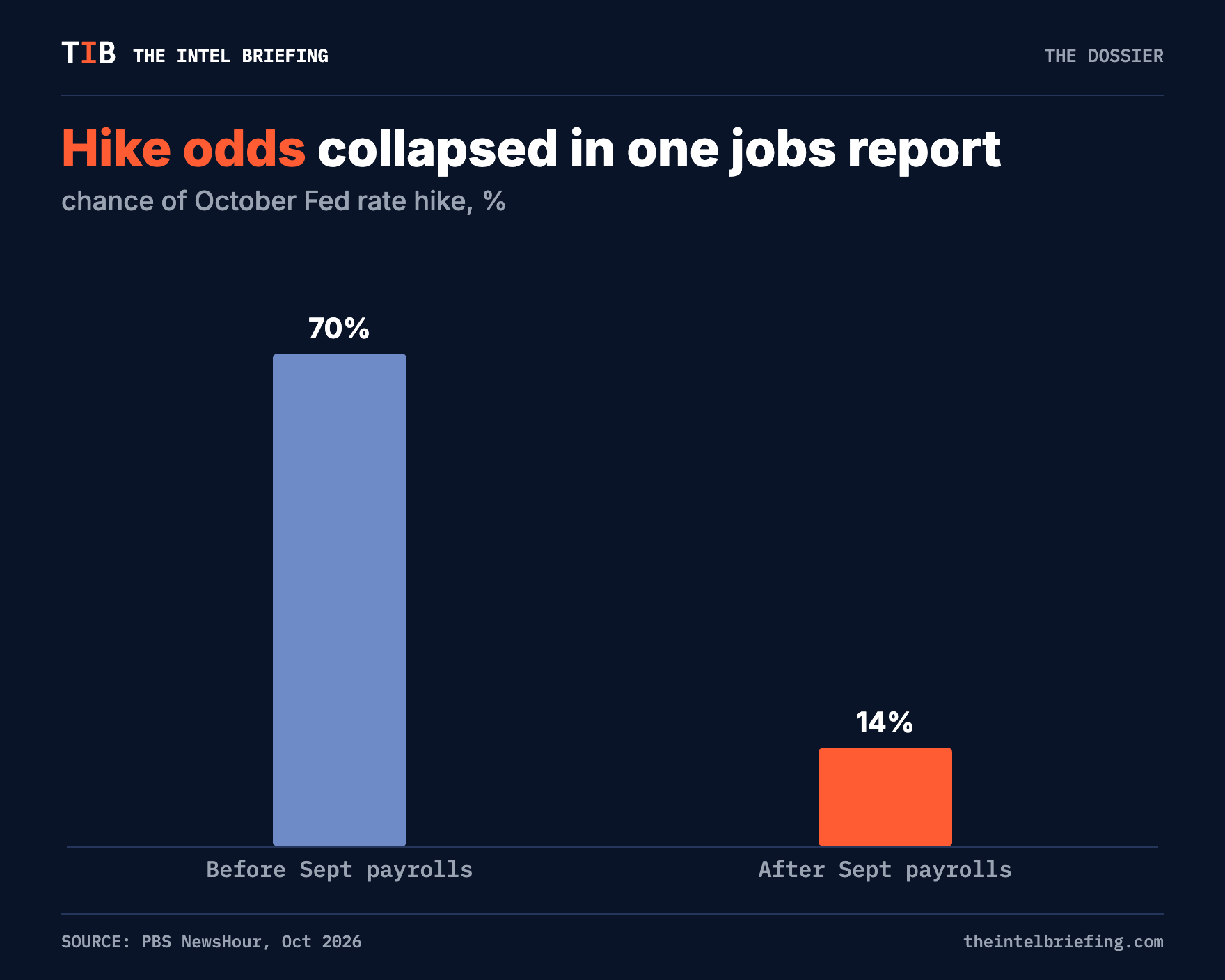
The clock matters. Microsoft reports 27 October, Alphabet and Amazon 27–28 October, and the FOMC decides 28 October, with October hike odds down to 14% from 70% after September payrolls of 29,000 and unemployment at 4.2%. Within three weeks the market gets both the demand signal and the rate signal that price this paper.
The evidence
1. The loss-absorbing layer is 15% of the stack. The package is $42 billion of Class A senior-secured debt and $18 billion of junior debt led by Blackstone, which is committing $9 billion of its own capital. Senior lenders rank ahead of junior lenders in repayment, as Premia Advisors sets out. On our arithmetic the senior tranche is 70% of $60 billion, the junior 30%, and Blackstone’s own money 15% (TIB estimate: tranche divided by package).
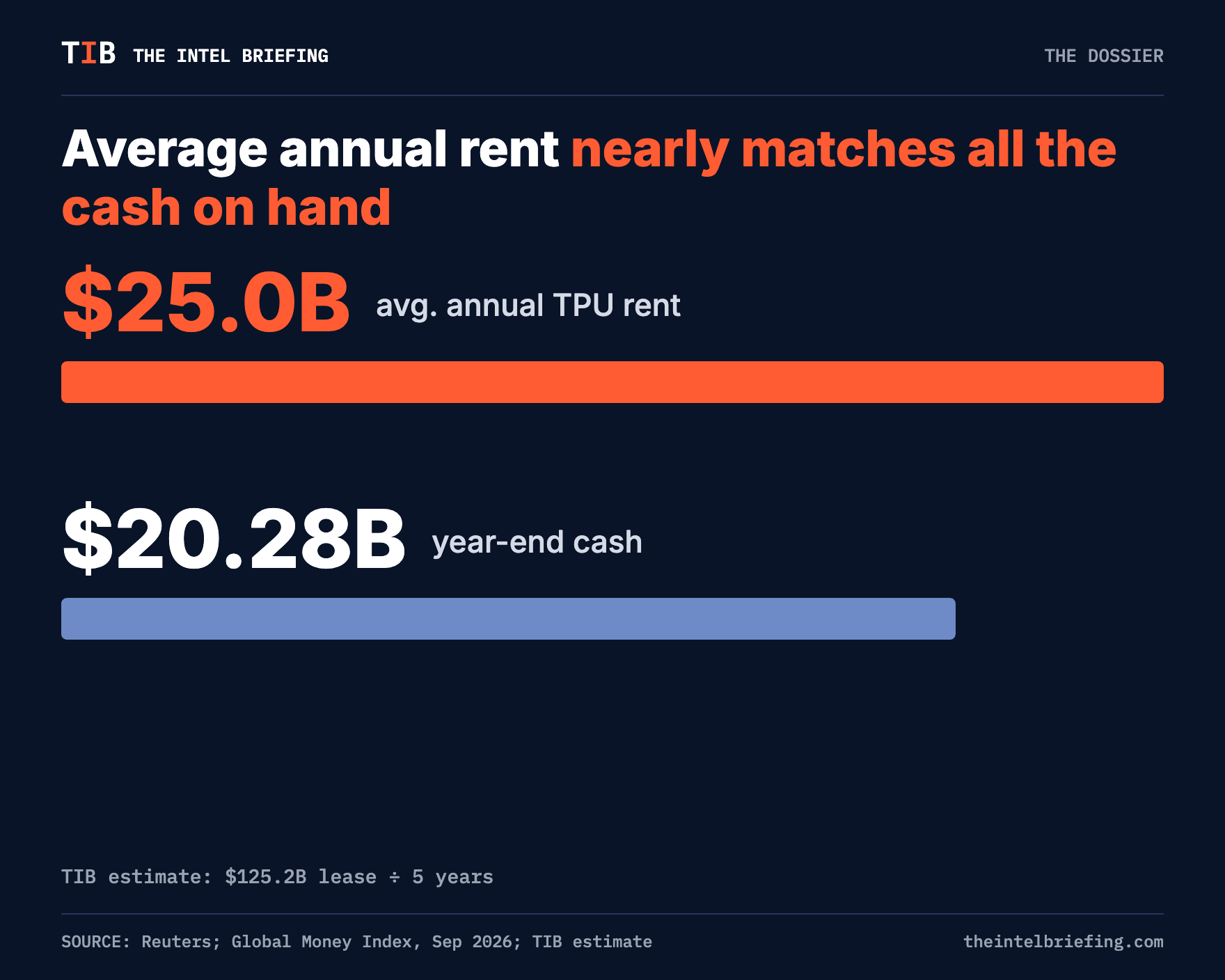
2. The rent is large against the revenue, and immediate against the cash. The $125.2 billion TPU commitment runs five years, an average of $25.0 billion a year (TIB estimate: $125.2B ÷ 5). Anthropic’s disclosed year-end cash of $20.28 billion is less than one year of that average. Quarterly revenue has moved fast — $4.73 billion in Q1 2026 and $11.5 billion in Q2 — but 2025’s operating loss was $8.06 billion on $7.33 billion of compute and infrastructure spending, so the rent line and the loss line are nearly the same line.
3. Broadcom sits on both sides of the trade. The same filing that discloses the lending facility discloses a lease backstop with maximum potential liability of approximately $29 billion once all relevant AI racks are deployed. The racks are bought by an Apollo-and-Blackstone special-purpose vehicle and leased to Anthropic, keeping the debt off Anthropic’s balance sheet, with Broadcom standing behind the rent. Against that, Broadcom reported Q3 fiscal 2026 revenue of $29.6 billion with AI semiconductor revenue of $16.7 billion, up 221%, and guides fiscal Q4 to approximately $34.8 billion for the quarter ending 1 November 2026. The $29 billion contingent cap is 83% of one guided quarter of revenue (TIB estimate).
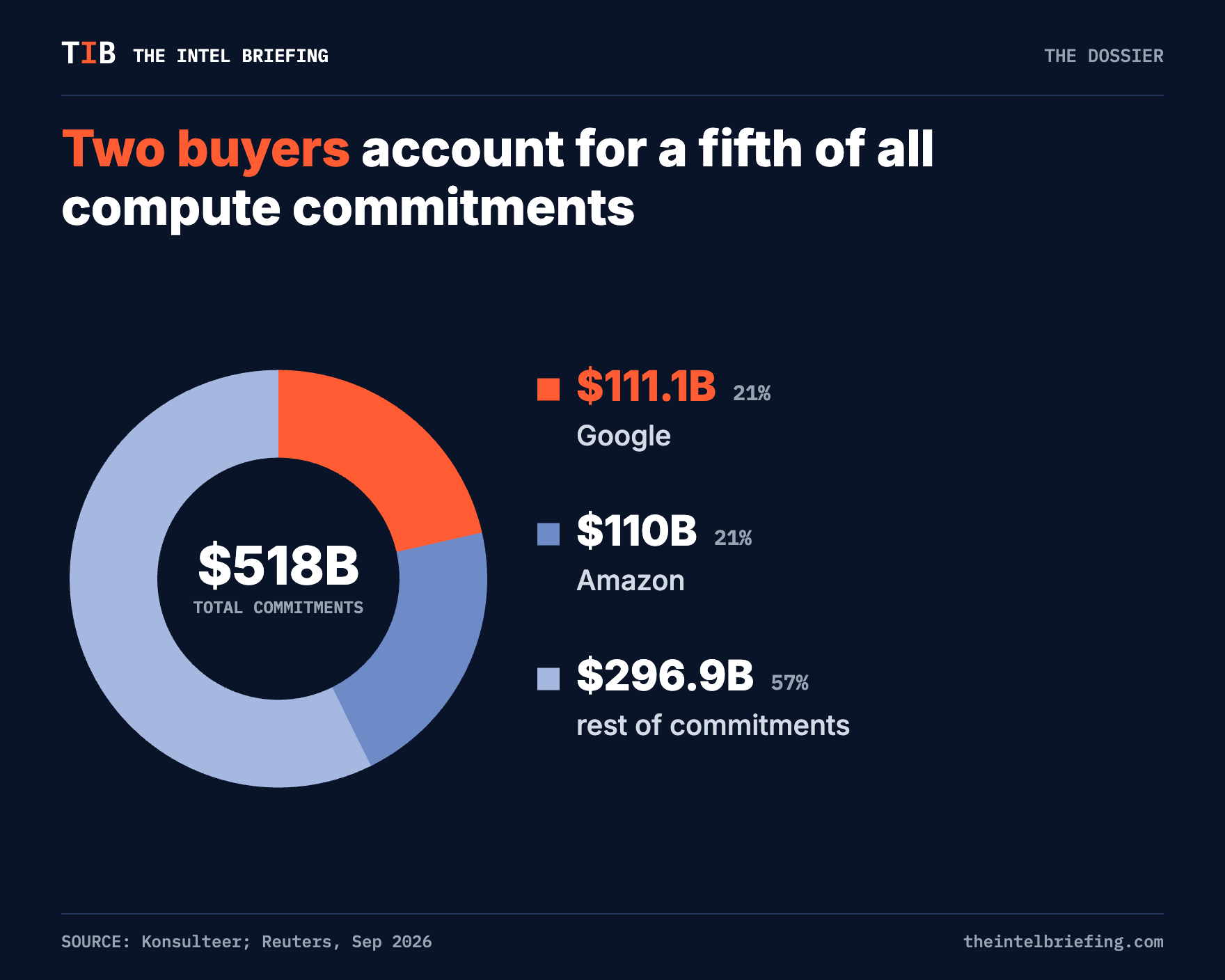
4. The demand side is concentrated in the same names that supply it. The prospectus shows Anthropic expects to spend at least $111.1 billion with Google and $110 billion with Amazon, while about 47% of 2025 sales were routed through those two cloud partners and two customers supplied nearly a quarter of revenue. The buyers of the compute are also the channel for the revenue that pays for it.
Below the paywall we set out five dated Key Judgments with probabilities and resolution sources, four scenarios built on revenue pace against credit appetite, the exposure map naming each party with its amount and its place in the order of losses, the one thing most coverage has got wrong about the size of this deal, the decision points between 7 October and 5 January with the threshold at each that moves our numbers, and what a reader in markets, in operations and in policy should do about it.