
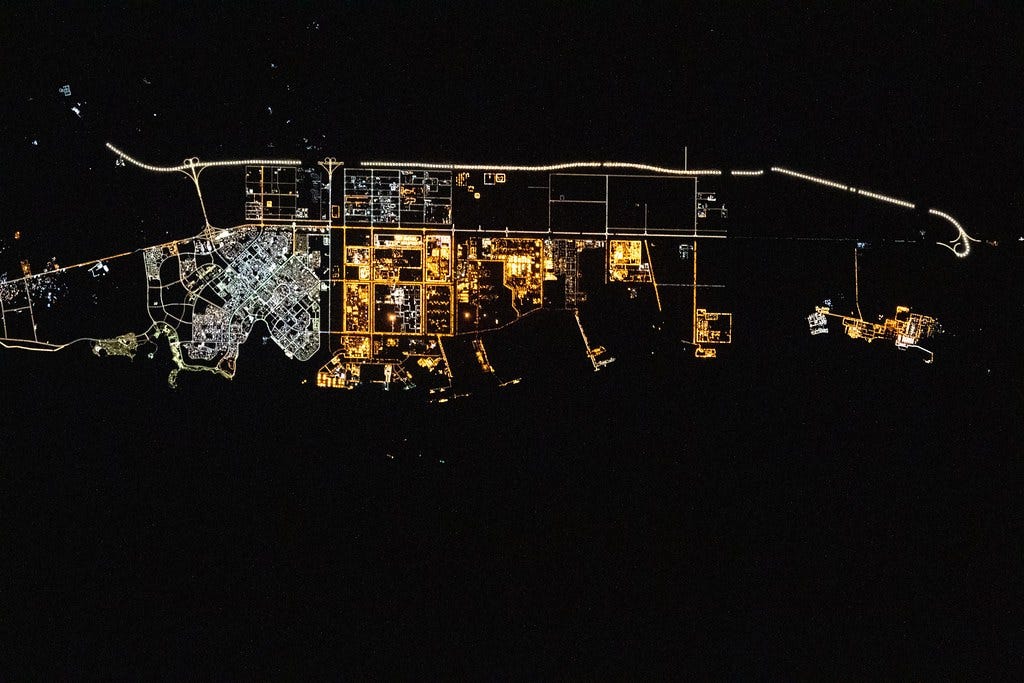
The city lights of Yanbu, Saudi Arabia. Photo: NASA Johnson / nasa, CC BY-NC-ND 2.0.
This week, every lever Washington controls was pulled before the 3 November midterms, and the fuel price barely moved. The one structural fact behind the five signals is that the shortage sits in refining capacity, and paper permissions do not repair that.
The week in five signals
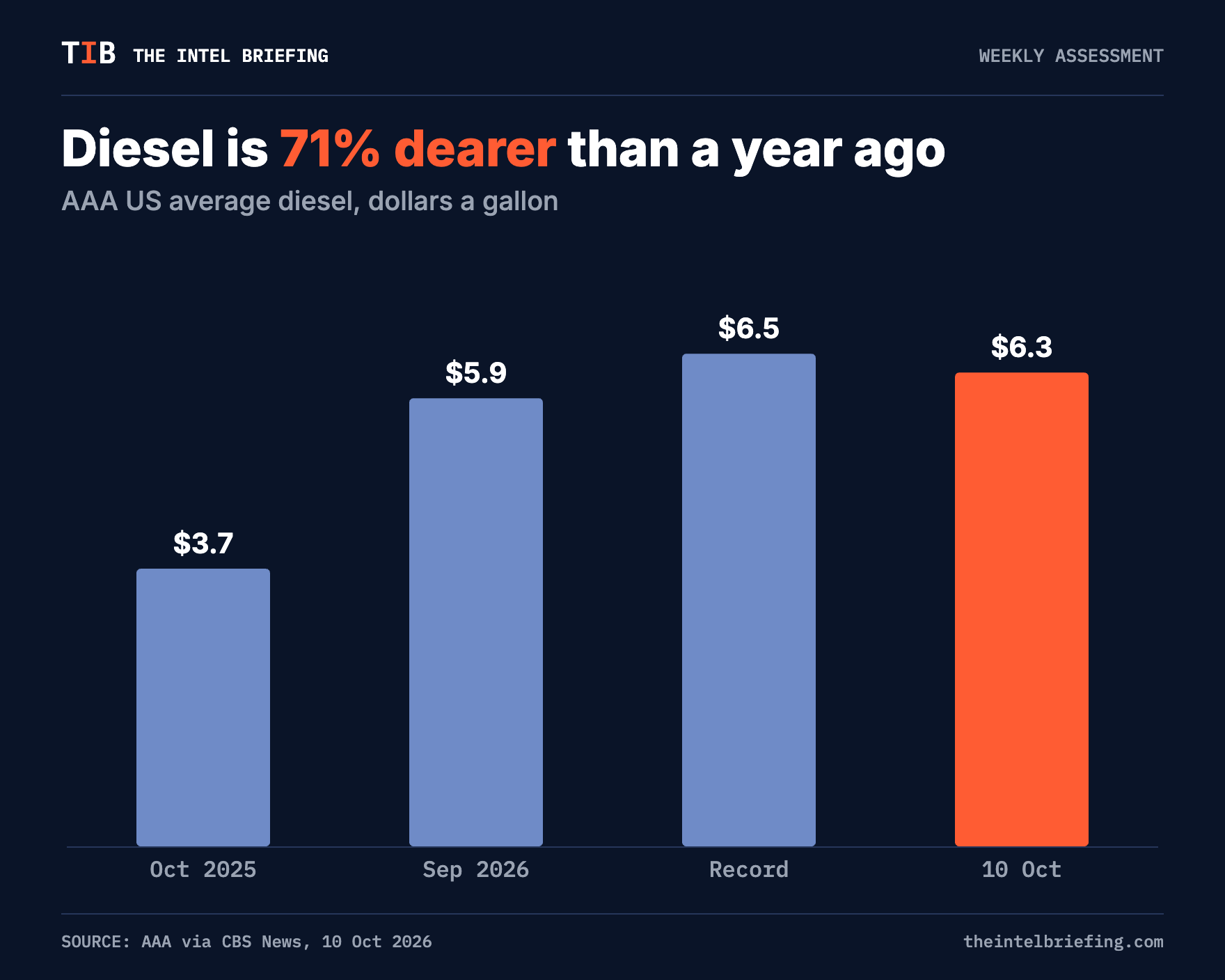
1 · ENERGY · Diesel is 71% dearer than a year ago and only 25 cents off its record. AAA’s national average was $6.28 a gallon on 10 October, against $5.94 a month earlier and $3.68 a year earlier. The record is $6.53, set on 22 September. TIB estimate: 6.28 / 3.68 = +71% on the year; 6.28 / 5.94 = +5.7% on the month. The Dallas Fed says global refining has lost as much as 6 to 8 million barrels a day since late spring, up to 10% of capacity. So what: the price is set by missing refinery output rather than by crude, so any fuel supply has to be sized against that gap.
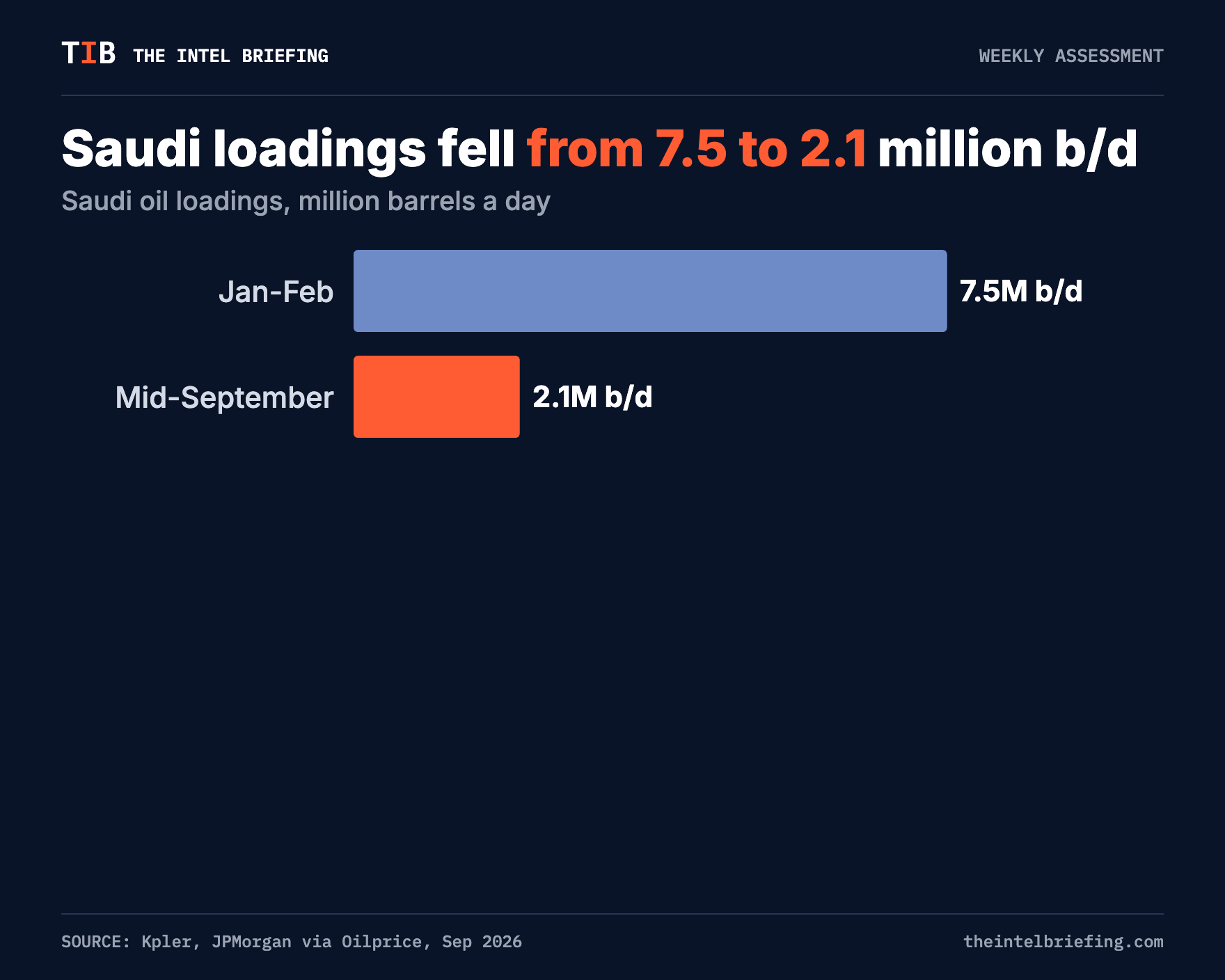
2 · WAR · Saudi Arabia is fighting to protect exports it cannot fully ship. Kpler and JPMorgan data show the East–West pipeline, with up to 7 million b/d of capacity, was hit by a drone on 11 September, leaving 4 to 5 million b/d offline. Saudi loadings fell from 7.5 million b/d in January–February to about 2.1 million b/d by mid-September. The Houthis claimed a strike on an Aramco facility in Riyadh on 3 October. So what: Washington has declined Saudi requests for military help twice while up to 100,000 Yemeni troops ready a ground offensive.
3 · MONEY · The long end of the curve now sits above the Fed’s policy range. The 10-year yield was 5.24% on 9 October, with the 2-year at 4.80% and the 30-year mortgage at 7.40%. A year earlier the 10-year was 4.13%. TIB estimate: +111 basis points on the year, and 124 points above the 4.00% top of the Fed’s range. So what: the bond market is already pricing more tightening than the committee has delivered.
4 · CYBER · An open-source tool is attacking banks. CrowdStrike reports that a suspected China-based, financially motivated actor (moderate confidence) ran the open-source agentic pentest tool ARTEX, backed by DeepSeek, GLM and Grok plus Claude, against South Korean lenders in late September and early October. Shinhan reported 25,000 people affected and Yegaram Savings 40,000. TIB estimate: 65,000 in total. So what: the tool runs on several models, so limits on any single model do not remove the capability.
5 · COMPUTE · Chip export policy is moving from letters to rules. Startup Fortune reports that Commerce is turning chip warning letters into binding rules before the US–China truce expires. Our pack carries the headline, not the rule text, so thresholds and dates are unknown. Compute Forecast sizes hyperscaler infrastructure commitments at $650B. So what: a binding rule, unlike a letter, can be priced into that $650B.