

This was the week the Gulf crisis stopped being a shipping story and became a winter story. A rejected peace offer, an extended Qatari force majeure and a central bank still fighting energy-driven inflation all point the same way: the costs of a closed strait are moving inland.
The week in five signals
1 · WAR ECONOMICS · Washington said no to the fast exit. On 26 September, President Trump rejected Iran’s seven-day proposal, presented at the UN General Assembly, to reopen the Strait of Hormuz in exchange for lifting the US naval blockade. He said Iran wanted a deal “because they’re losing so badly”, and indicated that operations could resume after the 3 November midterms. The strait has been largely closed to normal traffic for seven months. So what: the earliest realistic reopening window moves to after the midterms. Winter planning now assumes no Gulf supply.
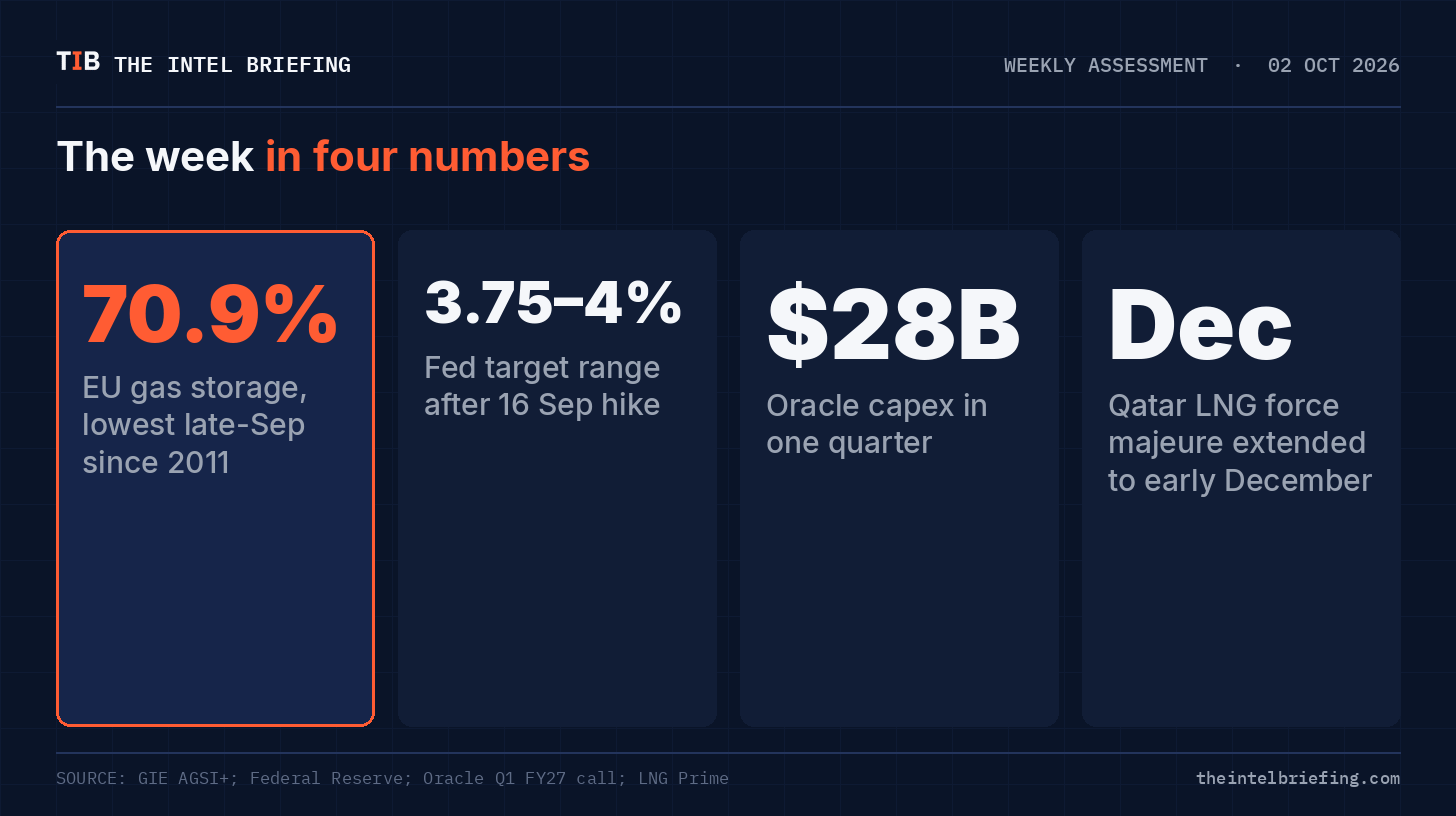
2 · ENERGY & CHOKEPOINTS · Qatar wrote off another two months. QatarEnergy extended force majeure on deliveries to Italy’s Adriatic terminal until early December, with similar notices to buyers in Pakistan, Bangladesh and India. EU storage stood at 70.9% on 26 September, the lowest for that date in AGSI data back to 2011. So what: Europe’s refill season ends short. This week’s Signal and Dossier map what that means for the winter. [TO DO: link “Signal” and “Dossier” to this week’s posts]
3 · MONEY & LEVERAGE · The Fed is still hiking into an energy shock. On 16 September, the Federal Reserve raised its target range by a quarter point to 3.75–4%, in a 12–0 vote. Its median projections put 2026 PCE inflation at 3.7% and the year-end policy rate at 4.1%. So what: higher rates make every long-dated energy and infrastructure project more expensive to finance, from LNG trains to data centres. The next decision is on 27–28 October.
4 · COMPUTE & POWER · The AI build-out is now a balance-sheet test. Oracle spent $28 billion on capital expenditure in its fiscal first quarter (June–August 2026), leaving free cash flow at minus $5 billion. It kept guidance of $90–95 billion for the full year and delivered 850 MW of AI capacity in the quarter, according to its 10 September earnings call. So what: at 3.75–4% policy rates, AI capacity is increasingly financed by customer prepayments and debt, not cash flow. The builders with the cheapest power and the cheapest capital will win.
5 · CYBER & TECH SOVEREIGNTY · The war’s home front is industrial control systems. US agencies updated their warning that Iran-affiliated actors are expanding attacks on programmable logic controllers in water and energy systems, now including Schneider Electric and Siemens devices, as Cybersecurity Dive reported. An EPA review found hundreds of US sites with critical or high-severity vulnerabilities. So what: the conflict’s cheapest escalation path runs through small US utilities, and nothing in the Hormuz talks covers it. [TO DO: Thursday, swap in a newer cyber item if one appears]
The Forecast Ledger opens
From this week, every judgment we publish carries a probability and a deadline, and goes into a public ledger. When a call resolves, we mark it HIT or MISS, and we explain the misses. This is normally the week of our quarterly scorecard. Since the ledger is new, there’s nothing to score yet. The first scorecard runs on the first Friday of January 2027.
Calls on record this week: 7 (5 in Wednesday’s Dossier, 2 below).