



In 2015, a startling statistic began to colonize the consciousness of the business world: the average human attention span had supposedly plummeted to just eight seconds, less than that of a goldfish. This single, easily digestible—and entirely fallacious—data point launched a thousand marketing strategies, reshaped content creation, and justified billions in ad-tech spending. It became the gospel for a generation of strategists, providing a simple, quantifiable explanation for the challenges of engaging an audience in a saturated digital landscape. But this briefing will demonstrate that the “8-second attention span” is one of the most successful and costly neuromyths in modern business history. The true crisis is not a collapse of attention, but its radical fragmentation and reallocation—a far more complex challenge that most firms are strategically unequipped to handle. The persistence of this myth reveals a collective, and deeply flawed, understanding of digital psychology, leading to a catastrophic misallocation of resources away from what truly builds value: trust and sustained engagement.
Deconstructing the Neuromyth: The Anatomy of a Viral Fallacy
The endurance of the goldfish myth is a masterclass in informational contagion. Its journey from a footnote in a marketing report to an undisputed fact cited in boardrooms highlights a critical vulnerability in corporate decision-making: a thirst for simple answers to complex problems. A forensic examination of its origins reveals a foundation not of scientific rigor, but of misinterpreted data and circular sourcing.
The 2015 “Microsoft Study” That Wasn’t
The claim that human attention spans had dropped from 12 seconds in 2000 to eight seconds in 2015 is almost universally attributed to a Microsoft report titled “Attention Spans”. However, deep investigation by journalists and researchers revealed a critical truth: the headline-grabbing statistic did not originate from Microsoft’s own research, which involved surveying 2,000 Canadians and studying the brain activity of 112 people. Instead, the Microsoft report cited an obscure, third-party data aggregator called “Statistic Brain.” Subsequent attempts to verify Statistic Brain’s sourcing found them infuriatingly vague, with no discernible link to credible, peer-reviewed scientific study. The statistic was, in effect, informational vaporware—a number without a verifiable origin, laundered through a corporate report to gain a veneer of legitimacy that it never deserved.
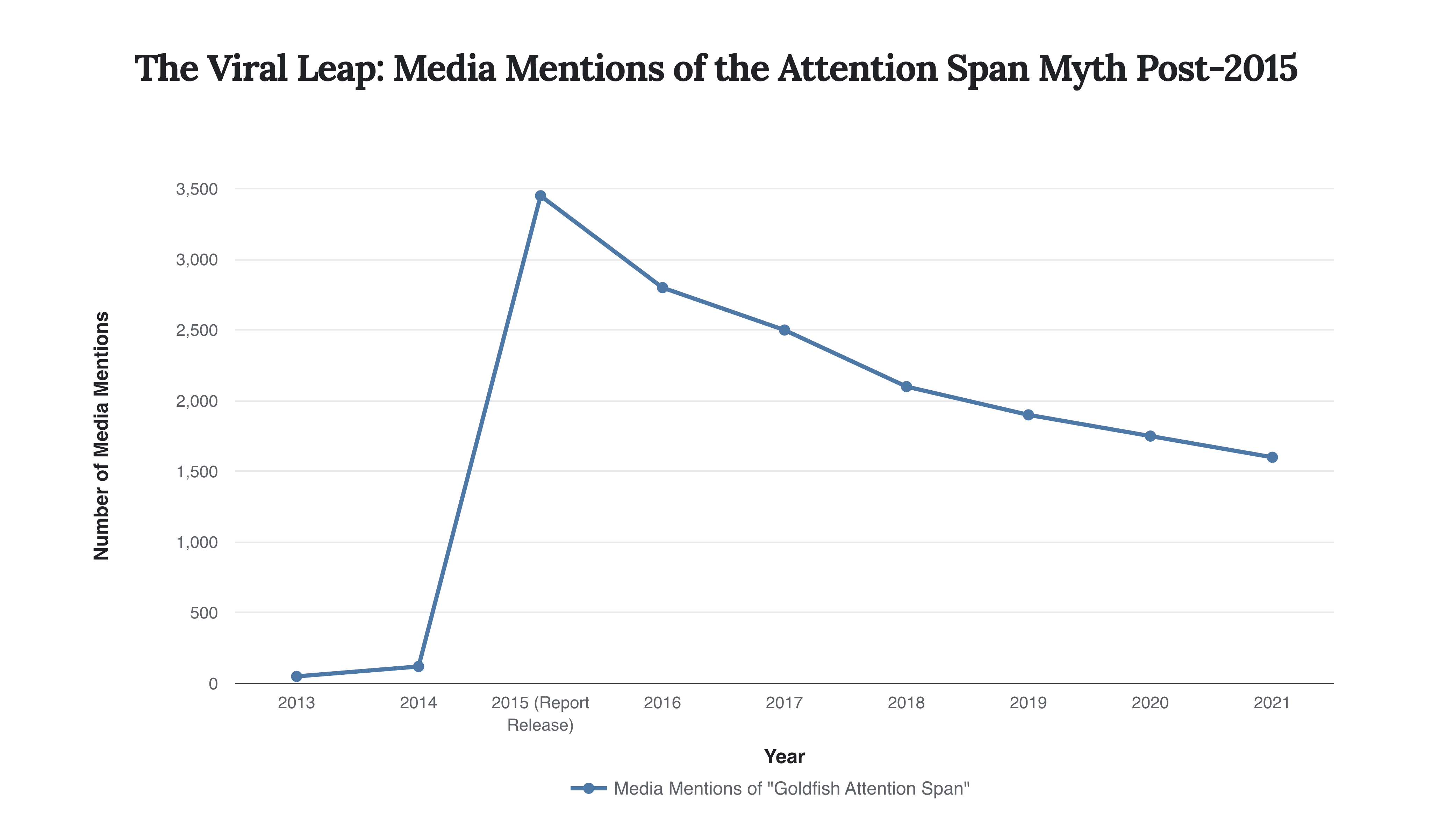
This chart illustrates the explosion of media mentions following the release of the misinterpreted 2015 report, cementing the myth in the public and professional consciousness.
The 9-Second Goldfish: A Tale of Scientific Folklore
The other half of the viral equation—the 9-second attention span of a goldfish—is equally baseless. Far from the forgetful creatures of popular lore, goldfish have become a model system for studying memory formation. Scientific studies have demonstrated that goldfish can remember and learn for months, if not years. They can be trained to navigate mazes, distinguish between different musical cues, and remember feeding times long after the initial training. The juxtaposition of a fabricated human limitation with a fictional animal benchmark created a powerful, albeit completely false, narrative of cognitive decline.
“The idea of an ‘average attention span’ is very much meaningless. It is task-dependent. How much attention we apply to a task varies depending on task demands.”
The Reality of Attention: A Portfolio, Not a Stopwatch
The core strategic error prompted by the goldfish myth is viewing attention as a single, depleting resource with a fixed duration. Modern neuroscience refutes this simplistic model. Human attention is not a stopwatch; it is a sophisticated portfolio of different cognitive states deployed based on task, motivation, and context. Our brains are not getting weaker; they are adapting to a high-stimulus environment by becoming more efficient at filtering and allocating focus.
