



36 million barrels. That is what Trump says Russia promised on 9 October: 4.8 million tonnes of diesel, about 9 to 10 days of US distillate use. In return Treasury issued General License 135, valid for 180 days, 20 days after Washington’s “sanctions from hell” law was signed. Delivery is unverified, and the volume is smaller than the G7’s own stock release. We think the licence buys little fuel and sets a larger precedent.
What changed
Dates first. Meduza reports the Russia sanctions law was signed on 19 September. It gives 100% tariff authority on the top five importers of Russian energy, 30 days to impose most sanctions, and a national-security suspension power. Debevoise dates the signing 18 September and puts the 30-day mark at 19 October. Sources differ by a day. Both agree the deadline falls on 19 October.
On 2 October the G7 agreed to release 100 million barrels over four months, diesel first.
On 9 October came the Trump–Putin call and OFAC General License 135. It authorises the sale, delivery, offloading and importation of Russian-origin diesel, including into the US, until 7 April 2027. CTOL reports that the text sets no volume cap and names no company. It bars debits to the accounts of the Central Bank, the National Wealth Fund and the Finance Ministry.
On 10 October Deputy Prime Minister Novak said Russia would lift its diesel export ban ahead of the 31 October schedule, per the same Türkiye Today report.
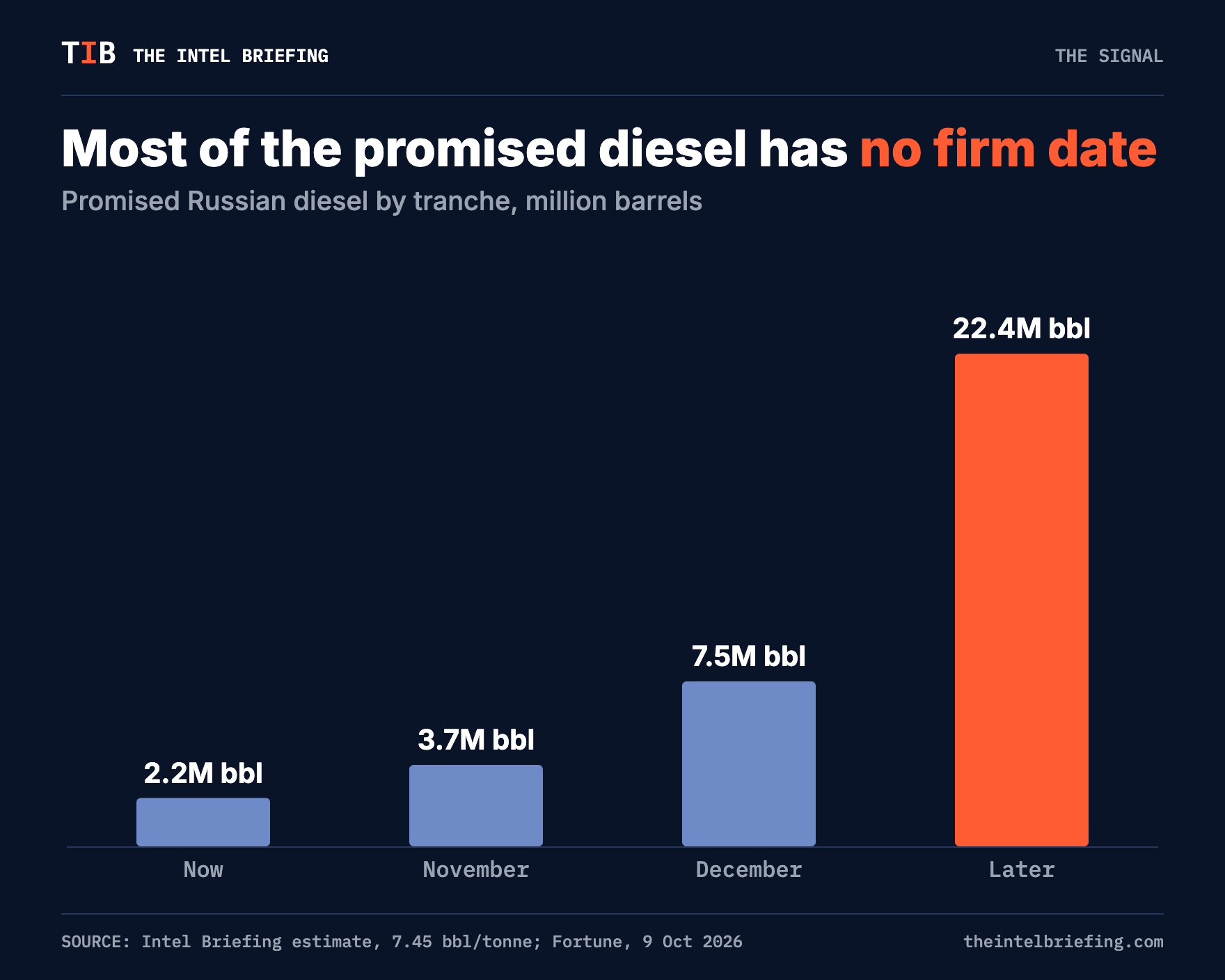
The promised volumes come in four tranches. Our conversion uses 7.45 barrels per tonne.
300,000 t now: about 2.2 million barrels.
500,000 t in November: about 3.7 million barrels.
1 Mt in December: about 7.5 million barrels.
3 Mt “later”: about 22.4 million barrels.
The total is 4.8 Mt, or about 35.8 million barrels (TIB estimate: 4.8 million t × 7.45).
Set against US demand, CTOL cites EIA at 3.685 million b/d of July distillate use. That makes the package 9.7 days (TIB estimate: 35.8 ÷ 3.685). At 4 million b/d it is nine days. Set against the G7 release, it is 36% of the 100 million barrels. The first two tranches, 0.8 Mt or about 6 million barrels, cover about 1.6 days.
The second-order effect
The US is not the market that matters here. The US has imported no Russian oil or gas since 2022, according to EIA as reported by AP. Any effect on the pump runs through global product prices, not through American terminals.
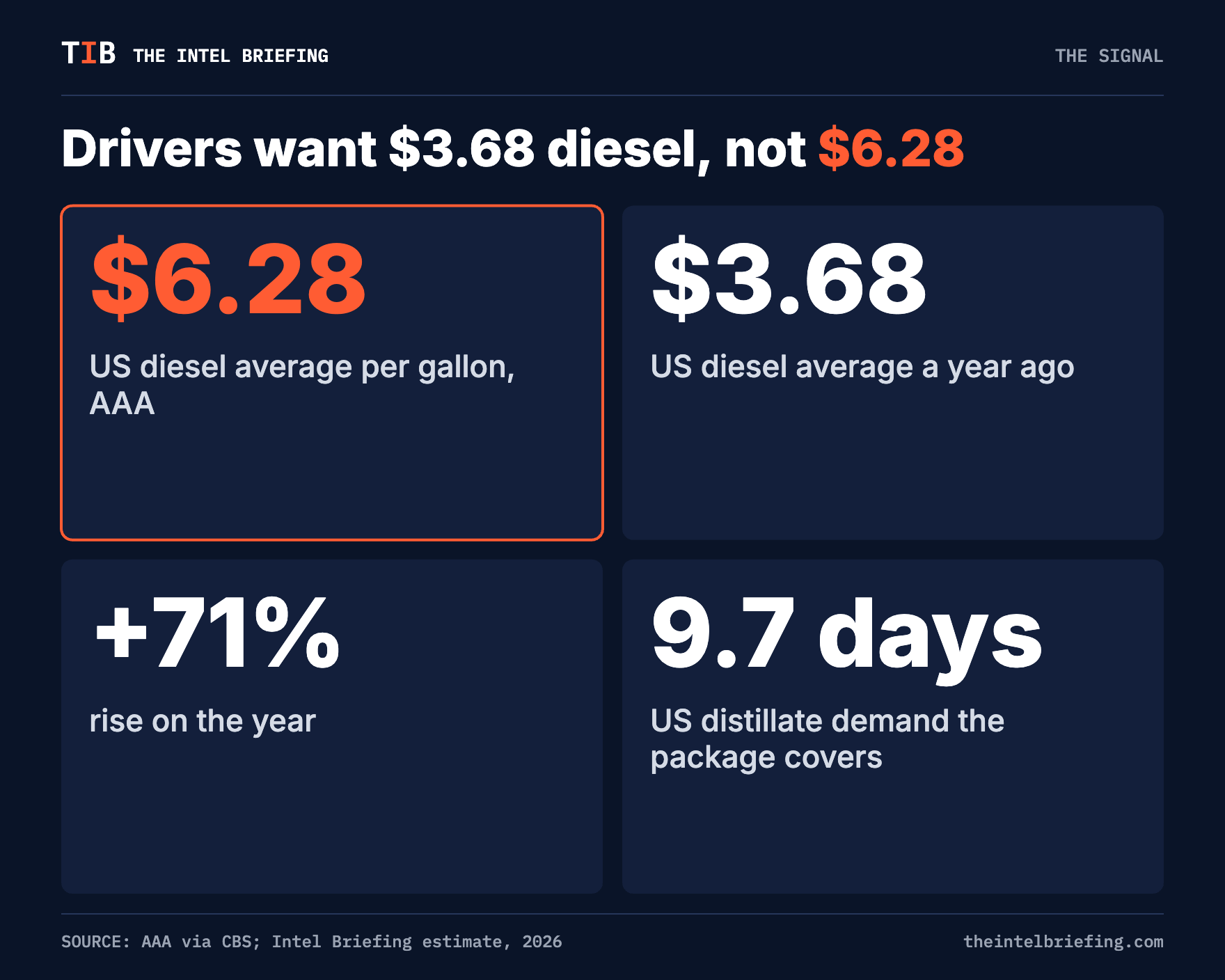
The pump price is the problem the licence targets. AAA data via CBS put the US diesel average at $6.28 a gallon. That compares with $5.94 a month ago and $3.68 a year ago, a rise of 71% on the year (TIB estimate: 6.28 ÷ 3.68). The record was $6.53 on 22 September, so the price sits 25 cents below it. The IEA’s September report had US diesel above $200 a barrel in early September, 94% over its pre-war level.
The Dallas Fed puts the cause in refining, not crude. Global refining capacity has been cut by 6 to 8 million b/d since late spring, up to 10% of the total. It says Ukrainian drone strikes cut Russian refining capacity by as much as 60% over summer 2026, though monthly estimates vary widely.
That is where the promise meets the plant. The IEA says Russian diesel output is down about 30%. Reuters reported that half of Russia’s six top diesel refineries cut output sharply or halted in September. Kirishi was fully shut.
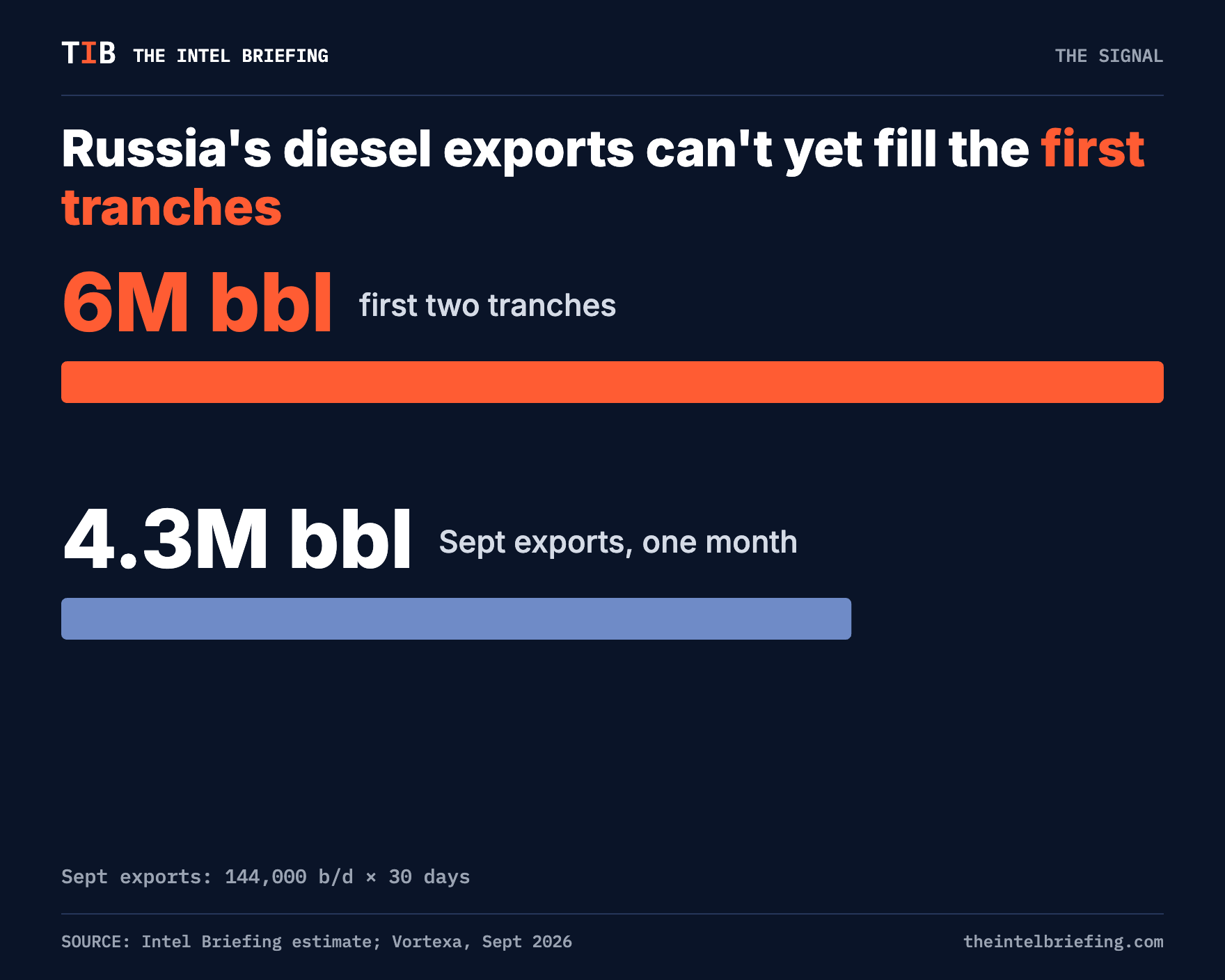
Vortexa put September seaborne diesel and gasoil exports at 144,000 b/d, down 28% from August and the lowest in a decade. That is about 4.3 million barrels a month (TIB estimate: 144,000 × 30). The first two tranches, 6 million barrels, would take roughly two months at a pace just below that.
The 4.0 Mt with no firm date is where the gap is. CTOL puts a normal Russian export month at about 2.5 Mt, so 4.8 Mt is 1.9 normal months.
There is a tension in the data. Washington’s stated “Greatest Priority”, per Trump’s post, is lower prices for farmers, ranchers and truckers. Every Ukrainian strike on a Russian refinery works against that. Energy News Beat reports that a Russian fuel terminal caught fire within hours of the deal, and its headline says Trump has pressed Kyiv to stop at least four times. We have not verified the count independently.
The talks channel has the same logic. Axios reports that Witkoff and Kushner brought “new ideas” to Miami on 9–10 October, including a partial ceasefire on energy and grain and a possible Moscow trip later in October. The White House wants a breakthrough before the midterms and winter. The midterms are on 3 November.
Who pays, who gains
Russia gains the most in terms of rights. It gets a US licence running 180 days, to 7 April 2027, and a lifted domestic export ban. Bloomberg reported that the diesel sales halt and higher refinery subsidies had blunted Moscow’s gains in the four weeks to 4 October.
Ukraine pays in leverage. Zelenskyy called the decision “a weak decision”. Its refinery strikes are the tool the Dallas Fed credits with the 60% capacity loss. The strikes now cut across a stated US priority.
US drivers and truckers are the intended gain. A package worth 9 to 10 days of US demand cannot by itself take diesel back from $6.28 toward $3.68. A separate executive order allows tax-exempt red-dyed diesel on highways.
Buyers in Turkey and Brazil took at least half of Russian diesel cargoes before the July restrictions, per CTOL. They are the likeliest first buyers once the ban lifts.
Refiners also gain from the current margins. Forbes says strong fuel margins propelled Marathon Petroleum, Phillips 66 and Valero sharply higher in Q3. Valero reports Q3 on 22 October.
India is exposed to the tariff side. CSIS says Russia’s share of its crude imports fell from over 50% in June–July to about 40% in August and about 31% in provisional September data. Section 113 allows tariffs of up to 100% and section 115 allows broad waivers.
What to watch
First loadings under GL 135. Current value: none confirmed. Novak says supplies to the US could start in October. The first tranche is 300,000 t, about 2.2 million barrels.
The 19 October deadline under the sanctions law. Current value: we found no report of any 100% tariff imposed. The line to watch is whether any tariff under section 113 is imposed, or whether section 115 waivers are used, when 30 days run out.
US diesel average (AAA). Current value: $6.28 a gallon. The marks are the $6.53 record of 22 September and the 3 November election.
On Wednesday
The Dossier answers one question: does the licence lower US diesel prices before 3 November, and what does it do to the leverage behind the Witkoff–Kushner talks? Members get the scenarios, the probabilities, the exposure map and the dated decision points.

Sources: Fortune · CBS News · Türkiye Today · Meduza · Axios · OFAC GL 135 · Debevoise · CSIS · CTOL · Dallas Fed · Energy Connects · Energy News Beat · Bloomberg · Forbes · Valero