


In May 2026, the foundational architecture of the internet passed a point of no return. The global rollout of Google’s fully integrated AI Search Interface—anchored by the Gemini-powered AI Overviews (AIO)—has triggered the most violent and systemic restructuring of the digital information economy since the invention of the hyperlink. The transition from a directory-based web to a generative, answer-based ecosystem is no longer a forecasted horizon; it is the current, measurable reality. We are witnessing the real-time obsolescence of traditional search engine optimization, the deliberate decoupling of user queries from outbound traffic, and a profound shift in the macroeconomic distribution of digital attention. The internet is no longer a directory of destinations; it is a synthesizer of answers, and the toll booth has fundamentally changed its pricing model.
The Alphabet Q1 2026 Earnings Reality
To understand the sheer magnitude of this architectural shift, one must examine the financial velocity underwriting it. The market entered 2026 braced for a structural collapse in Google’s search advertising business, hypothesizing that generative AI would ruthlessly cannibalize the traditional ad-click funnel. This consensus proved catastrophically wrong. In the first quarter of 2026, Alphabet reported consolidated revenues of $109.9 billion, representing an explosive 22% year-over-year acceleration that violently dismantled analyst models. Google Search and Other revenues did not contract; they expanded by 19% to reach $60.4 billion.
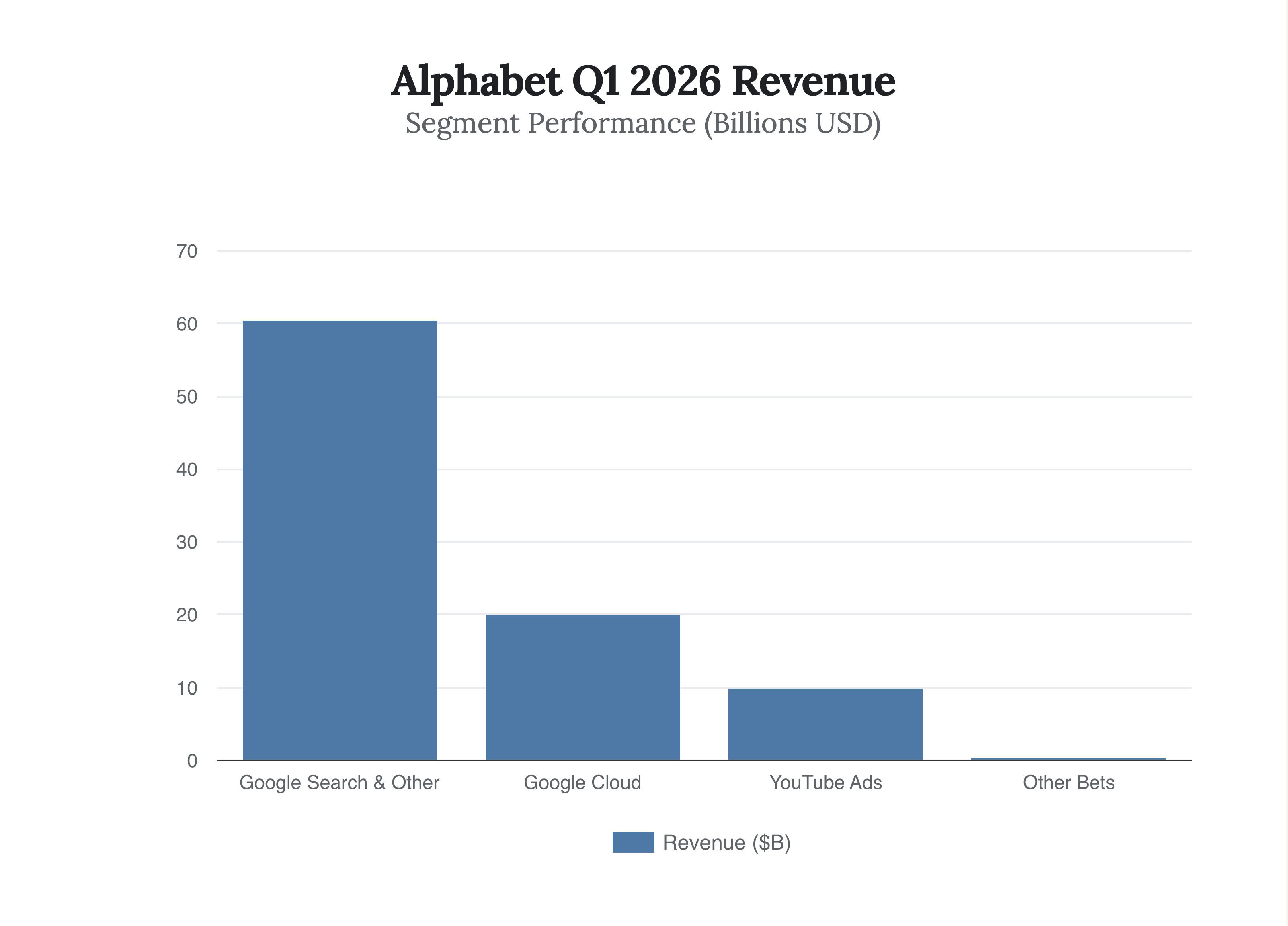
During the April 2026 earnings call, Alphabet CEO Sundar Pichai explicitly linked this performance to the integration of Gemini into the core search experience. The data reveals that users engaging with AI Overviews and the standalone “AI Mode” are executing more complex, higher-value commercial queries and returning to the search interface with greater frequency. Rather than destroying ad inventory, the AI Overviews have effectively trapped the user within Google’s ecosystem for a longer duration, allowing the platform to monetize high-intent micro-moments. Simultaneously, Google Cloud shattered records by growing 63% year-over-year to $20.03 billion, propelled entirely by enterprise demand for generative AI infrastructure and custom TPU (Tensor Processing Unit) clusters. The cloud backlog nearly doubled sequentially to $462 billion. Alphabet has effectively subsidized the destruction of traditional search traffic by monetizing the inference compute required to execute it.
The Architecture of the Zero-Click Singularity
The mechanics of the AI Overview represent a fundamental departure from the lexical retrieval model (BM25) that governed search for two decades. When a user submits a query in May 2026, Google does not merely fetch documents containing matching keywords. Instead, it utilizes Retrieval-Augmented Generation (RAG) to dynamically synthesize a response from its latent space, drawing upon heavily weighted, authoritative nodes across the web. As of March 2026, AI Overviews trigger on approximately 48% to 55% of all global Google search queries.
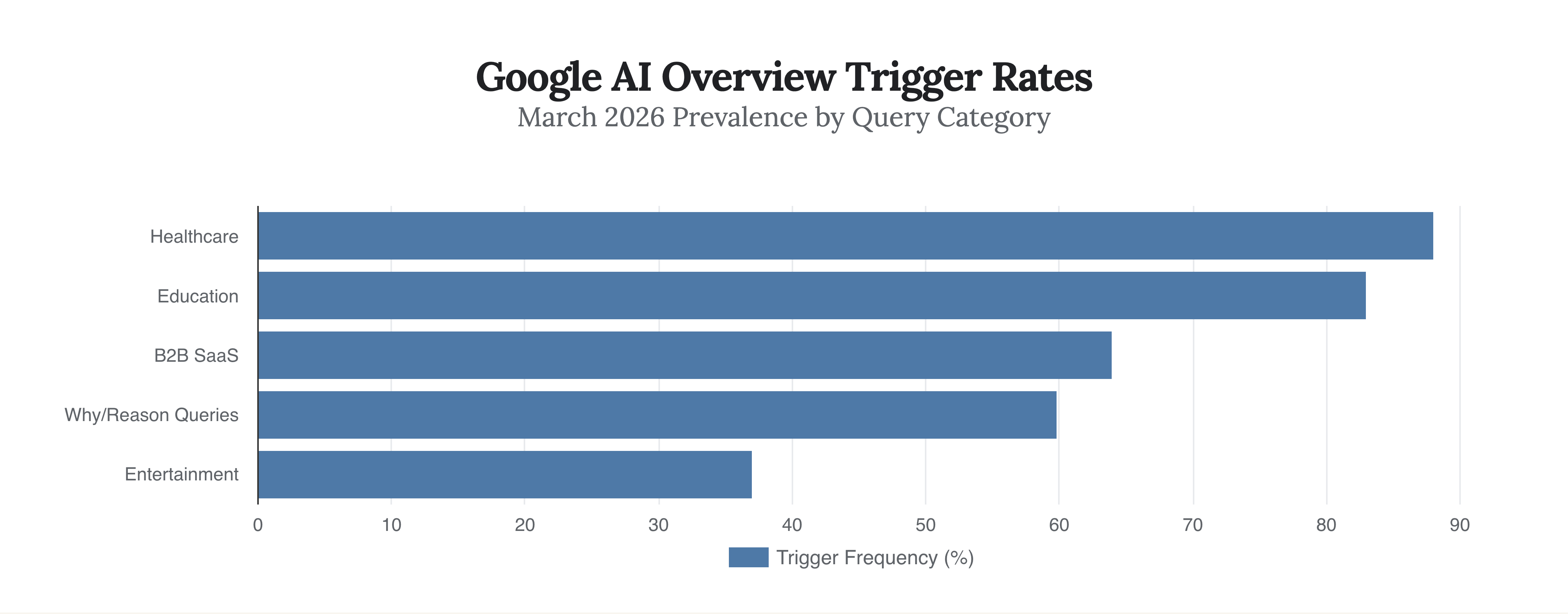
However, the distribution of these triggers is highly asymmetric. Informational and “Your Money or Your Life” (YMYL) categories are bearing the brunt of the AI transformation. Healthcare queries see an astonishing 88% trigger rate, while educational queries sit at 83%. Ahrefs’ analysis of 146 million Search Engine Results Pages (SERPs) in early 2026 revealed that question-based queries (specifically “Why” and “How” modifiers) trigger AIOs at nearly a 60% rate. Conversely, purely transactional queries (e.g., “buy running shoes size 10”) remain dominated by traditional Google Shopping ads. The immediate strategic implication for corporate marketing teams is binary: If your brand is not the foundational context injected into the AI Overview, your organic search ranking is mathematically irrelevant.
The Organic Hemorrhage: Measuring the 61% Collapse
The second-order effect of the AIO interface is a staggering hemorrhage of organic traffic to third-party websites. For over twenty years, capturing the number one organic spot on a high-volume Google SERP was a guaranteed driver of enterprise value, yielding an average click-through rate (CTR) of 25% to 30%. In 2026, that paradigm is dead. According to exhaustive data from Seer Interactive and Ahrefs, the organic CTR for the number one ranked page drops by an apocalyptic 58% to 61% on queries where an AI Overview is present.
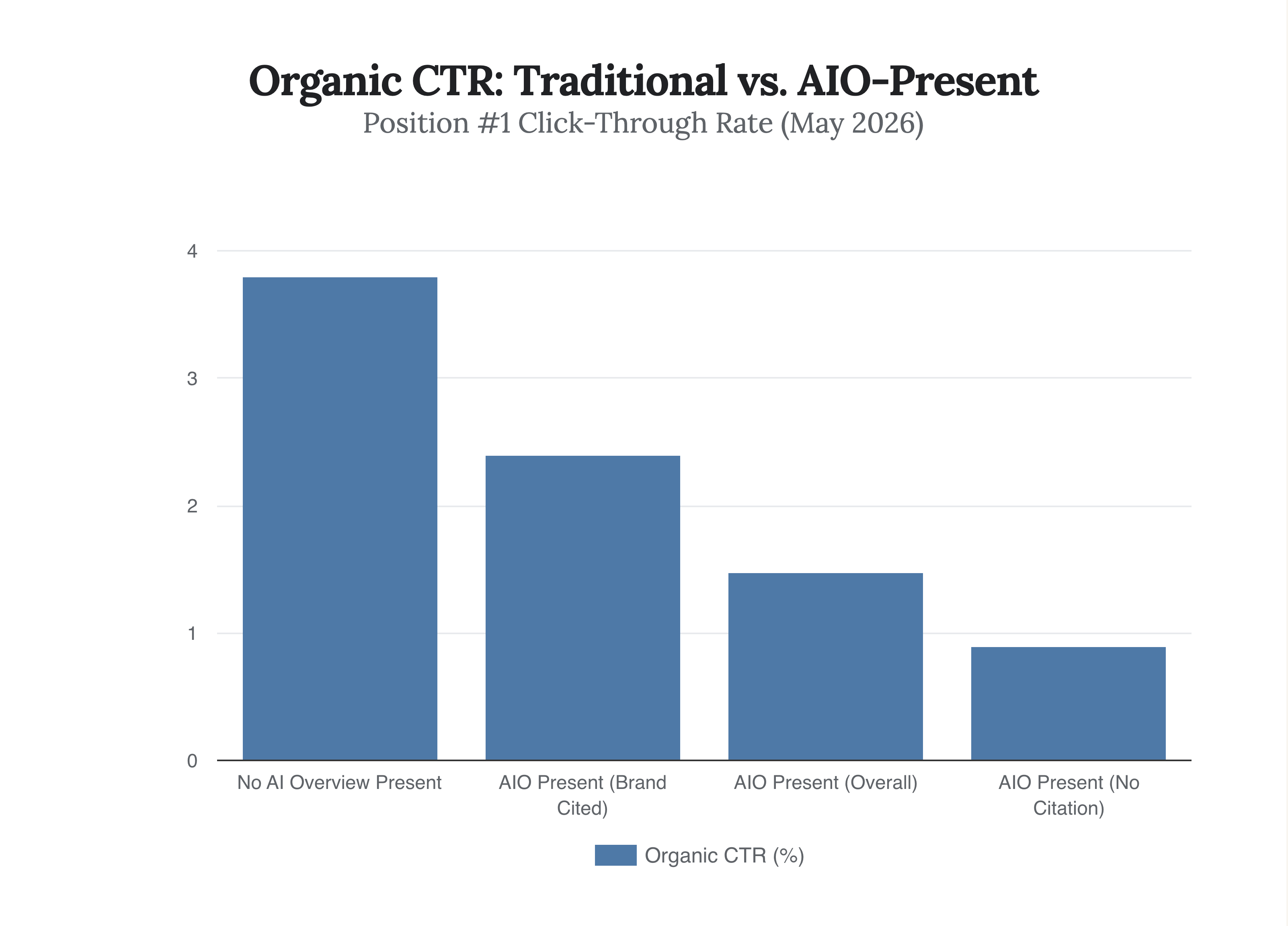
The global zero-click search rate—defined as a query that ends without the user clicking a link to an external domain—has escalated to a baseline of 60%. However, when isolated strictly to queries that trigger an AI Overview, the zero-click rate skyrockets to 80%–83%. The user asks a complex question, the Google LLM synthesizes a highly accurate, multi-step answer at the top of the interface, and the user simply closes the tab. The website whose content was ingested to generate that answer receives exactly zero attribution, zero traffic, and zero monetization. For the first time in the history of the commercial web, capturing the number one organic search position frequently results in a net traffic loss compared to historical baselines.
The “Bounce Click” Defense and the Publisher Crisis
The financial impact on digital publishers has been predictably catastrophic. Traditional media, which built its business model on high-volume, low-intent search traffic, is facing an extinction-level event. According to May 2026 benchmark data from Piano.io tracking hundreds of publisher sites, global publisher traffic from Google Search has dropped by 36% year-over-year. Google Discover referrals fell an additional 21%.
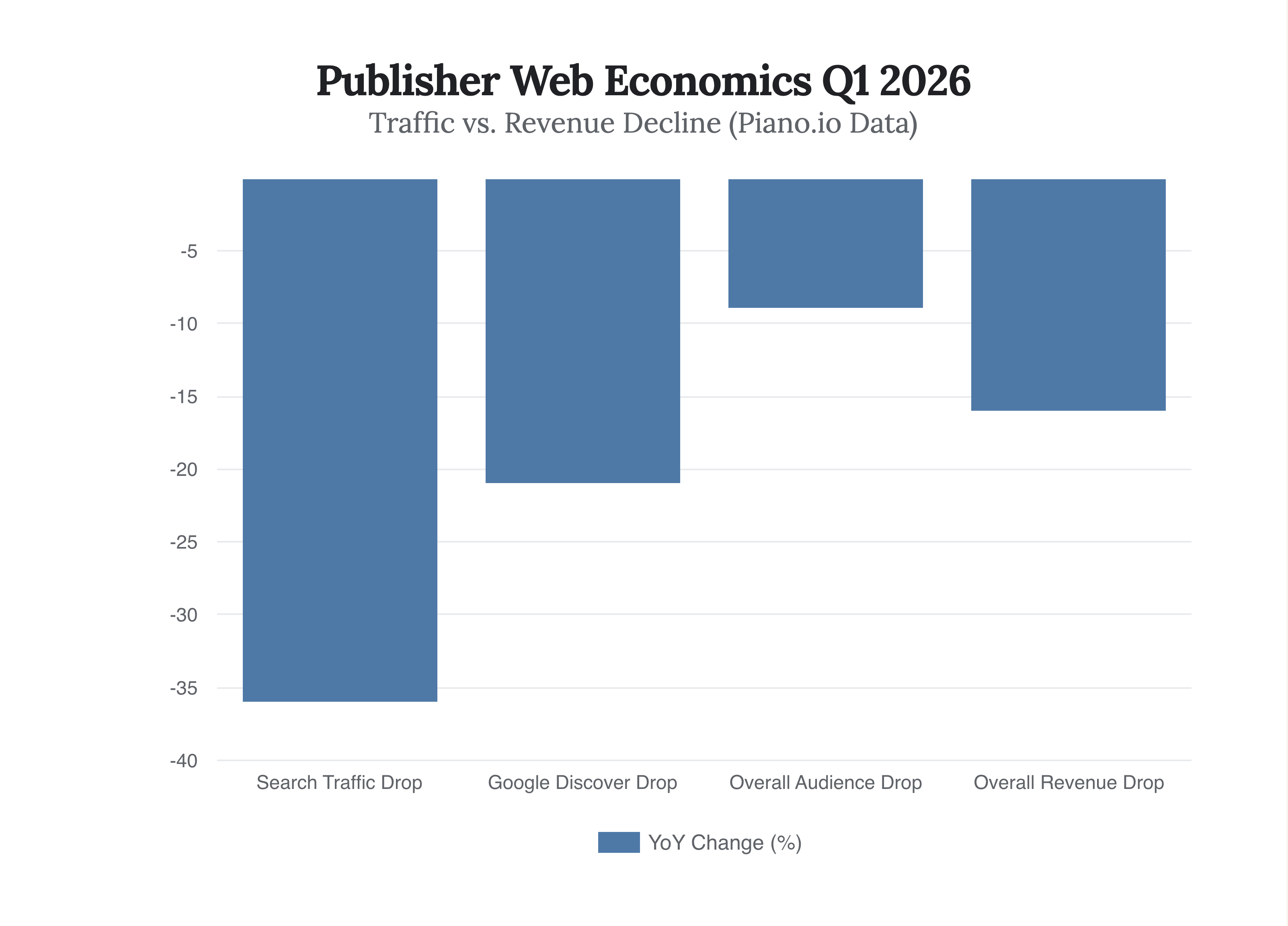
Google’s official response to this crisis has been meticulously clinical. Liz Reid, Google’s Head of Search, articulated on the Bloomberg Odd Lots podcast in April 2026 that AI Overviews are primarily eliminating “bounce clicks.” A bounce click occurs when a user clicks a link, fails to find the immediate answer in the first paragraph, and immediately hits the back button to try another link. Reid argued that by providing the synthesized answer instantly, Google is saving the user from a degraded experience, even if it deprives the publisher of an ad impression. The reality is that “bounce clicks” comprised the lifeblood of ad-arbitrage media properties. Content like weather updates, horoscopes, recipe blogs, and basic definition pages are being aggressively absorbed by the AI interface. Google is not destroying publisher traffic by accident; it is methodically eliminating the low-intent “bounce click” that publishers monetized but users despised. Interestingly, publishers that have cultivated direct relationships via paid subscriptions, apps, and walled-garden newsletters are surviving; Piano.io notes that while search traffic plummeted 36%, overall revenue for diversified publishers only fell 16%.
The Rise of the Latent Space Competitors: ChatGPT and Perplexity
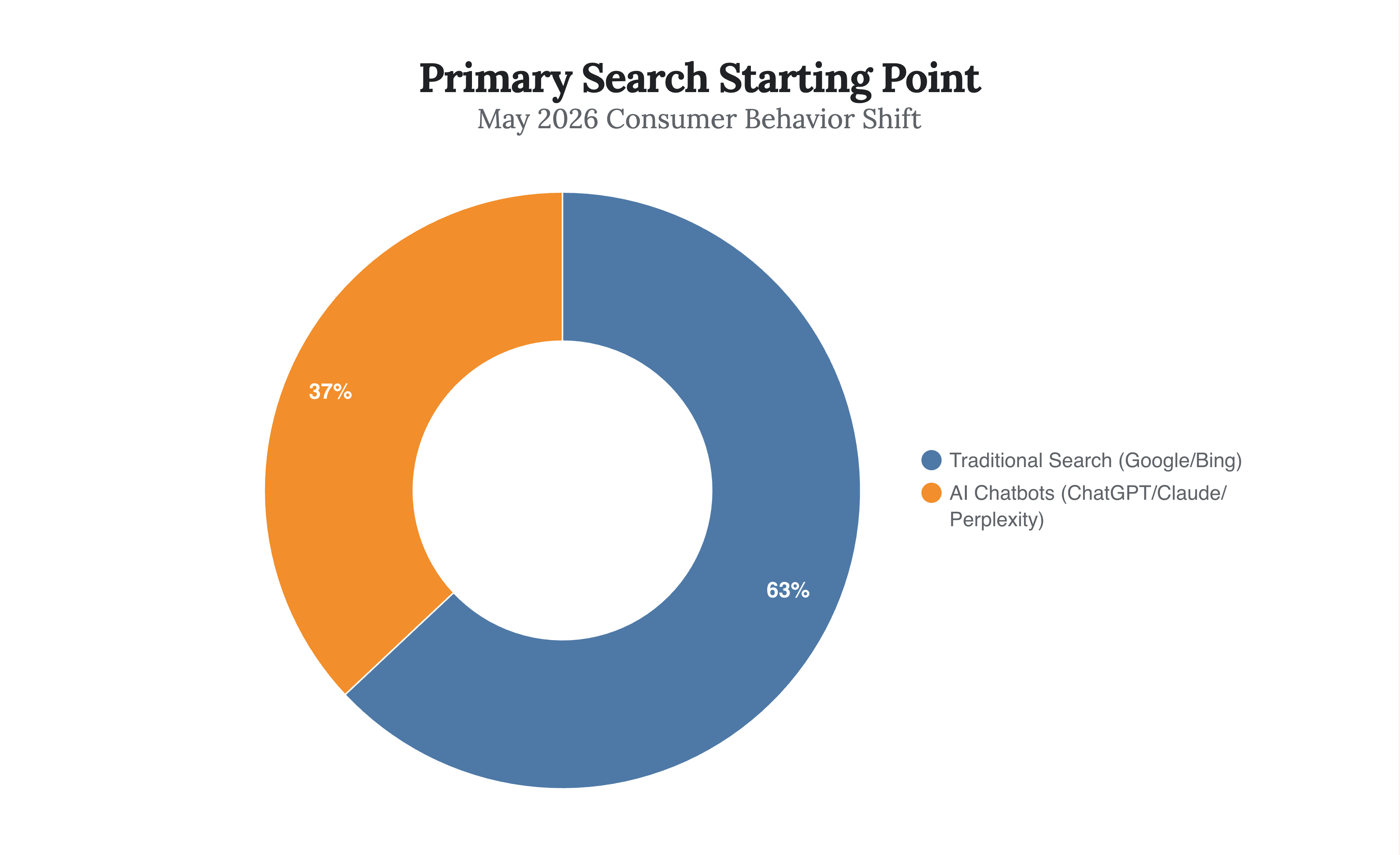
Google’s aggressive pivot to AI Overviews is not occurring in a vacuum; it is a defensive maneuver against a rapidly fragmenting discovery landscape. As of May 2026, OpenAI’s ChatGPT has crossed an estimated 891 million monthly active users, making it the fourth most-visited website globally. More importantly, the psychological habituation of the consumer has shifted. A staggering 37% of active AI users now bypass traditional search engines entirely, utilizing AI chatbots as their primary starting point for digital discovery.
While Google retains an overwhelming ~90% share of total search query volume, the composition of AI-specific referral traffic tells a different story. Despite Google AI Overviews reaching 2 billion users natively on the SERP, ChatGPT drives an overwhelming 87.4% of all external AI referral traffic to third-party websites. Users engaging with OpenAI’s interface are seemingly more likely to click through cited references than users navigating Google’s integrated ecosystem. Perplexity AI, positioning itself strictly as an answer engine, processing hundreds of millions of queries with a highly affluent user base (80% college graduates, 65% high-income white-collar), represents a precise scalpel aimed at Google’s most lucrative demographic. The most dangerous competitor to Google Search is not another search engine, but a chat interface that trains users to expect finality instead of options.
The Economics of Inference: CapEx and the Silicon Chokepoint
Providing generative answers at a global scale of over 8 billion queries per day requires an infrastructural mobilization previously unseen in peacetime economics. In their Q1 2026 earnings release, Alphabet updated its full-year capital expenditure (CapEx) guidance to an unprecedented $180 billion to $190 billion, signaling that 2027 CapEx will increase even further. This capital is not being allocated to traditional servers; it is being incinerated in the pursuit of planetary-scale inference compute, predominantly through the massive deployment of proprietary TPU v5 and v6 architectures, alongside Nvidia GPU clusters.
