



The geopolitical architecture of the European continent is undergoing an accelerated, forced restructuring as of May 2026. Following a direct executive directive, the Pentagon has formally initiated the withdrawal of 5,000 active-duty U.S. military personnel from the Federal Republic of Germany. Scheduled to be executed over the next six to twelve months, this drawdown immediately removes approximately 14% of the 35,989 American service members currently stationed within German borders. The withdrawal of 5,000 U.S. troops from Germany is not a strategic realignment; it is the punitive weaponization of military posture designed to discipline a dissenting ally.
The catalyst for this force reduction is entirely decoupled from theater threat assessments, Russian containment, or conventional deterrence calculus. It is a direct retaliatory mechanism triggered by the diplomatic collision between President Donald Trump and German Chancellor Friedrich Merz regarding the ongoing U.S. conflict with Iran. Following Merz’s public assertion that American negotiators were being “humiliated” by Tehran and that Washington lacked a viable exit strategy, the response was swift kinetic divestment. The data reality is clinically precise: European security structures are now subordinate to the immediate transactional demands of Washington’s bilateral political disputes.
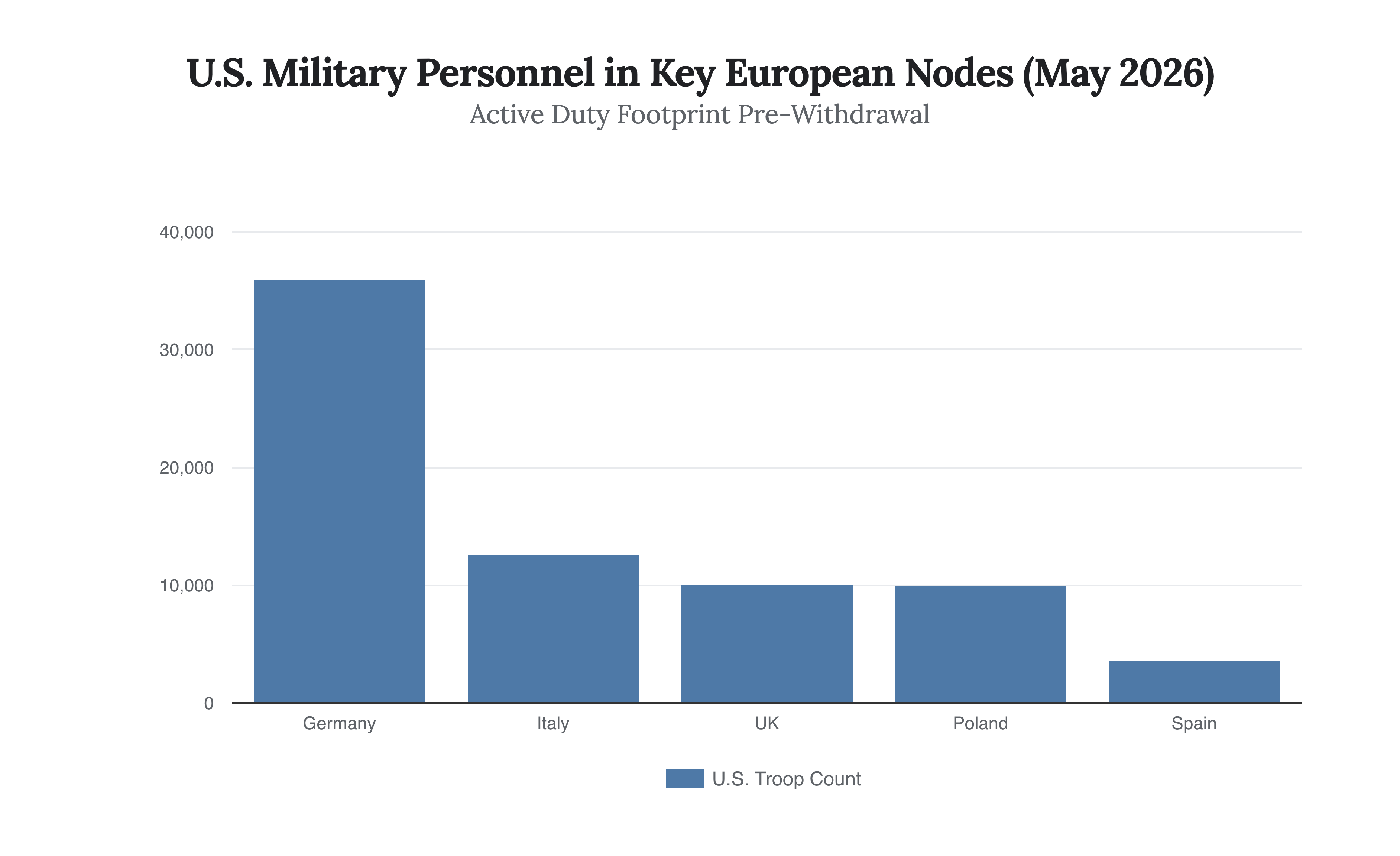
The Operational Anatomy of the Drawdown
The mechanical execution of this withdrawal disproportionately degrades the U.S. Army’s rapid-deployment capabilities across the continent. The primary formation targeted in this force reduction is the 2nd Cavalry Regiment, a Stryker Brigade Combat Team (SBCT) stationed in Vilseck, Bavaria. This unit is not a static garrison force; it is a highly mobile mechanized infantry brigade explicitly designed to project immediate combat power toward NATO’s eastern flank.
By stripping the 2nd Cavalry Regiment from Bavaria, Washington is purposefully blinding its own rapid-response capabilities across the European theater to settle a bilateral political score. The Stryker Brigade represents a vital operational bridge between heavy armored divisions and light infantry. Unlike M1 Abrams-heavy formations, which require weeks of complex rail logistics to move across Europe, Stryker units can road-march directly to flashpoints like the Suwałki Gap within a 96-hour window. Removing this asset does not simply reduce a headcount; it fundamentally severs the kinetic connective tissue that allows U.S. European Command (EUCOM) to operate as a first responder.
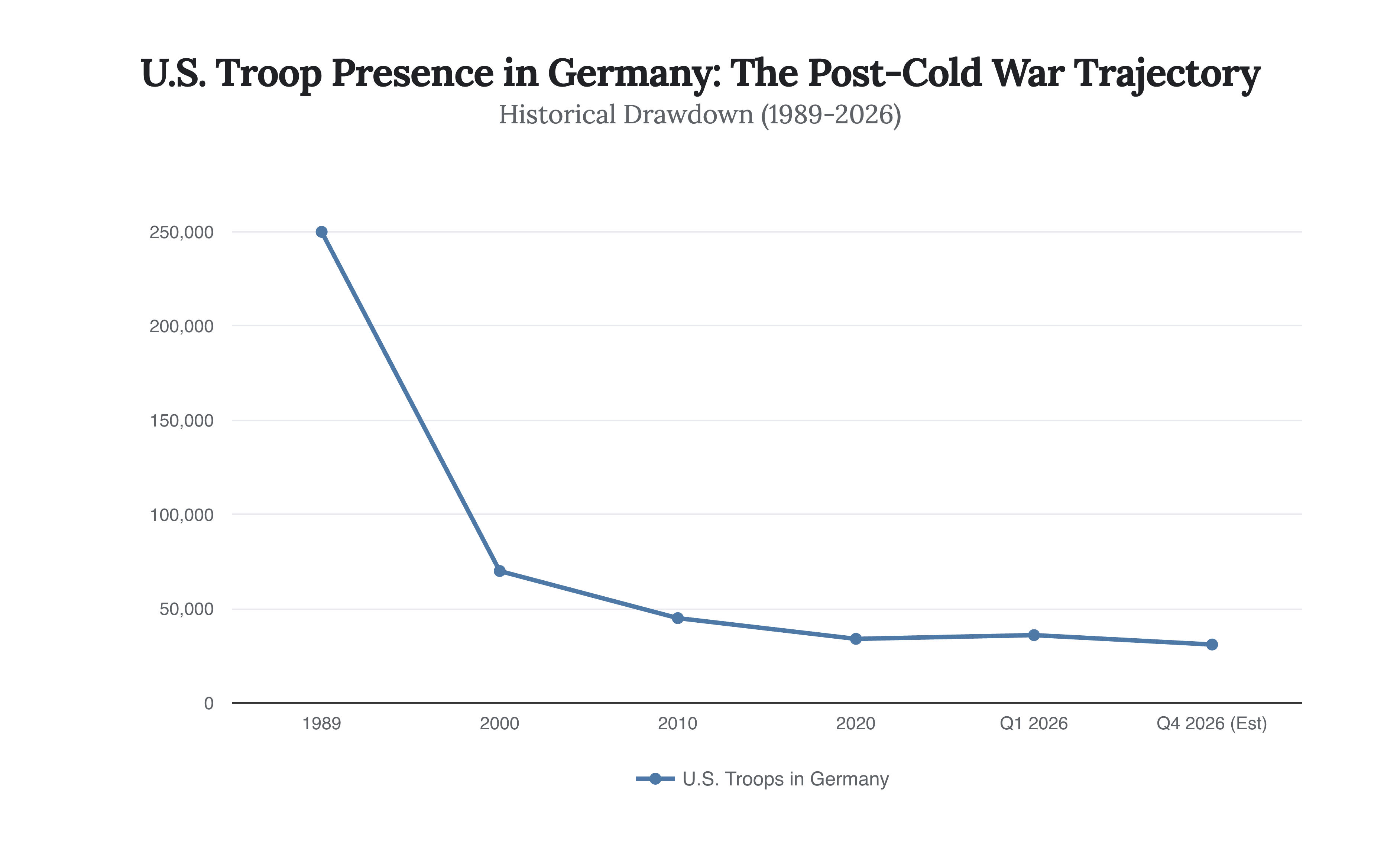
The historical trajectory of U.S. troop levels in Germany highlights the severity of this modern inflection point. From a Cold War peak of roughly 250,000 personnel in 1989, the footprint contracted to approximately 34,000 by 2020, before experiencing a slight surge post-2022. The current May 2026 reduction forces the overall presence down to roughly 31,000 troops, establishing a hollowed-out force posture that prioritizes base maintenance, medical evacuation at Landstuhl, and logistics at Ramstein Air Base over actionable ground-combat mass.
The Capability Void: Long-Range Fires and the MDTF
The secondary, yet arguably more devastating, component of the May 2026 Pentagon directive is the explicit cancellation of planned technological modernizations. The order abruptly halts the deployment of the 3rd Battalion, 12th Field Artillery Regiment. This Long-Range Fires Battalion was scheduled to deploy later this year to integrate into the 2nd Multi-Domain Task Force (MDTF) already operating in Germany.
The MDTF is the cornerstone of the U.S. Army’s future warfare doctrine, integrating electronic warfare, cyber capabilities, and advanced kinetic strikes to penetrate complex Anti-Access/Area Denial (A2/AD) networks like those in Kaliningrad. The 3rd Battalion was slated to field the Typhon system—firing SM-6 and Tomahawk cruise missiles—alongside the Precision Strike Missile (PrSM) platform. By cancelling this deployment, the U.S. has voluntarily denied EUCOM the ability to hold adversary command nodes at risk from standoff distances ranging from 500 to over 1,300 kilometers.
The cancellation of the Long-Range Fires Battalion deployment proves that the United States is now willing to sacrifice theater-level deterrence to enforce transactional loyalty from Berlin. The failure to deploy these systems leaves a critical gap in NATO’s integrated air and missile defense architecture, forcing European capitals to radically accelerate their indigenous procurement timelines for long-range precision fires, recognizing that the American arsenal can be restricted at a moment’s notice.

The Geoeconomic Annihilation of Vilseck
The macro-level strategic shifts are manifesting as localized economic catastrophes on the ground. The Bavarian town of Vilseck, home to the Rose Barracks and the targeted 2nd Cavalry Regiment, faces an immediate demographic and economic implosion. The data reality on the ground is stark: Vilseck has a permanent local population of roughly 6,500 residents. The withdrawal of the Stryker Brigade removes 5,000 active-duty soldiers, alongside an estimated 7,000 to 8,000 dependents, families, and civilian support staff.
