


On April 15, 2026, a Manhattan federal jury delivered a fatal blow to the world’s most untouchable entertainment empire. In a landmark decision, Live Nation Entertainment and its subsidiary Ticketmaster were found liable for operating an illegal monopoly over the live events industry. The specific numbers attached to the verdict—including a precise calculation that Ticketmaster overcharged consumers by exactly $1.72 per ticket across tens of millions of transactions—sound almost clinical in their exactitude. But beneath the surface data, this ruling represents a tectonic shift in modern antitrust enforcement and a masterclass in strategic game theory playing out in real time.
For years, the live entertainment industry operated under a quiet, resigned consensus: Live Nation was simply too big, too entrenched, and too well-lawyered to fail. Yet, the architecture of their dominance has finally been decoded and dismantled in open court.
The Game Theory of a Federal Defection
In early March 2026, just days into the highly anticipated trial, the Department of Justice shocked the live entertainment ecosystem by reaching a sudden, unexpected settlement with Live Nation. The terms were the quintessential definition of “behavioral remedies.” The DOJ required Live Nation to create a $280 million settlement fund, divest a mere 13 amphitheater booking agreements, and adhere to a 15% cap on specific service fees. Live Nation’s leadership, operating under the assumption that settling with the federal apex predator would definitively neutralize the legal threat, critically miscalculated the strategic landscape.
They assumed the coalition of nearly 40 states acting as co-plaintiffs would fold without the unlimited resources and backing of the federal government. Instead, the state attorneys general recognized a classic Information Asymmetry. They knew what industry insiders have known for a decade: behavioral remedies—promises to essentially “play fair”—do not fix structural monopolies.
The true revelation of the April 2026 Live Nation verdict is not merely that a monopoly existed, but that federal regulators blinked first, leaving a renegade coalition of states to successfully dismantle a $25 billion empire.
The states executed a highly credible threat by rejecting the DOJ’s settlement wholesale and pressing forward to a jury trial on their own. By doing so, they shattered Live Nation’s calculated Nash Equilibrium. The entertainment giant had essentially paid $280 million to the federal government for a mere Band-Aid, only to be dragged into a bruising five-week trial by the states—and lose decisively on every major count.
The Weaponization of Vertical Integration
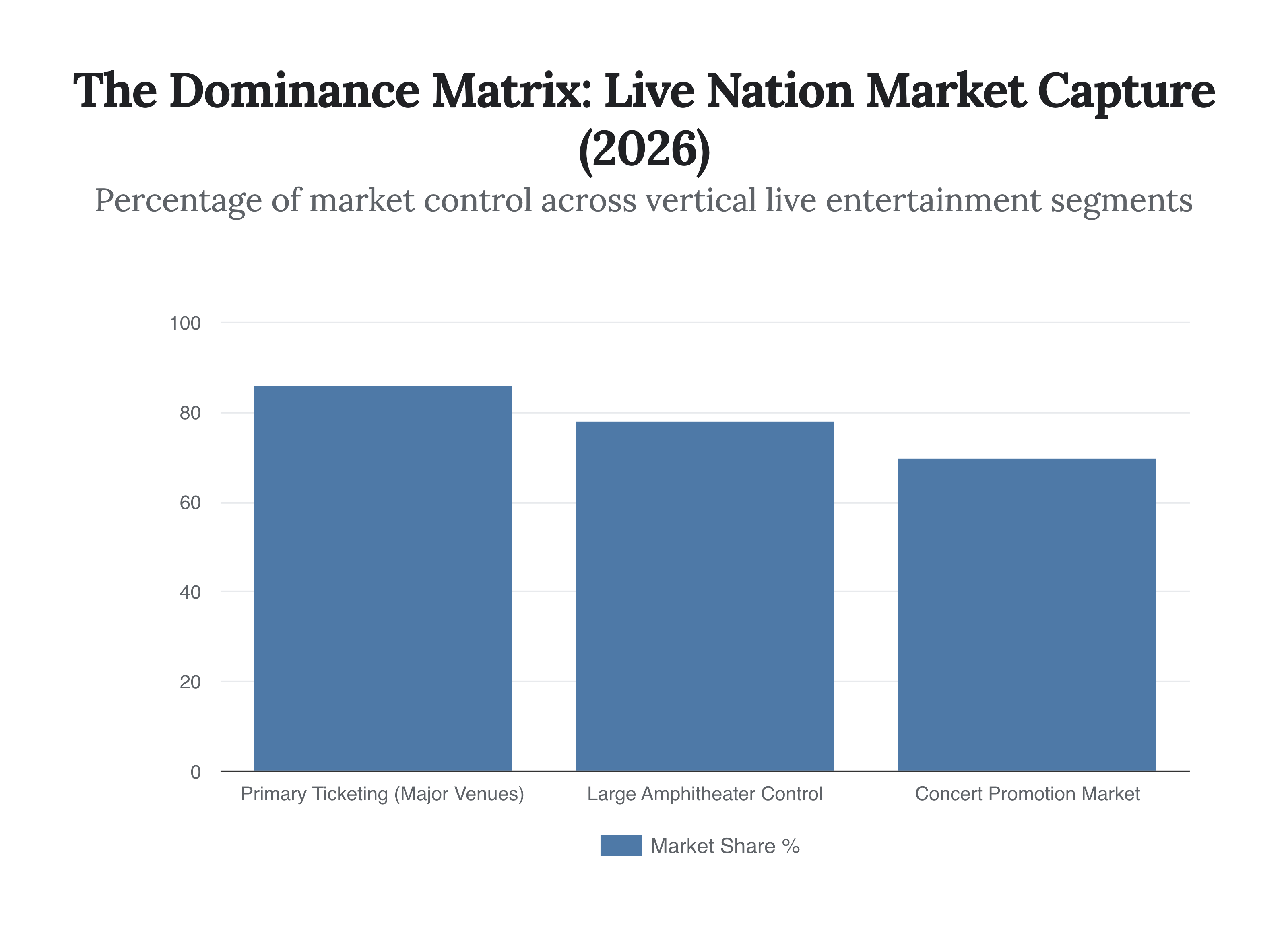
To truly comprehend how Live Nation extracted such immense, resilient value from the market, one must examine the precise architecture of their vertical integration. Live Nation does not simply process the digital tickets; they manage the touring artists, own the physical venues, and execute the event promotions. During the trial, damaging internal communications were brought to light, revealing executives referring to their market strategy as a “velvet hammer”. This is vertical leverage weaponized to its ultimate theoretical limit.
If an independent venue operator wishes to book a top-tier artist who is managed or promoted by Live Nation, they are overwhelmingly pressured into signing long-term, exclusive contracts to use Ticketmaster for their primary ticketing. If the venue refuses and attempts to use a competitor like SeatGeek or AXS, the implicit threat is severe: the blockbuster tour simply skips their venue, starving the operator of vital revenue. This dynamic creates an impenetrable economic moat. It restricts the oxygen of competition and enforces an artificial pricing floor that ultimately trickles down to the consumer in the form of opaque service fees.
Unlock deeper strategic alpha with a 10% discount on the annual plan.
Support the data-driven foresight required to navigate an era of radical uncertainty and join a community of institutional-grade analysts committed to the truth.
A Financial Juggernaut Under Fire
The profound irony of the April 2026 verdict is that it arrived just as Live Nation was quietly concluding the most lucrative operational period in its corporate history. While fighting an existential antitrust battle, the fundamental business was printing cash at unprecedented scale.
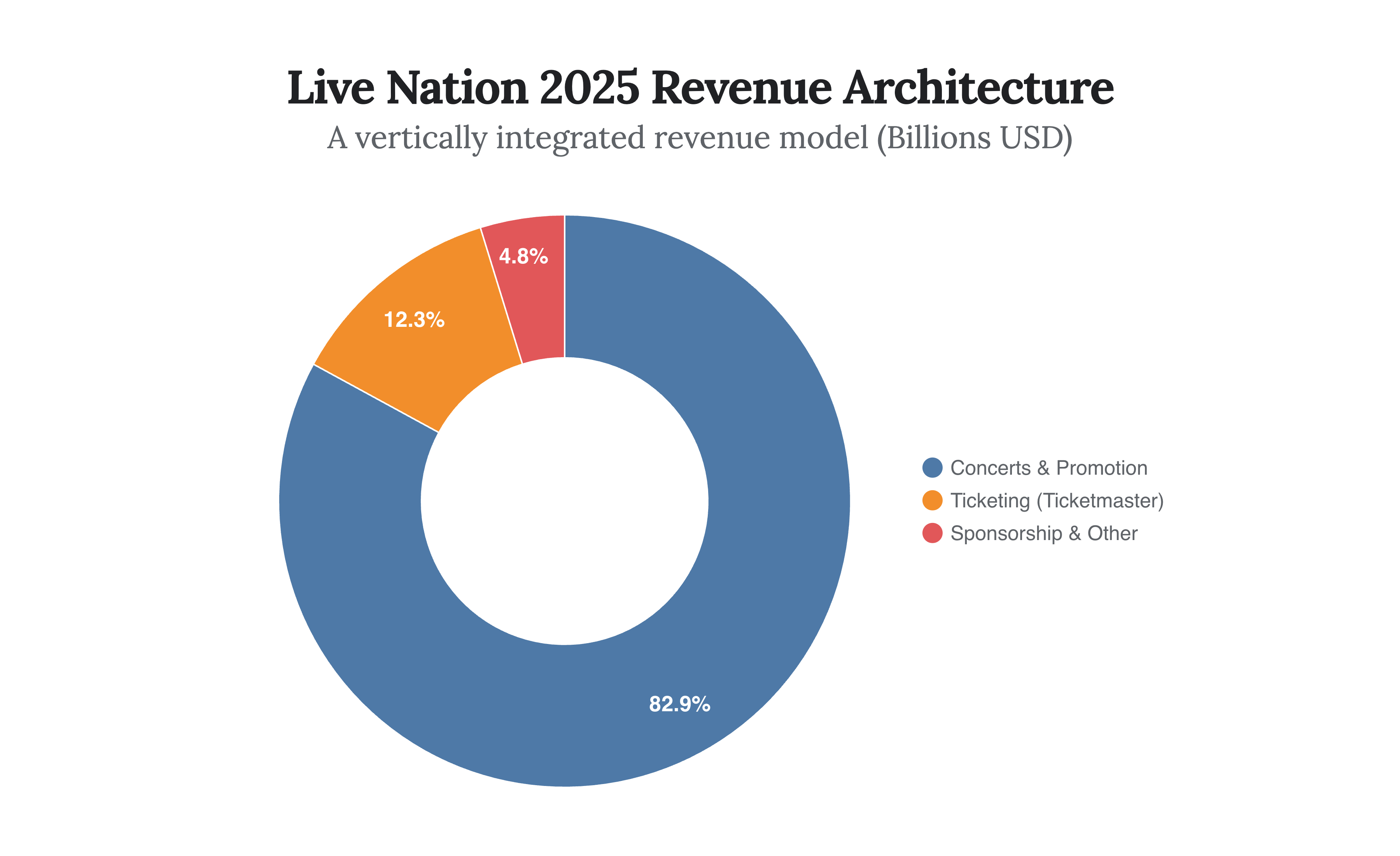
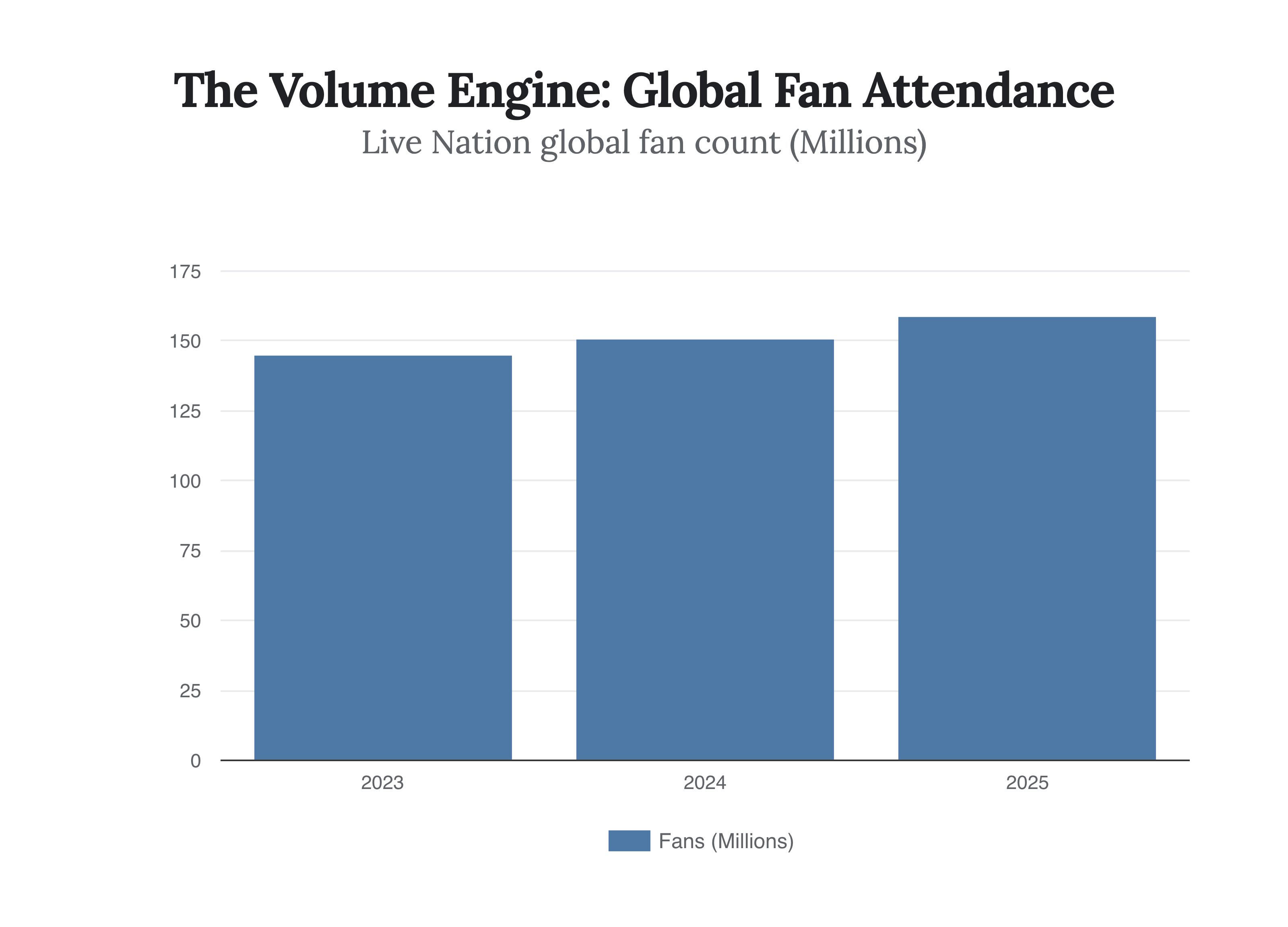
In their February 2026 earnings report, covering the full 2025 fiscal year, Live Nation posted a staggering $25.2 billion in total global revenue—a 9% year-over-year expansion. More tellingly, they hosted a record-breaking 159 million fans across 55,000 shows globally. For the first time, international fan attendance eclipsed domestic U.S. numbers, proving the model’s global scalability.
To add context to this financial dominance, one must look at the forward guidance the company provided just weeks before the trial commenced. In February 2026, Live Nation projected that 2026 would be yet another record-breaking year, noting that 80% of their large venue shows for the year were already booked. Furthermore, the company reported $4 billion in deferred revenue—cash already collected for events that haven’t even happened yet. This staggering metric highlights the ultimate asymmetric advantage of the ticketing monopoly: Live Nation operates as a de facto bank, holding billions in consumer capital at zero interest before delivering the product.
The financial paradox embedded in these figures is a critical signal for strategic intelligence. Live Nation frequently argues in public relations campaigns and congressional hearings that their ticketing margins are incredibly thin, asserting that the vast majority of face-value ticket revenue and fees go directly to artists and independent venues. Yet, the sheer math of their scale overrides this defense. The $3.1 billion generated strictly from ticketing operations in 2025 proves that even a mathematically “thin” margin, when applied to 346 million fee-bearing tickets, yields a massive, hyper-predictable cascade of cash flow.
When a corporate entity commands 86% of the primary ticketing market, the true profit is not found in the margin elasticity—it is guaranteed by the absolute, unavoidable volume of the tollbooth.
The Impending Structural Anvil
What happens next is where the true strategic alpha lies for institutional investors, venue operators, and market participants. Following the April 15 liability verdict, Judge Arun Subramanian will now preside over a highly anticipated remedy phase via a separate bench trial. Having secured a decisive victory with the jury, the coalition of states is aggressively pushing for structural remedies—most notably, the forced divestiture of Ticketmaster from Live Nation entirely.
Behavioral remedies, such as the DOJ’s earlier attempt to impose a 15% fee cap at select amphitheaters, are notoriously fragile. They are easily circumvented by complex corporate accounting, rebranding fees, or shifting costs to other unregulated segments of the vertical stack. Structural remedies, however, fundamentally alter the geometry of the board.
If Ticketmaster is spun off as a standalone, independent entity, the artificial economic link between artist promotion and venue ticketing is permanently severed. Venues will suddenly regain the sovereign agency to field competitive bids from rival ticketing platforms without the latent, existential fear that Live Nation will retaliate by routing major stadium tours to a competing venue down the street.
When behavioral remedies fail to constrain a $25 billion entertainment monopoly, the only remaining market corrective is the total, unsparing structural divestiture of its ticketing apparatus.
For the broader market, the signal is flashing bright red. A forced corporate divestiture in late 2026 or 2027 would trigger the largest repricing of live entertainment assets in two decades. Live Nation has already vowed to appeal the jury’s verdict, leaning heavily on the narrative that their sheer scale and dominance are merely the result of superior execution rather than anticompetitive malice.
But the jury has spoken, and the data paints a vastly different picture of coercion and artificial market capture. The velvet hammer has finally met the anvil of state-level enforcement, proving that in the modern era of antitrust law, even the most impenetrable monopolies are just one credible threat away from structural collapse.