



The Liquidity Paradox of Q1 2026
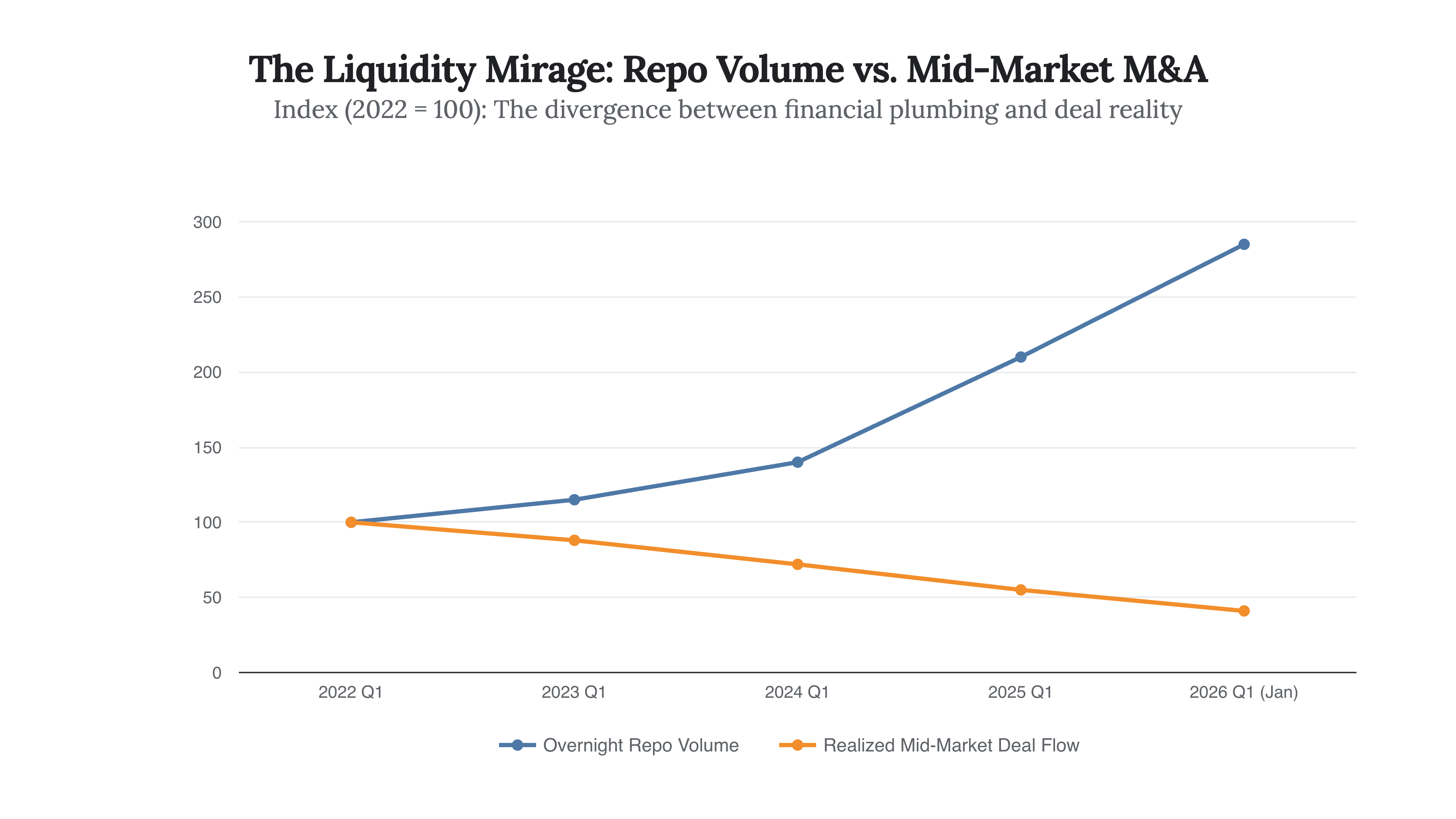
As we close the books on January 2026, a singular, terrifying paradox has gripped the institutional landscape. If you look at the headline metrics, the system is awash in cash. The overnight repo market has exploded from $6 trillion in 2024 to a staggering $12.6 trillion today. Blackstone is declaring that dealmaking has reached “escape velocity.” AI-focused venture rounds are closing at valuations that defy gravity, with Anthropic’s recent capital injection valuing the firm at over $61 billion. On the surface, the machine is humming. Everyone is talking. The noise is deafening.
But look at your calendar. Look at your finalized transaction log. The velocity of money has decoupled from the velocity of speech.
We are currently living through a “Phantom Liquidity” crisis. While central banks and mega-cap tech firms churn capital in a closed loop of high-frequency treasury operations and AI infrastructure build-outs, the real economy—mid-market M&A, commercial real estate refinancing, and Series B venture capital—has entered a deep freeze. The spread between outreach volume (emails, invites, pitches) and meeting realization (term sheets signed, wires sent) has never been wider. We call this the “Ghost Economy,” and it is defined not by a lack of capital, but by a catastrophic collapse in the two things required to deploy it: valuation consensus and counterparty trust.
This dossier dissects the structural breakdown of early 2026. We are witnessing the collision of the 2026 CRE Maturity Wall, the Private Equity liquidity trap, and the degradation of digital communication channels by agentic AI. You are not imagining the silence. It is structural.
The $1.8 Trillion Maturity Wall Has Breached
For three years, the mantra in Commercial Real Estate (CRE) was “Extend and Pretend.” Lenders engaged in a conspiracy of benevolence with borrowers, granting 12-month extensions in 2024 and 2025, praying for a return to the zero-interest-rate policy (ZIRP) era. That prayer has gone unanswered. The Federal Reserve’s pivot in late 2025 was too mild and came too late. Now, the bill has arrived.
