


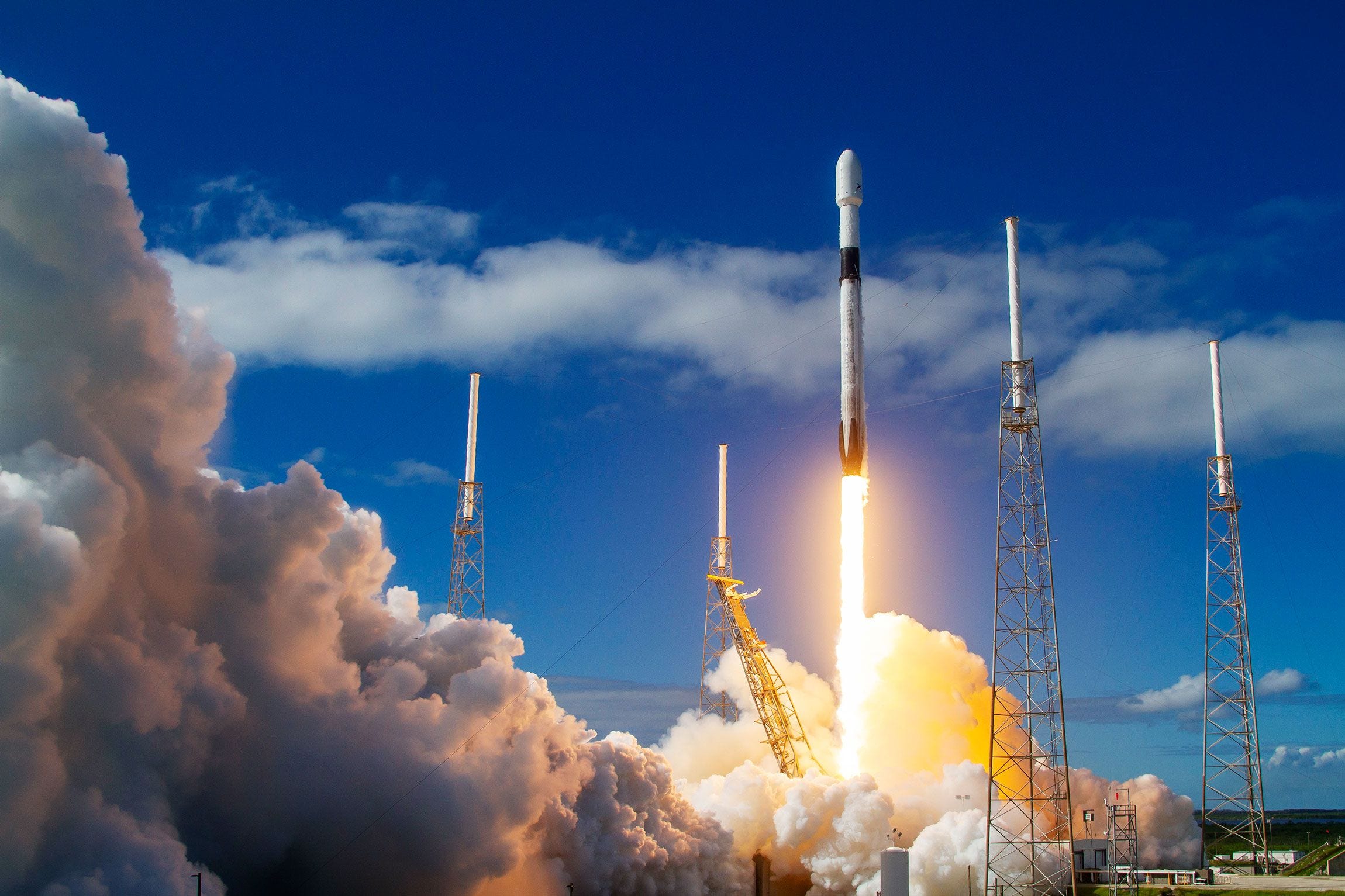
SpaceX’s Starlink satellite launch campaign represents one of the most aggressive and strategically significant deployments of space hardware in history. The sheer velocity of this effort is not merely a logistical achievement; it is a foundational element of the company’s competitive strategy, creating a multi-layered moat that encompasses economics, technology, and market access. In 2024 alone, SpaceX conducted 134 Falcon launches, with a staggering 89 dedicated to expanding the Starlink constellation.
This pace, averaging a Starlink-centric launch every four days, has enabled the company to deploy over 7,600 satellites to date and serve over seven million subscribers across 150 countries. This briefing deconstructs the strategic pillars of Starlink’s launch dominance, analyzes the technological evolution fueling its expansion, and provides a forward-looking assessment of the insurmountable challenges it presents to competitors and the long-term implications for global connectivity.
The Relentless Cadence: Forging Supremacy in Low Earth Orbit
The core of Starlink’s strategic advantage lies in its unprecedented launch cadence, a capability built upon the bedrock of its reusable Falcon 9 rocket. This relentless pace of deployment is a weaponized form of vertical integration, allowing SpaceX to build out its constellation at a speed and cost that competitors, reliant on third-party launch providers, simply cannot match. The operational tempo has been steadily accelerating, transforming Low Earth Orbit (LEO) into a domain largely defined by Starlink’s presence.
The Exponential Growth of a Mega-Constellation
Since the first operational launch in 2019, the number of Starlink satellites deployed annually has grown exponentially. In 2023, SpaceX launched over 2,000 Starlinks, and the pace in 2024 and 2025 has continued to accelerate, with the company deploying over 2,500 satellites in 2025 alone. This aggressive schedule is not just about populating the constellation; it’s about achieving critical mass to offer global coverage, densifying the network to increase capacity and speed, and constantly replenishing older satellites to maintain the network’s health. The result is a constellation that now comprises over 65% of all active satellites in orbit.
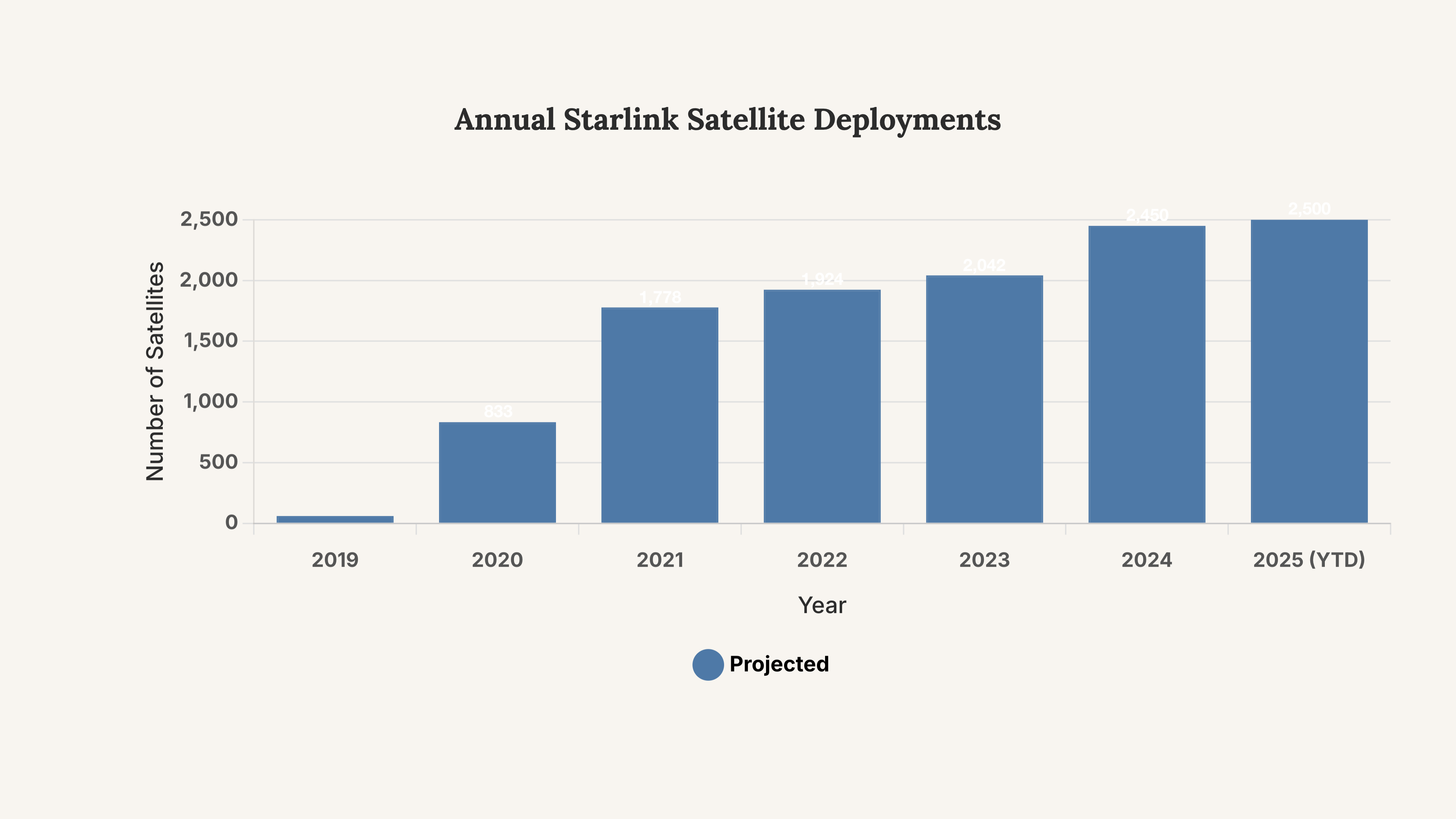
Caption: The chart above illustrates the dramatic acceleration in the number of Starlink satellites launched annually, showcasing a near-exponential growth curve that has allowed SpaceX to rapidly establish a dominant orbital presence.
Mastery of Reusability and Launch Economics
The engine driving this cadence is the Falcon 9’s reusability. By routinely recovering and reflying first-stage boosters, SpaceX has fundamentally altered the economics of space access. This capability has driven down the marginal cost of a launch, enabling the company to dedicate a majority of its manifest to its own internal project without crippling financial strain. While exact internal costs are not public, the ability to launch at a fraction of the price charged to external customers creates a powerful economic moat. Competitors like Amazon’s Project Kuiper and the Eutelsat OneWeb constellation face a stark reality: they must either pay market rates for launch services—often from competitors like SpaceX itself—or invest billions in developing their own reusable launch systems, a process that takes the better part of a decade.
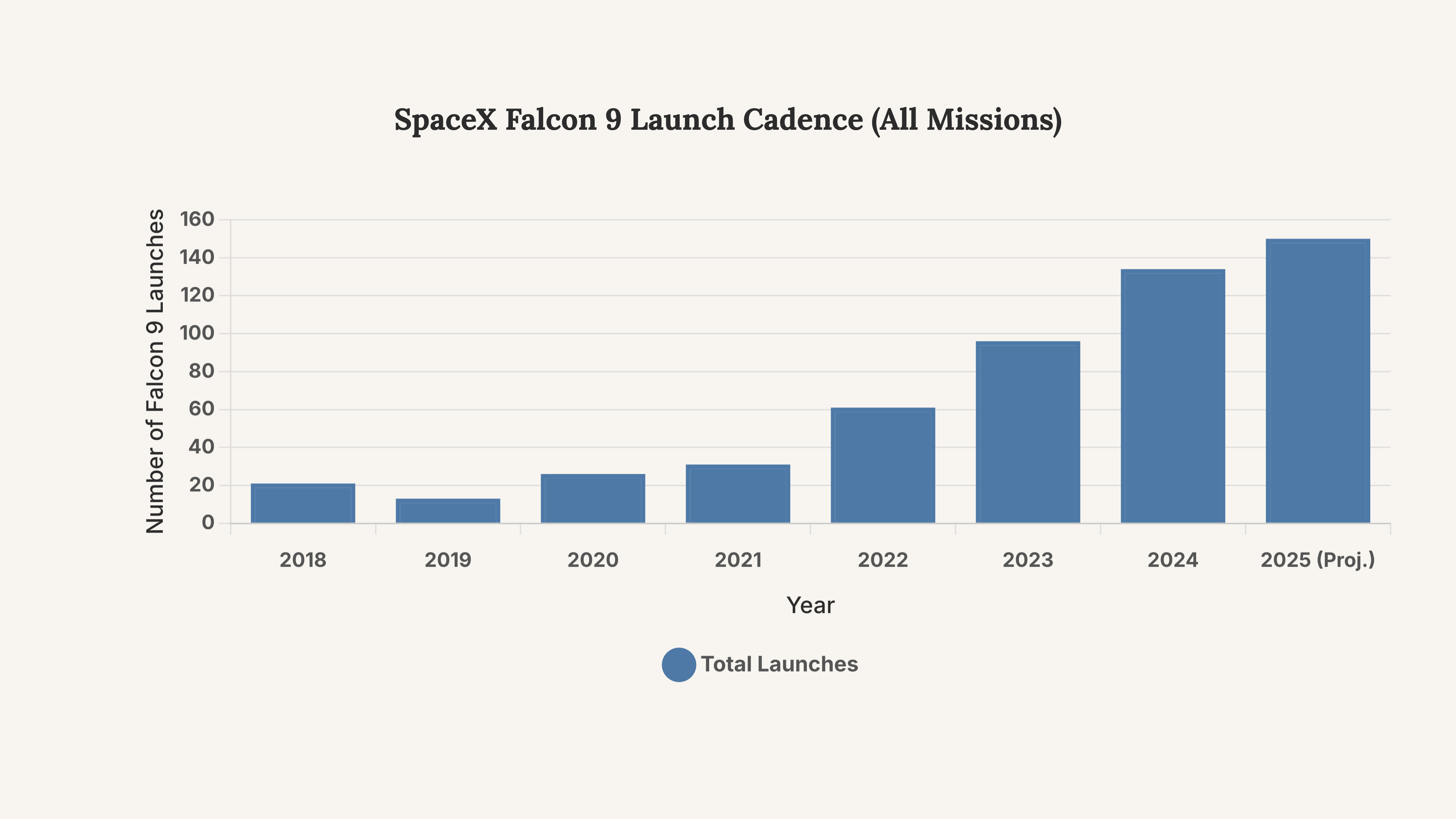
Caption: This data shows the rapid increase in SpaceX’s overall launch activity, a prerequisite for the high-cadence deployment of the Starlink network. The surge from 2021 onwards directly correlates with the aggressive expansion of the constellation.
The Technological Evolution of the Constellation
Starlink’s dominance is not solely a function of numbers; it is also a story of rapid technological iteration. The ability to launch frequently allows SpaceX to deploy new satellite generations and capabilities at a pace that is impossible in the traditional satellite industry, where spacecraft are designed to operate for 15 years or more. Starlink satellites have a much shorter design life of around five years, turning the constellation into a constantly evolving, improving infrastructure layer in orbit.
From V1.5 to V2 Mini: A Leap in Capability
The transition from the workhorse V1.5 satellites to the newer V2 Mini satellites marks a significant leap in network capacity. Launched via the Falcon 9, the V2 Minis are an interim step towards the full-sized V2 satellites planned for Starship. Despite the “Mini” designation, each of these satellites has approximately four times the bandwidth capacity of the earlier V1.5 models. This is achieved through more powerful phased-array antennas and the use of E-band for backhaul, freeing up more Ka- and Ku-band spectrum for user links. The V2 Minis are also heavier, weighing around 800 kg compared to the approximately 306 kg of the V1.5s, which reduces the number of satellites that can be launched on a single Falcon 9 but significantly increases the total bandwidth deployed per mission.
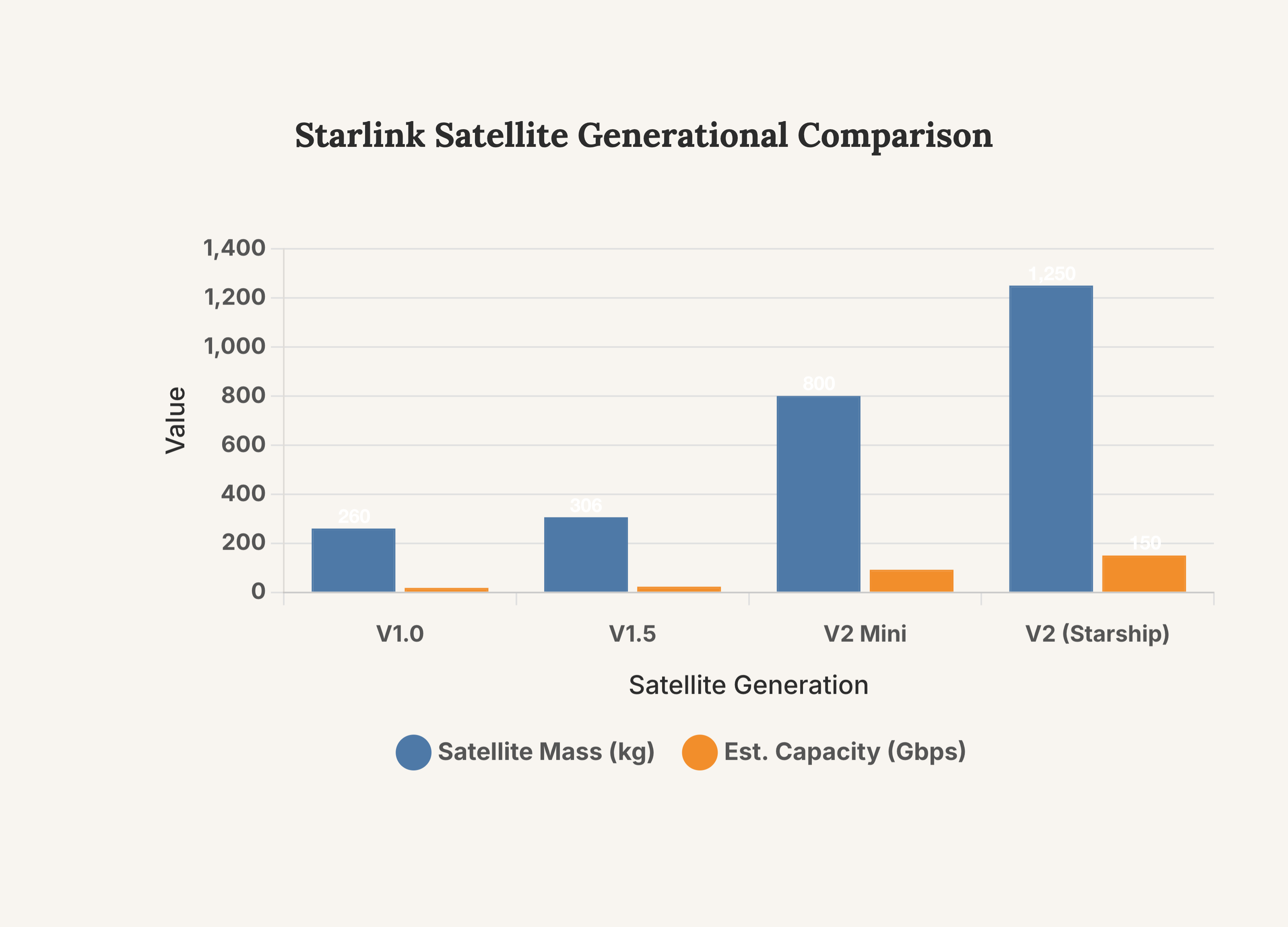
Caption: This chart highlights the substantial increase in both mass and estimated bandwidth capacity with each new generation of Starlink satellites. The jump to the V2 Mini represents a quadrupling of capacity, a key factor in network performance improvement.
The Dawn of Direct-to-Cell Connectivity
One of the most disruptive innovations integrated into recent Starlink launches is the “Direct to Cell” payload. The first satellites with this capability were launched in early 2024, and by the end of the year, texting services were already being tested with partners like T-Mobile. This technology allows standard LTE smartphones on the ground to connect directly to the satellites, bypassing the need for traditional cell towers and eliminating mobile dead zones. SpaceX is rapidly launching hundreds of these satellites to enable text services initially, with voice and data services planned for 2025. This move positions Starlink not just as a rural broadband provider but as a global telecom infrastructure player capable of challenging incumbent mobile network operators.
Remaking the Economics of LEO: From Niche to Mass Market
The combination of low-cost, high-cadence launches and mass-produced, rapidly iterating satellites has allowed SpaceX to fundamentally reshape the economic landscape of LEO. Starlink is driving a paradigm shift from bespoke, expensive satellites to a mass-market, service-oriented model, putting immense pressure on all other players in the satellite industry.
Subscriber Growth Fueled by Orbital Density
Starlink’s subscriber growth has been explosive, directly correlated with the expansion of its orbital constellation. After reaching one million subscribers in late 2022, the service surged to four million by September 2024 and is reported to have crossed seven million by mid-2025. This rapid user acquisition is only possible because the launch campaign continuously adds capacity to the network, preventing the service degradation that would otherwise occur from oversubscription. The ability to add terabits of capacity with each launch allows Starlink to absorb millions of new users while simultaneously improving median download speeds.
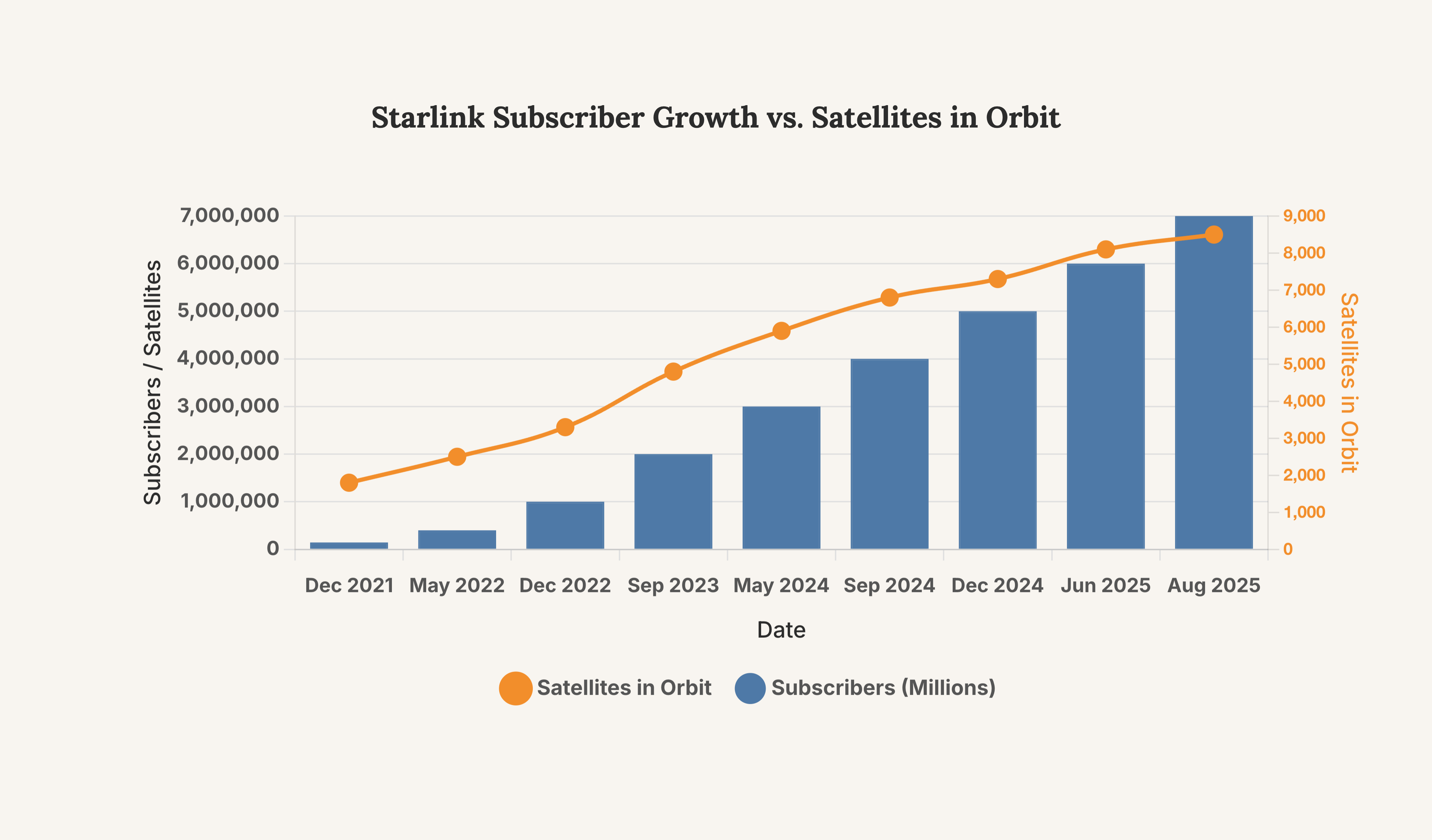
Caption: This combination chart illustrates the symbiotic relationship between constellation size and user growth. As the number of satellites in orbit (the line) has steadily increased, it has enabled an acceleration in subscriber acquisition (the bars).
“We are seeing a variety of companies that are actually building hardware and shooting into space... but it isn’t just Starlink anymore... the space is going to get really crowded as a result.” - Jonathan McDowell, Astrophysicist, Harvard-Smithsonian Center for Astrophysics.
Despite the rise of other constellations, the sheer scale of Starlink’s deployment sets it apart. The network’s density is a key performance differentiator, enabling lower latency and more resilient service. While competitors like OneWeb have completed their initial 634-satellite constellation, they are dwarfed by Starlink’s thousands of operational spacecraft.
Strategic Foresight: The Starship Catalyst
While the Falcon 9 has been the engine of Starlink’s rise, the company’s next-generation Starship vehicle represents an existential threat to any remaining competition. Starship promises to reduce launch costs by another order of magnitude and, crucially, to deploy a new, much larger generation of Starlink satellites that are physically too big to fit in a Falcon 9 fairing. Recent test flights have already demonstrated a key deployment mechanism for these future satellites.
The V2 Satellite: A Paradigm Shift in Bandwidth
The full-sized Starlink V2 satellites, designed for launch on Starship, will be a game-changer. These satellites are expected to weigh around 1,250 kg and offer roughly ten times the bandwidth of the first-generation models. A single Starship launch could deploy dozens of these satellites, adding more capacity to the network in one mission than multiple Falcon 9 launches combined. This will not only enable Starlink to serve tens of millions more customers but will also unlock higher-end enterprise and government services that require immense bandwidth, such as 4K video streaming and real-time cloud computing.
“The next generation [Starlink] satellite will launch on Starship and deliver gigabit connectivity anywhere in the world.” - Michael Nicolls, VP of Engineering, Starlink.
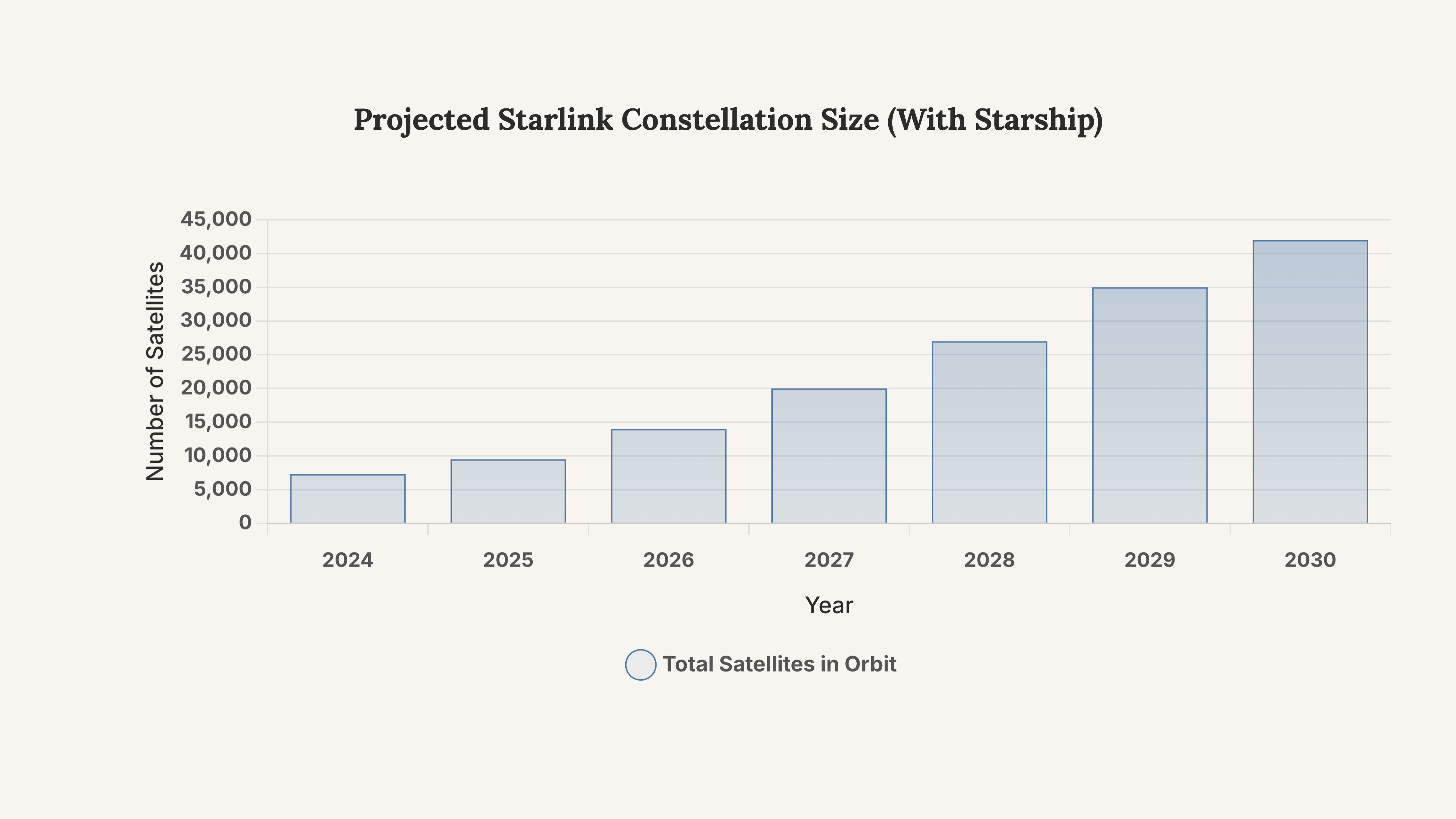
Caption: This projection illustrates the potential for exponential growth in the Starlink constellation once Starship becomes fully operational for satellite deployment, potentially enabling the full 12,000-satellite initial plan and subsequent expansions to over 40,000.
The implications of this launch capability are profound. It will allow SpaceX to build a network with such overwhelming capacity and a low enough cost basis that it could effectively monopolize the LEO broadband market. The barrier to entry for any potential competitor will rise from billions to tens of billions of dollars, coupled with the need to develop a fully and rapidly reusable super-heavy launch vehicle.
In conclusion, the Starlink launch campaign is far more than a series of deployments; it is a masterclass in strategic execution. By leveraging a vertically integrated, high-cadence launch system, SpaceX is not just building a satellite network; it is constructing an economic and technological fortress. The relentless pace of launches enables rapid technological iteration, constant capacity expansion, and a cost structure that competitors cannot replicate. The impending operational debut of Starship is set to amplify this advantage to an almost insurmountable degree, cementing Starlink’s position as the dominant force in satellite communications for the foreseeable future. The true product is not the satellite or the internet service, but the launch capability itself—a strategic asset that is actively reshaping the future of the global space economy.