


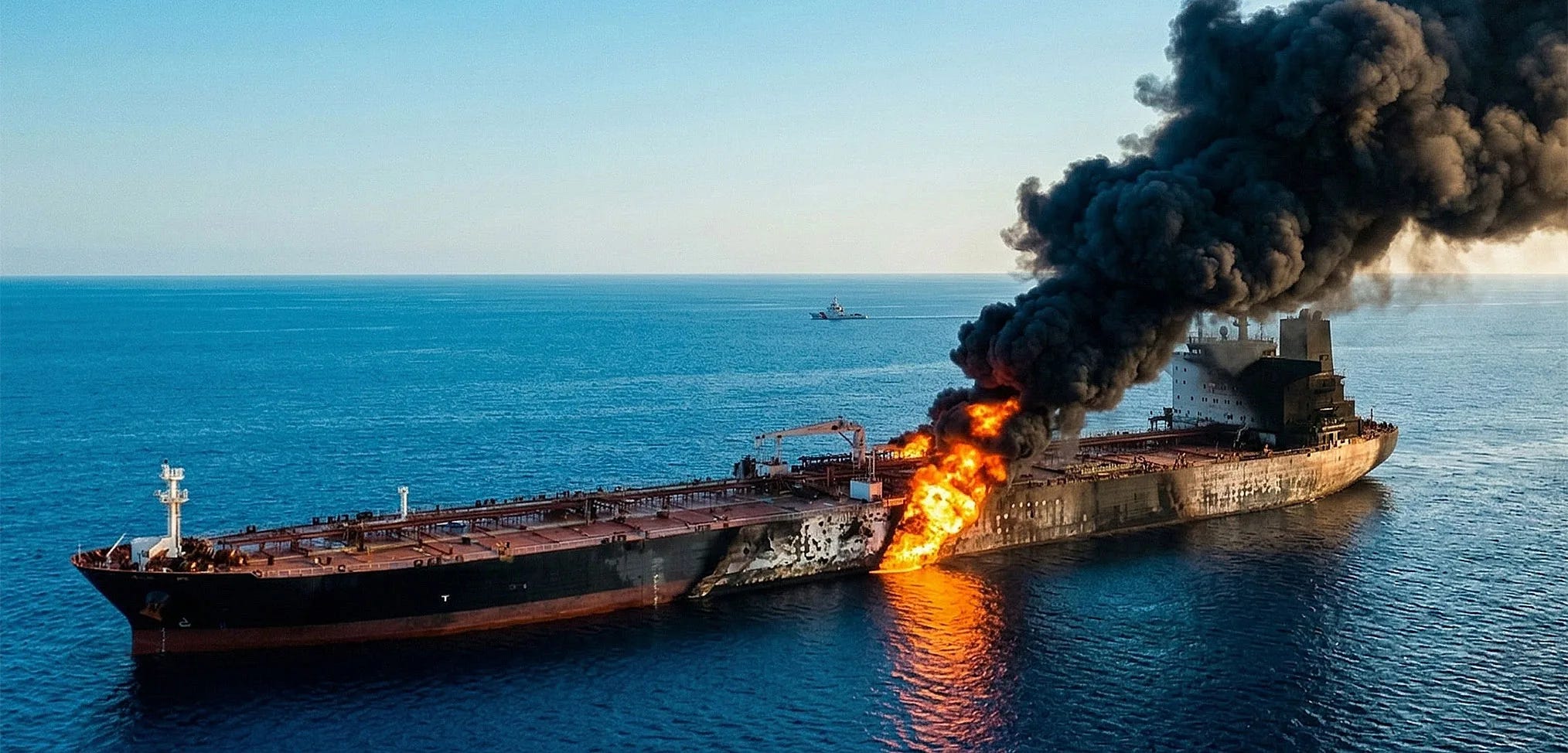
On February 28, 2026, the geopolitical tectonic plates beneath the Middle East fractured. Following joint United States and Israeli military strikes against Iranian leadership—which resulted in the death of Supreme Leader Ali Khamenei—the Strait of Hormuz went into immediate cardiac arrest. This 21-mile-wide maritime artery, which serves as the sole exit from the Persian Gulf to the open ocean, is not merely a regional shipping lane. It is the central nervous system of the modern industrialized world.
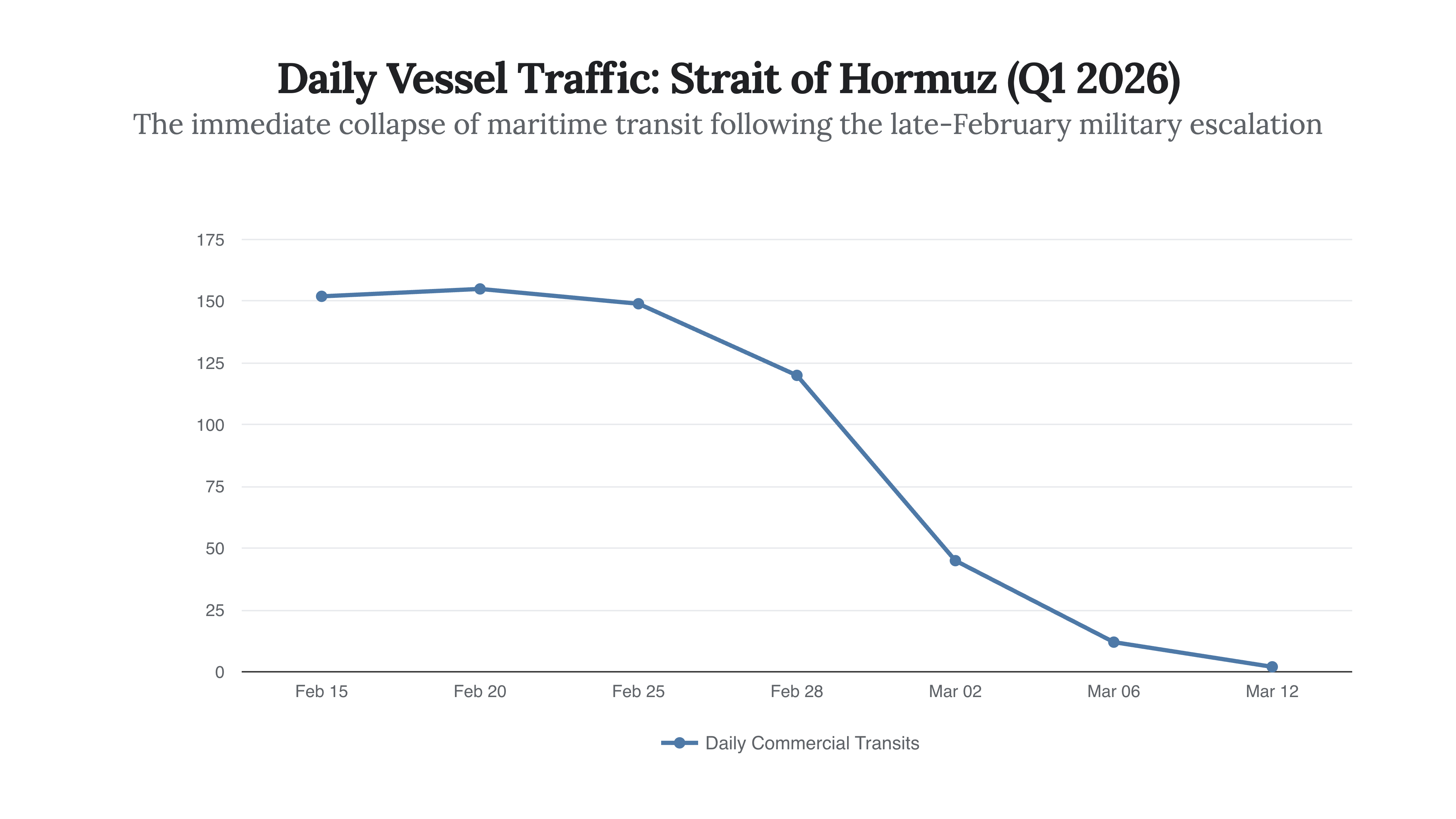
To understand the sheer magnitude of this crisis, we must look at the hard data from Q1 2026. Prior to the escalation, the strait facilitated the transit of approximately 20 million barrels per day (mb/d) of crude oil and petroleum liquids, accounting for roughly 20% to 25% of all global seaborne oil trade. In tandem, it carried over 112 billion cubic meters (bcm) of liquefied natural gas (LNG) annually, predominantly from Qatar and the UAE, representing roughly 20% of total global LNG trade. In a matter of days, the corridor transitioned from a bustling superhighway averaging 153 daily vessel transits to a militarized ghost town. Following explicit warnings from the Islamic Revolutionary Guard Corps (IRGC) and subsequent strikes on commercial vessels, tanker traffic has dropped to near absolute zero.
The Geography of Absolute Leverage
The Strait of Hormuz represents the ultimate geographical monopoly. The global economy has spent decades optimizing for hyper-efficient, just-in-time supply chains, deeply dependent on frictionless maritime trade. But efficiency is the enemy of resilience. The current blockade exposes a catastrophic single point of failure. In modern asymmetric warfare, a $10,000 loitering munition can indefinitely paralyze a $600 billion annual energy corridor.
As of early March 2026, over 150 tankers have dropped anchor outside the strait, refusing to risk their crews or their billion-dollar cargo loads without protection and indemnity insurance—which major underwriters have largely withdrawn. Major global carriers, including Maersk, MSC, and CMA CGM, have entirely suspended transits. The market reaction was violent and immediate, with Brent crude briefly surging past $126 per barrel, marking the largest physical disruption to the global oil market since the 1970s energy crisis.
The Rationality of Maximum Disruption
To analyze this through the lens of strategic logic, we must discard the notion that Iran’s actions are merely retaliatory tantrums. This is a highly calculated manipulation of systemic vulnerabilities. Iran has correctly identified global economic disruption as its highest-leverage pressure point. By holding a fifth of the world’s energy supply hostage, Tehran is not trying to win a conventional naval war; it is attempting to alter the cost-benefit analysis of its adversaries by weaponizing inflation and supply scarcity on a planetary scale.
The ruthlessness of this game theory is most evident in how Iran is treating its allies. Beijing has publicly urged all parties to keep the strait open. China is heavily exposed, relying on the Strait of Hormuz for 40% of its oil imports and 30% of its LNG. Early market assumptions in 2025 suggested that Chinese-flagged vessels might enjoy a “green light” due to diplomatic alignment. The March 2026 data shatters this illusion. Ship-tracking data reveals that Chinese tankers are trapped alongside Western vessels. When regime survival is on the line, the rational strategic move is to inflict maximum indiscriminate economic pain on the global system, regardless of who gets caught in the crossfire.
Unlock deeper strategic alpha with a 10% discount on the annual plan.
Support the data-driven foresight required to navigate an era of radical uncertainty and join a community of institutional-grade analysts committed to the truth.
The Dangerous Illusion of the Pipeline Bypass
For forty years, defense planners and energy traders slept soundly under a shared, comforting assumption: if the Strait of Hormuz ever closed, the Gulf states had a backup plan. Saudi Arabia’s East-West Pipeline (Petroline) to the Red Sea and the United Arab Emirates’ Abu Dhabi Crude Oil Pipeline (ADCOP) to the Gulf of Oman were touted as the ultimate insurance policies. The stark reality of Q1 2026 proves this narrative was dangerously incomplete.
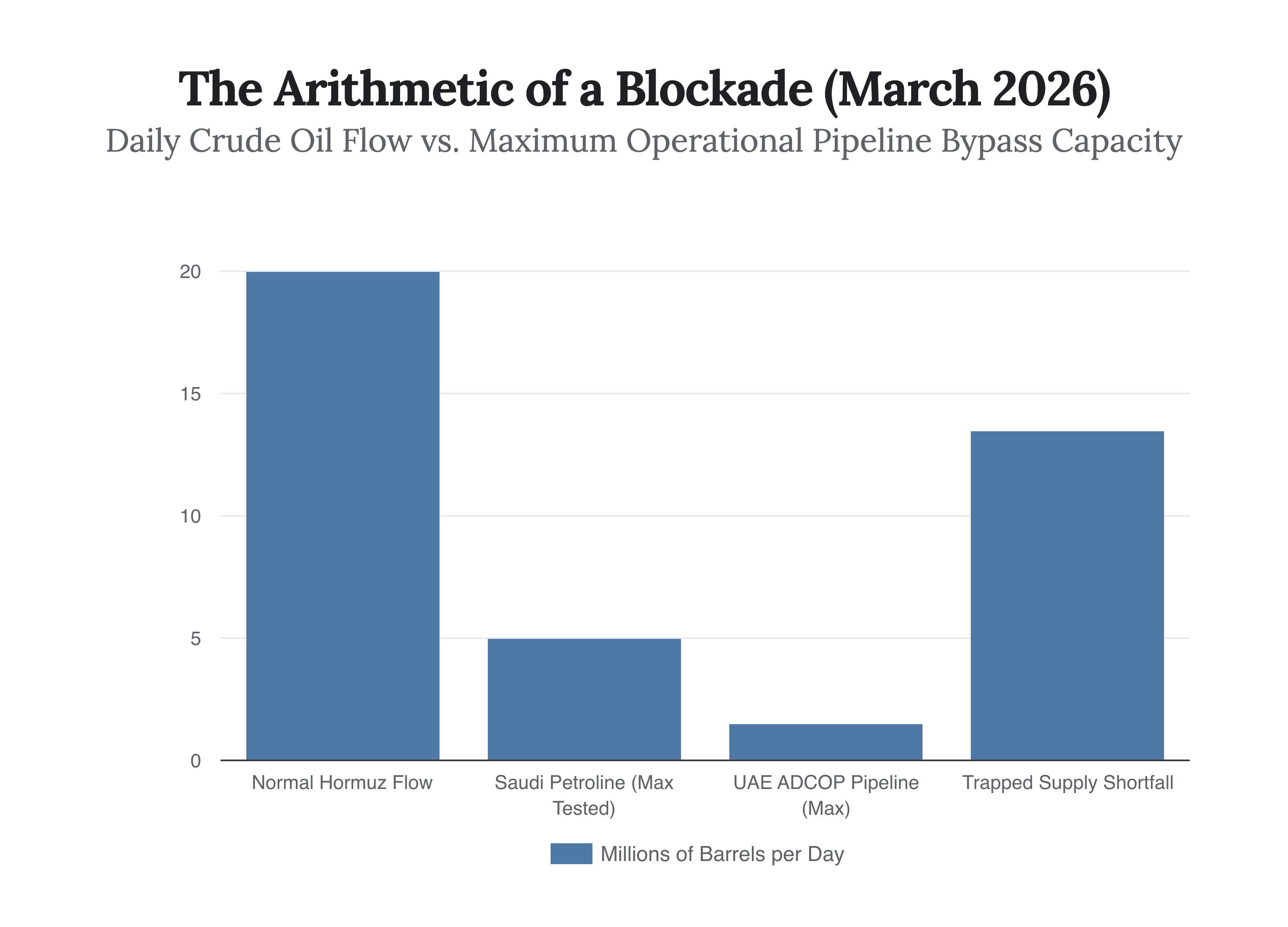
Let us look at the arithmetic. Normal daily crude flow through the strait is 20 mb/d. Saudi Arabia’s Petroline was recently expanded to a nominal capacity of 7 mb/d, but market sources and historical flow testing indicate the Red Sea export terminals at Yanbu can effectively handle closer to 4 to 5 mb/d under wartime operational constraints. The UAE’s ADCOP can transport roughly 1.5 to 1.8 mb/d to Fujairah. Iraq, Kuwait, and Bahrain have virtually zero viable bypass infrastructure.
Even if every bypass pipeline operates at absolute maximum capacity, they can only offset roughly 5.5 mb/d. This leaves a staggering, unmitigated shortfall of nearly 14.5 million barrels per day trapped behind the blockade. For four decades, global markets priced in the assumption that Gulf bypass pipelines were an ironclad insurance policy—today, the math proves they are barely a band-aid on a structural hemorrhage. The infrastructure was originally designed to bleed off the pressure of a short-term, partial disruption, not to sustain the global economy through an indefinite closure.
The Zero-Sum Game of Liquefied Natural Gas
If the crude oil scenario is dire, the natural gas landscape is staring into the abyss. While oil markets can at least scramble for marginal pipeline capacity, the LNG sector faces a terrifying physical absolute: there are zero alternative routes to export natural gas from Qatar or the UAE to the global maritime market. Every single molecule of the 112 bcm exported annually by Qatar is entirely dependent on safe passage through the strait.
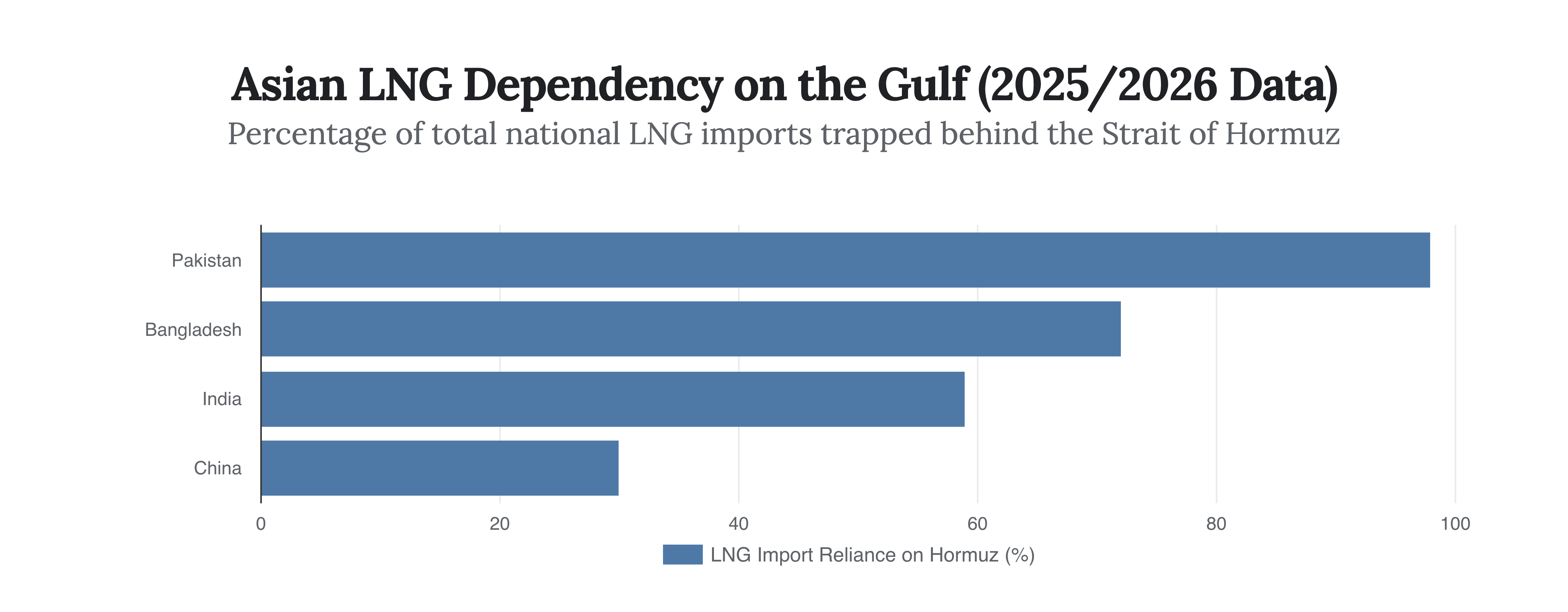
The asymmetric impact here will redraw geopolitical alliances. Europe, having severed itself from Russian pipeline gas, now relies on Qatar for 12% to 14% of its total LNG imports. The loss of this supply heading into the injection season guarantees extreme price volatility across the continent. However, the true catastrophe falls on the developing economies of South Asia. According to Q1 2026 data, Pakistan is reliant on Qatar for 98% of its LNG imports. Bangladesh depends on the Gulf for nearly 75% of its supply. India sources 59% of its LNG from Qatar and the UAE.
For these nations, a sustained blockade does not just mean higher prices; it means immediate industrial gas curtailments, widespread rolling blackouts, and sovereign balance sheet crises. While crude oil markets can scramble for marginal physical workarounds, the LNG sector faces a brutal, binary reality: every cargo transits the Strait, or it simply doesn’t move at all.
The Contagion Effect on Global Supply Chains
Crucially, the Strait of Hormuz does not exist in a vacuum. Because the underlying conflict involves a highly complex web of regional proxy forces, the Red Sea and the Suez Canal have simultaneously become unnavigable. Sensing the strategic vulnerability of Western supply chains, Houthi forces have violently resumed their attacks on commercial vessels in the Bab al-Mandeb strait.
For the first time in modern history, both of the Middle East’s primary maritime corridors are concurrently choked. The “shortcuts” of global trade are closed. Ships attempting to bypass the region entirely are forced into massive multi-week detours around the Cape of Good Hope. This adds immense transit time and effectively removes vast amounts of vessel capacity from the global shipping system, driving freight rates to astronomical highs.
We have officially entered an era of radical uncertainty. The globalized energy market—built on the promise of perpetual peace and open sea lanes—has collided with the hard realities of geography and kinetic warfare. The events of March 2026 are not a temporary aberration; they are a permanent structural shift in how nations and corporations must price risk, calculate resilience, and secure the physical commodities that power the modern world.