


The 98th Academy Awards and the Nash Equilibrium of Authorship
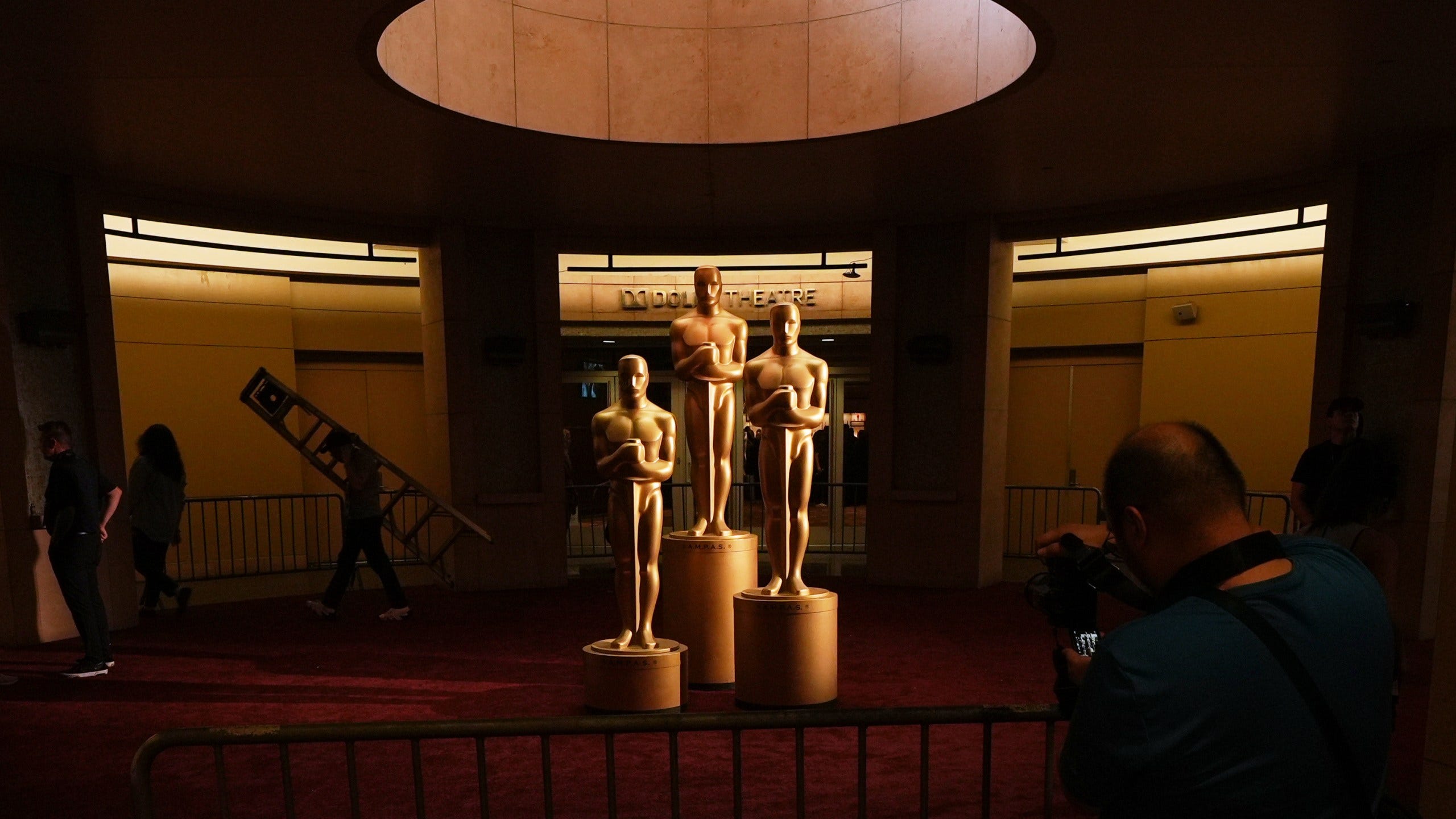
Last night, on March 15, 2026, the 98th Academy Awards concluded at the Dolby Theatre in Los Angeles. While the public narrative centers on Paul Thomas Anderson’s One Battle After Another capturing six statuettes, including Best Picture, and Michael B. Jordan taking Best Actor for Sinners, the true institutional shift occurred entirely off-camera. The underlying game board of global entertainment has been permanently altered by code.
Leading up to the 2026 ceremony, the Academy adopted a new set of rules regarding Artificial Intelligence. Rather than issuing a blanket ban on synthetic generation, the governing body adopted a cautious neutrality, ruling that AI tools neither help nor harm a film’s eligibility. The only regulatory boundary is the subjective requirement that “human creative authorship dominates” the final product. This represents a fragile Nash Equilibrium: the Academy, representing the legacy industry, is forced to accept technological inevitability to prevent a total collapse of institutional relevance, while tech players accept the superficial branding of “human oversight” to maintain cultural prestige. The joke made by host Conan O’Brien about his job inevitably being taken by a “Waymo in a tux” underscores a pervasive, existential terror running through the industry’s labor force.
By codifying that generative AI neither helps nor harms a film’s eligibility so long as “human authorship dominates,” the Academy has quietly sanctioned the total algorithmic restructuring of Hollywood’s financial architecture.
The $33.55 Billion Payoff Matrix
To understand the incentive structures driving code adoption, one must examine the baseline data reality of the current cinematic economy. According to year-end data from Gower Street Analytics, the 2025 global box office closed at $33.55 billion. This represents an 11.8% year-over-year increase from 2024’s anemic $30 billion, but critically, it remains over 20% below the 2019 pre-pandemic high of $42.3 billion.

This macro-recovery is fundamentally asymmetric. Hollywood is playing a non-zero-sum game internally regarding theatrical windowing, while state actors are playing a zero-sum game externally. Look no further than the highest-grossing film of the past year. While Western media fixates on domestic theatrical recovery, the undeniable reality of 2025 is that a state-backed Chinese animated feature, Ne Zha 2, extracted over $2.26 billion from the global ecosystem, completely bypassing American distribution channels. It accounted for 6.74% of the entire global cinematic yield.
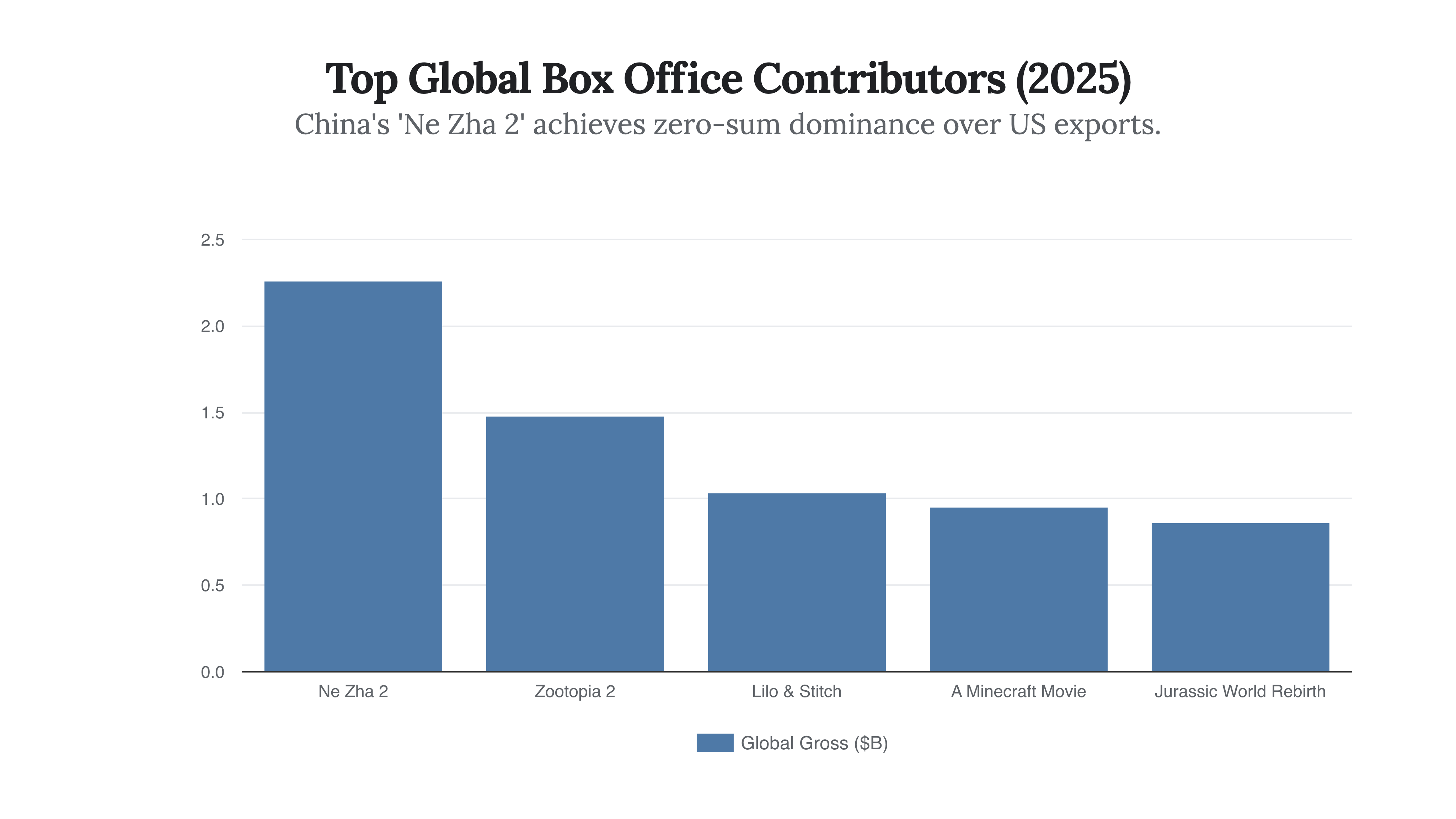
When foreign competitors possess localized monopolies capable of generating multi-billion-dollar gross revenues without relying on the US box office, Hollywood’s legacy export model faces catastrophic margin compression. To survive this international threat, American studios are aggressively accelerating toward the only viable cost-reduction vector: synthetic production pipelines.
Unlock deeper strategic alpha with a 10% discount on the annual plan.
Support the data-driven foresight required to navigate an era of radical uncertainty and join a community of institutional-grade analysts committed to the truth.
Disney’s Defection and the Silicon Valley Prisoner’s Dilemma
In any Game Theory framework involving a cartel (in this case, the legacy Hollywood studios), the most critical vector of analysis is defection. For the past twenty-four months, the major studios have been locked in a high-stakes Prisoner’s Dilemma: hold the collective line against artificial intelligence to protect legacy union relationships and intellectual property integrity, or break rank to slash visual effects (VFX) budgets. In late 2025, Walt Disney Studios defected.
Disney closed 2025 by reasserting total market hegemony, generating an estimated $6.58 billion in global gross. This massive liquidity influx was driven almost entirely by legacy IP exploitation, namely Zootopia 2 ($1.48 billion) and Lilo & Stitch ($1.04 billion). Leveraging this capital dominance, Disney struck a monumental $1 billion licensing deal with OpenAI, integrating Marvel, Star Wars, and legacy Disney characters directly into the Sora video generation architecture.
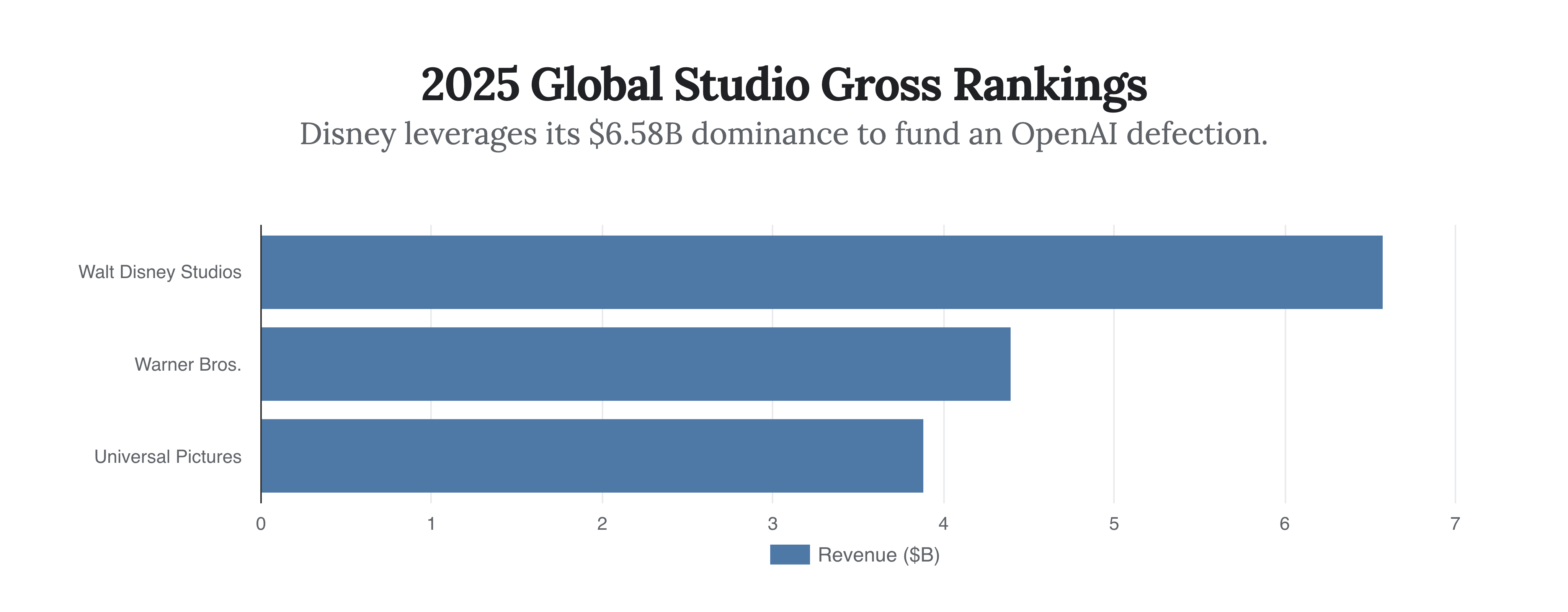
This move is a calculated dominant strategy. By licensing its IP directly into the training layers of the world’s most powerful AI models, Disney ensures it commands the economic rents of the latent space. Disney’s unprecedented $1 billion partnership to feed its proprietary IP into OpenAI’s Sora architecture represents a fatal defection from the legacy studio cartel, confirming that the future of entertainment is primarily a software licensing play. This creates massive information asymmetry across the sector. Warner Bros. ($4.4 billion global gross) and Universal ($3.89 billion) are now structurally disadvantaged, reliant on traditional, capital-intensive human rendering pipelines while Disney weaponizes algorithmic generation.
Labor Code and the Weaponization of Likeness
The friction between human labor and code reached a boiling point in early 2026. OpenAI’s deployment of Sora 2 introduced capabilities allowing users to directly upload and synthesize real human likenesses into generative environments. This immediately triggered an aggressive tit-for-tat retaliation from Hollywood labor pools. Talent agencies like WME and CAA moved rapidly to opt their A-list rosters out of synthetic models, attempting to construct an artificial scarcity of high-value human faces.
The danger of unverified likeness generation was violently demonstrated just weeks before the Oscars when a hyper-realistic deepfake featuring Brad Pitt and Tom Cruise, generated via Chinese firm ByteDance’s AI architecture, went viral across social channels. This incident exposed the extreme fragility of human brand capital in the era of open-source video generation.
However, the true institutional pressure is emanating from the federal state. Operating under a December 2025 executive order, the Department of Justice’s AI Litigation Task Force became fully operational on January 10, 2026. Their primary target? California state laws AB 2602 and AB 1836, which were specifically designed to shield performers from unauthorized AI replicas. The DOJ’s aggressive early 2026 move to strike down California’s AI likeness protection laws signals that the federal government views the unlimited scaling of synthetic actors as a matter of macroeconomic competitiveness, rendering local labor unions effectively powerless. The geopolitical calculus is stark: the US government will not allow domestic tech conglomerates to be knee-capped by localized labor disputes while foreign models scale their rendering capabilities unhindered.
Forward Projections: The New Calculus for Q3 2026
As we advance deeper into 2026, the baseline physics of cinematic production have been irreversibly rewritten. The historical technical limitation of generative video—specifically “temporal consistency,” wherein characters and environments shift or morph between frames—has been largely eradicated by platforms like Google’s Veo 3.1 and OpenAI’s Sora 2 Pro.
This stabilization has transitioned AI from an experimental novelty into production-grade “Dynamic Pre-Vis” (Pre-Visualization). Directors are now bypassing traditional storyboard artists and physical location scouting, iterating complex, million-dollar sequences directly from a desktop interface. The credible threat to traditional VFX houses is absolute.
For institutional observers and entertainment operators, the Q3 2026 payoff matrix is heavily skewed toward entities that control foundational IP and possess the raw compute required to synthesize it. As temporal consistency models eradicate traditional visual effects pipelines, studios that fail to aggressively adopt dynamic pre-visualization by Q3 2026 will face an insurmountable cost-basis disadvantage against their algorithmic competitors. The 98th Academy Awards may have dutifully celebrated the persistence of human execution, but the next cycle of cinematic dominance will be authored entirely in the latent space.