



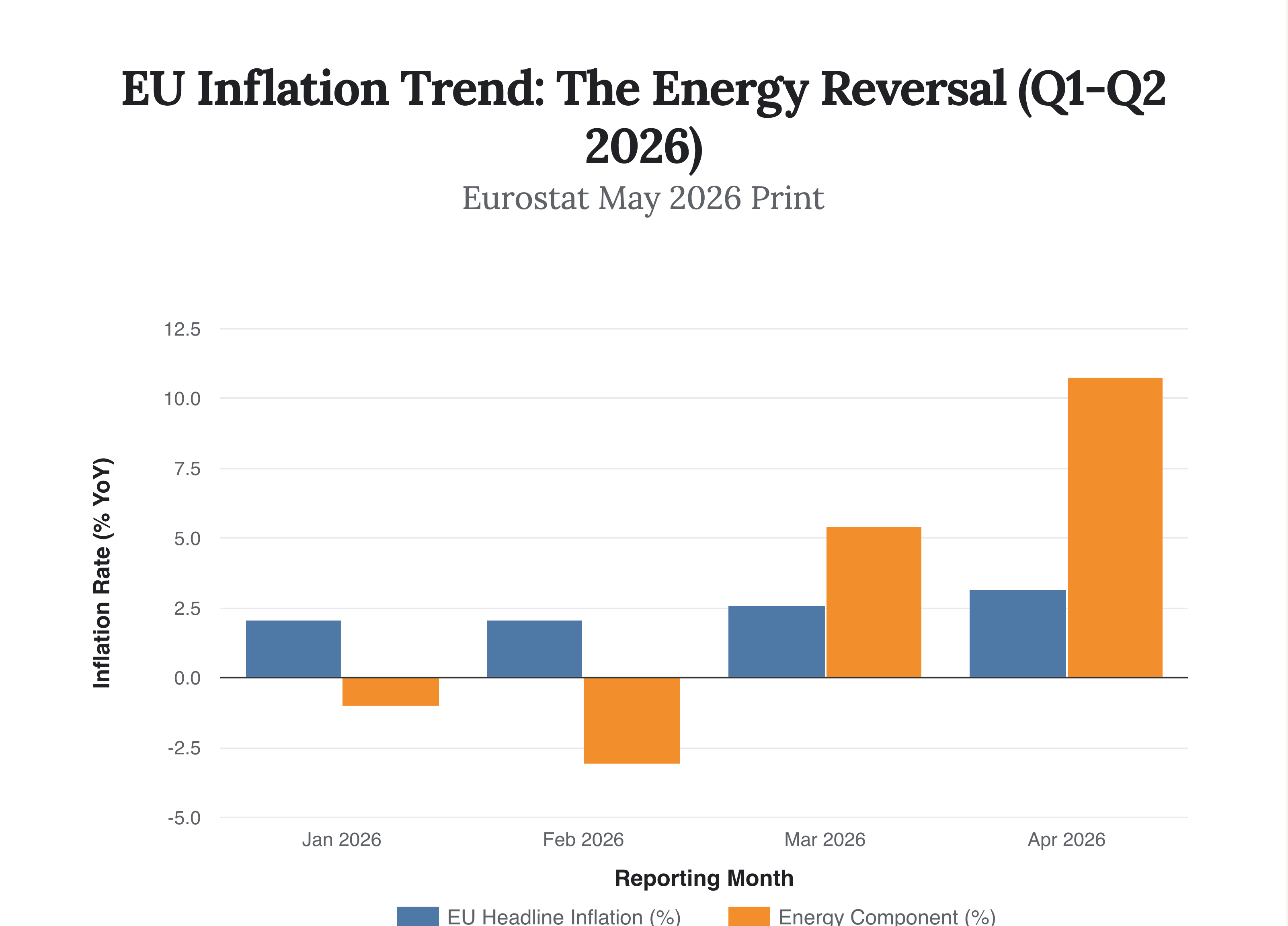
The macroeconomic consensus of a stabilized European Union has been violently shattered by the geopolitical realities of Q2 2026. Data released by Eurostat in late May 2026 confirms that the Euro area annual inflation rate climbed abruptly to 3.0% in April [1.1.1], marking the highest print since September 2023. Across the broader 27-member bloc, the situation is even more acute, with headline inflation rocketing from 2.1% in February to 3.2% in April. This immediate reversal from a disinflationary glide path is not an internal monetary failure but a direct kinetic transmission from the escalating conflict involving Iran and the resulting disruption of the Strait of Hormuz. Because this narrow maritime chokepoint handles a vast percentage of the world’s liquefied natural gas (LNG) and crude oil, any localized friction immediately translates into a global supply shock.
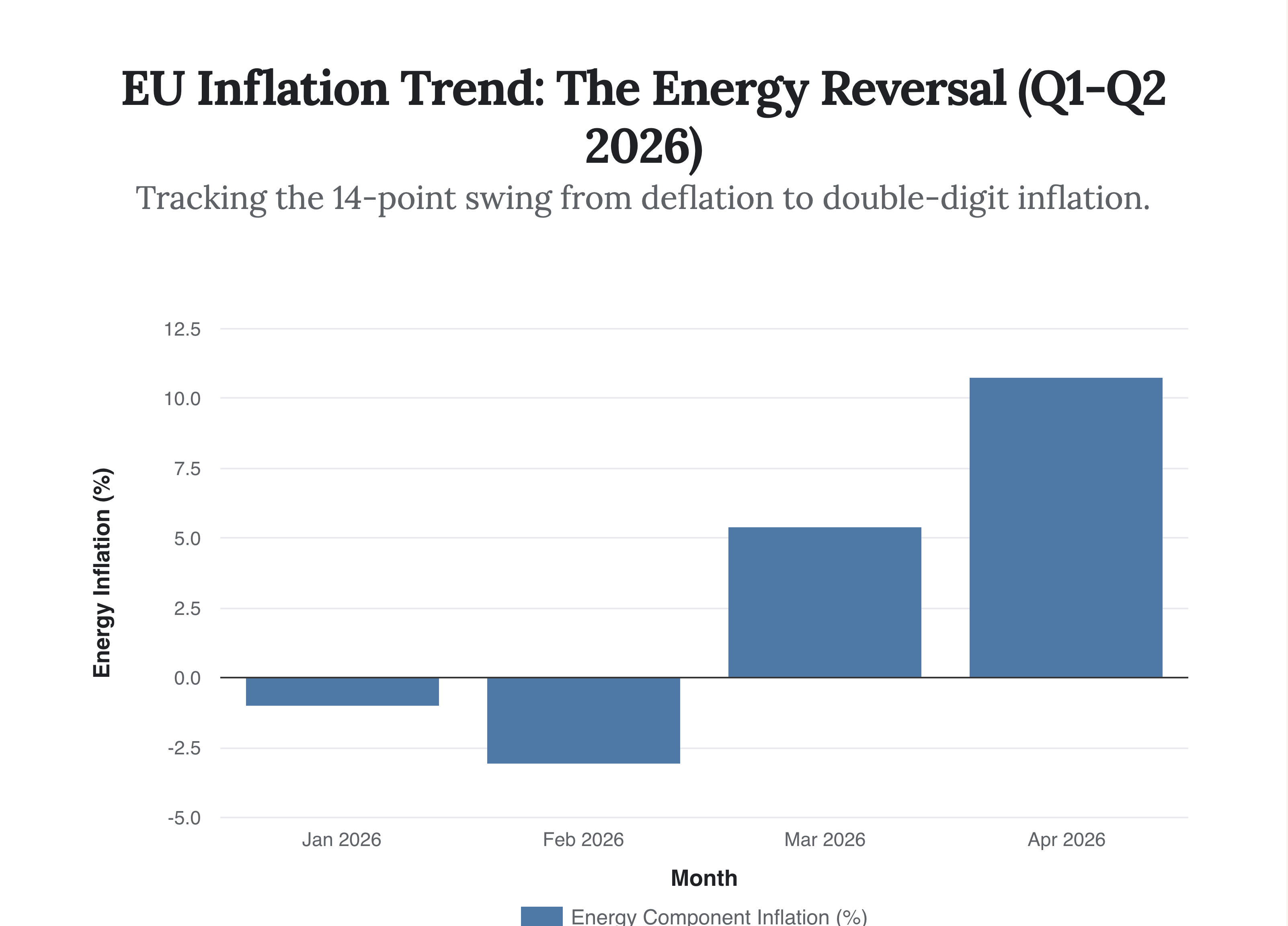
The underlying metrics reveal the sheer velocity of this crisis. Prior to the escalation in the Middle East, European energy costs were actively pulling headline inflation downward, registering at a deflationary -3.1% in February 2026. By April 2026, energy inflation had reversed course with devastating speed, soaring to +10.8%. This delta of nearly 14 percentage points within a single financial quarter represents a catastrophic shock to both macroeconomic stabilization models and institutional forecasting. Unlike the 2022 Russian gas supply shock, which was heavily localized to pipeline infrastructure, the 2026 Hormuz crisis is multi-modal, simultaneously infecting oil, LNG, maritime logistics, and agricultural inputs with an inescapable risk premium.
The European Central Bank is now caught in a brutal stagflationary bind. Forward projections, which had previously anticipated a smooth glide path to 2.1% inflation in 2025 and 1.7% in 2026, have been vaporized by real-time geopolitical friction. As of late May 2026, the data confirms that inflationary pressures are no longer isolated to volatile energy components; the transmission mechanism is actively bleeding into the services sector (+1.54 percentage points in recent trailing metrics) and broader industrial supply chains. This interconnected dynamic guarantees that the European consumer and industrial base will endure a sustained period of margin compression.
Pricing the Risk Premium: Dutch TTF and Institutional Panic
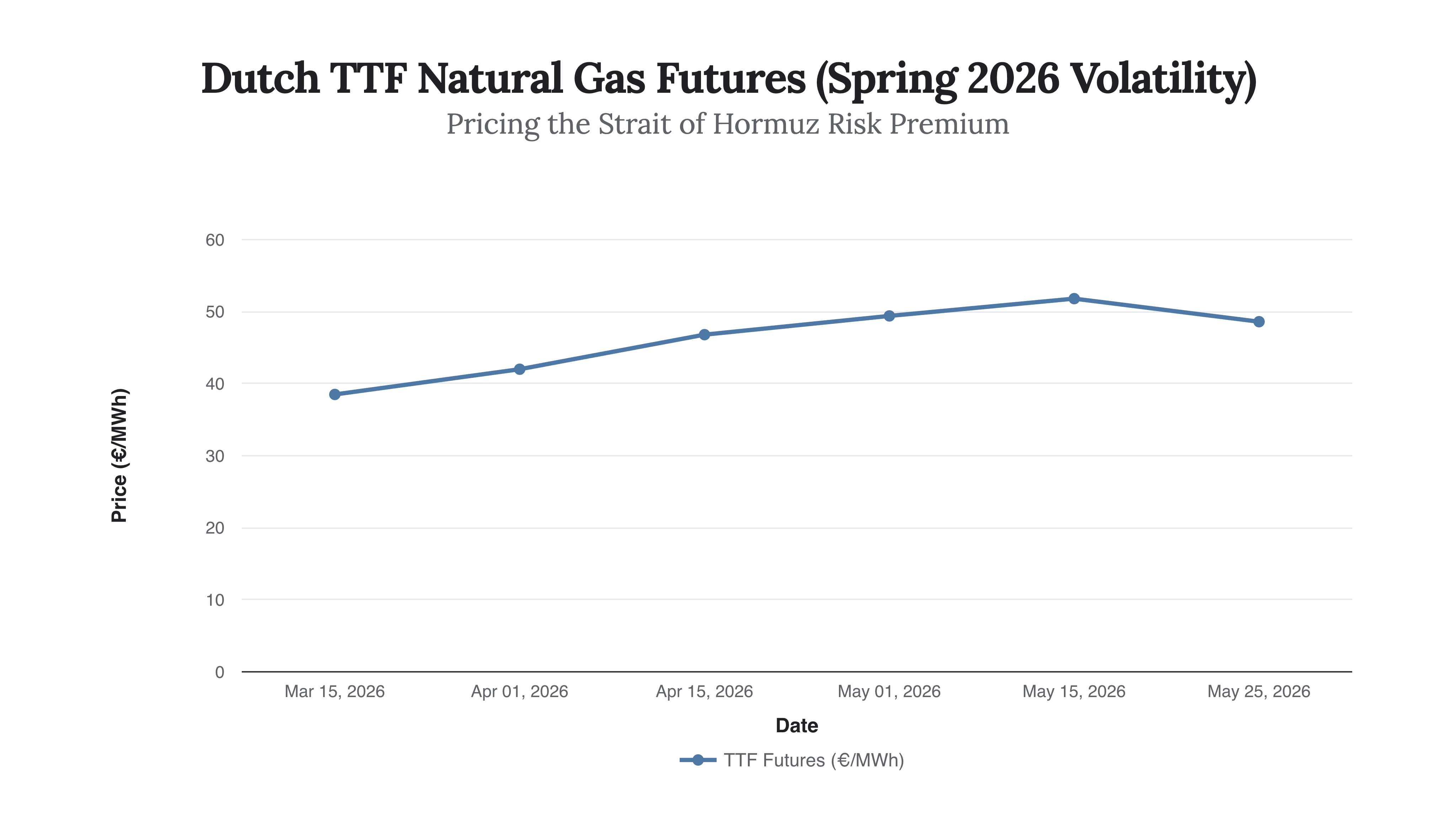
The Dutch Title Transfer Facility (TTF) natural gas benchmark serves as the ultimate geopolitical fear gauge for the European continent. In mid-May 2026, TTF futures for June delivery breached the psychological threshold of €51.80/MWh, representing a violent spike from the low-€40s baseline established just weeks prior. While late May has seen a slight moderation to the €48.60/MWh level as immediate panic subsides, the structural floor for European gas prices has been permanently elevated. This pricing dynamic is not driven by a physical supply deficit or localized winter demand; it is a profound institutional recalculation of geopolitical risk in real-time.
The European natural gas market is currently trapped between two opposing structural forces: the necessity of robust storage injections, which were heavily incentivized early in the year, and the real-time degradation of reliable LNG import routes. Because Europe effectively decoupled from Russian pipeline gas in the aftermath of 2022, it became existentially reliant on seaborne LNG. Now, with the Strait of Hormuz bottlenecked by conflict, that hard-won dependency is manifesting as extreme price volatility. The rapid transition from Russian pipeline dependency to global LNG dependency has merely swapped one centralized geopolitical vulnerability for an even more volatile maritime exposure.
Furthermore, negative seasonal spreads are beginning to severely slow down the pace of European gas storage injections. Facility operators are increasingly hesitant to purchase gas at €50/MWh spot prices to fill reserves for the upcoming winter, risking a systemic under-supply if the Middle East conflict triggers a total maritime blockade. This hesitation is exactly the mechanism by which a short-term price shock metastasizes into a structural winter crisis. Institutional traders are aggressively pricing in an extended conflict, with forward curves remaining heavily backwardated yet fundamentally elevated across the entire 2026–2027 delivery windows.

The Fiscal Bleed: Sovereign Balance Sheets Under Siege
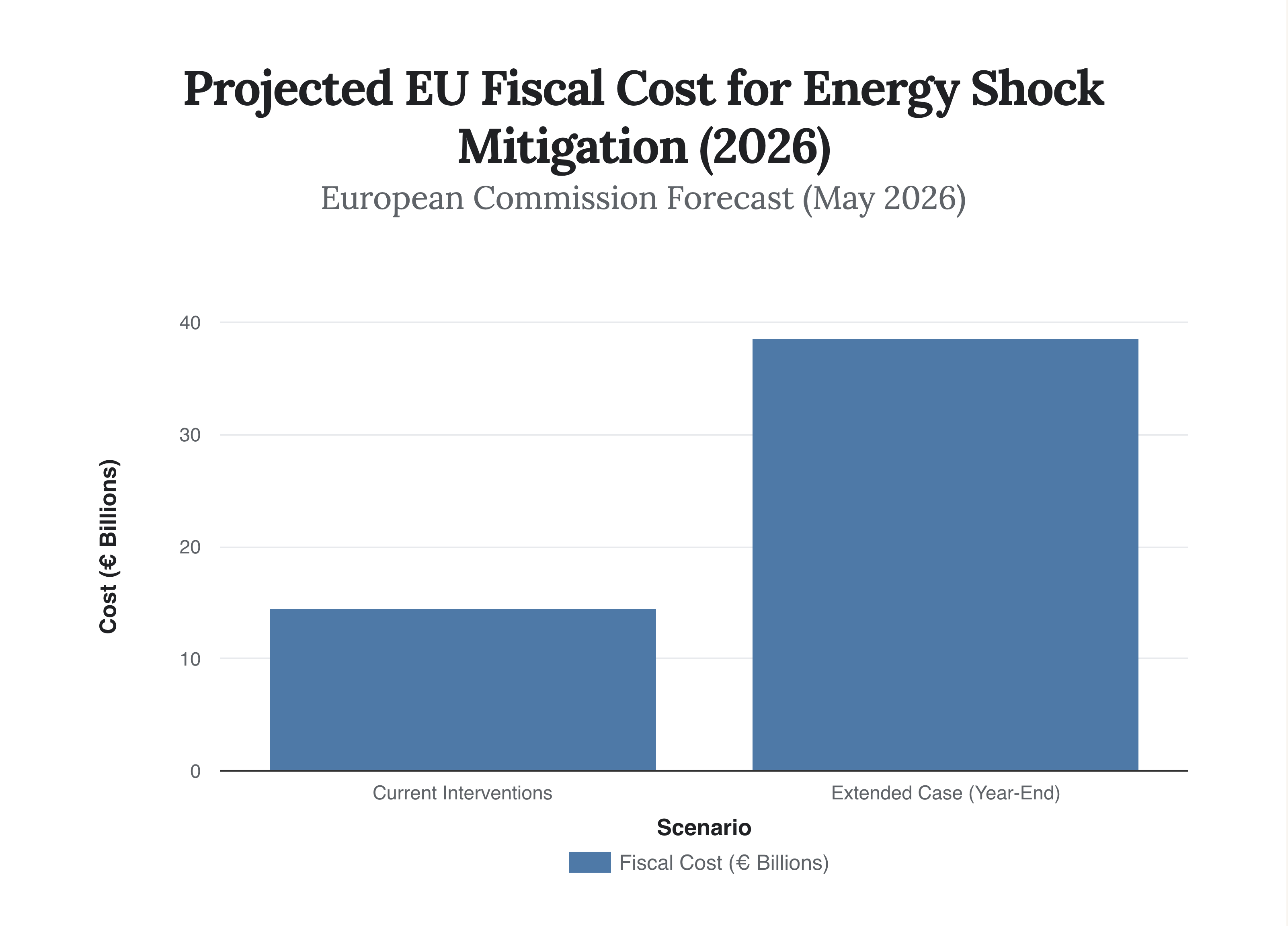
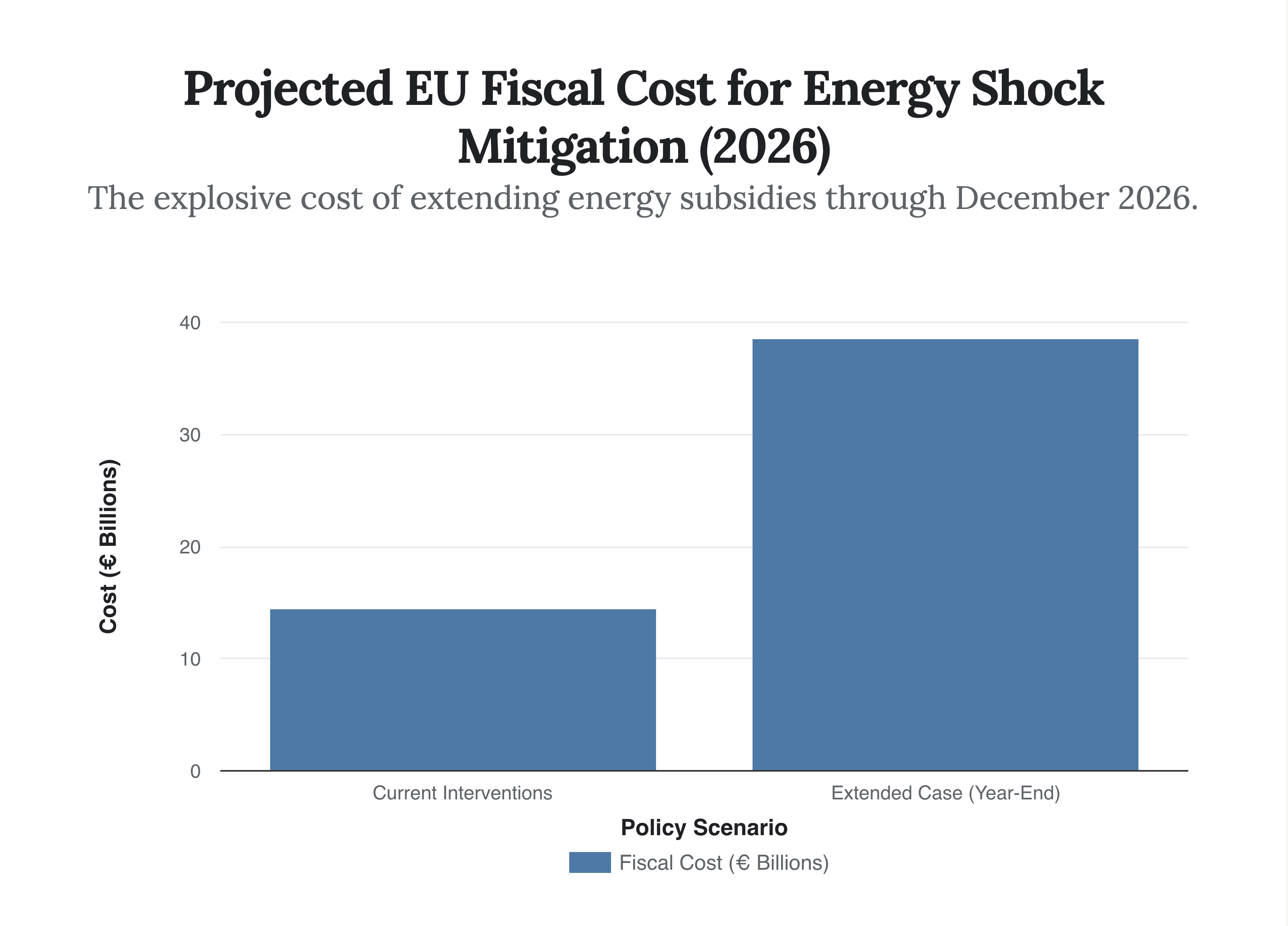
The macroeconomic fallout of this energy shock is forcing European governments into a corner they simply cannot afford to occupy. According to European Commission data published in May 2026, newly adopted budgetary policy measures designed to mitigate the current energy price spike are already projected to cost €14.5 billion (0.07% of EU GDP) for the year. However, this figure is clinically optimistic. It assumes that the geopolitical conflict will swiftly resolve and that emergency subsidies will expire as scheduled without triggering a domestic political backlash.
If the conflict drags on and the Strait of Hormuz remains contested, the Commission estimates that extending these protective measures until the end of 2026 will skyrocket the fiscal cost to a staggering €38.6 billion (0.2% of EU GDP). This rapid expansion of state intervention comes at the exact moment when European fiscal space is contracting violently. Average EU budget deficits are now projected to climb from 3.1% in 2025 to 3.5% in 2026, with ten member states already violating the mandated 3% GDP deficit ceiling. By 2027, that number is projected to rise to 13 states, indicating a widespread breakdown in sovereign fiscal discipline.
The European model of insulating the consumer from global reality via state-funded subsidies is accelerating a sovereign debt crisis, as governments are forced to borrow at multi-year high interest rates to pay for immediate electricity spikes. We are witnessing a stark divergence in national responses based on underlying fiscal health and grid composition. Spain, leveraging its massive relative advantage in renewable energy generation, recently approved a €5 billion emergency package to slash grid fees for energy-intensive industries by 80%. Conversely, nations without massive fiscal headroom or significant renewable baseloads are being forced to pass the costs directly to the industrial consumer, eroding competitiveness block-wide.
Second-Order Effects: Deindustrialization and the Real Wage Collapse
Second-Order Effects: Deindustrialization and the Real Wage Collapse
The downstream impacts of the May 2026 energy shock extend far beyond immediate sovereign deficits; they are culminating in the permanent destruction of aggregate demand and industrial capacity. Inflationary environments historically operate as a highly regressive tax, and the current dynamic is systematically hollowing out the European middle class. Wage growth is failing entirely to track the velocity of essential input increases. Housing, utility, and food prices are accelerating three to four times faster than nominal wages. The return of +10.8% energy inflation guarantees that real wages will remain deeply submerged in negative territory for the duration of 2026.
For the industrial sector, the math is definitively punitive. Heavy industry, from German chemicals to French automotive manufacturing, relies exclusively on predictable input costs. With electricity continuing to be taxed more heavily than fossil gas in many jurisdictions, the fundamental incentive for industrial electrification is actively destroyed. The delta in global competitiveness is widening to an unmanageable degree. European wholesale electricity prices for energy-intensive industries remain more than double the corresponding US levels and nearly 50% above Chinese equivalents. When European benchmark gas sits near €50/MWh and electricity prices spike aggressively during hours of low renewable output, energy-intensive enterprises face a terminal equation.
The ultimate realization of the 2026 European energy crisis is not merely a transient cost-of-living spike, but the permanent relocation of heavy industry to geographies with secure, localized energy production. The European Union has indeed accelerated solar and wind deployment, generating a record 30% of its electricity from these sources recently. Yet, this renewable capacity remains wildly intermittent. Without grid-scale battery storage operating at a magnitude currently unseen on the continent, Europe remains permanently exposed to the geopolitical whims governing global hydrocarbon supply lines. Until structural grid flexibility and defense logistics are fundamentally overhauled, Europe will continue to import Middle Eastern volatility directly into its domestic inflation metrics, forcing an irreversible recalibration of its economic output.