


Monday, January 19, 2026
The post-war trade order did not end with a whimper, but with a real estate offer. On Saturday, President Donald Trump fundamentally altered the geometry of the Western alliance, not with a policy paper, but with a social media ultimatum that has sent shockwaves from Berlin to Copenhagen. The threat is stark: a 10% universal tariff on eight European nations starting February 1, escalating to a punitive 25% on June 1. The condition for their removal? The acquiescence of the Kingdom of Denmark to the sale of Greenland to the United States.
This is no longer a trade dispute about steel overcapacity or subsidies for Airbus. It is the weaponization of market access for territorial expansion—a move that redefines sovereignty as a tradable asset. As markets open this morning, the DAX has shed 1.3% and the CAC 40 is down 1.9%, pricing in not just a trade war, but a geopolitical rupture. For the strategic planner, the question is no longer if tariffs will rise, but whether the European Union can deploy its “Big Bazooka”—the Anti-Coercion Instrument (ACI)—without precipitating a recession that the fragile 2026 recovery cannot withstand.
The Greenland Gambit: Geography as Leverage
The selection of the eight targeted nations—Denmark, Norway, Sweden, France, Germany, the UK, the Netherlands, and Finland—is not random. These are the nations that most vocally opposed the initial overtures regarding Greenland in late 2025. By grouping economic heavyweights like Germany and the UK with the Scandinavian bloc, the White House is attempting to fracture European solidarity, leveraging German industrial anxiety against Danish territorial integrity.
The strategic calculus is precise. The United States remains the indispensable export market for these nations. By threatening a 10% tariff in just 12 days, the administration is betting that the fear of economic stagnation will override diplomatic principles. However, the threat of a 25% escalation on June 1 creates a “sovereignty cliff,” a deadline that forces businesses to front-load imports and scramble for supply chain alternatives, creating immediate inflationary pressure.
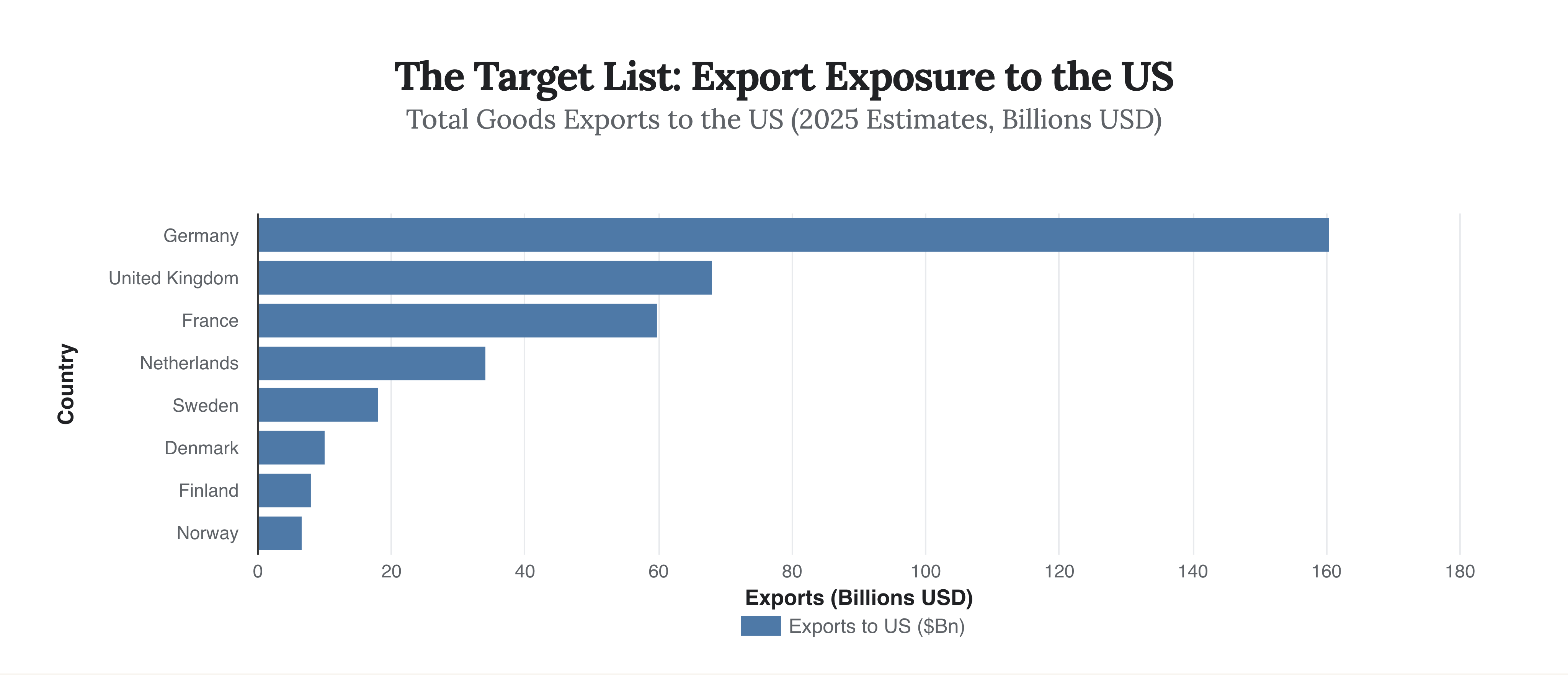
The chart above reveals the asymmetry of the threat. While Denmark is the political target, Germany is the economic hostage. With over $160 billion in exports at risk, Berlin faces a potential cost far exceeding that of Copenhagen. This mismatch is designed to create internal friction within the EU, forcing the bloc to decide whether to sacrifice its economic engine for a principle of territorial sovereignty held by one of its smaller members.
The Blast Radius: Economic Fallout
The immediate economic impact of a 10% tariff is manageable but painful; the prospect of 25% is catastrophic. Goldman Sachs and Nomura analysts have already revised their 2026 growth forecasts downward. Germany, struggling to emerge from the stagnation of 2025, faces a potential GDP hit of 0.3% under the 10% scenario. If the escalation to 25% occurs in June, we are looking at a full-blown recessionary trigger for the Eurozone.
Sectoral Vulnerabilities
The pain will not be distributed evenly. The automotive sector, already grappling with the EV transition and Chinese competition, is the most exposed industrial vertical. However, the agri-food sector faces a unique threat. Europe runs a
