


On Thursday, May 21, 2026, the architecture of global venture capital was permanently altered. The U.S. Department of Commerce executed an unprecedented industrial policy maneuver, announcing the signing of nine letters of intent to provide $2.013 billion in federal incentives under the CHIPS and Science Act. However, unlike historical grant programs designed to subsidize fundamental academic research, this tranche arrived with a profoundly disruptive contingency: the United States government is taking direct minority equity stakes in the recipient quantum computing firms. This explicit transition from passive grantmaker to active stakeholder signals that quantum computing has officially crossed the threshold from an experimental physics endeavor into a critical, zero-sum pillar of national security and macroeconomic infrastructure.
The distribution of this sovereign capital reveals a highly targeted strategy aimed at resolving the most severe bottleneck in the industry: utility-scale manufacturability. IBM secured the largest allocation, receiving a staggering $1 billion to establish a standalone quantum foundry dubbed “Anderon” in Albany, New York. Designed to utilize advanced 300-millimeter wafer processes, Anderon is tasked with scaling the fabrication of superconducting wiring and in-line wafer testing capabilities for multiple quantum technology vendors. Simultaneously, GlobalFoundries secured an additional $375 million to expand its quantum foundry capacity, directly bolstering its ongoing silicon photonics partnerships. The remaining allocations were distributed among a curated portfolio of specialized firms, including a $100 million proposed incentive for PsiQuantum, as well as distinct strategic tranches for Atom Computing, D-Wave, Infleqtion, Quantinuum, Rigetti, and Diraq.
By transitioning from passive grantmaker to active shareholder, the U.S. government has effectively underwritten a sovereign wealth fund dedicated exclusively to quantum dominance, permanently altering the risk premium for private capital overnight.
The political economy of this decision cannot be overstated. Driven by the Trump administration’s aggressive push to secure “taxpayer upside” in strategic industries—a model previewed in mid-2025 when the government took a 10% equity stake in Intel and established major positions in critical mineral providers like MP Materials—the quantum equity program fundamentally re-prices the private market. Institutional investors must now evaluate quantum startups not merely on their algorithmic roadmaps, but on their sovereign backing. Industry analysts have already noted the “comparative disadvantage” faced by major players conspicuously absent from the Commerce Department’s list, including Google, Microsoft, and IonQ, who must now compete against government-subsidized foundries without the implicit endorsement of federal equity integration.
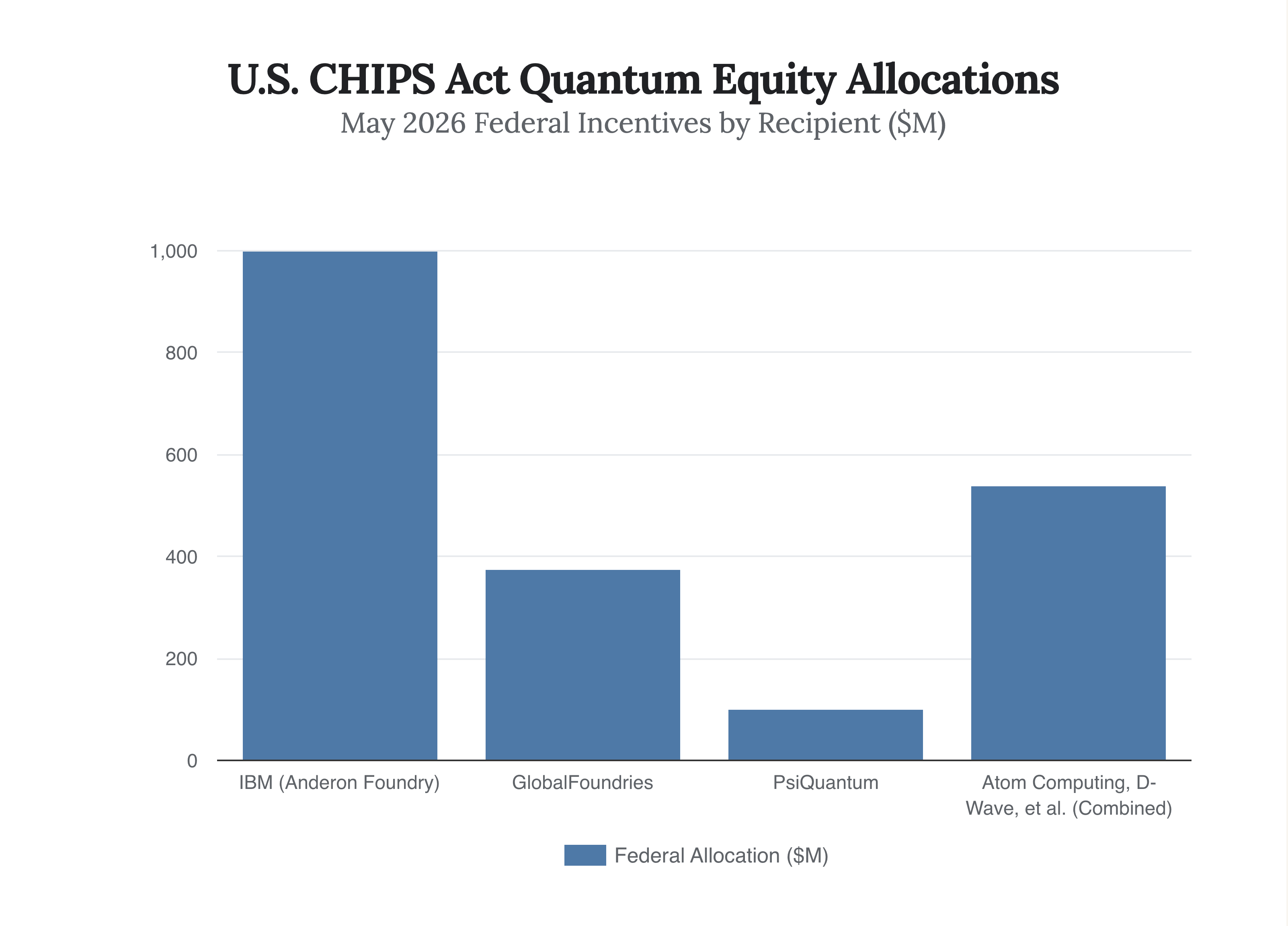
As visualized in the chart above, the heavy concentration of capital directed toward physical infrastructure—specifically the $1.375 billion allocated strictly to the Anderon and GlobalFoundries manufacturing centers—demonstrates that Washington views the “picks and shovels” of quantum hardware as the true strategic vulnerability. The era of artisanal, hand-tuned dilution refrigerators and bespoke qubit fabrication in university basements has ended. The federal mandate is now focused entirely on domestic, high-yield, utility-scale manufacturability.
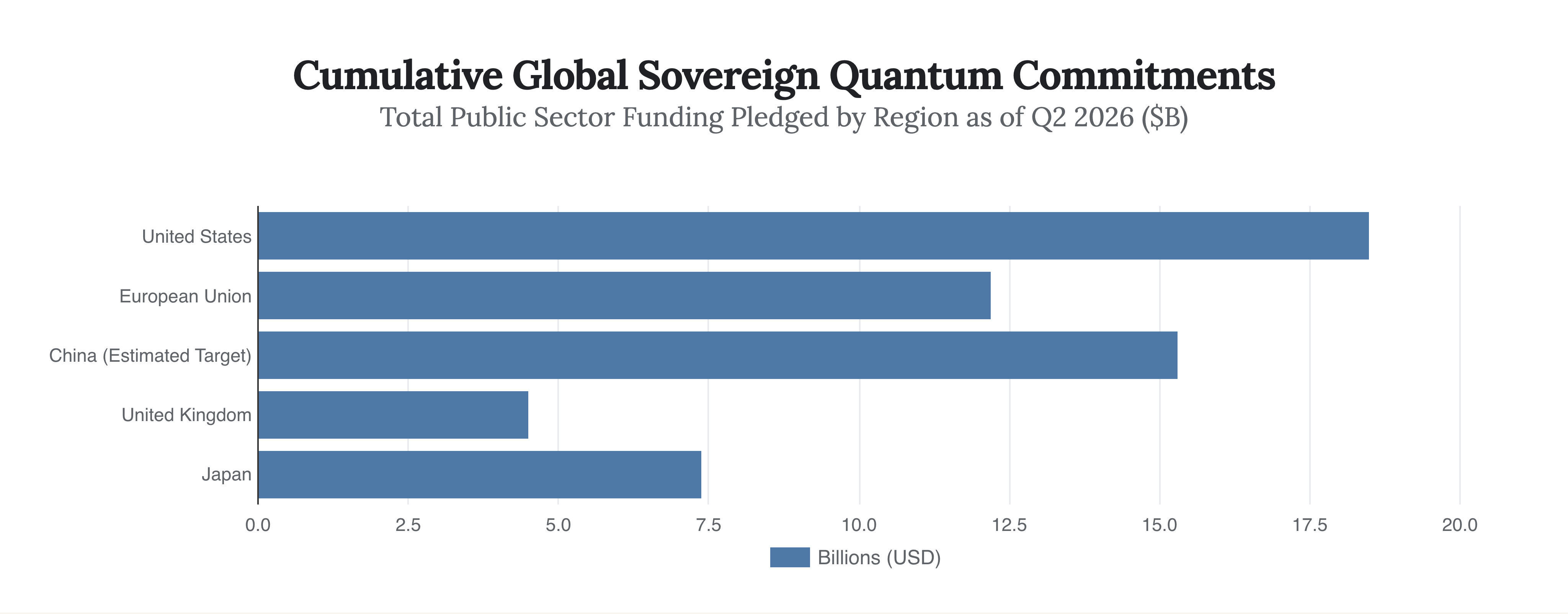
This American mobilization is occurring against a backdrop of escalating global sovereign commitments. By the end of 2025, cumulative public-sector commitments to quantum technologies globally reached $56.7 billion. China has rapidly operationalized a 1-trillion-yuan venture capital guidance fund to mobilize state and private capital into deep tech, heavily emphasizing quantum information sciences. Europe countered with the EU Quantum Europe Strategy adopted in July 2025, alongside France’s €1.8 billion Plan Quantique. Meanwhile, the United Kingdom unleashed a dual-pronged approach, supplementing its £2.5 billion National Quantum Strategy with the £1 billion ProQure program. The May 2026 U.S. CHIPS Act deployment is not merely an economic stimulus; it is an escalation in an ongoing geopolitical hegemony war over the fundamental mathematics that will secure—or compromise—the 21st-century intelligence apparatus.
The Liquidity Bifurcation: Public Triumphs vs. Private Consolidation
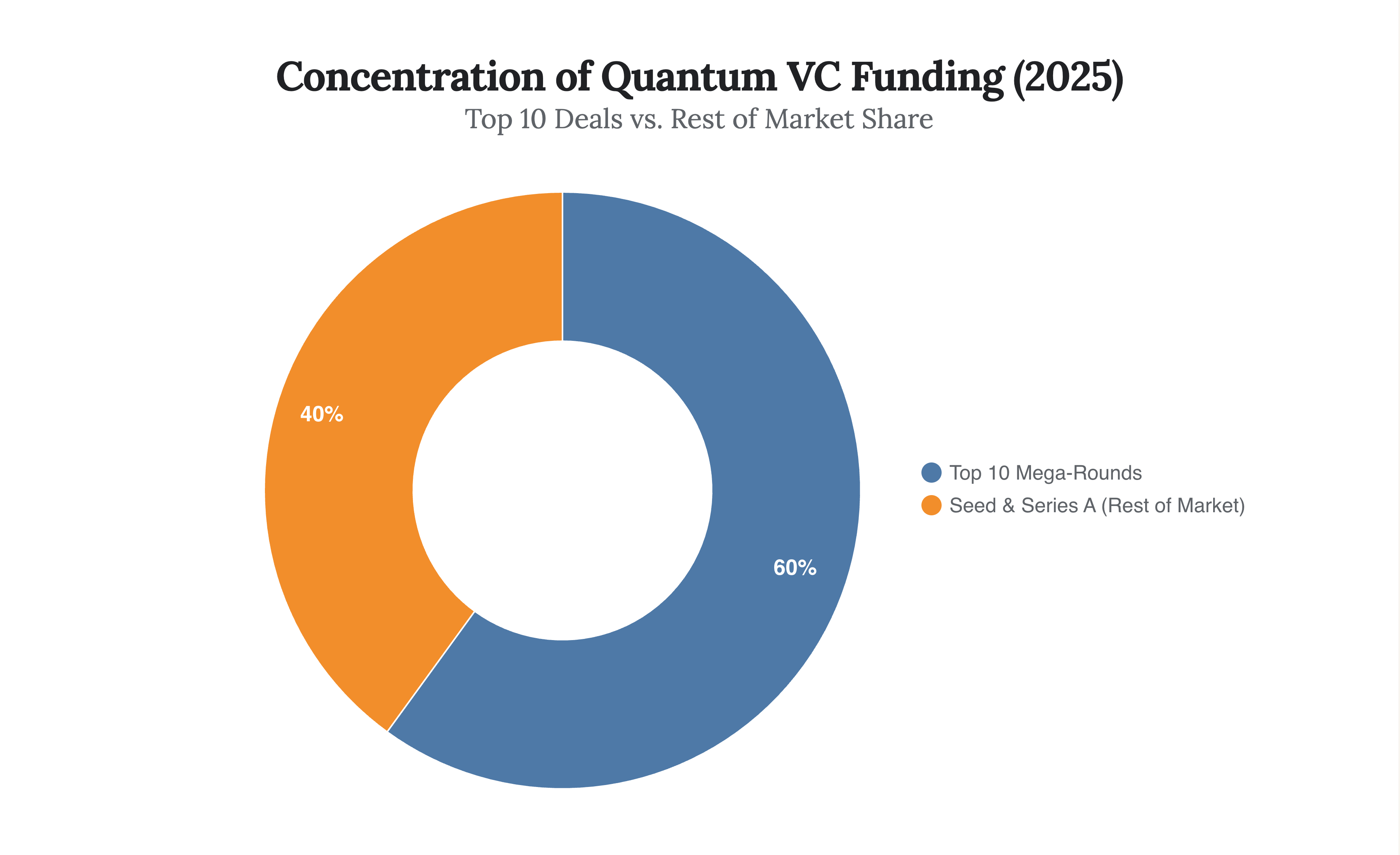
While sovereign capital provides the foundational floor, the private venture capital markets are experiencing a violent, bifurcated consolidation. According to the QED-C State of the Global Quantum Industry 2026 report released in April 2026, private VC investment into quantum technologies hit a record $4.9 billion in 2025, representing a staggering 192% year-over-year surge from the $1.7 billion recorded in 2024. However, this topline exuberance masks a ruthless centralization of capital. The McKinsey Quantum Technology Monitor 2026 indicates that 60% of total 2025 venture investment was concentrated within the top ten deals. The market has decided which hardware architectures it believes in, and the cost of scaling those chosen platforms has skyrocketed.
The venture capital landscape has bifurcated violently: institutional capital has abandoned funding theoretical physics and is now exclusively backing engineering roadmaps capable of delivering fault-tolerant logic gates.
As we analyze the Q1 2026 realized data, the cooldown in deal volume is palpable, even as total capital deployed remains historically elevated. Crunchbase data for the first quarter of 2026 reveals that companies in the quantum computing category pulled in $1.2 billion in seed-through-growth stage funding. While robust, this puts the industry on track to land slightly below the unprecedented 2025 peaks. The reason is not a lack of interest, but a lack of viable late-stage targets. Seed rounds for novel quantum architectures have virtually evaporated; institutional capital is no longer willing to fund alternative physical modalities that lack a ten-year line of sight to a million physical qubits.
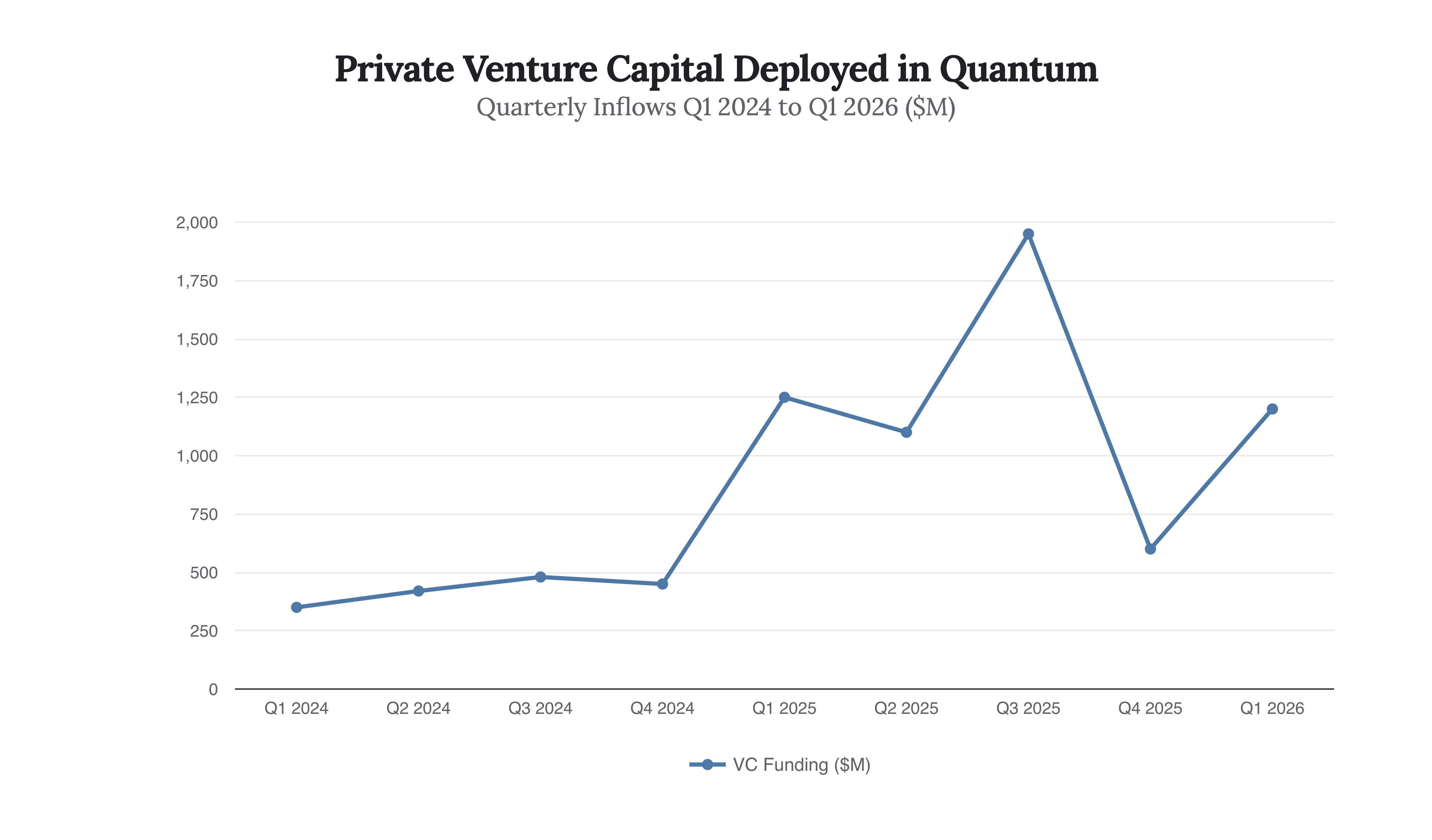
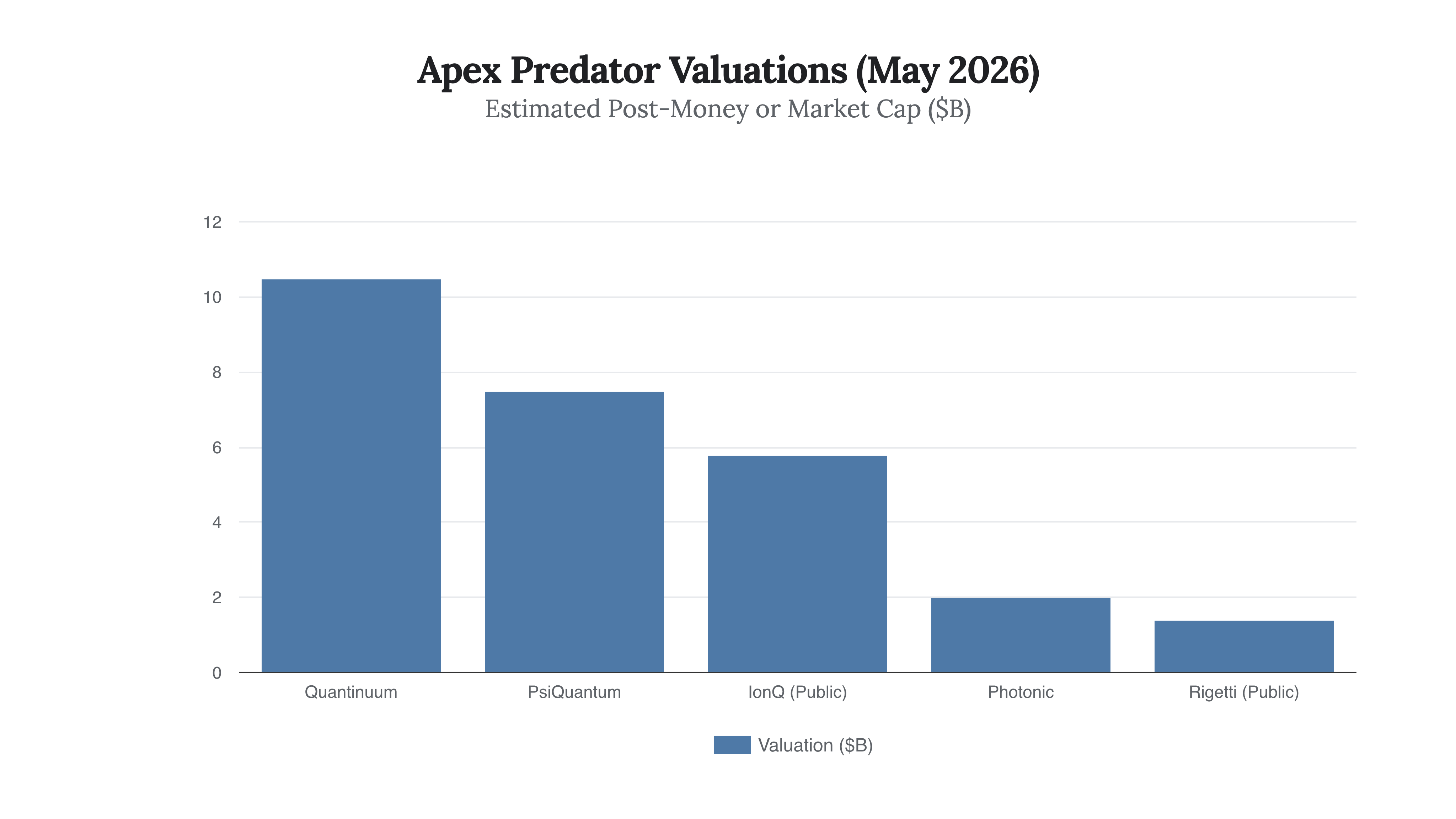
The anomaly of Q3 2025—specifically the eight-day window in September 2025—will be studied by financial historians as the moment the quantum industry matured into a true deep-tech asset class. In slightly over a week, $1.92 billion was deployed across just three mega-rounds: IQM secured $320 million led by Ten Eleven Ventures; Quantinuum raised $600 million at a $10 billion pre-money valuation; and PsiQuantum finalized a massive $1 billion Series E at a $7 billion post-money valuation. This density of capital deployment forced every tier-one venture firm to capitulate and take a position, effectively establishing the “Apex Predators” of the quantum ecosystem.
This momentum has carried directly into May 2026. The current month has been the busiest of the year for large quantum financings. Vancouver-based Photonic, which focuses on silicon spin qubits linked by photons, secured a $200 million financing round, cementing a $2 billion valuation. Simultaneously, QuantWare, a Dutch startup pioneering dedicated quantum open-architecture fabrication, secured $178 million in a Series B. Quantum Motion, a London-based startup leveraging standard silicon transistor manufacturing processes, announced a $160 million Series C co-led by DCVC and Kembara. The connective tissue between all three of these May 2026 mega-deals is their reliance on existing semiconductor manufacturing techniques. Capital is actively rotating away from exotic, unproven material sciences and funneling directly into firms that can leverage the established silicon and photonics supply chains.
The Mega-Rounds and Decacorn Valuations: Tracking the Apex Predators
The public markets currently assign a collective valuation of over $36 billion to the leading pure-play quantum computing companies, a staggering figure given that commercial utility-scale quantum advantage has not yet been universally demonstrated across enterprise workloads. However, the premium is being paid for terminal value dominance. Throughout 2025 and into early 2026, specialized pure-play quantum stocks posted trailing twelve-month gains ranging from 712% to over 5,700%, dwarfing the broader technology indices and rendering classical semiconductor rallies seemingly muted by comparison.

This public enthusiasm has generated a feedback loop, driving unprecedented private valuations and fueling aggressive mergers and acquisitions. In 2025, IonQ—leveraging its inflated equity as currency—executed a $1.1 billion acquisition of Oxford Ionics, bringing highly specialized trapped-ion expertise in-house to accelerate its commercial roadmap. Meanwhile, Xanadu announced a public listing via a Special Purpose Acquisition Company (SPAC), ensuring it has the liquid currency necessary to compete in the talent wars. We are witnessing the emergence of the first true quantum conglomerates.
The quantum ecosystem is currently experiencing a ruthless capitalization filter, where only entities capable of raising nine-figure tranches can secure the foundational supply chains necessary for utility-scale fault tolerance.
At the center of this decacorn phenomenon is the involvement of massive sovereign and institutional asset managers. PsiQuantum’s September 2025 $1 billion Series E was not led by traditional Silicon Valley venture capitalists; it was co-led by BlackRock and Temasek Holdings (Singapore’s state investment firm), with participation from Baillie Gifford, the Qatar Investment Authority (QIA), and Counterpoint Global (Morgan Stanley). When BlackRock—the world’s largest asset manager—leads consecutive late-stage rounds for a pre-revenue quantum hardware firm, it reclassifies the asset from “speculative venture” to “strategic macroeconomic infrastructure.” PsiQuantum’s promise to deliver a million-qubit fault-tolerant quantum computer, backed by facilities in Brisbane and Chicago, requires billions in physical capital expenditures. By Q1 2026, PsiQuantum conducted an additional, highly exclusive venture round featuring NVIDIA (NVentures), signaling deep integration between classic GPU infrastructure and future quantum processing units (QPUs).