



The data from January 2025 tells a story that defies the prevailing geopolitical narrative. While the world discusses decoupling, tariffs, and the “China Plus One” exodus, the factory floors of Shenzhen and Suzhou are quietly undergoing a metamorphosis that renders these threats partially obsolete. The latest figures released this week reveal a stark reality: China is no longer the world’s workshop of cheap labor; it is becoming the world’s fortress of automated precision.
In December 2024, defying forecasts of a slowdown due to looming trade restrictions, China’s exports surged by 10.7%, crushing the expected 7%. But the aggregate number hides the true signal. The real story lies in what China is making. Exports of industrial robots jumped 45%, and integrated circuit (IC) production soared by over 22% for the year. This is not a manufacturing sector in retreat; it is a sector shedding its skin, trading low-wage assembly for high-capital automation at a pace the West has largely underestimated.
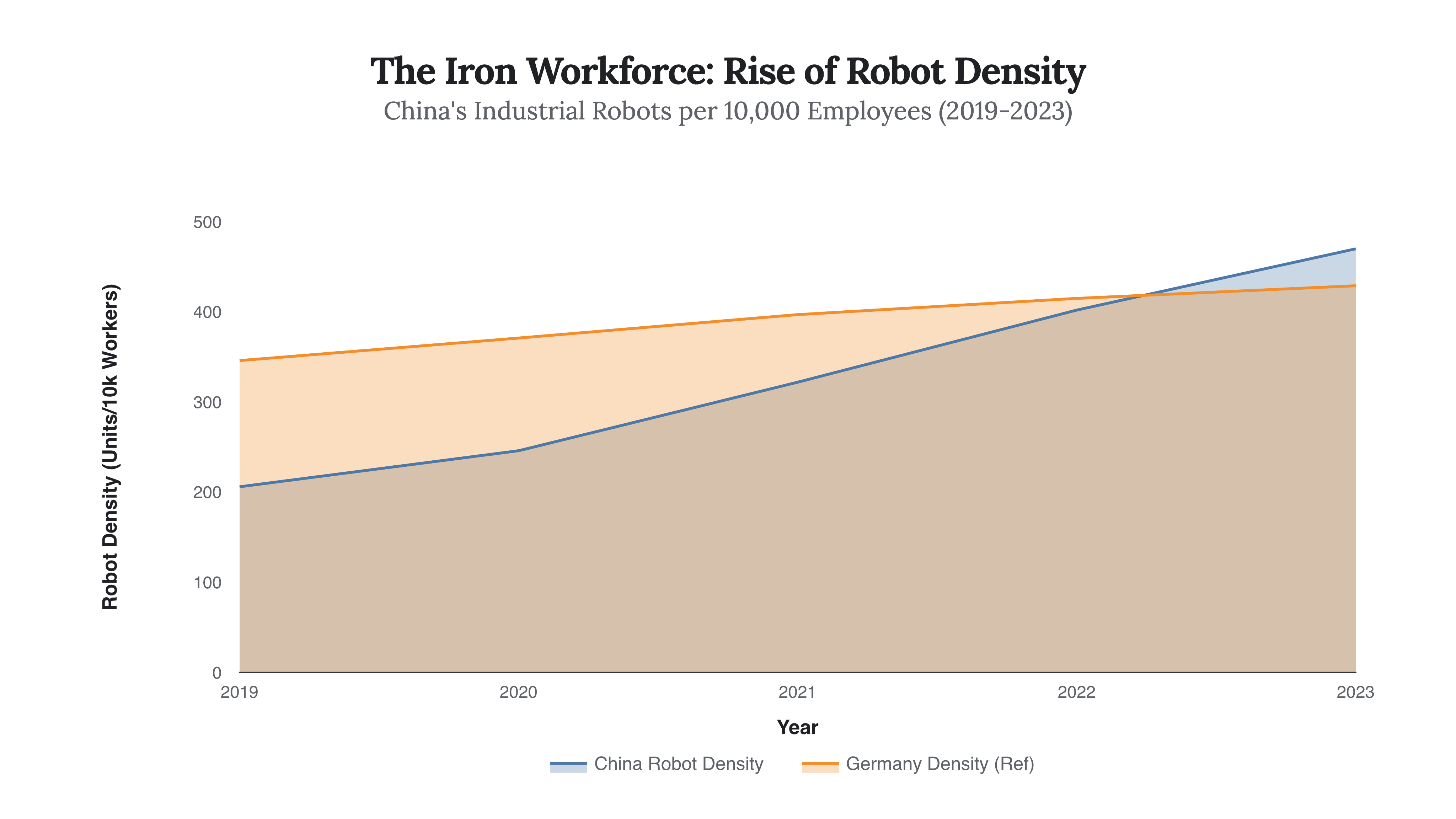
The chart above illustrates the kinetic pivot of the Chinese economy. In just four years, China’s robot density has more than doubled, overtaking Germany and Japan to rank third globally. This is the “Robot Dividend” intended to replace the vanishing “Demographic Dividend.” By 2024, China accounted for 54% of all industrial robot installations worldwide. The factory is no longer just filled with workers; it is the machine itself.
“China has achieved such a high robot density due to its huge investment in automation technology... despite having a large workforce of about 37 million people in the manufacturing sector.” — Takayuki Ito, President of the International Federation of Robotics (2024 Report)
The Architecture of Resilience
This automation is not merely about efficiency; it is a defensive architecture against external containment. As the United States and its allies tighten export controls on advanced semiconductors, China has responded by aggressively expanding its domestic capacity for legacy and mid-tier electronics. The strategy is clear: if you cannot buy the brain, you build the body so effectively that the brain has nowhere else to go.
Throughout 2024, the electronic information manufacturing sector consistently outperformed the broader industrial economy. While general manufacturing limped along with single-digit growth, the high-tech electronics sector maintained a double-digit lead, driven by a national mandate for self-sufficiency in the supply chain.
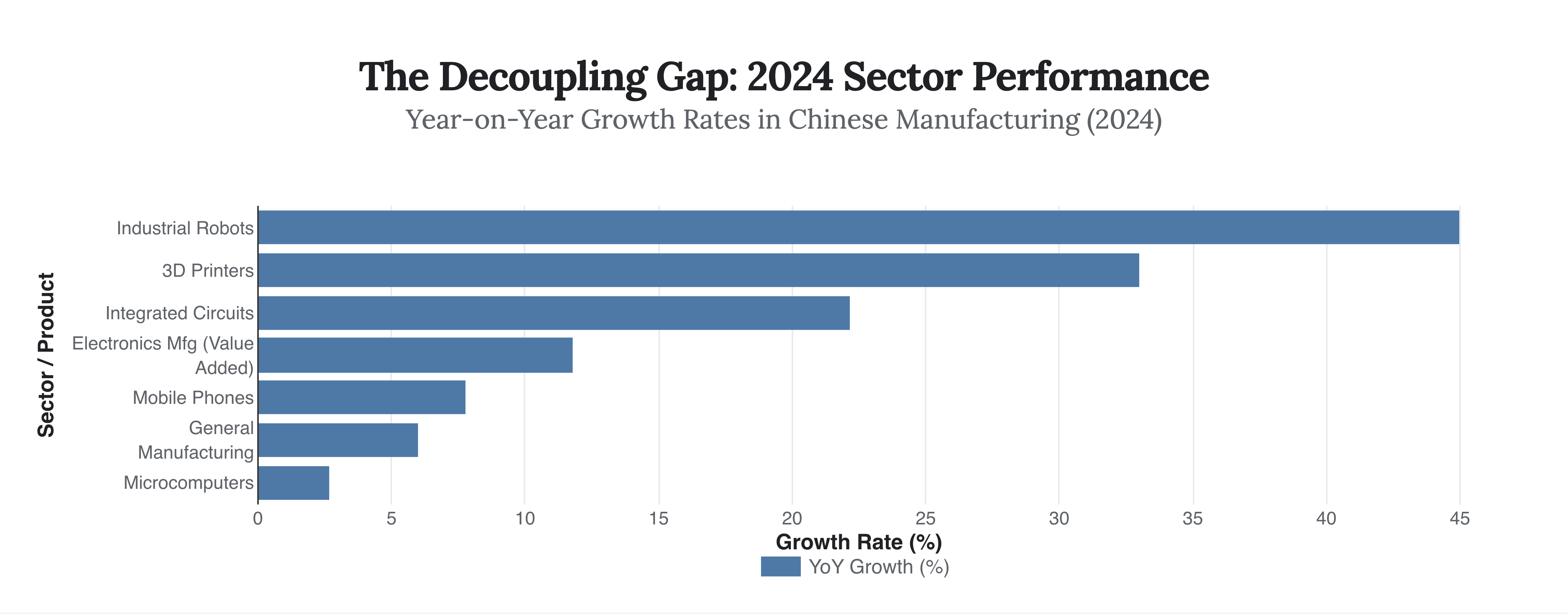
The disparity in growth rates reveals the strategic priority. Legacy consumer goods like microcomputers are seeing stagnant growth—these are the supply chains slowly migrating to Vietnam and India. However, the “hard tech”—industrial robots, 3D printers, and integrated circuits—are exploding. This is the “Fortress Economy” in action: shedding the low-value skin to protect the high-value core.
“Enterprises above a designated size reported a total revenue of RMB 16.19 trillion... The sector’s strong performance highlights its resilience despite global economic uncertainties.” — Ministry of Industry and Information Technology (2025 Briefing)
The Kinetic-Cognitive Pivot
The final piece of this puzzle is the integration of these automated systems into a cognitive whole. Companies like BYD and Huawei are now operating plants that are reportedly 97% autonomous. In these “dark factories,” production lines do not sleep, do not strike, and remain immune to viral outbreaks. This kinetic capability creates a gravity well that keeps the global supply chain anchored, even as political rhetoric demands a drift away.
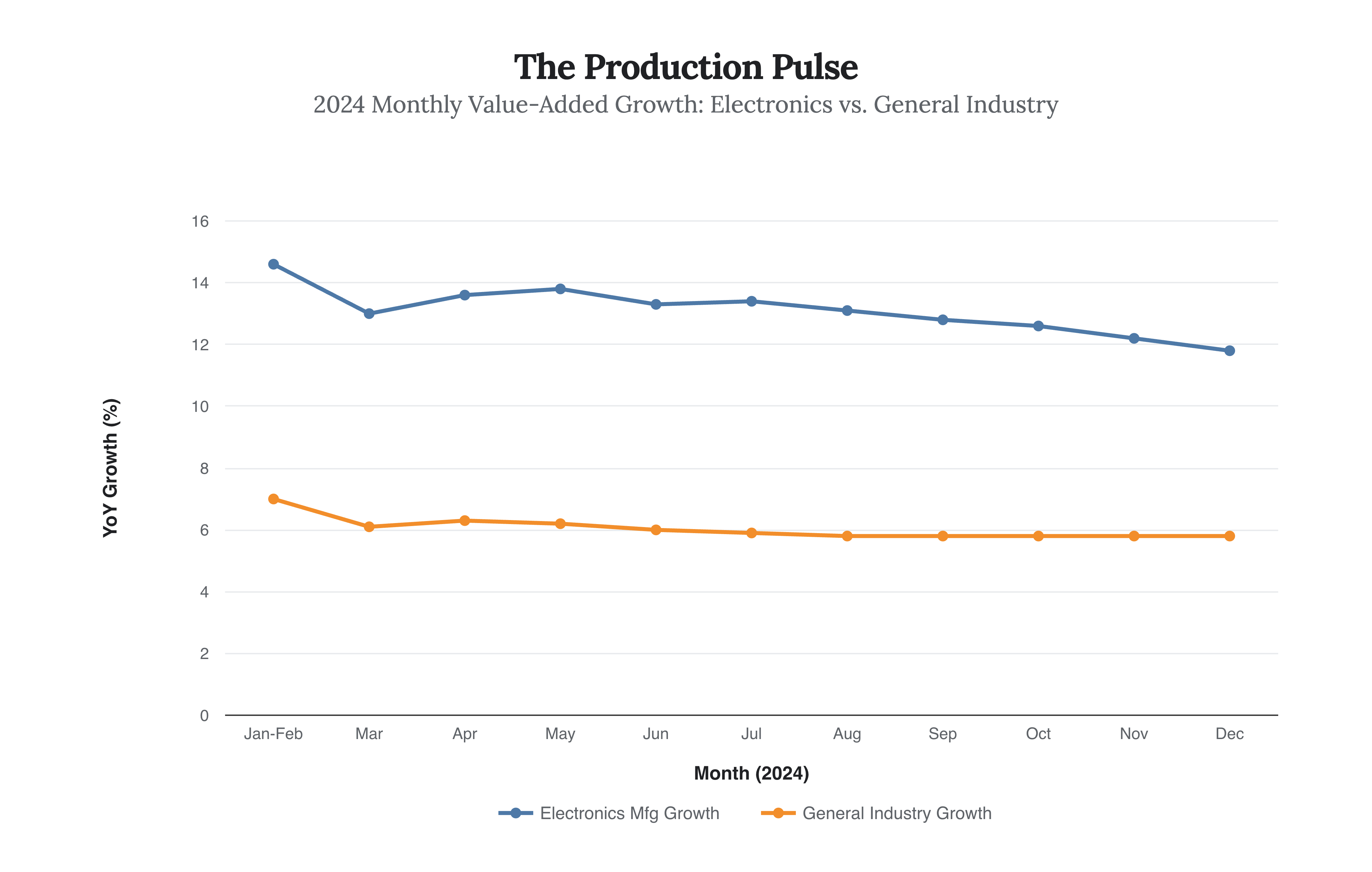
As the chart above demonstrates, the electronics sector (the blue line) has consistently decoupled from the general industrial trend (the green line). While the broader economy stabilized at around 6% growth, electronics manufacturing maintained a furious pace, averaging nearly double that rate. This sustained divergence suggests that high-tech manufacturing is being artificially accelerated through policy and investment, effectively insulating it from the broader economic cooling.
The insight for the coming decade is uncomfortable but unavoidable: The West is building walls to keep Chinese products out, but inside those walls, China is building a machine that may eventually not need the West at all.