


The Architecture of Erasure
As of February 2026, the digital world has achieved near-total saturation, with social media user identities reaching a staggering 5.66 billion. Within this hyper-connected lattice, the most potent tool in the user’s arsenal is not the ‘Like’ or the ‘Share,’ but the ‘Block.’ This binary switch—the ability to unilaterally erase another human being from one’s perceived reality—has moved beyond a simple safety feature to become a foundational element of modern cognitive architecture. In 2026, the act of blocking is no longer a defense against harassment; it is an act of digital terraforming, a deliberate pruning of the social landscape to ensure a curated, frictionless existence.
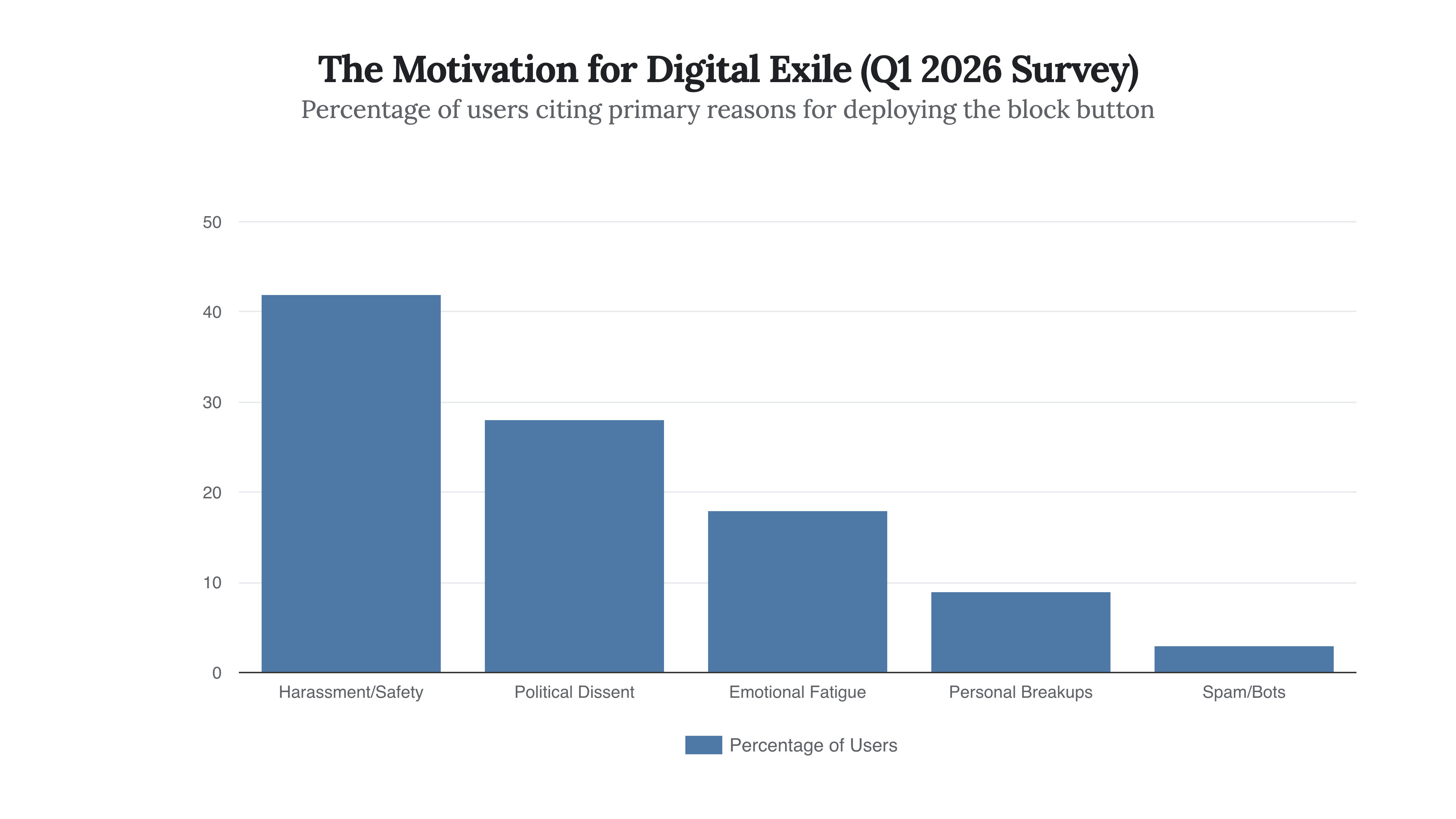
The psychological weight of this ‘Digital Exile’ cannot be overstated. When a user engages the block button, they are not just muting a voice; they are enacting a form of social death. Data from Q4 2025 indicates that the average social media user now maintains a ‘block list’ that has grown by 22% year-over-year. This surge is driven by a fundamental shift in user behavior: the transition from debating dissent to deleting it. The ‘Block’ button has become the ultimate psychological analgesic, providing an immediate dopamine hit of control in an increasingly chaotic information environment.
The X-Paradigm: When the Shield Becomes Transparent
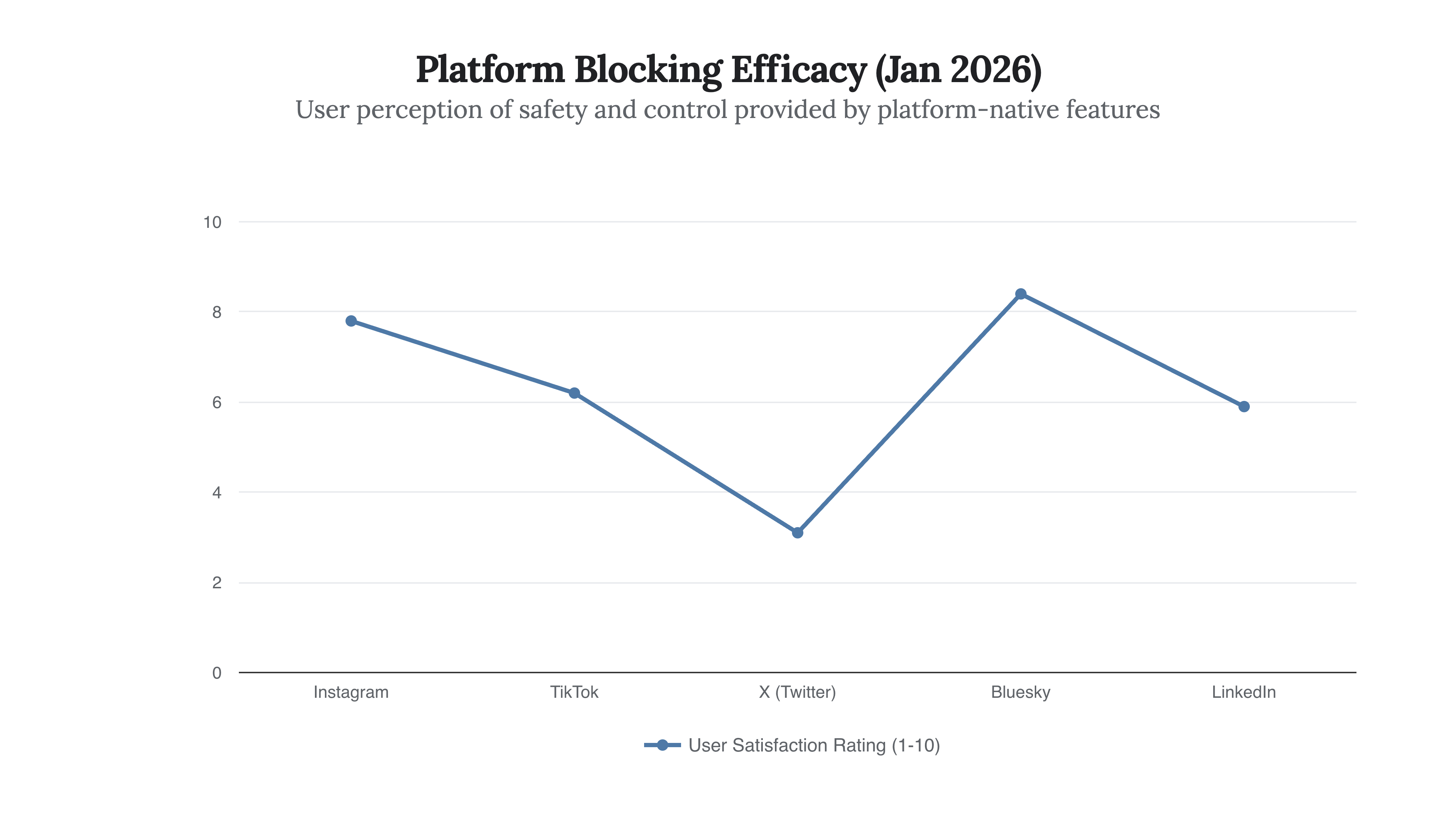
The landscape of digital exclusion underwent a seismic shift in late 2024 and throughout 2025, primarily led by X (formerly Twitter). The platform’s decision to allow blocked users to view public posts—while still preventing engagement—fundamentally dismantled the ‘Digital Restraining Order’ that users had come to rely on. By February 2026, the second-order effects of this policy are clear: the sense of sanctuary that the block button once provided has evaporated. The modern block is no longer a wall; it is a one-way mirror where the exiled can still watch the executioner from the shadows.
This policy change has forced a mass migration. High-value creators and vulnerable populations have increasingly fled the ‘Public Town Square’ model for ‘Bunker Platforms’ like Signal, Discord, and specialized WhatsApp communities. Data suggests that 31% of users who were previously ‘public’ on X have switched to private modes or deactivated entirely since the blocking mechanics were diluted. This is the ‘Transparency Trap’: by attempting to reduce echo chambers through forced visibility, platforms have instead incentivized the total withdrawal of diverse voices into impenetrable, encrypted silos.
The Neurobiology of the Blocked
What happens to the human brain when it is suddenly and inexplicably erased? Studies released in early 2025 by Stanford University and other leading research institutions have mapped the neural signatures of digital exclusion. The results are chilling. Being ‘blocked’ triggers the same dorsal anterior cingulate cortex activity associated with physical pain. In the brain’s evolutionary logic, social exclusion is a threat to survival. In 2026, the brain does not distinguish between being cast out of a physical tribe and being blocked by a digital peer; the physiological stress response is identical.
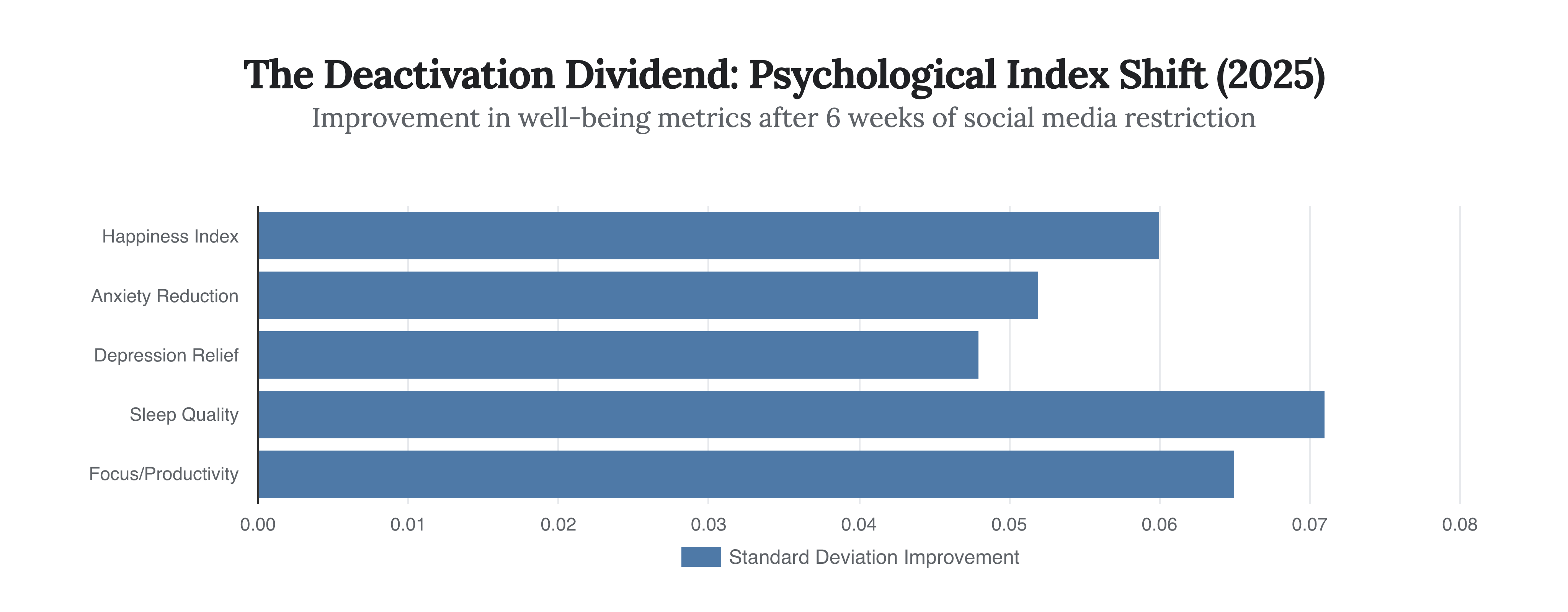
Furthermore, the ‘Deactivation Dividend’—a term coined after a landmark 2025 study—shows that users who actively restrict their social media exposure or ‘block’ the noise of the platform report a 0.060 standard deviation improvement in happiness and a significant reduction in clinical anxiety. This creates a paradox: the act of blocking others improves the blocker’s mental health while simultaneously degrading the mental health of the blocked. We are living in a zero-sum empathy economy where one person’s peace of mind is purchased through another person’s digital annihilation.
Unlock deeper strategic alpha with a 10% discount on the annual plan.
Support the data-driven foresight required to navigate an era of radical uncertainty and join a community of institutional-grade analysts committed to the truth.
The Rise of AI-Automated Exile
By early 2026, the burden of manual blocking has been offloaded to artificial intelligence. New ‘Personal Safety Agents’ now sit as a layer between the user and the platform, automatically blocking accounts that match specific behavioral patterns, political leanings, or linguistic markers. We have entered the era of the ‘Predictive Block,’ where individuals are exiled not for what they have said, but for what an algorithm predicts they might say.
This automated exclusion is creating a ‘Fragmented Reality.’ When two users in the same physical room look at the same trending topic, their algorithmic blocks ensure they are seeing two entirely different universes. The digital exile is no longer just a person; it is an entire perspective. Data from January 2026 indicates that 14% of Gen Z users now utilize third-party AI blocking tools that ‘pre-cleanse’ their feeds based on ideological compatibility. This is the ultimate evolution of the echo chamber: a self-healing, AI-enforced bubble that treats dissent as a system error to be patched.
The Social Credit of Visibility
In this environment, visibility has become a form of social currency, and the ability to block is the power to devalue that currency. Being ‘unblockable’—a status often sought by political figures and influencers through platform-level protections—is the new digital high-ground. Conversely, for the average user, the constant fear of being blocked has led to a ‘Self-Censorship Spiral.’ In 2026, the most effective form of content moderation is not platform-led; it is the internalized fear of digital non-existence.
The data reality is stark: 48% of teens surveyed in late 2025 believe social media has a negative impact on people their age, yet only 14% say it affects them personally. This ‘Optimism Bias’ suggests that while we recognize the systemic cruelty of the digital exile economy, we believe our own block lists are justified. We view our own use of the button as ‘curation’ and others’ use of it as ‘censorship.’ This cognitive dissonance is the lubricant that allows the machinery of digital exile to function without friction.
Conclusion: The Permanent Record vs. The Permanent Exile
The psychology of the block button is ultimately a reflection of our inability to scale human empathy to the level of 5.66 billion users. We were never meant to process the opinions of everyone on Earth, and the block button is our biological emergency brake. However, in engaging that brake, we are tearing the social fabric beyond repair. The digital world in 2026 is no longer a public square; it is a collection of high-walled fortresses where the exiled are forgotten, and the residents are increasingly lonely behind their perfect, silent walls.
Strategic analysts must recognize that ‘Digital Exile’ is now a primary driver of market shifts and social movements. The migration away from transparent platforms and the rise of AI-driven exclusion are not just trends—they are the new rules of engagement. In a world where you can be erased with a single click, the only true alpha lies in the communities that refuse to use the guillotine.