


The number on the screen isn’t just a price; it is a verdict. On Wednesday morning, gold trading breached the psychological fortress of $4,888 per ounce, a figure that would have seemed like science fiction just twenty-four months ago. But the vertical ascent of the yellow metal is not a celebration of wealth. It is a measurement of fear. As the Greenland diplomatic crisis deepens and the fallout from the Venezuela incursion ripples through global markets, capital is no longer seeking return—it is seeking asylum.
For decades, the financial world operated on the assumption that the U.S. Dollar was the ultimate sanctuary. That assumption formally died this week. The rush we are witnessing—driving gold up nearly 77% in a single year—is not a standard commodity cycle. It is the visible dismantling of trust in the Atlantic alliance. When traditional allies like France and Germany are threatened with tariffs over Arctic territorial disputes, the bedrock of the post-1945 economic order fractures. Gold is simply filling the cracks.
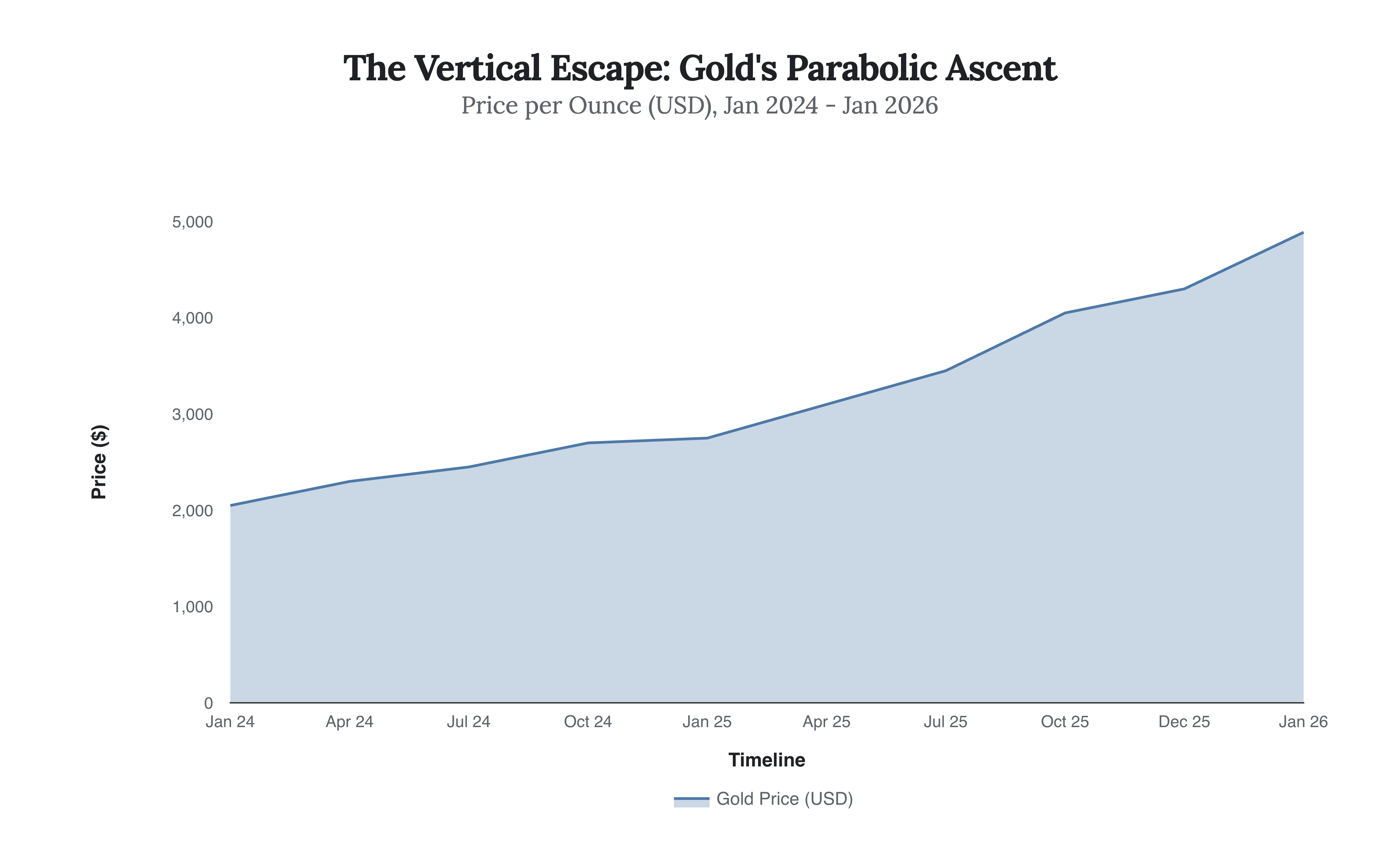
This chart traces more than just inflation or interest rate speculation; it traces the collapse of geopolitical certainty. The inflection point in late 2025, where the curve goes nearly vertical, correlates precisely with the escalation of the “Greenland Saga” and the breakdown of U.S.-E.U. trade talks. Investors are not buying gold to get rich; they are buying it to avoid becoming poor in a currency that is increasingly weaponized by political unpredictability.
“When U.S. foreign policy leans towards transactional, unpredictable and bypassing multilateral frameworks, it can erode policy credibility and incentivises diversification away from the USD.”
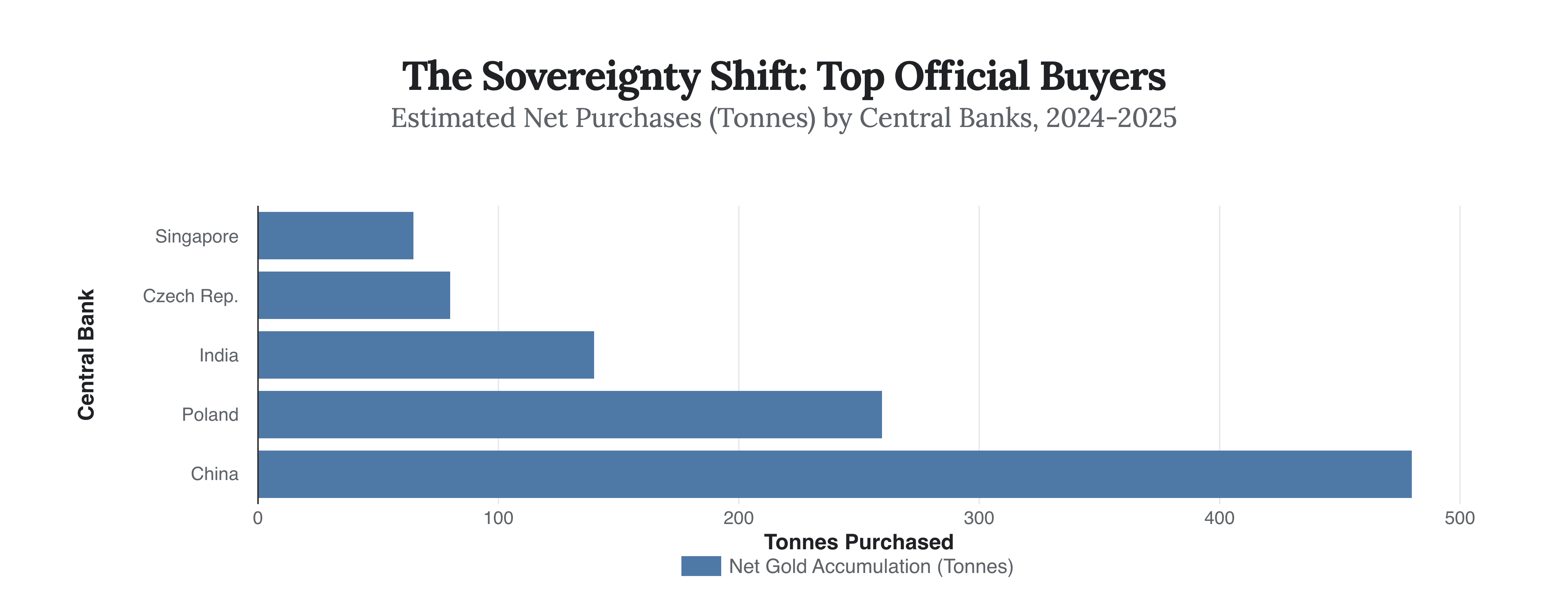
The retreat from the dollar is being led not by day traders, but by sovereigns. This is the hidden architecture of the current rally: a massive, coordinated accumulation of physical bullion by central banks preparing for a world where the dollar is no longer neutral. The “risk-free” asset is no longer a U.S. Treasury bond; it is a bar of metal in a vault in Shanghai or Warsaw.
While Western consumers are just waking up to the headline price, nations like China, Poland, and India have been quietly building fortresses of gold for eighteen months. They are effectively insulating their economies from the very sanctions and tariff wars that are now dominating the news cycle from Davos. The data shows a clear migration of sovereignty: gold is moving from West to East, from paper markets to physical vaults.
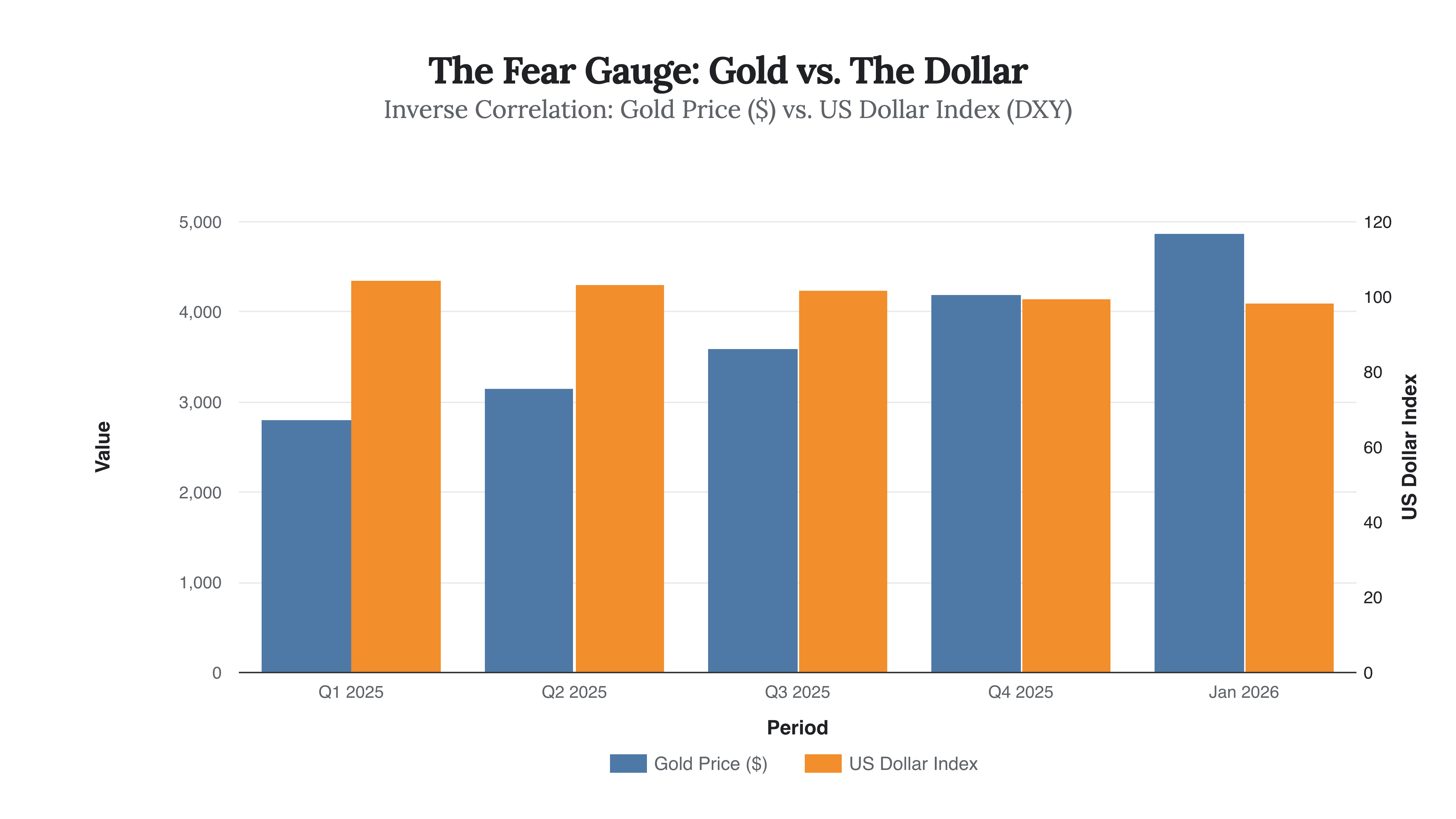
This accumulation has created a floor under the price that technical analysts cannot explain. Usually, high interest rates—which the Federal Reserve held steady through much of 2025—would crush gold prices. Gold pays no yield, so it usually suffers when bonds pay 5%. But that correlation has broken. We are currently witnessing a “decoupling” where gold rises regardless of rates, driven entirely by the fear of systemic rupture. The market is pricing in the risk that the dollar itself is the liability.
The inverse relationship between the Greenback and Gold has reasserted itself with vengeance in the opening weeks of 2026. As the Dollar Index (DXY) slips below 99.0—battered by rumors of retaliatory European trade measures—gold acts as the exact counterweight. It is a zero-sum game of confidence. Every percentage point of faith lost in the fiat system is instantly transmuted into the price of bullion.
We are left with a paradox. The record high of $4,888 is nominally a sign of value, but existentially, it is a warning siren. It signifies the death of the “global commons” where trade and currency were assumed to be apolitical. In this new era of fragmented power, gold is the only neutral territory left.
“Gold remains supported not by prolonged conflict per se, but by an ongoing backdrop of geopolitical uncertainty and policy unpredictability.”
As we watch the tickers tape these historic numbers, we must understand that we are not watching a bubble. We are watching a lifeboat. The price is not rising because gold has changed; it is rising because the world around it is sinking. In a world of weaponized currencies, the only safe asset is the one that belongs to no one.
This hits hard tbh. The idea that gold's vertical climb isnt about getting rich but avoiding becoming poor is such a key distinction. I've been watching my parents' generation still treating dollars like the default safe haven while central banks are litterally building vaults of physical gold. That sovereigns are leading the retreat from the dollar rather than retail investors feels like one of those quiet shifts that history books will mark as the turning point.