



On a Friday morning in July 2024, the world’s digital nervous system suffered a seizure. It wasn’t caused by a sophisticated nation-state actor or a rogue AI, but by a software update from a single vendor that many of the world’s largest organizations had consolidated around for protection. The CrowdStrike outage was more than just a technical glitch; it was the trap springing shut. For years, the cybersecurity industry has marched toward a singular dogmatic goal: consolidation. The promise was seductive—merge your hundreds of security tools into one “platform,” simplify your architecture, and sleep soundly. But the data from 2024 and 2025 reveals a darker reality: we have traded complexity for fragility, creating an architecture where a single error can bypass billions of dollars in defensive spending.
The consolidation narrative was built on a logical premise: the average enterprise was drowning in tools. In 2019, organizations juggled an average of 70+ distinct security vendors. The friction of managing this sprawl was real. But the industry’s correction—aggressively merging into the arms of a few “platform” giants like Microsoft, Palo Alto Networks, and CrowdStrike—has created a new, perhaps more dangerous, systemic risk. We optimized for efficiency and accidentally designed a global kill switch.
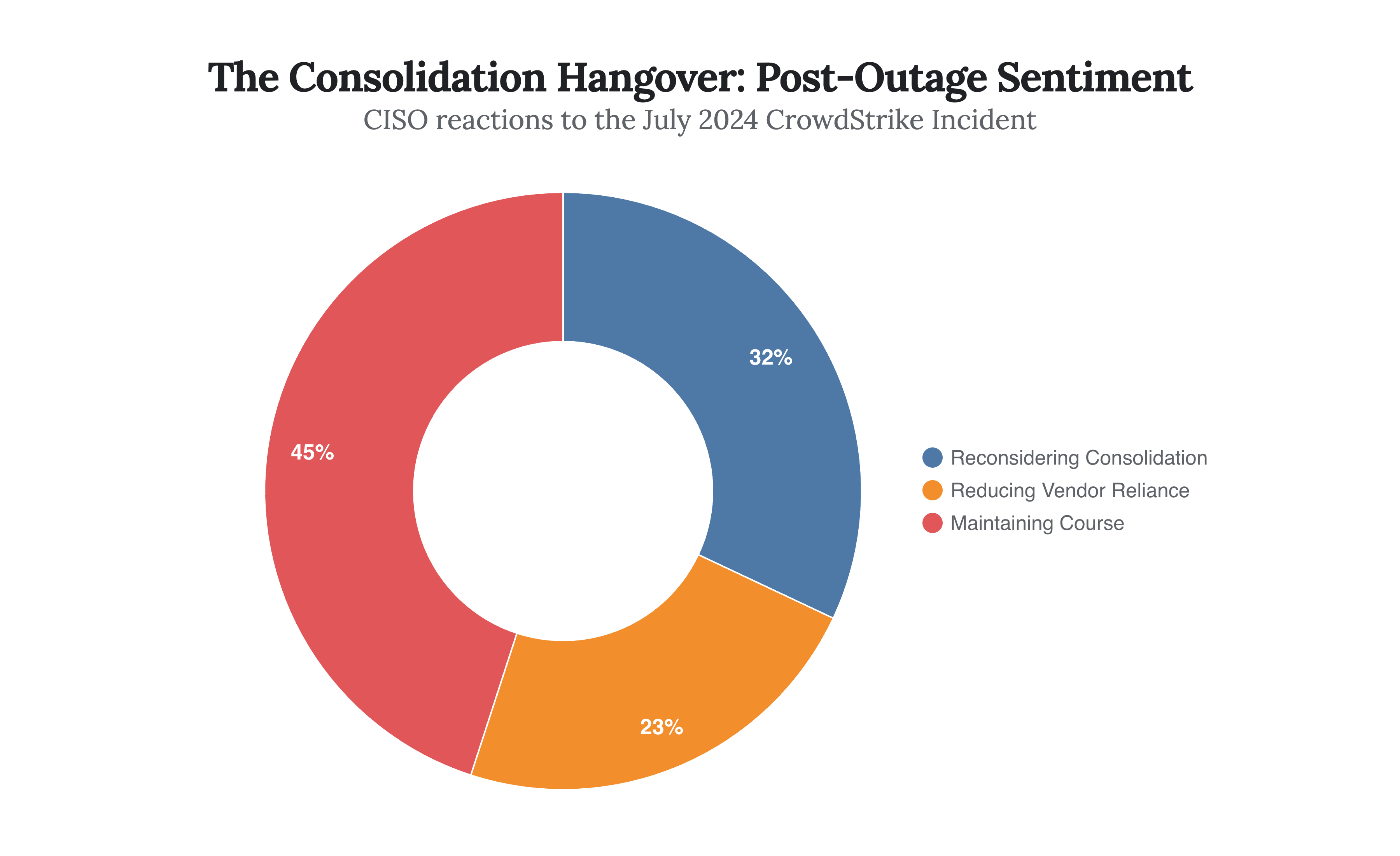
The immediate fallout of the outage wasn’t just operational; it was psychological. As the chart above illustrates, nearly 55% of IT decision-makers immediately signaled an intent to pivot away from aggressive single-vendor consolidation. The “all-in-one” strategy, once the hallmark of a mature security posture, is now being viewed as a liability. This skepticism is well-founded when we look at the financial data. We are spending more than ever, yet we are not seeing a proportional drop in breaches.
In 2024, global cybersecurity spending surged to an estimated $215 billion, driven by fears of AI-enhanced attacks and regulatory pressure. Yet, the effectiveness of this spending is questionable. A startling 44% of CISOs reported an inability to detect data breaches with their existing tools, and the global average cost of a data breach remains stubbornly high at $4.88 million. We are pouring concrete into a foundation that is cracking.
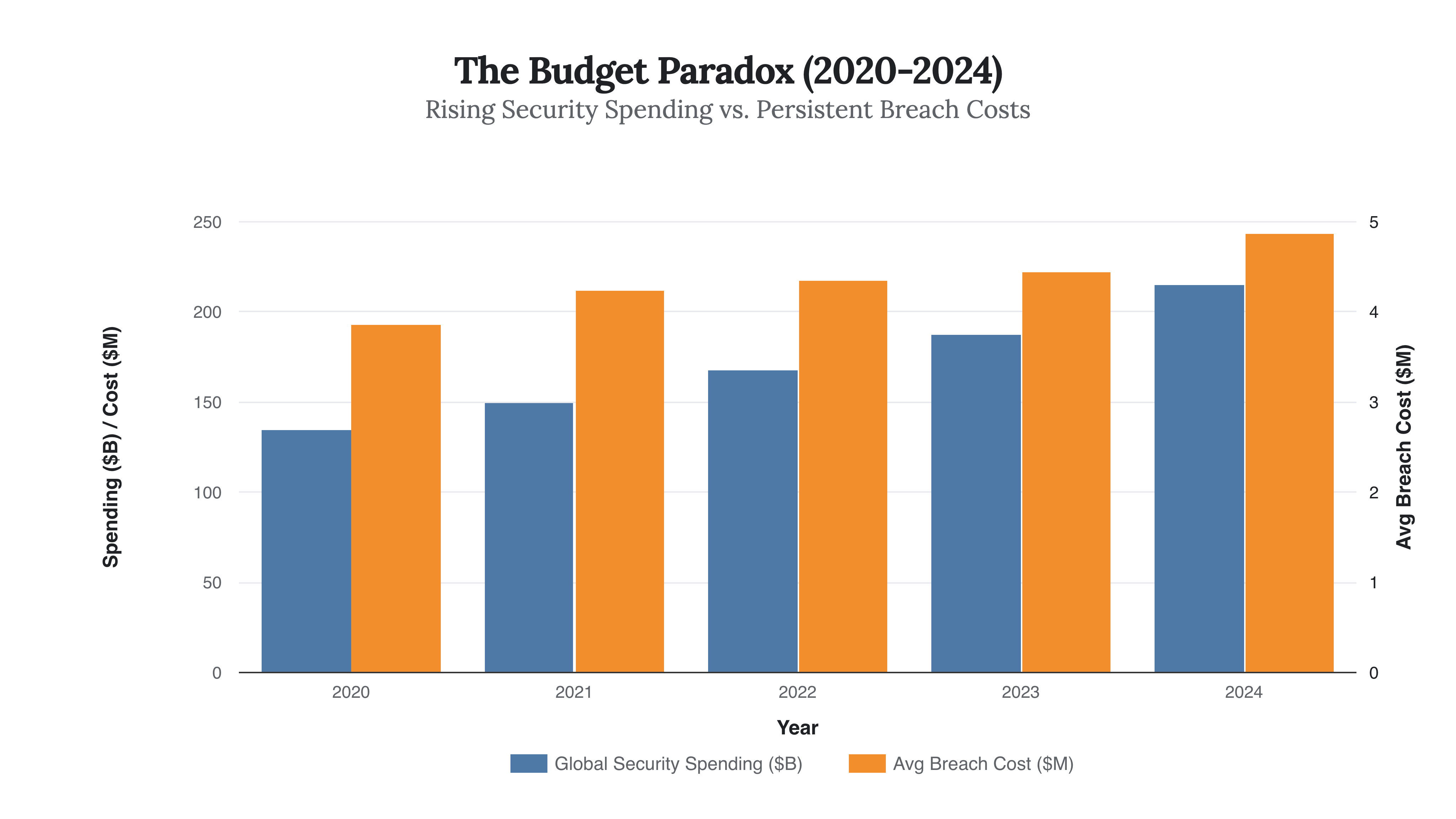
The chart above reveals the industry’s uncomfortable truth: there is a decoupling between input (budget) and outcome (safety). While spending has climbed nearly 60% since 2020, the cost of failure—a breach—has risen in tandem. If consolidation was the silver bullet, we should see the “Avg Breach Cost” line trending down as efficiencies kick in. Instead, we see the opposite. The “single pane of glass” often obscures the reality that attackers only need to find one crack in that glass to shatter the entire window.
“A Security Operations Center (SOC) may love the ‘single pane of glass,’ but attackers love monocultures even more. If they learn how to breach your EDR, and that tool is also your identity provider, they’ve mapped your entire kill chain.”
This monoculture is driven by the massive market share of a few dominant players. The market cap of the top cybersecurity firms dwarfs the rest of the industry, creating an oligopoly where a few codebases underpin the security of the global economy. Investors love “platformization” because it locks customers in; security architects are realizing it locks resilience out.
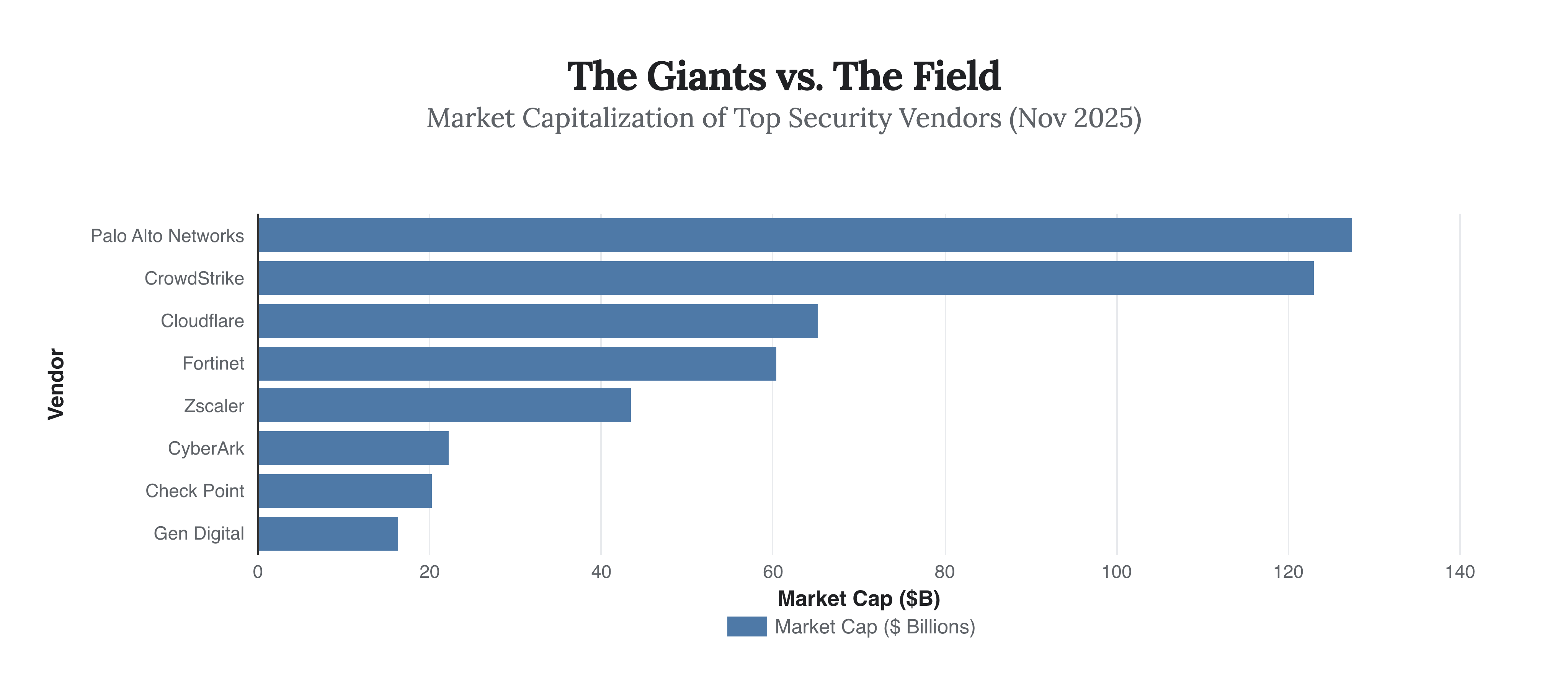
The massive disparity in size shown here underscores the centralization risk. When the top two or three vendors hold the keys to the kingdom for the majority of the Fortune 500, a vulnerability in one becomes a global crisis. The “Trap” is the belief that buying the biggest logo on the chart buys safety. In reality, it buys shared fate. If Palo Alto Networks or CrowdStrike sneezes, the world catches a cold.
So, where do we go from here? The trend for late 2025 and beyond is a “Resurrection” of best-of-breed—but with a twist. It is not about returning to the chaotic sprawl of 2019, but about intentional diversity. Organizations are now seeking “architectural decoupling,” ensuring that their endpoint protection doesn’t share a genetic defect with their firewall or identity system. They are building air gaps not just between networks, but between vendors.
“Trust—but verify. And then verify again with a tool from a different vendor. The era of blind faith in the ‘platform’ is over.”
The consolidation trap seduced us with the promise of simplicity. It told us that if we just paid one bill to one giant, the chaos would stop. But chaos is the natural state of the internet. True resilience doesn’t come from building a higher wall around a single castle; it comes from ensuring that if the castle falls, the kingdom can still function.