



In the back alleys of Shenzhen’s Huaqiangbei electronics market, a shattered Nvidia H100 GPU—fried from overuse in a crypto mine or bricked by a remote firmware update—is no longer trash. It is a strategic asset. As of late 2025, the street price to “resurrect” a banned, broken AI chip has doubled, hitting ¥20,000 ($2,800). This mundane figure is not a supply chain quirk; it is the single most reliable lead indicator for the next wave of state-sponsored ransomware.
For years, intelligence agencies tracked missile silos and troop movements. Today, the precursor to a devastating cyber offensive is a subtle inflation in the price of e-waste. Advanced Persistent Threat (APT) groups, particularly those aligned with sanctioned regimes like Russia and North Korea, are voraciously consuming salvaged high-end compute to fuel a new generation of “off-grid” AI operations. They are building what I call the Zombie Foundry: a decentralized, unmapped supercomputing mesh built entirely from smuggled and repaired hardware.
This briefing analyzes the correlation between these black-market hardware spikes and the subsequent “Ransomware 3.0” campaigns. We will dissect the economics of the illicit chip trade, the technical necessity of local compute for AI-driven malware like “PromptLock,” and why a $2,800 repair bill in Shenzhen is the warning siren for a $50 million ransom demand in New York.
The Zombie Foundry: Anatomy of the Illicit Supply Chain
The global blockade on high-performance semiconductor exports to China and Russia has not stopped the flow of chips; it has merely driven it underground, creating a bifurcation in the market. While legitimate firms struggle with compliance, illicit actors have built a robust parallel economy focused on salvage.
The “Hao Global” indictment in December 2025, which exposed a $160 million smuggling ring moving 7,000+ Nvidia H100s labeled as “adapter modules,” was just the tip of the iceberg. The real story is the secondary market for broken silicon. State-sponsored groups are buying damaged units at a discount and paying premium rates to specialized repair shops to rehabilitate them. This allows them to bypass the “trackers” the U.S. began planting in new shipments in mid-2025.
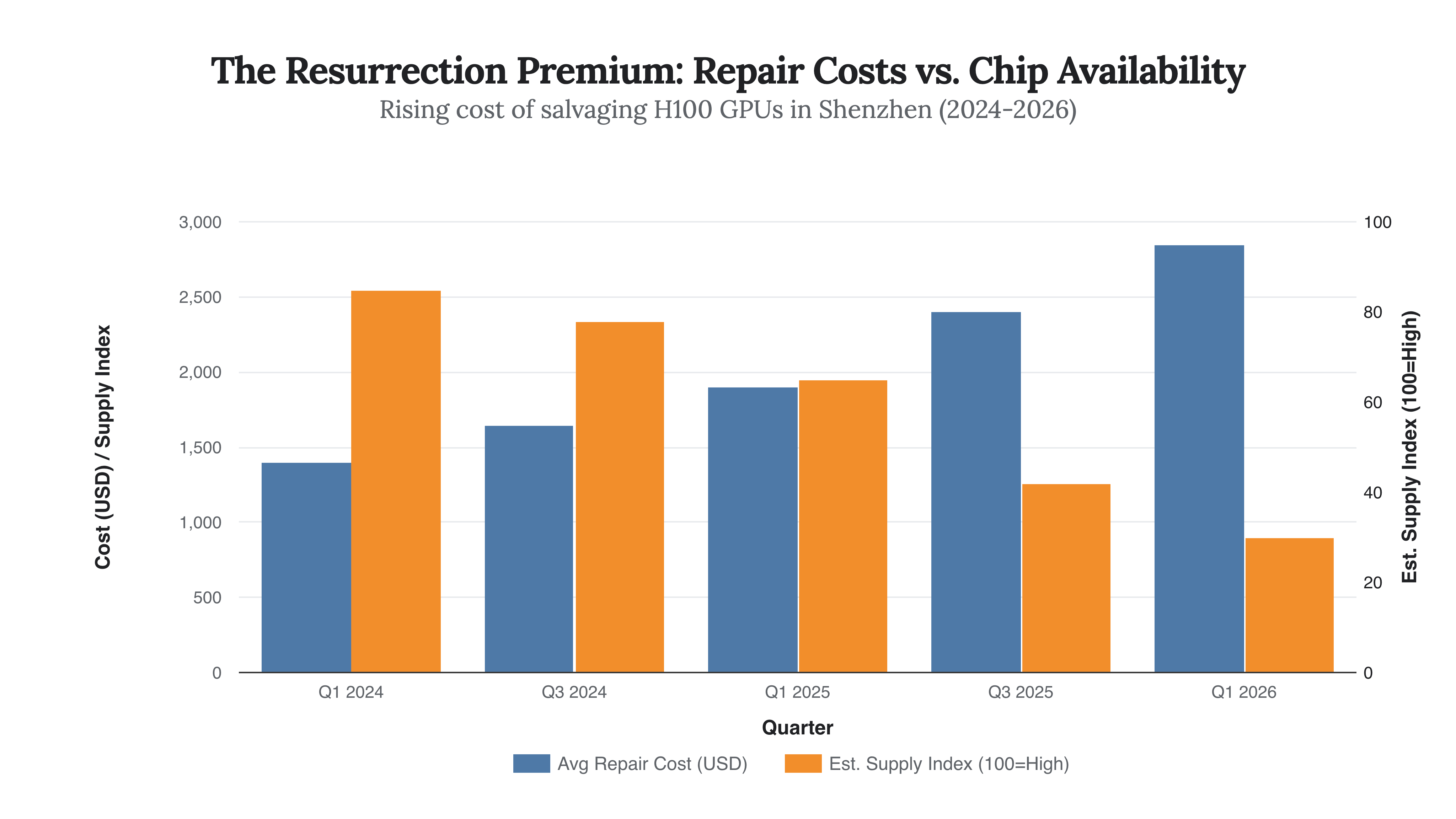
Figure 1: As the supply of fresh, smuggled chips tightens (Blue Line) due to enhanced enforcement, the cost to repair and salvage damaged units (Red Bars) has skyrocketed. This inverse correlation signals a desperation for compute power that precedes a major operational push.
The Economics of Erasure
Why pay $2,800 to fix a chip? Because the alternative—using public cloud infrastructure—is operational suicide. To train offensive AI models or run massive brute-force decryption campaigns, threat actors cannot use AWS or Azure, where their workloads would be flagged by anomaly detection algorithms. They need sovereign compute: air-gapped, untraceable, and fully controlled.
