


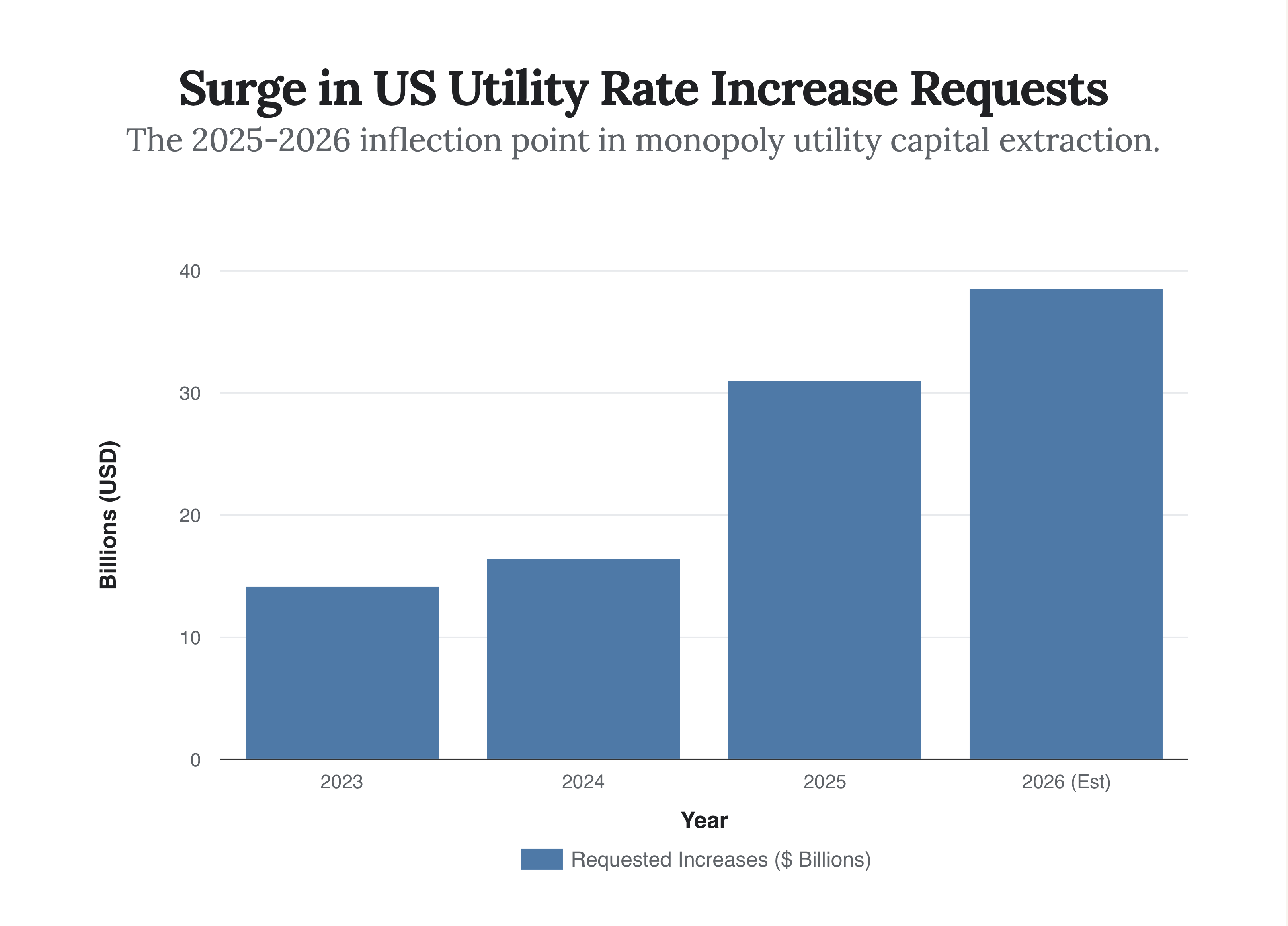
Looking back from the vantage point of 2031, the macroeconomic narrative of the mid-2020s is often oversimplified by financial historians as a straightforward battle against post-pandemic inflation. However, for those operating on the ground in the realm of intelligence and strategic foresight, the true structural fracture—the specific moment the underlying architecture of American and European civic stability began to genuinely crack—occurred in the spring of 2026. It was not the price of lumber, semiconductors, or even used cars that triggered the profound political and economic realignments of the late 2020s; it was the arrival of the mail-delivered utility bill. By May 2026, the quantitative data was absolutely undeniable and systemically terrifying: a historic $31 billion in requested utility rate increases from the previous year had begun to cascade through the domestic financial system, landing squarely on the shoulders of the captive residential ratepayer [1.3.5]. Across the United States, utility companies in 49 states, alongside the District of Columbia, had either secured approvals or were aggressively pending massive rate hikes that fundamentally altered the cost of living. The psychological shock to the consumer class was profound. While the inflation of discretionary goods can be mitigated by behavioral changes—delaying a vacation, buying a cheaper brand—electricity and water are fundamentally inelastic commodities. They are not consumer choices; they are a tax on biological and social existence in the modern era. When the cost of this existence suddenly spikes by double digits within a single billing cycle, the reaction is not mere consumer dissatisfaction; it is visceral, existential anger. According to internal analyses from the Brookings Institution at the time, household utility costs had risen by a staggering 41 percent in the five years following the pandemic’s onset, with electricity specifically surging by 32 percent.
By the close of 2026, the utility bill had mutated from a predictable monthly administrative expense into a volatile, highly regressive tax on basic biological existence. This mutation broke the century-old ‘regulatory compact’—the unspoken agreement between the state, the monopoly utility providers, and the citizens, which guaranteed a reasonable rate of return for the utilities in exchange for reliable, broadly affordable power for the populace. The American consumer, who had already spent an average of $1,833 on electricity bills in 2024, was suddenly facing projections of near-continuous cost escalation, driven not by temporary spot-market anomalies, but by structural, locked-in capital expenditures. The data mapped a highly fractured landscape of regional inequality. By May 2026, the national average for residential electricity stood at 18.05 cents per kilowatt-hour, but this average concealed horrifying extremes. In Louisiana, ratepayers enjoyed a relatively insulated 12.44 cents per kilowatt-hour, while residents of California were subjected to a punishing 33.75 cents, and Hawaii suffered under a crushing 42.00 cents. This divergence was not merely a matter of geography; it was a real-time stress test of differing regulatory regimes, infrastructure legacies, and political mandates. The utility monopolies, functioning under the Investor-Owned Utility (IOU) model, were essentially guaranteed a return on equity of 9 to 11 percent on their capital expenditures. This created a perverse incentive structure: the more the utility spent on ‘grid hardening,’ infrastructure renewal, and generation transitions, the more profit they were legally entitled to extract from their captive ratepayer base. The consumer, lacking any alternative market mechanism to opt out of this localized monopoly, was forced to absorb the entirety of this risk-free corporate capitalization. As 2026 progressed, the realization that this was a structural, mathematical certainty rather than a temporary geopolitical supply shock began to radicalize the electorate. The ‘energy crisis’ of 2022 had been easily blamed on external actors and kinetic conflicts, but the rate shock of 2026 was undeniably domestic, systemic, and seemingly permanent. The sheer scale of the capital being deployed—and subsequently billed back to the public—was unprecedented, setting the stage for a localized populism that would soon engulf both state legislatures and national political platforms.
The Data Center Parasitism Dilemma
If the baseline utility infrastructure hikes provided the necessary kindling for the ratepayer rebellion of 2026, the explosive, unprecedented energy demands of artificial intelligence hyperscalers provided the catastrophic accelerant. By the mid-2020s, the cognitive dissonance between the virtual, ethereal branding of ‘the cloud’ and the brutally physical, resource-devouring reality of gigawatt-scale data centers became impossible for local communities to ignore. The scaling laws of generative artificial intelligence required computational clusters of staggering density, transforming previously quiet exurban corridors into the energy-consumption equivalents of heavy industrial smelting zones. In Loudoun County, Virginia—long known as the data center capital of the world—the physical constraints of the grid collided violently with the insatiable appetite of the tech sector, leading to severe political backlash. The artificial intelligence revolution of the mid-2020s was, in physical terms, nothing more than a massive, unsanctioned wealth transfer from the local residential ratepayer to the Silicon Valley hyperscaler. This parasitic dynamic was not a metaphor; it was a literal accounting reality documented on millions of monthly bills. Because the existing electrical grid was originally engineered for the relatively static, predictable load profiles of residential neighborhoods and legacy commercial centers, the sudden insertion of a 500-megawatt data center required massive, immediate transmission upgrades. Under the prevailing regulatory frameworks of 2026, these multi-billion-dollar grid expansions were largely socialized across the entire ratepayer base. The tech giants secured the necessary power to train their trillion-parameter models, while the working-class residents of the surrounding counties effectively financed the transmission lines required to deliver it. The political blowback was instantaneous and bipartisan. In Wisconsin, the realization that a single new Microsoft data center in Mount Pleasant would consume the same amount of power as the entire city of Madison triggered a wave of localized panic. Polling conducted by Wisconsin Conservation Voters in the spring of 2026 revealed a staggering shift in public sentiment: 84 percent of voters across all political affiliations expressed severe concern over the cost of electricity, and a definitive 93 percent demanded that Big Tech—not local ratepayers—should pay for 100 percent of the new energy infrastructure they required. Furthermore, 70 percent of voters concluded that the economic costs of hosting these data centers actively outweighed any theoretical benefits. The hyperscalers, recognizing the existential threat this populist anger posed to their expansion plans, attempted to flood the political zone. Entities including Anthropic, OpenAI, and Meta directed at least $150 million into state and federal elections during the 2026 cycle via complex networks of political organizations, desperately promising to ‘absorb more of their electricity costs’ under mounting public pressure. In Memphis, Tennessee, the backlash crystalized around Elon Musk’s artificial intelligence company, xAI, where state representatives launched high-profile campaigns specifically targeting the placement of a massive supercomputer in a predominantly Black neighborhood, citing both the localized energy drain and the subsequent rate hikes it would trigger for vulnerable populations. The realization that AI scaling required a physical tax on the working class’s utility bill destroyed the tech industry’s long-standing halo effect. Citizens began to understand that every query processed by a large language model implicitly relied on the spinning turbines and transmission lines that they were personally subsidizing. The data center was no longer viewed as an engine of local economic growth; it was accurately recognized as a hostile extraction engine, pulling cheap electrons from the grid and pushing the expensive, socialized infrastructure costs onto the very public it claimed to serve.
Europe’s Retail-Wholesale Decoupling
While the United States grappled with the socializing of tech infrastructure costs, the European continent in 2026 was tearing itself apart over an entirely different, yet equally devastating, structural failure: the ultimate decoupling of wholesale generation costs from retail utility bills. To the uninitiated observer, the European energy transition appeared to be an unmitigated numerical success. According to the highly circulated Ember European Electricity Review of 2026, wind and solar power had generated a record 30 percent of the European Union’s electricity in the previous year, officially overtaking fossil fuels for the first time in recorded history. The total solar generation alone reached a massive 369 terawatt-hours, an increase of 20 percent year-over-year. As a direct result of this massive influx of zero-marginal-cost renewable energy, the wholesale electricity markets began to exhibit extreme, unprecedented volatility. By April 2026, negative wholesale prices had become a routine, almost mundane occurrence across the continent. On April 26, 2026, the hourly electricity price on the Epex Spot SE exchange in Germany plummeted to an astonishing -€413.7 per megawatt-hour. Similar negative price collapses were recorded simultaneously in France (-€412.55/MWh), Hungary (-€500/MWh), and the Czech Republic (-€489.28/MWh). Basic economic theory would suggest that a sustained collapse in wholesale supply costs would result in a massive financial windfall for the end consumer. The reality, however, was a cruel, bureaucratic paradox. The ultimate paradox of the European green transition was realized in April 2026: a system where wholesale electricity was effectively free, yet the working-class citizen could no longer afford to turn on the heat. Despite the plunging wholesale rates, the retail electricity prices paid by European households remained relentlessly high, crippling domestic budgets and devastating industrial competitiveness. EU retail prices for energy-intensive industries remained elevated at over twice the levels seen in the United States and nearly 50 percent above those in China. The root cause of this decoupling was the structural composition of the European utility bill itself. As the European Commission’s Citizens’ Energy Package explicitly admitted in early 2026, fixed electricity taxes and levies accounted for an average of 25 percent of the total price paid by households. Furthermore, the massive capital expenditures required to build the transmission lines, balance the intermittent load, and subsidize legacy fossil-fuel backup capacity (the ‘capacity markets’) were heavily front-loaded onto the retail ratepayer. The system was functionally broken: when the sun shone and the wind blew, the grid was flooded with excess power that could not be stored due to severe bottlenecks and insufficient grid-scale battery deployment, driving prices negative. Yet, the consumer was still forced to pay the massive fixed infrastructure costs required to maintain this highly unstable balancing act. The human toll of this paradox was catastrophic. By early 2026, nearly 1 in 10 European citizens could not afford to adequately heat their homes, and more than 30 million Europeans officially reported struggling to pay their utility bills on time. In the Czech Republic, rigorous data from the Charles University Environment Centre revealed that over 10.3 percent of households were at severe risk of energy poverty, driven not by a decrease in absolute income, but by the relentless, sharp increase in base energy costs. The social contract of the green transition—that temporary capital investments would eventually yield an era of abundant, near-free clean energy—was fundamentally shattered. The working classes of Europe realized they were trapped in a permanent cycle of subsidizing a grid architecture that actively punished them, breeding a deep, systemic euroskepticism that would heavily influence the populist parliamentary victories of the late 2020s.
The Bipartisan Weaponization of the Utility Bill
The organic, localized fury generated by skyrocketing utility bills did not remain in a vacuum; it was rapidly identified, harvested, and weaponized by political operatives across the ideological spectrum, culminating in what industry insiders dubbed ‘the new politics of electricity’. Historically, utility regulation had been a deeply technocratic, low-visibility domain, managed by obscure public utility commissions and ignored by national campaigns. However, by the 2026 midterm election cycle, the utility bill had officially displaced international trade policy and raw inflation as the primary proxy for working-class economic anxiety. Polling data from Evergreen Action in early 2026 confirmed this seismic shift, revealing that more than eight in ten voters reported paying higher energy costs, with energy affordability ranking second only to grocery prices as the absolute top concern for the electorate. As the political establishment quickly discovered in 2026, you cannot deregulate away the cost of a physical grid upgrade; the iron laws of thermodynamics and capital expenditure do not respond to executive orders. The Democratic party, desperate to reclaim ground with working-class demographics, explicitly pivoted their campaign strategies to attack monopoly utilities and the Republican establishment’s handling of corporate oversight. In multiple state-level battlegrounds, this strategy proved lethally effective. In New Jersey, Governor-elect Mikie Sherrill won a critical mandate by explicitly promising to declare a state of emergency on utility costs and aggressively freeze rates. In Virginia, Governor-elect Abigail Spanberger successfully campaigned on a dual mandate of lowering baseline energy bills while simultaneously forcing data centers to pay a drastically higher share of the infrastructure burden. These victories were not anomalies; they were a reproducible blueprint. A leaked memo from Climate Power post-2025 elections highlighted how candidates found massive success directly tying rising utility costs to specific policy failures, beating back millions of dollars in opposition spending by simply centering the lived reality of an increasingly expensive American life. Conversely, the Trump administration, despite making aggressive populist promises to slash energy prices through domestic fossil fuel deregulation, found itself completely paralyzed by the structural realities of the grid. While the administration successfully authorized new drilling leases and temporarily suppressed spot-market natural gas prices, the administration completely failed to lower the actual utility bills arriving at voters’ homes. The reason was entirely structural: the massive rate hikes of 2026 were not driven by the cost of fuel, but by the guaranteed returns on capital expenditure (CapEx) for grid hardening, transmission buildouts, and legacy debt servicing. Even as the administration pointed to lower wholesale gas prices, the EIA data showed household electricity costs continuing their relentless upward trajectory, increasing significantly under their watch. The Republican base, heavily concentrated in exurban and rural zones highly sensitive to energy costs, began to fracture as the realization dawned that deregulating fuel extraction did absolutely nothing to restrain the localized monopoly pricing power of their regional utility provider. The bipartisan weaponization of the utility bill transformed state public utility commissions—previously sleepy administrative bodies—into vicious, highly contested political battlegrounds. Citizens began showing up by the thousands to rate-case hearings, demanding forensic audits of utility spending. The 2026 midterms proved that energy policy could no longer be debated in the abstract terms of climate timelines or corporate deregulation; it had to be explicitly answered in the unforgiving mathematics of the monthly residential bill.

Grid Hardening and the Climate Surcharge Era
Beneath the political theater and the localized anger surrounding data centers lay a much deeper, more intractable financial pathology: the staggering cost of physically hardening the legacy grid against an increasingly hostile environment. By 2026, the era of ‘cheap and reliable’ base load generation had been definitively replaced by the ‘climate surcharge’ era. Financial projections from utility sector analysts indicated that investor-owned utilities in the United States alone were locked into deploying more than $1.1 trillion in capital investments during the 2025–2029 period. This astronomical sum was not primarily intended to lower costs or drastically improve consumer service; rather, it was a desperate, reactive sprint to rebuild aging infrastructure, comply with shifting federal mandates, and armor transmission assets against severe weather events. Climate adaptation rapidly became the ultimate vehicle for monopoly profit maximization, transforming natural disasters into guaranteed, ratepayer-funded returns on equity. The state of California served as the ultimate, grim harbinger for this national trend. In the aftermath of the
