


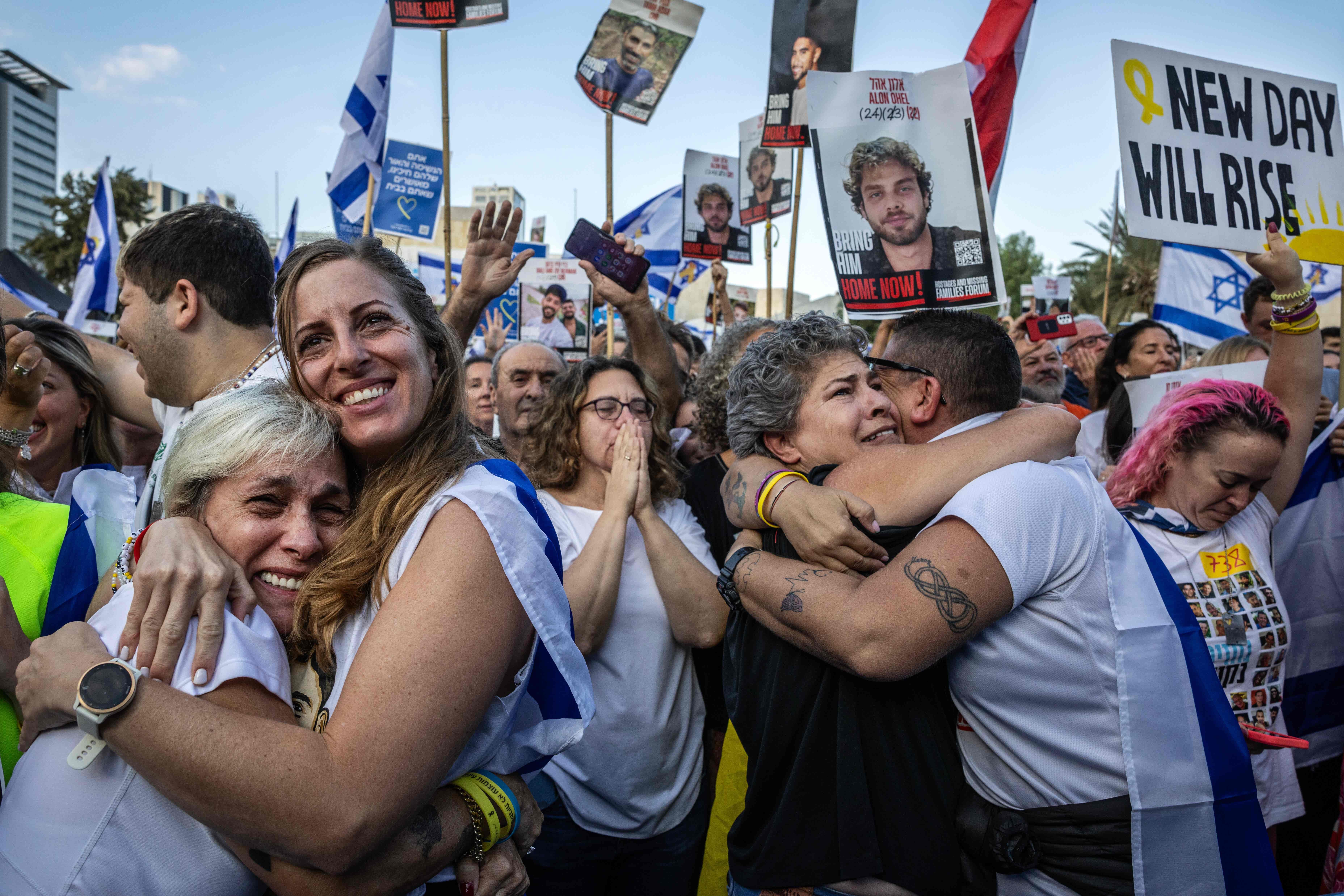
The ongoing Israel-Hamas captive exchange negotiations represent far more than a humanitarian effort; they are a high-stakes strategic battleground where the conflict’s future is being forged. The terms of any potential agreement—or the persistent failure to reach one—will have profound and lasting consequences for Israeli society, the Palestinian national movement, and the geopolitical stability of the Middle East. For Israel, the negotiations force a near-impossible choice between the cherished national ethos of redeeming captives and the strategic imperative of dismantling Hamas. For Hamas, the captives are the ultimate leverage, a tool to secure the release of thousands of its members from Israeli prisons, dictate the terms of a ceasefire, and assert its political survival. This analysis deconstructs the intricate layers of the captive exchange, examining the historical precedents that shape today’s calculus, the shifting political fault lines within Israel, the phased architecture of recent proposals, and the strategic foresight required to understand the second-order effects of any potential deal.
The Anatomy of a Deal: Deconstructing the Phased Approach
Months of intense, indirect negotiations, primarily mediated by Qatar, Egypt, and the United States, have coalesced around a multi-phase framework. While specific details have shifted, the fundamental structure involves a sequence of exchanges and de-escalation, designed to build confidence while managing immense political risk on both sides. This phased approach acknowledges the deep mistrust and the monumental gap between the ultimate objectives of the warring parties.
From Humanitarian Gestures to Hard Bargains
The initial phase, as outlined in various proposals throughout 2025, consistently prioritizes the release of a specific category of Israeli captives: women, children, the elderly, and the sick. In exchange, Israel would release a significant number of Palestinian prisoners, also starting with women and minors, and implement a temporary ceasefire lasting several weeks. This structure allows both sides to claim an early humanitarian victory. Subsequent phases, however, escalate the stakes dramatically. Phase two typically involves the release of male Israeli soldiers and remaining civilians in exchange for a larger, more contentious group of Palestinian prisoners, including those serving life sentences for lethal attacks. This phase is invariably linked to demands for a more permanent ceasefire and a significant withdrawal of Israeli forces from key areas in Gaza. The final phase centers on the exchange of the bodies of deceased captives for the remaining high-value Palestinian prisoners, a grim but critical component for bringing closure and fulfilling commitments.
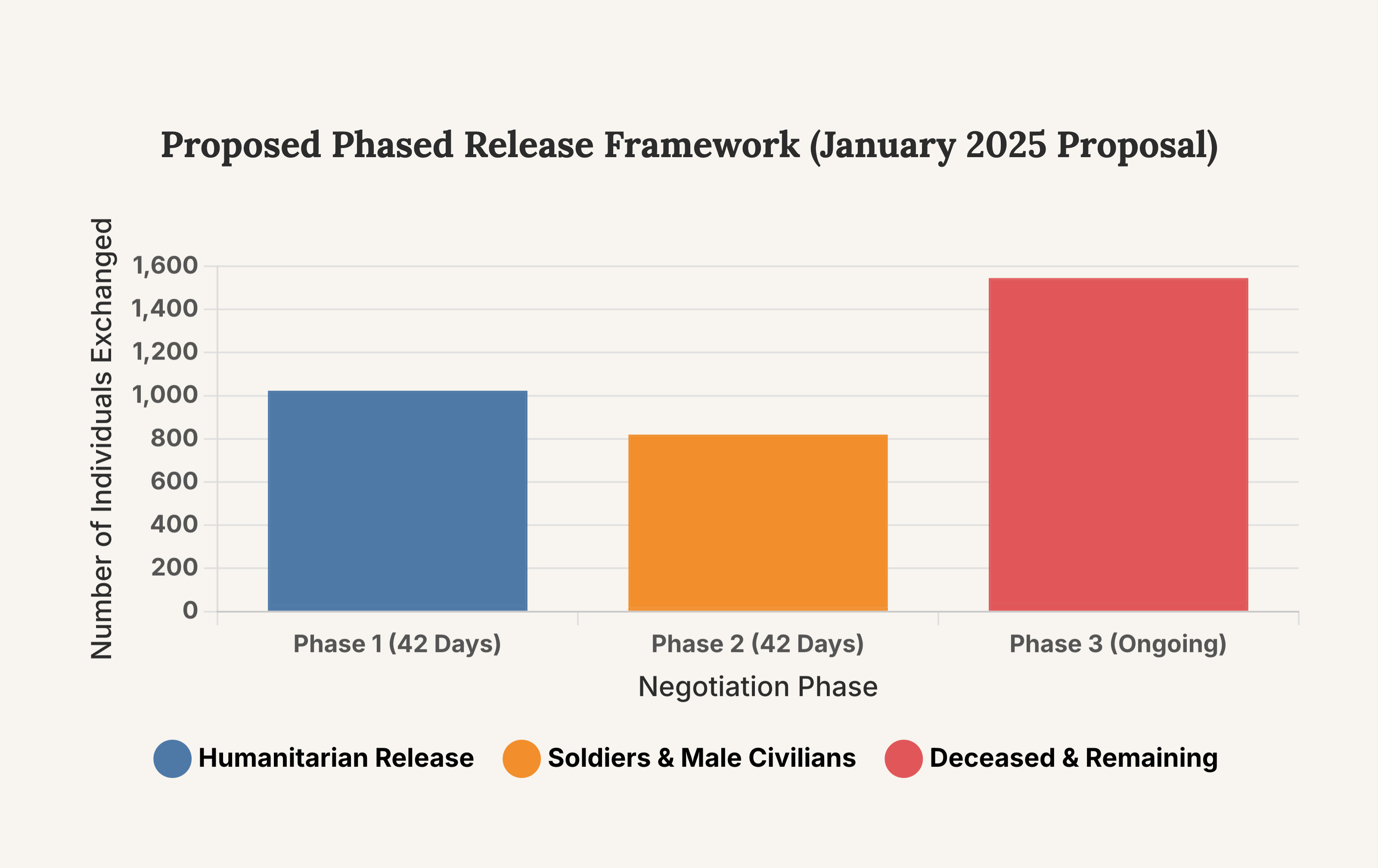
Caption: The chart above illustrates a representative three-phase deal structure based on proposals discussed in early 2025. It highlights the escalating scale of the exchange, moving from an initial humanitarian-focused release to the more strategically complex exchange of soldiers and high-security prisoners in later phases.
The Sticking Points: Sovereignty, Security, and Survival
The transition from a temporary truce to a “sustainable calm” or permanent ceasefire remains the single greatest obstacle. Hamas insists on a complete end to hostilities and a full IDF withdrawal as a precondition for releasing all captives, viewing this as the only guarantee of its survival. For the Israeli government, particularly its right-wing elements, agreeing to these terms is tantamount to conceding victory to Hamas, leaving its military and governance capabilities intact. This fundamental conflict of objectives has caused talks to repeatedly stall. As a senior Hamas official stated, the goal is a deal that ends the war and immediately begins the exchange process. Conversely, Israeli Prime Minister Benjamin Netanyahu has consistently maintained two primary war aims: destroying Hamas and bringing all hostages home, arguing that military pressure is essential to achieving both.
The Weight of History: Precedent and the Asymmetry of Exchange
Israel’s history is punctuated by lopsided prisoner exchanges, a reality that deeply informs the current strategic calculus. The nation has a long-standing, albeit increasingly debated, commitment to bringing its soldiers and citizens home, often at a disproportionate cost. Over decades, Israel has released over 7,000 prisoners to secure the freedom of just 16 Israelis and the remains of others. This history of asymmetrical swaps creates a powerful incentive for militant groups to engage in hostage-taking.
The Ghost of Gilad Shalit
The 2011 exchange for captive soldier Gilad Shalit is the most significant historical precedent casting a shadow over the current talks. In that deal, Israel released 1,027 Palestinian prisoners, including 280 serving life sentences for involvement in deadly attacks, in exchange for one soldier. That 1-to-1,027 ratio established a benchmark that Hamas seeks to replicate and that Israeli security officials are desperate to avoid repeating. Many officials and analysts argue the Shalit deal significantly strengthened Hamas and incentivized further abductions. The military leader of Hamas at the time, Ahmed Jabari, confirmed that the prisoners released in that deal were collectively responsible for the deaths of 569 Israeli civilians. This precedent is not merely a historical footnote; it is a central element in the internal Israeli debate and Hamas’s negotiation strategy.
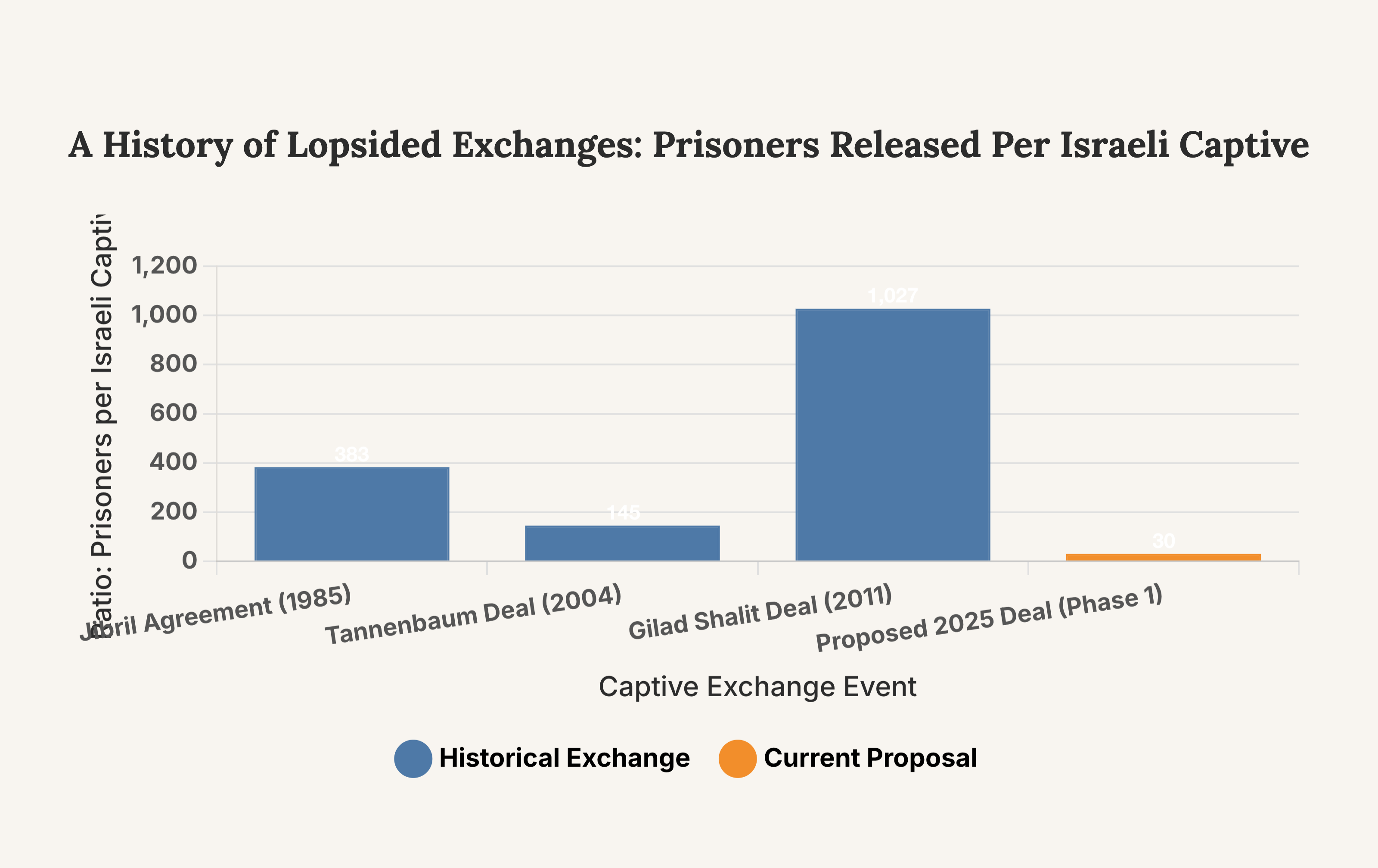
Caption: This chart visualizes the stark asymmetry in major prisoner exchanges. The 2011 Gilad Shalit deal stands out as a historical high point, setting a precedent that current Israeli negotiators are under immense pressure to break, while Hamas seeks to leverage it. The initial phase of recent proposals suggests a significantly lower, though still asymmetric, ratio.
“The difficulty in acknowledging the moral argument, established in Jewish law, that ‘captives are not to be ransomed for more than their value,’ and the necessity to consider long-term implications in hostage situations do not bode well for the resilience of Israeli society in similar situations in the future.”
The Domestic Battlefront: Israel’s Political Schism
The hostage crisis has exposed and exacerbated deep fault lines within Israeli society and its government. The debate over a potential deal is not merely a tactical disagreement but a clash of fundamental worldviews, pitting the sacred value of redeeming captives against the perceived existential need for a decisive military victory. This internal conflict has become a significant constraint on the government’s room for maneuver.
A Coalition Divided
Prime Minister Netanyahu’s governing coalition is a fragile alliance of his Likud party, centrist factions, and far-right religious nationalist parties. For the latter, led by figures like Itamar Ben-Gvir and Bezalel Smotrich, any deal that does not result in the complete dismantling of Hamas is a betrayal of the war’s objectives and a threat to their political platform. They have repeatedly threatened to collapse the government if a deal perceived as too lenient is approved. This political pressure significantly narrows the government’s negotiating flexibility. Polling data from 2025 reveals this stark political divide: while a vast majority of opposition voters (91%) supported a deal, support among coalition voters was far weaker, with a small majority (52%) in favor and a significant minority (37%) opposed.
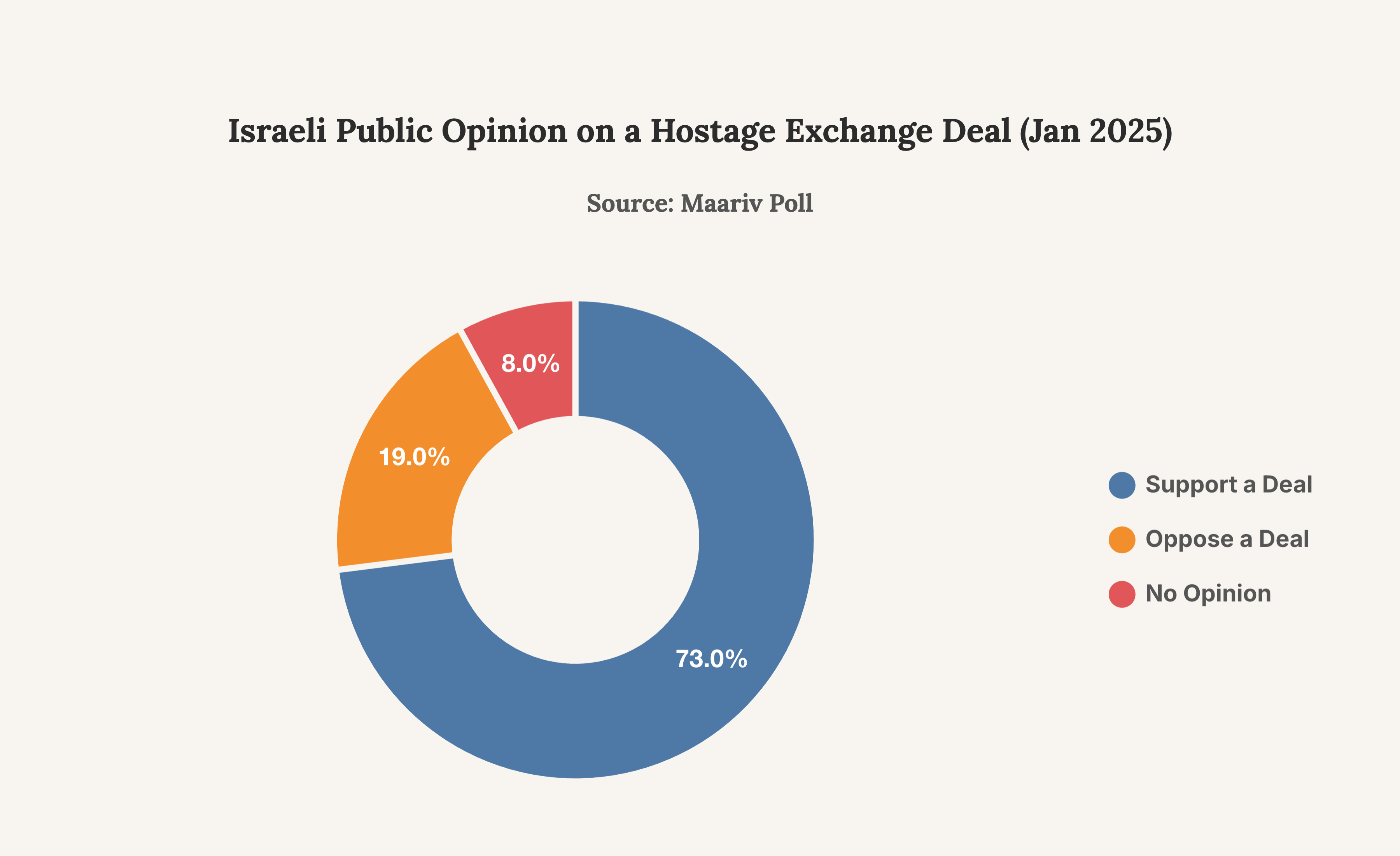
Caption: Public support for a hostage deal in Israel is strong overall, but polling reveals a significant partisan divide. While a majority across the spectrum favors an agreement, opposition is concentrated among voters of the governing coalition parties, creating immense political pressure on the leadership.
The Calculus of Release: Who is Being Exchanged?
On the other side of the ledger are the thousands of Palestinian prisoners in Israeli jails. Understanding the composition of this population is key to grasping the strategic cost of any exchange for Israel. As of late 2025, Israeli prisons held over 9,000 Palestinians on security grounds. These are not a monolithic group; they are categorized as sentenced prisoners, remand detainees (awaiting or undergoing trial), and administrative detainees, who are held without trial on security grounds. Hamas’s key demand is the release of prisoners serving long sentences for severe security offenses, which Israel views as a direct threat to its future security.
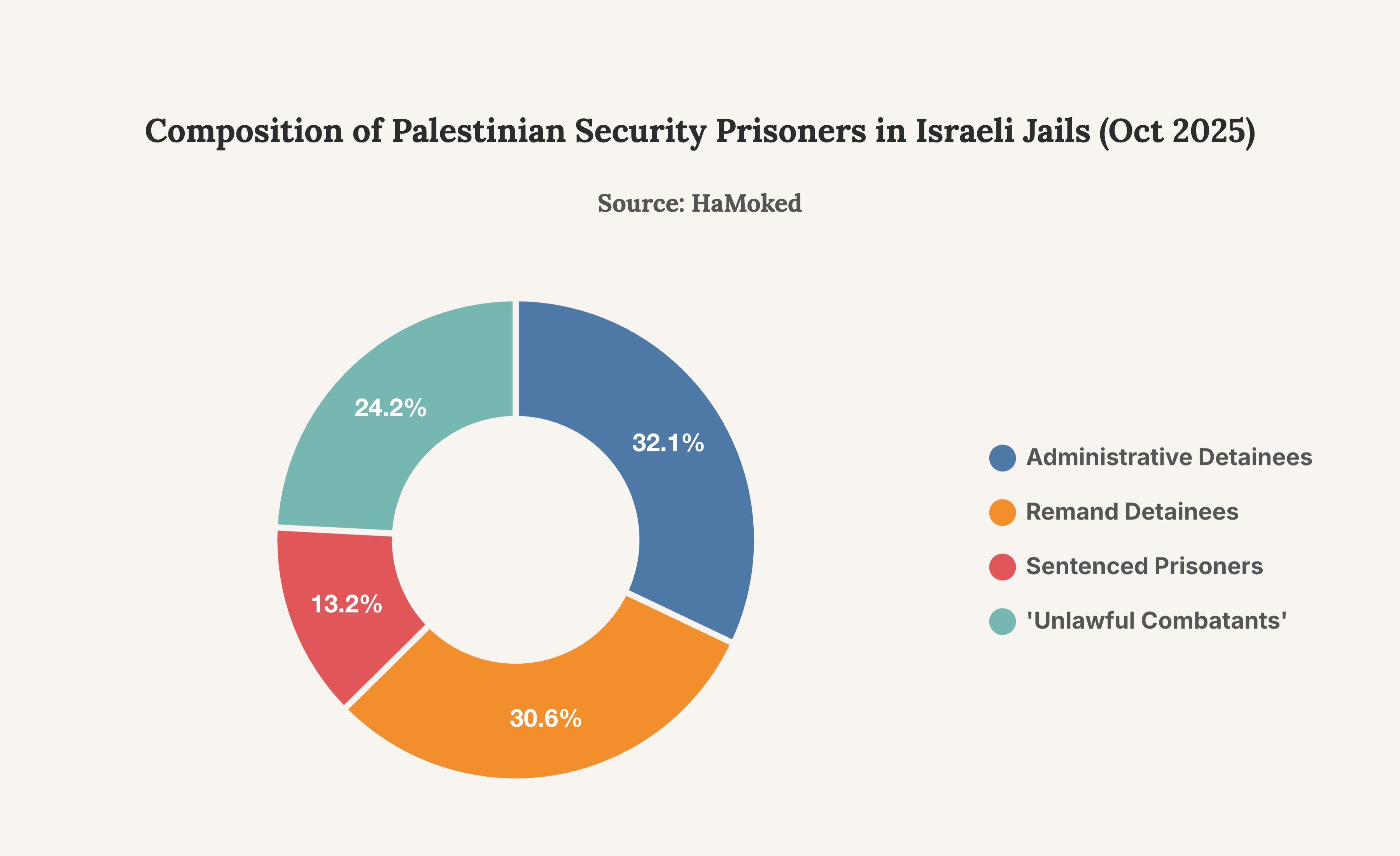
Caption: This chart breaks down the population of Palestinian security prisoners held by Israel. A significant portion are administrative and remand detainees held without a final conviction, a point of major contention. Hamas prioritizes the release of the ‘Sentenced Prisoners’ group, which includes many convicted of violent attacks.
Strategic Foresight: The Second-Order Effects
The resolution of the current captive crisis will reverberate far beyond the immediate exchange. Both a successful deal and a continued stalemate carry profound implications for the future of the conflict and the region.
Scenarios and Consequences
A comprehensive deal that ends the war but leaves Hamas in power in some form, even if demilitarized, would be hailed as a major victory by the group and its backers. It could reshape Palestinian politics and embolden other actors to see hostage-taking as a winning strategy. Conversely, a collapse of talks followed by intensified Israeli military action in pursuit of the remaining hostages risks immense casualties and a deeper humanitarian crisis, potentially drawing in other regional actors and further isolating Israel internationally. The role of mediators, particularly the United States, Qatar, and Egypt, is crucial in navigating this perilous landscape. Their ability to bridge the gap between the parties’ core demands will determine whether a fragile truce can be transformed into a durable ceasefire.
“Hamas is willing to negotiate, but it seems like the only way to get everyone out is to end the war. So at this stage, it seems like you can’t have both.” - Raphael Cohen, Senior Political Scientist, RAND Corporation
The negotiations are a microcosm of the broader conflict: a zero-sum struggle where one side’s existential guarantee is the other’s strategic defeat. The path forward is fraught with risk, and the choices made in the negotiating rooms of Doha and Cairo will define the security landscape of the Middle East for years to come. The immediate focus remains on the phased return of captives, a process that is both a humanitarian imperative and a strategic minefield. As of early November 2025, the process of returning the remains of deceased captives continues, serving as a constant, grim reminder of the human cost and the unresolved nature of the conflict.
The painful reality is that the Israel-Hamas captive exchange is not a problem to be solved, but a strategic dilemma to be managed, where every potential path forward carries a heavy and unavoidable price.