



As of April 2026, the artificial intelligence sector is colliding with the hard physical limits of global energy infrastructure. The exponential scaling of Large Language Models (LLMs) and generative algorithms has transformed data centers from quiet digital repositories into ravenous industrial power sinks, straining national grids and prompting regulatory crackdowns. However, a silent revolution has just crossed the threshold from theoretical physics into commercial viability. We are witnessing the end of the von Neumann bottleneck, not through brute force, but through biomimetic elegance that renders traditional data centers obsolete. The shift toward “brain-inspired” or neuromorphic computing is no longer a speculative venture; it is the definitive hardware pivot of the late 2020s.
In March 2026, researchers at the University of Cambridge, operating alongside deep-tech hardware innovators, unveiled a breakthrough in hafnium oxide-based “memristors.” Unlike traditional computing architectures—which isolate memory and processing, wasting vast amounts of energy shuttling data back and forth—neuromorphic chips store and process information in the exact same physical location. This mimics the synaptic efficiency of the human brain. Concurrently, a landmark study published in Nature Nanotechnology by the University of California San Diego demonstrated a hardware platform capable of reducing AI energy consumption by up to 70%. When applied to edge devices—such as autonomous drones, wearable biosensors, and smart manufacturing robotics—this architecture allows for real-time pattern recognition without requiring a constant, high-bandwidth tether to a cloud server.
The strategic implications are massive. For the past decade, AI supremacy was dictated by access to massive compute clusters—favoring tech oligopolies and sovereign wealth funds capable of dropping billions on traditional GPUs. Neuromorphic edge computing democratizes intelligence. By slashing the power requirements, companies like Innatera—which recently partnered with Synopsys to scale brain-inspired processors for industrial edge devices—are enabling “always-on” physical AI. This creates a severe information asymmetry: manufacturers who adopt neuromorphic microcontrollers will achieve real-time autonomous decision-making on the factory floor, while their competitors remain entirely dependent on latent, expensive cloud infrastructure.
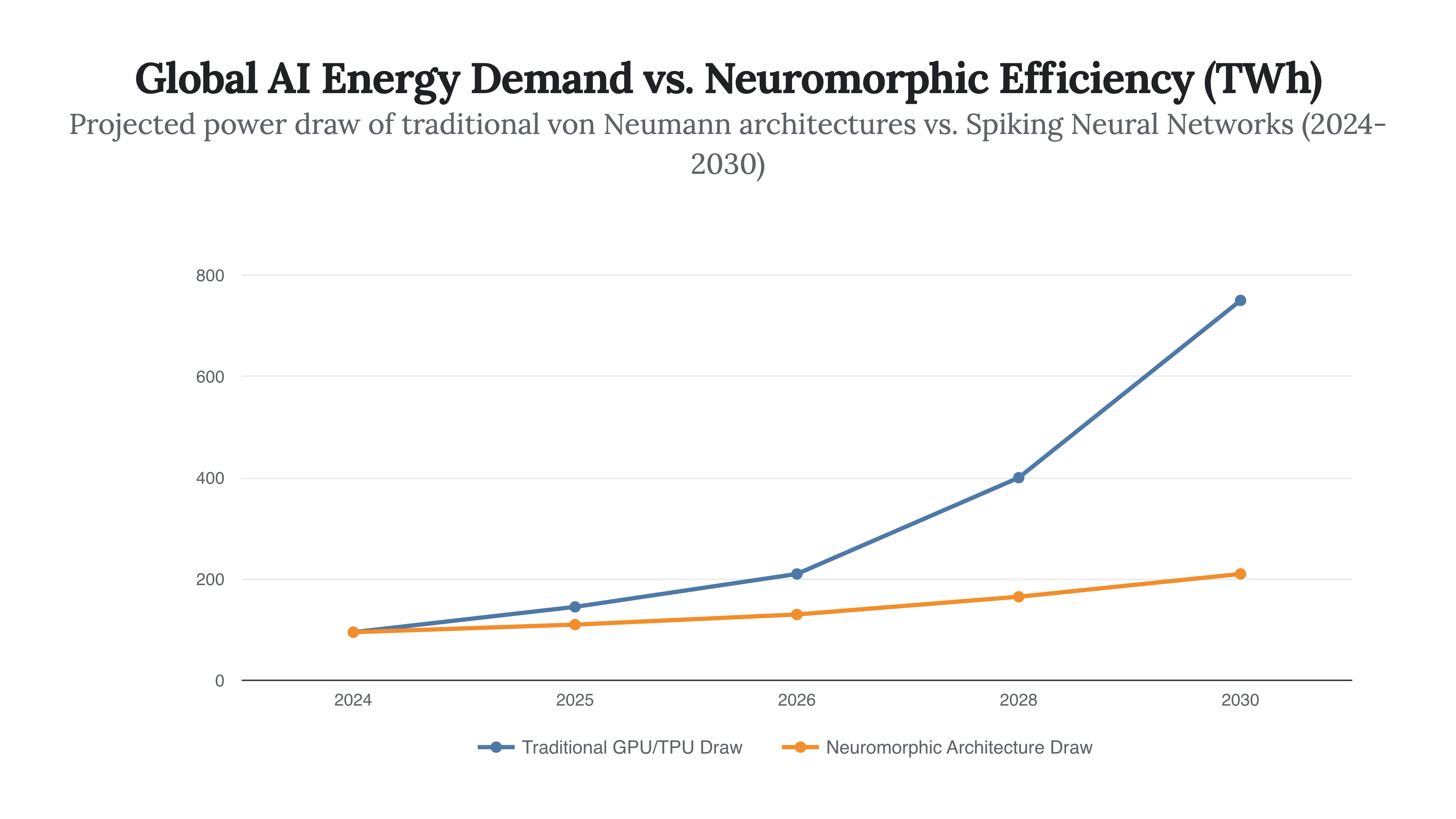
From a strategic perspective, the adoption of neuromorphic chips alters the geopolitical vulnerability of nations. Currently, the artificial intelligence supply chain is fragile, entirely dependent on specific fabrication nodes for high-end GPUs. If compute can be distributed seamlessly across billions of low-power edge devices using Spiking Neural Networks (SNNs), the tactical need for centralized mega-data centers diminishes. This distributed intelligence grid is highly resilient to kinetic or cyber attacks. According to recent market analysis by Fortune Business Insights, the global neuromorphic chip market—valued at a mere $125.2 million in 2026—is projected to compound at a staggering 50.6% CAGR, reaching over $3.3 billion by 2034. The industrial internet of things (IoT) is dominating this early adoption phase, proving that the technology has moved far past academic curiosity.
We must analyze the incentives of the legacy semiconductor giants. Their primary cash cow is the massive, power-hungry GPU. The introduction of ultra-efficient, event-driven computing threatens this revenue model. However, the energy reality provides them no choice. With the US grid unable to support the projected 750 Terawatt-hours required by traditional AI by 2030, capital is fleeing toward efficiency. The commercial battlefield has fundamentally shifted from “Who has the fastest processor?” to “Who has the smartest energy footprint?” Investors who fail to recognize this paradigm shift will find themselves holding the bag on obsolete, thermally unviable infrastructure.

The Q1 2026 Crypto Plunge: The Fracture of the Corporate Treasury Model
The first quarter of 2026 delivered a brutal reality check to the cryptocurrency ecosystem, ending in a severe liquidity drain that shattered the euphoria of previous years. Closing April 2026, Bitcoin recorded a devastating 22% to 24% drawdown for the quarter, sliding from early-year highs near $87,500 down to the $64,000–$68,000 range. This marks Bitcoin’s worst first-quarter performance since the infamous 2018 “crypto winter”. But the raw price action only tells half the story. The Bitcoin treasury model is no longer an “infinite money glitch”; it has violently fractured into a survival-of-the-fittest liquidation event.
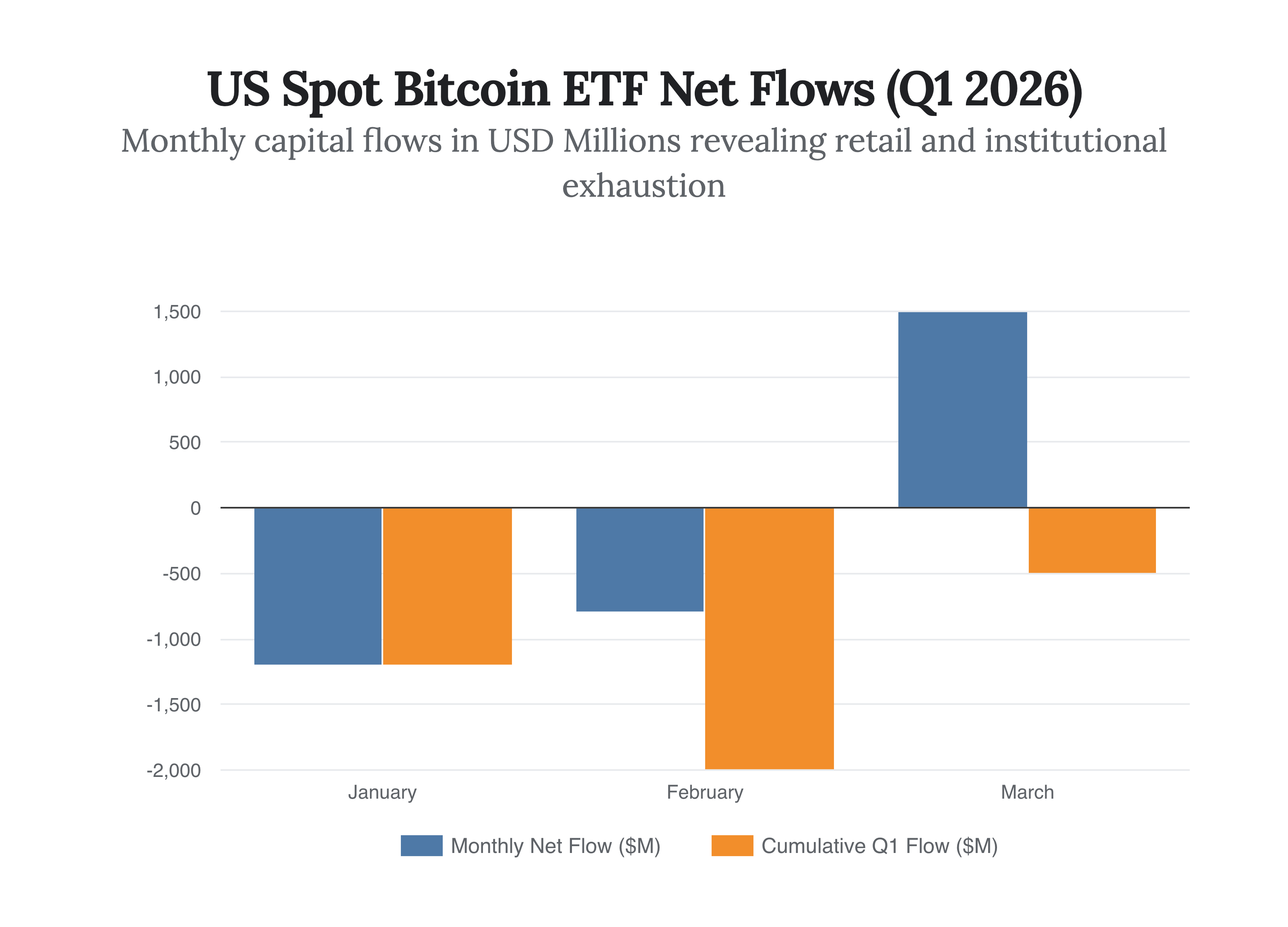
To understand the mechanics of this crash, one must examine the macroeconomic “pressure cooker” that defined early 2026. The U.S. Federal Reserve signaled a rigid “higher for longer” interest rate environment to combat sticky 2.7% inflation. Concurrently, escalating geopolitical violence—specifically the outbreak of the US-Iran war in late February—triggered a classic flight to safety among institutional investors. The assumption that Bitcoin would act as a frictionless safe-haven asset during times of sovereign warfare was stress-tested and unequivocally failed. Instead, Bitcoin traded like a high-beta tech stock. The highly anticipated Spot Bitcoin ETFs, which had driven immense capital inflows throughout 2024 and 2025, reversed course, experiencing nearly $500 million in net outflows during Q1 2026. The structural buy-side pressure evaporated precisely when it was needed most.
The most fascinating strategic development is the bifurcation of public companies holding Bitcoin. During the bull market, firms realized they could generate explosive shareholder value simply by issuing debt to purchase Bitcoin—a strategy of “accretive dilution.” But as prices sank below critical collateral thresholds, the leverage turned radioactive. Companies previously viewed as “Promoters” of passive HODLing are now being forced to act as “Asset Managers.” We saw firms like Empery Digital liquidating 370 BTC to repay outstanding term loans after their stock price cratered 75%, and Genius Group divesting their $8.5 million position entirely to settle pressing liabilities. The market is actively punishing leveraged corporate exposure while distinguishing it from pure spot holdings.
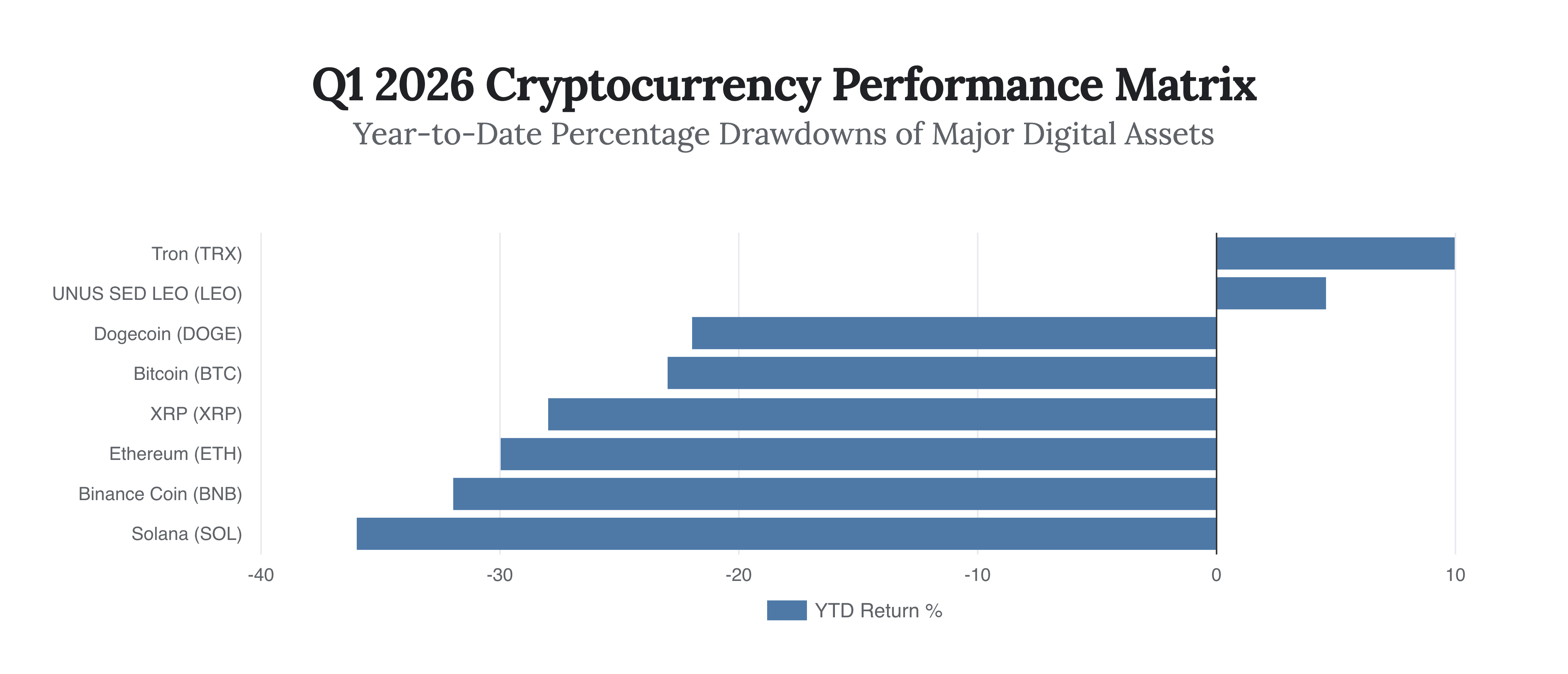
What we are witnessing is the great shakeout of the Bitcoin treasury strategy. Entities that utilized BTC as collateral for credit facilities found themselves facing forced liquidations when the price breached the $65,000 support level. Meanwhile, major mining operations are aggressively pivoting. No longer content to simply mine and hold a volatile asset, companies like Riot Platforms are rebalancing their operations toward Artificial Intelligence and High-Performance Computing (HPC) data centers, hedging their bets by providing physical infrastructure for the AI boom. This is a classic game-theoretic adaptation: when the primary payoff matrix deteriorates (Bitcoin block rewards and price), rational actors diversify into a secondary matrix with higher immediate utility (AI compute leasing).
Looking ahead to Q2 2026, history suggests a bullish rebound is possible, as April has historically favored crypto assets. However, retail liquidity is entirely exhausted. Any sustained recovery will rely entirely on the resumption of institutional ETF inflows and a stabilization of the Middle Eastern geopolitical landscape. Investors must now assess crypto assets not on their ideological purity, but on their localized utility and the fiscal health of the treasuries holding them. Those holding leveraged Bitcoin equity are sitting on a powder keg of governance and liquidation risks.
Global Oil Volatility: The Price of the Hormuz Blockade
By early April 2026, the global energy market was thrust into unprecedented chaos. The catalyst was the physical closure of the Strait of Hormuz, a maritime choke point that traditionally handles 20% of global seaborne oil and liquified natural gas (LNG) supplies. As the US-Iran military conflict escalated, millions of barrels of crude per day were effectively stranded, resulting in one of the most severe supply disruptions in modern geopolitical history. The closure of the Strait of Hormuz has transformed the global energy market from a delicate balancing act into a geopolitical hostage situation.
The price action reflects sheer panic combined with physical market tightness. Brent crude, the global benchmark, rocketed nearly 80% year-to-date, surging past $110 per barrel by April 6, 2026. West Texas Intermediate (WTI) mirrored this violent ascent, clearing $112 per barrel with an intraday high brushing $116 following belligerent rhetoric from U.S. President Donald Trump. Trump issued a stark ultimatum: if Iran did not reopen the Strait of Hormuz by April 6 (a deadline extended to Tuesday, April 7), the U.S. military would launch “extremely hard” strikes against Iranian bridges and power infrastructure.
Let us break down the strategic positioning of the actors involved. Iran’s blockade is a classic asymmetric denial strategy. They cannot defeat the U.S. Navy in a direct, symmetric engagement, but they possess the geographic leverage to choke off global energy flows, inflicting massive economic pain on Western democracies and Asian manufacturing hubs alike. This is designed to fracture the U.S. coalition by forcing nations dependent on Middle Eastern oil to pressure Washington into a ceasefire. The U.S. administration, conversely, is utilizing the threat of total infrastructural decimation to establish deterrence. However, the game theory of credible threats dictates that if Trump’s ultimatum passes without compliance, he must execute the strike, or U.S. leverage permanently collapses.
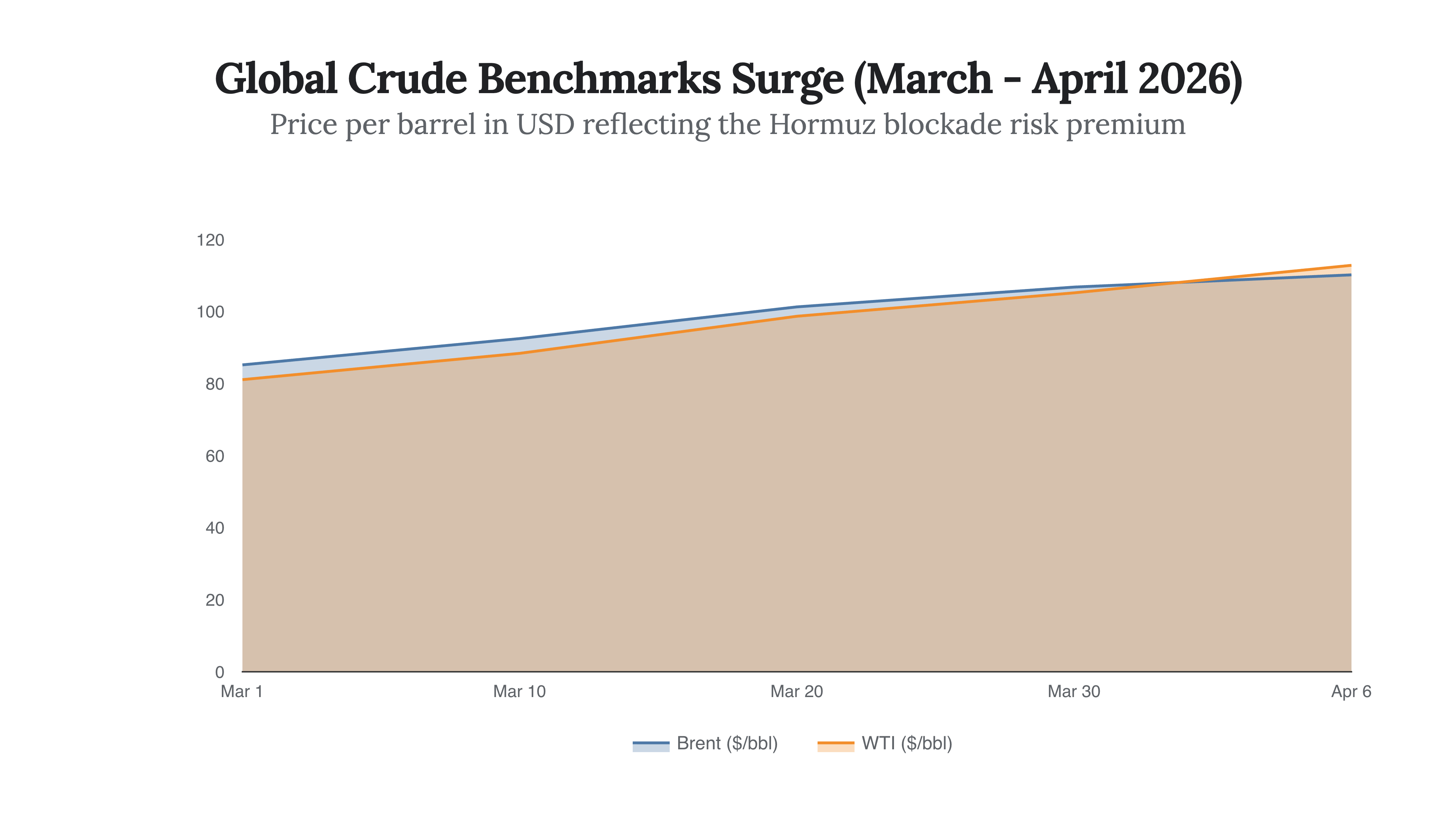
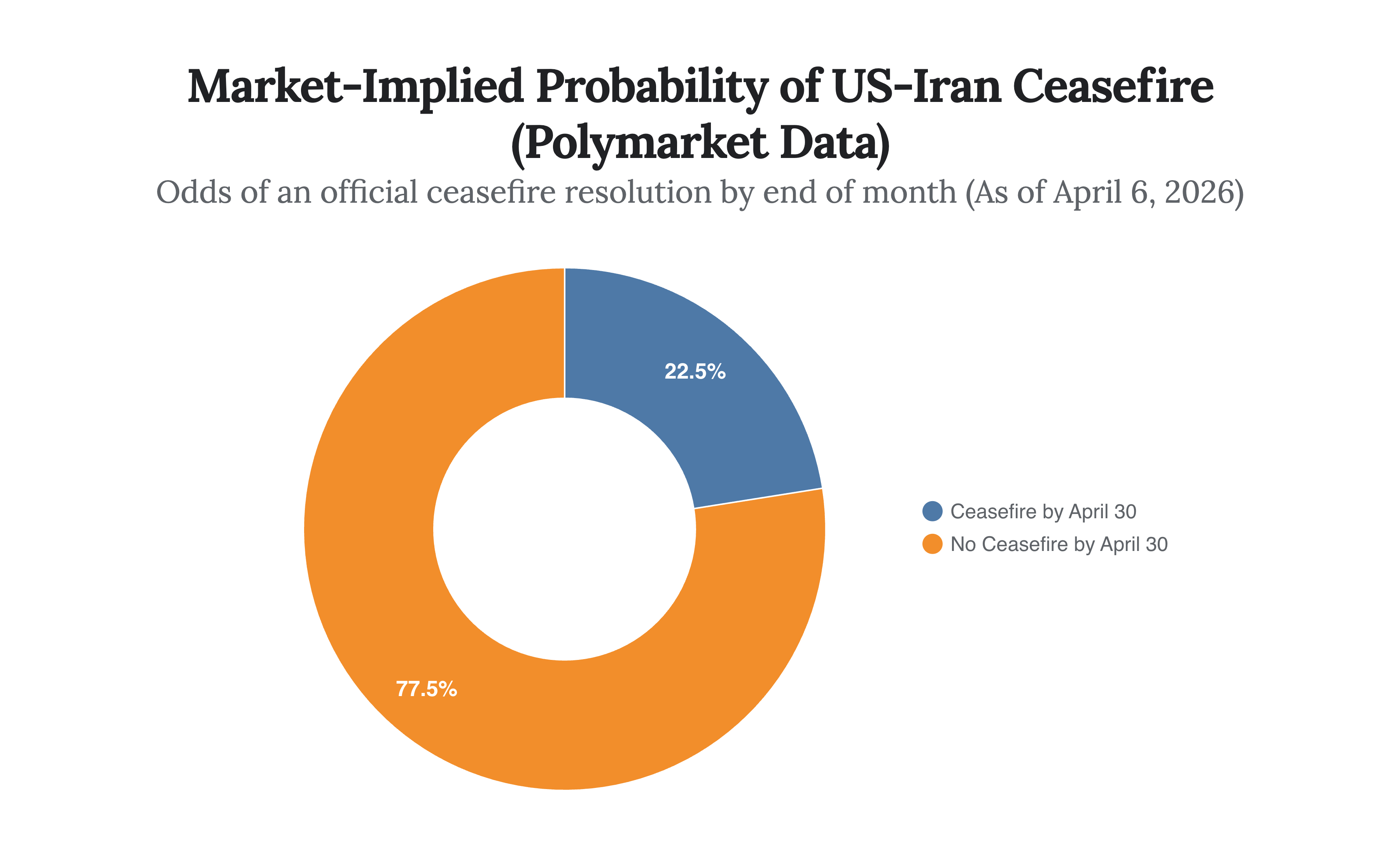
Institutional forecasts are deeply pessimistic regarding a rapid resolution. Rabobank analysts warned that even if shipping were to miraculously resume tomorrow, the damage to regional refineries and production infrastructure would keep supplies constrained for months. They project Brent crude will average $107 per barrel throughout Q2 2026. Furthermore, predictive markets reflect profound skepticism regarding a swift diplomatic exit. According to Polymarket data from April 6, the probability of an official U.S.-Iran ceasefire by the end of April sits at a dismal 22.5%, though it rises to 51.5% by the end of June.
The secondary economic effects of $110+ oil are already rippling through the system. We are witnessing acute shortages in refined products like diesel and jet fuel. This translates directly to higher logistics costs, which will inevitably bleed into consumer price indices (CPI) globally. The Federal Reserve’s battle against inflation, which already appeared stalled at 2.7%, is now facing a massive, exogenous supply-side shock. Central banks cannot print oil, and raising interest rates further will only crush domestic demand without reopening the Strait of Hormuz. The global economy is effectively holding its breath, waiting to see which actor blinks first in the Persian Gulf.
Unlock deeper strategic alpha with a 10% discount on the annual plan.
Support the data-driven foresight required to navigate an era of radical uncertainty and join a community of institutional-grade analysts committed to the truth.
The U.S.-Iran Military Escalation: The Mechanics of a Quagmire
The transition from diplomatic posturing to open military conflict occurred precisely on February 28, 2026, when the United States and Israel launched coordinated airstrikes deep within Iranian territory. The initial tactical objectives were clear: cripple the regime’s ballistic missile infrastructure and decapitate its rapidly advancing nuclear program. However, as the war enters its sixth week in early April, the operational reality has proven far more complex than the clinical, surgical strikes envisioned by war planners. Washington is trapped in an escalation paradox where any attempt to neutralize Iran’s nuclear capability simultaneously incentivizes Tehran to accelerate it.
