


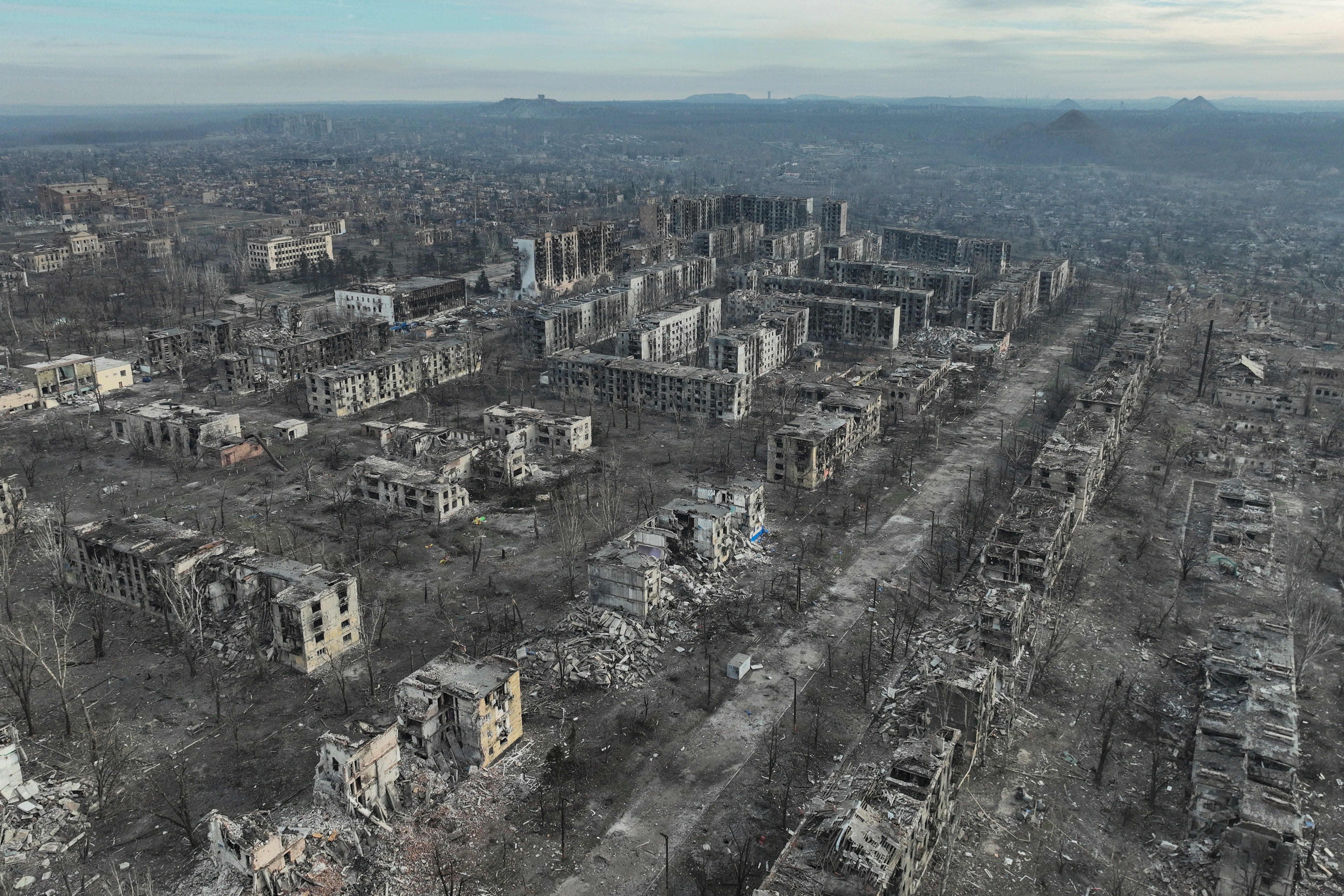
The battle for Pokrovsk, a city that has transformed from a vital logistical artery for Ukrainian forces into a crucible of attritional warfare, is reaching a perilous inflection point. Russian forces, employing a grinding pincer movement and infiltration tactics, are tightening their grip, threatening one of the most consequential strategic shifts in the Donbas since the fall of Avdiivka.
The loss of this city, once home to 60,000 and a key transport hub, would not be a mere territorial concession; it would trigger a cascade of military and economic crises for Kyiv, potentially unhinging the defensive line in Donetsk and handing Moscow a significant political victory. This briefing deconstructs the strategic importance of Pokrovsk, models the devastating second-order effects of its potential fall, and outlines the critical indicators that leaders must monitor in the coming weeks. The core thesis is this: the fight for Pokrovsk is not just for a city, but for the integrity of Ukraine’s entire eastern defensive architecture and its long-term economic viability.
The Keystone of the Donbas: Quantifying Pokrovsk’s Strategic Value
Pokrovsk’s importance cannot be overstated; it is a lynchpin in the Ukrainian defense of Donetsk Oblast. Its road and rail networks are the primary conduits for supplies, ammunition, and troop rotations for the Ukrainian forces defending the central Donbas front. To lose it would be to cripple the logistical backbone of this entire sector.
Logistical & Military Implications
The city serves as a launchpad for Ukrainian operations and a critical node for retreat and reinforcement. Russian military strategy appears to have shifted from costly frontal assaults to a more sophisticated model of encirclement, drone warfare, and precision strikes aimed at severing these logistical ties. Reports indicate that Russian sabotage and reconnaissance groups have already infiltrated the city’s outskirts, engaging in urban combat and targeting supply lines. The Ukrainian military has acknowledged the numerical inferiority its forces face, with President Volodymyr Zelenskyy stating troops on the Pokrovsk front are outnumbered eight to one. This manpower crisis exacerbates the challenge of defending against Russia’s multi-directional advance.
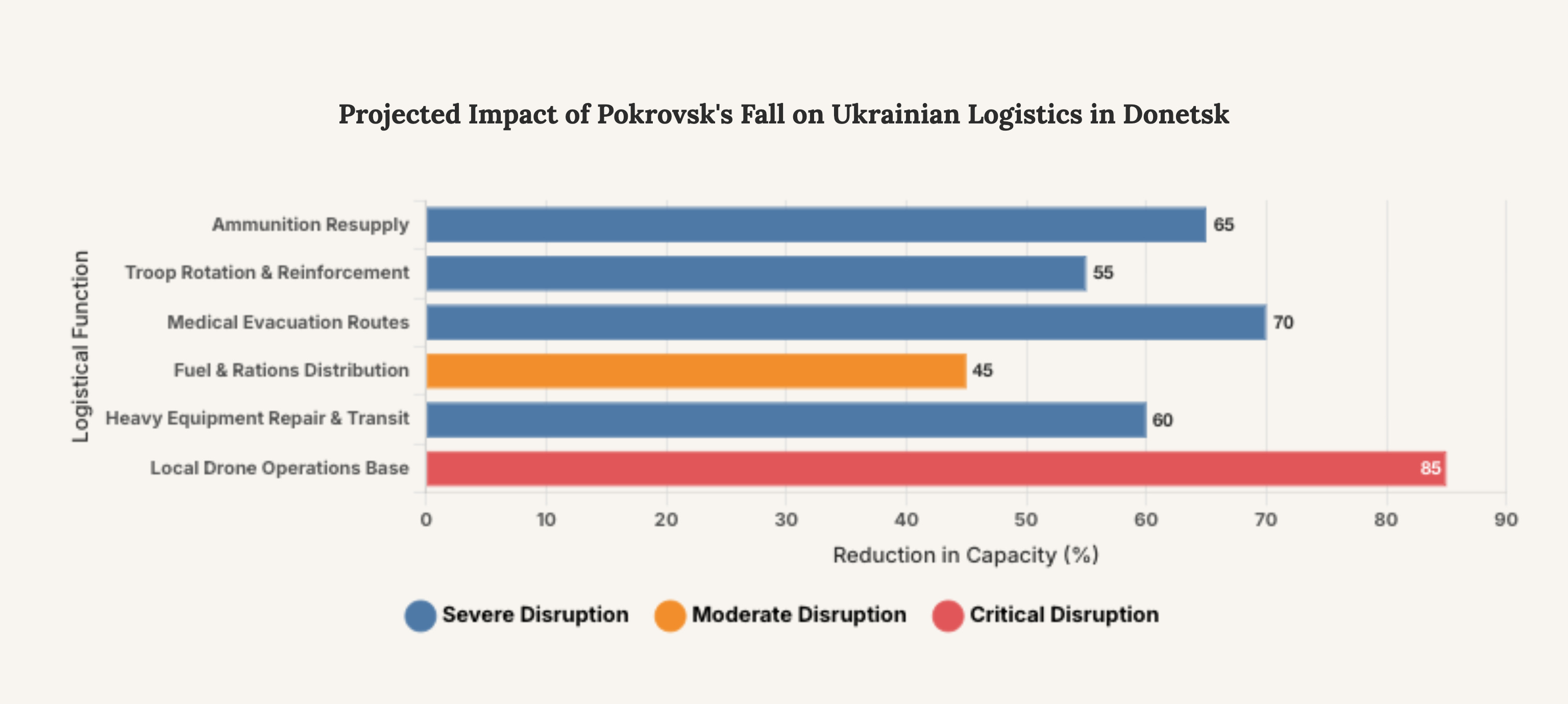
This chart models the projected immediate impact on key Ukrainian military logistics functions in the Donetsk Oblast following a potential fall of Pokrovsk. The loss of the city’s road and rail hubs would critically disrupt ammunition resupply and medical evacuations, forcing a major realignment of supply routes under duress.
Economic Bedrock at Risk
Beyond its military significance, Pokrovsk is an industrial hub. The region is home to Ukraine’s only mine producing coking coal, a crucial component for its steel industry. The suspension of mining operations has already dealt a blow to Ukraine’s economy. The fall of the city would not only cede these economic assets but could lead to what some analysts describe as an “economic catastrophe,” as the steel industry is a major source of tax revenue for the Ukrainian budget. The war in Donbas has already had a devastating economic impact, with industrial production in Donetsk Oblast contracting by 60% in the early years of the conflict. The loss of Pokrovsk would compound this economic devastation.
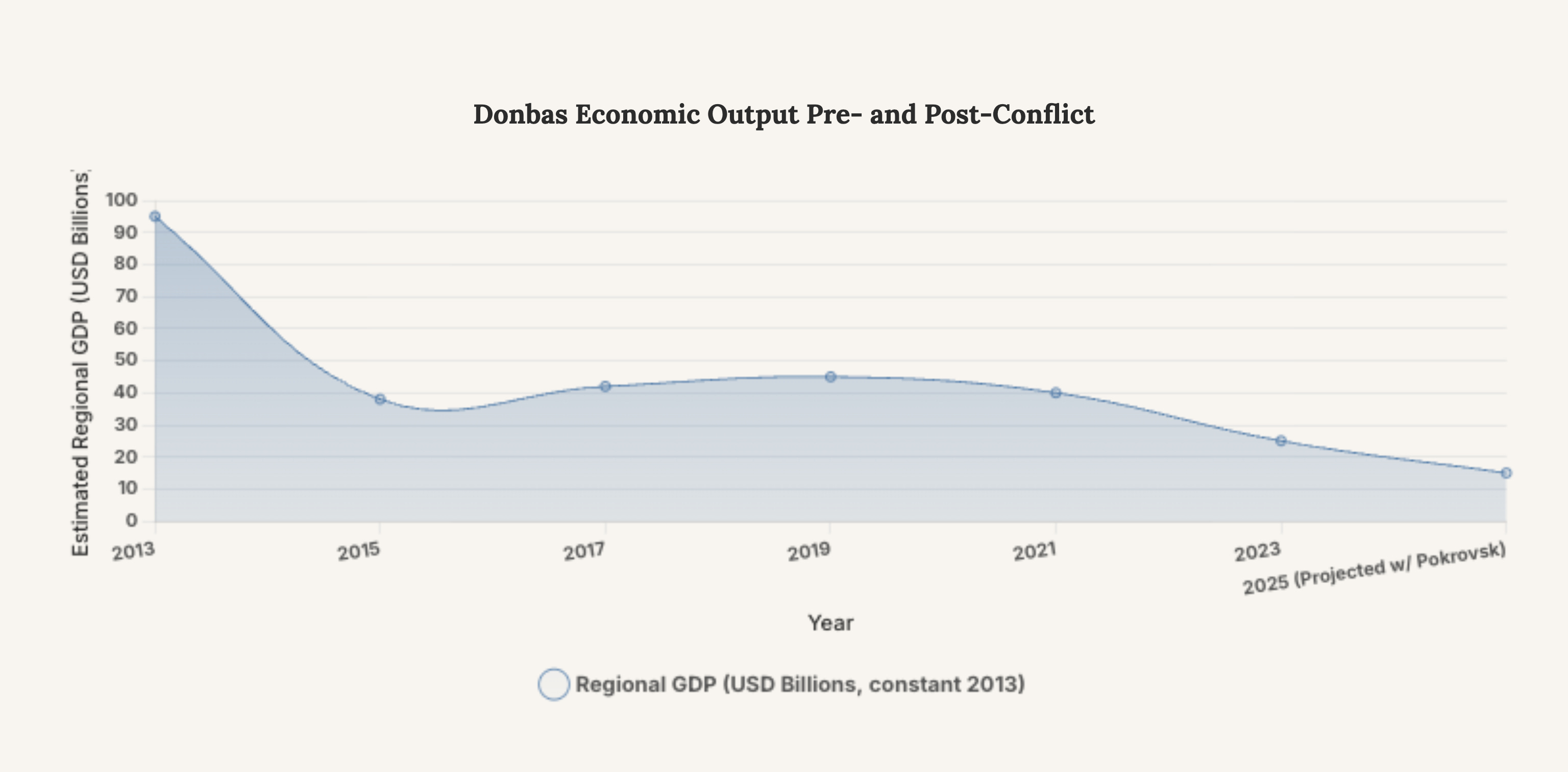
This chart illustrates the severe economic decline of the Donbas region since 2014, with a projection showing the potential further contraction of the regional economy should Pokrovsk and its surrounding industrial assets be lost.
The Architects of Attrition: Deconstructing the Russian Battle Plan
Russia’s campaign to seize Pokrovsk is a manifestation of its evolving military strategy, learning from the costly battles of Bakhmut and Avdiivka. Instead of relying solely on massed frontal assaults, Russian forces are employing a multi-pronged approach designed to maximize Ukrainian attrition while minimizing their own losses where possible.
The Pincer and the Infiltration
Russian forces are executing a classic pincer movement, advancing from multiple directions to encircle Pokrovsk and cut it off from reinforcement. This is complemented by the infiltration of small, mobile infantry units into the city’s urban areas. These groups establish forward positions, direct artillery and drone strikes, and sow chaos behind Ukrainian lines, disrupting logistics and forcing Ukrainian defenders to fight in multiple directions at once. This tactic creates a contested “grey zone” where clear front lines cease to exist, making a cohesive defense exceedingly difficult.
“(Russia potentially) capturing Pokrovsk will complicate logistics and be a PR blow to Ukrainians, but I don’t think that it’s going to influence the battlefield on a large scale significantly.” - Konrad Muzyka, director of Poland-based Rochan military consultancy.

This visualization depicts the estimated composition of Russian forces arrayed against Pokrovsk. The heavy concentration of motorized infantry and artillery underscores Russia’s strategy of using overwhelming firepower to support infantry advances and suppress Ukrainian defenses.
The Glide Bomb Advantage
A critical element of Russia’s tactical success is its extensive use of guided glide bombs. These weapons, launched from aircraft outside the range of many Ukrainian air defense systems, can obliterate fortified positions and create breaches for infantry to exploit. The lesson from Avdiivka, as stated by Ukraine’s Defence Minister Rustem Umerov, is the urgent need for modern air defense systems to counter this threat. The sheer destructive power of these munitions demoralizes defenders and systematically dismantles the urban infrastructure that would otherwise provide cover.
The Cascade Effect: Modeling the Strategic Aftermath
The fall of Pokrovsk would initiate a strategic domino effect, endangering the remaining Ukrainian-held cities in the Donbas and creating new vectors of attack for Russian forces.
The Crumbling Defensive Line
Losing Pokrovsk would force Ukrainian troops to fall back to a new, likely less-prepared, defensive line. This would expose the southern flank of the Kramatorsk-Sloviansk agglomeration, the heart of Ukraine’s remaining presence in Donetsk. The terrain west of Pokrovsk offers fewer natural defensive advantages, consisting largely of open fields. Russia’s objective is clear: capture the entirety of Donetsk Oblast, and the fall of Pokrovsk would be a significant step toward that goal.
“Without steel mills, the Ukrainian economy will cease to exist. This is a very, very important part of the economy.” - Zinchenko, on the economic importance of the region.
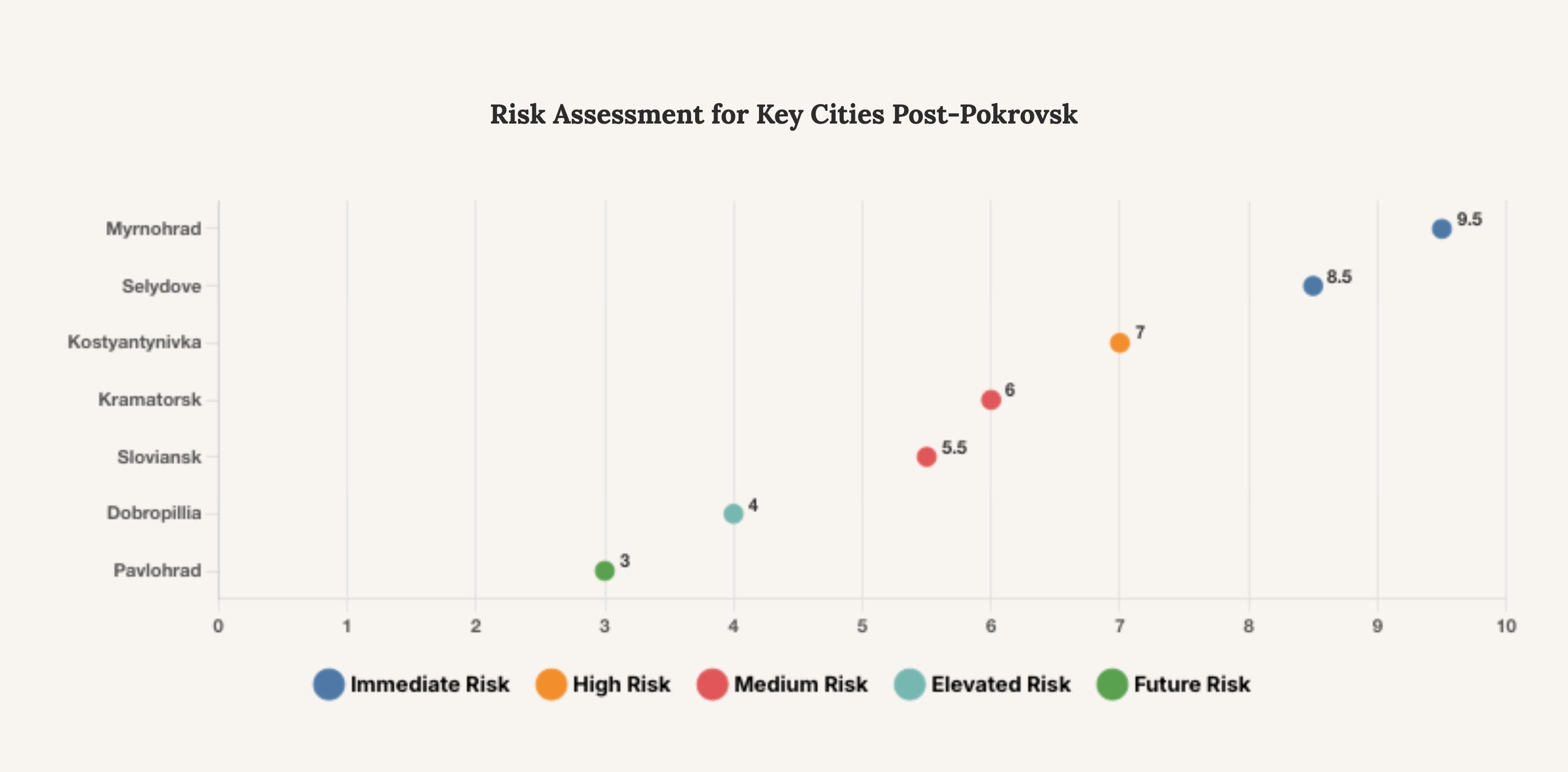
This chart provides a risk assessment for other key Ukrainian-held cities in the region, scoring the likelihood of them facing a direct Russian assault within 90 days of Pokrovsk’s potential capture. Myrnohrad and Selydove would be immediately vulnerable.
Opening the Gateway West
The capture of Pokrovsk would not only consolidate Russia’s control over Donetsk but also create a platform to launch offensive operations westward into the Dnipropetrovsk region. One of Russia’s most powerful force groupings is already advancing west of Pokrovsk, forcing Ukraine to stretch its limited reserves. A breakthrough here could threaten to cut off Ukrainian forces in the eastern Zaporizhzhia region, further destabilizing the southern front.
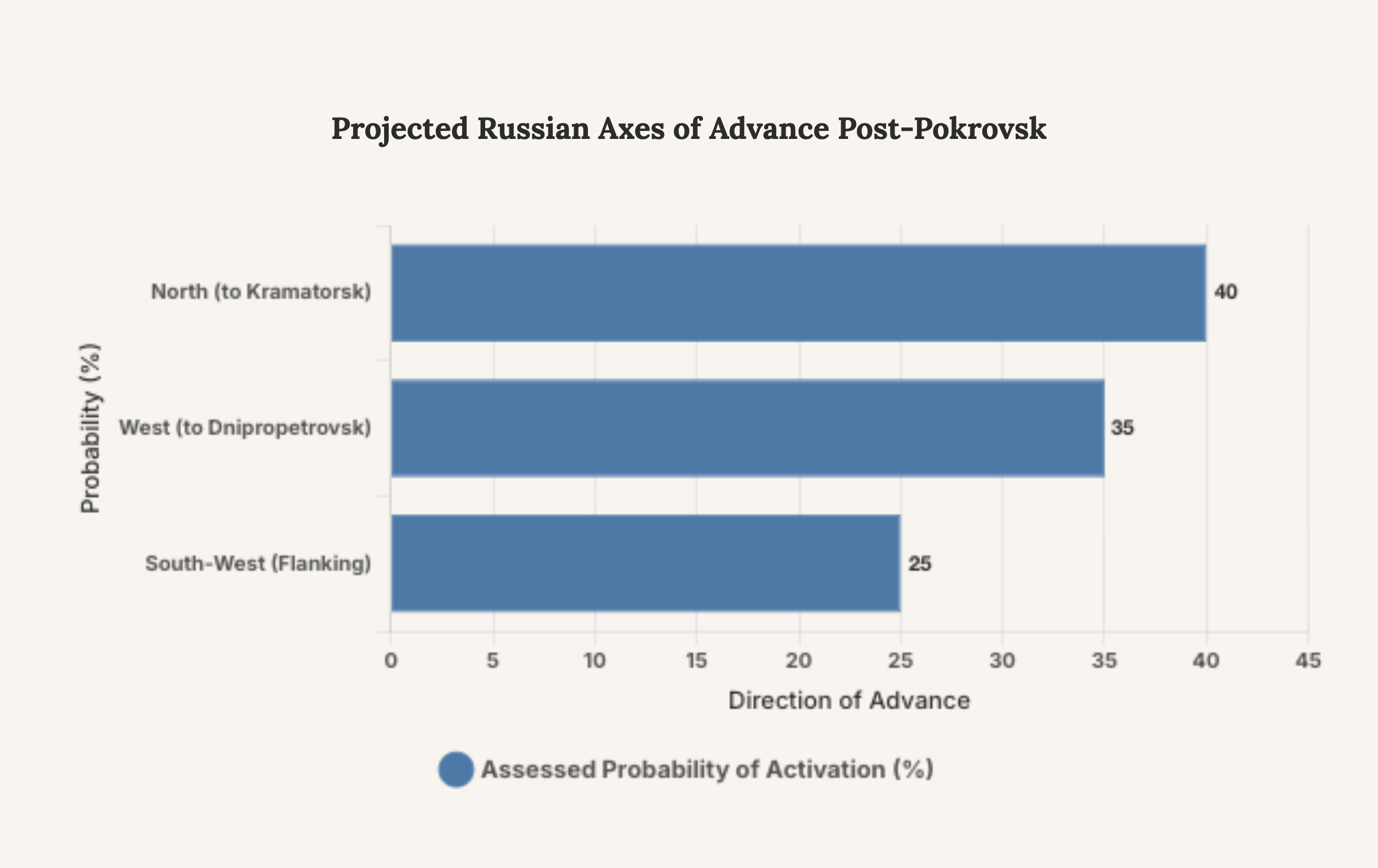
This analysis projects the likely primary and secondary axes of advance for Russian forces after securing Pokrovsk. While consolidating control of Donetsk by moving north toward Kramatorsk is the primary objective, a significant push west to pressure Dnipropetrovsk is a high-probability secondary effort.
Signposts and Strategic Foresight: The Next 90 Days
The coming weeks are critical. For policymakers, investors, and military leaders, monitoring a specific set of indicators will be essential to anticipating the trajectory of the conflict.
Indicators to Watch
Logistics Routes: Pay close attention to the status of the T0504 and M-30 highways. Increased interdiction by Russian drones and artillery will signal a further tightening of the noose. The breakdown of logistics is a leading indicator of an impending withdrawal.
Force Deployment: The redeployment of elite Ukrainian units, such as the 3rd Assault Brigade, which was used in Avdiivka, would indicate the severity of the situation. Conversely, the commitment of additional Russian army corps would signal an intent to accelerate the city’s capture.
Political Rhetoric: Both Kyiv and Moscow will manage the narrative. An increase in Russian claims of encirclement, even if premature, is designed to create psychological pressure. Ukraine, in turn, will emphasize the cost being inflicted on Russian forces. The decision to withdraw, as seen in Avdiivka, is often a difficult political as well as military calculation.

This chart presents a speculative forecast modeling the potential shift in territorial control within Pokrovsk over the next 60 days under current tactical momentum. It projects a gradual but steady erosion of Ukrainian control as Russian infiltration and encirclement tactics take their toll.
The battle for Pokrovsk is a microcosm of the wider war: a contest of attrition, adaptation, and political will. For Ukraine, holding the city is a matter of strategic necessity, but not at the cost of losing the combat power needed to defend the nation. For Russia, its capture is a critical step towards achieving a key war aim and a potent symbol of its grinding, relentless advance. The loss of Pokrovsk would be a severe blow, but as the war has repeatedly demonstrated, the loss of a single battle does not determine the outcome of the war. The key question is whether Ukraine can execute a tactical withdrawal if necessary to preserve its forces for the next fight, or if the political and strategic cost of retreat is deemed too high.
The fall of Pokrovsk would fundamentally reshape the geography of the war in Donbas, forcing a costly Ukrainian retreat and ceding both a vital military hub and a cornerstone of its industrial economy to Russia.