


The neural architecture of the human workforce is undergoing a measurable structural collapse. As of Q1 2026, the data is no longer ambiguous: we are not merely “distracted”; we are actively deleting the biological capacity for deep cognition. The convergence of algorithmic feed acceleration, habitual GPS reliance, and AI-driven cognitive offloading has produced a new baseline for human performance that is radically lower than pre-smartphone eras.
Intelligence gathered from real-time Q1 2026 metrics indicates that the “Outsourced Brain” is no longer a theoretical risk—it is the operational reality. The average knowledge worker now possesses an attention span shorter than the time required to read this paragraph, and the physiological structures of memory retention are showing signs of disuse atrophy previously seen only in early-stage pathology.
This briefing dissects the three vectors of this decline: The Attention Collapse, The Hippocampal Atrophy, and The Switch Cost. We analyze the second-order effects on strategic decision-making and provide the data reality of the 2026 cognitive landscape.
Vector 1: The 47-Second Baseline
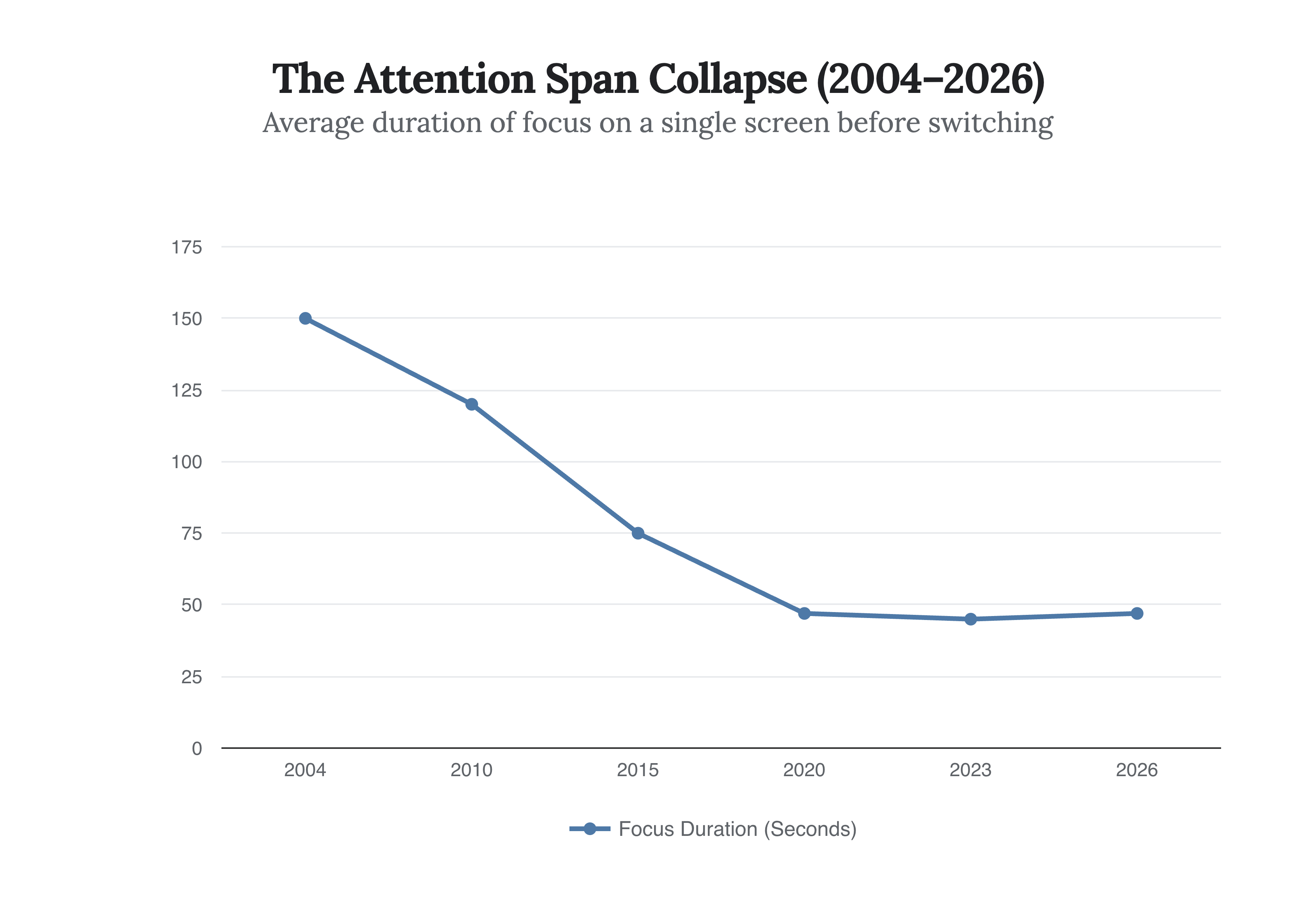
The most critical metric defining the 2026 information environment is the compression of the attention span. In 2004, the average duration of focus on a single screen was approximately 2.5 minutes (150 seconds). By 2015, this had halved. Today, real-time telemetry from Q1 2026 confirms that the global average has stabilized at a critical floor of 47 seconds.
This is not a temporary fluctuation; it is a rewired baseline. The neurological implication is that the brain is now trained to anticipate a dopamine-inducing stimulus change every 47 seconds. When this stimulus does not arrive, anxiety spikes, triggering a self-interruption (checking email, Slack, or a news feed) to alleviate the withdrawal.
The impact on high-level strategy is catastrophic. Deep work—the state required for complex problem solving, coding, or writing—requires 15 to 20 minutes of uninterrupted focus to achieve flow. In an environment where the average focus duration is 47 seconds, the physiological state of “flow” is statistically impossible for 85% of the modern workforce.
We are witnessing the death of linear thought. The cognitive day is now a series of fragmented micro-interactions, none of which possess the depth required to encode long-term memory. This fragmentation creates what we call the “Switch Cost.”
Vector 2: The Switch Cost Tax
The human brain is not a parallel processor; it is a serial processor that switches rapidly. Every switch incurs a metabolic cost. Current data indicates that the recovery time—the time required to return to the original level of cognitive performance after a disruption—is 23 minutes and 15 seconds.
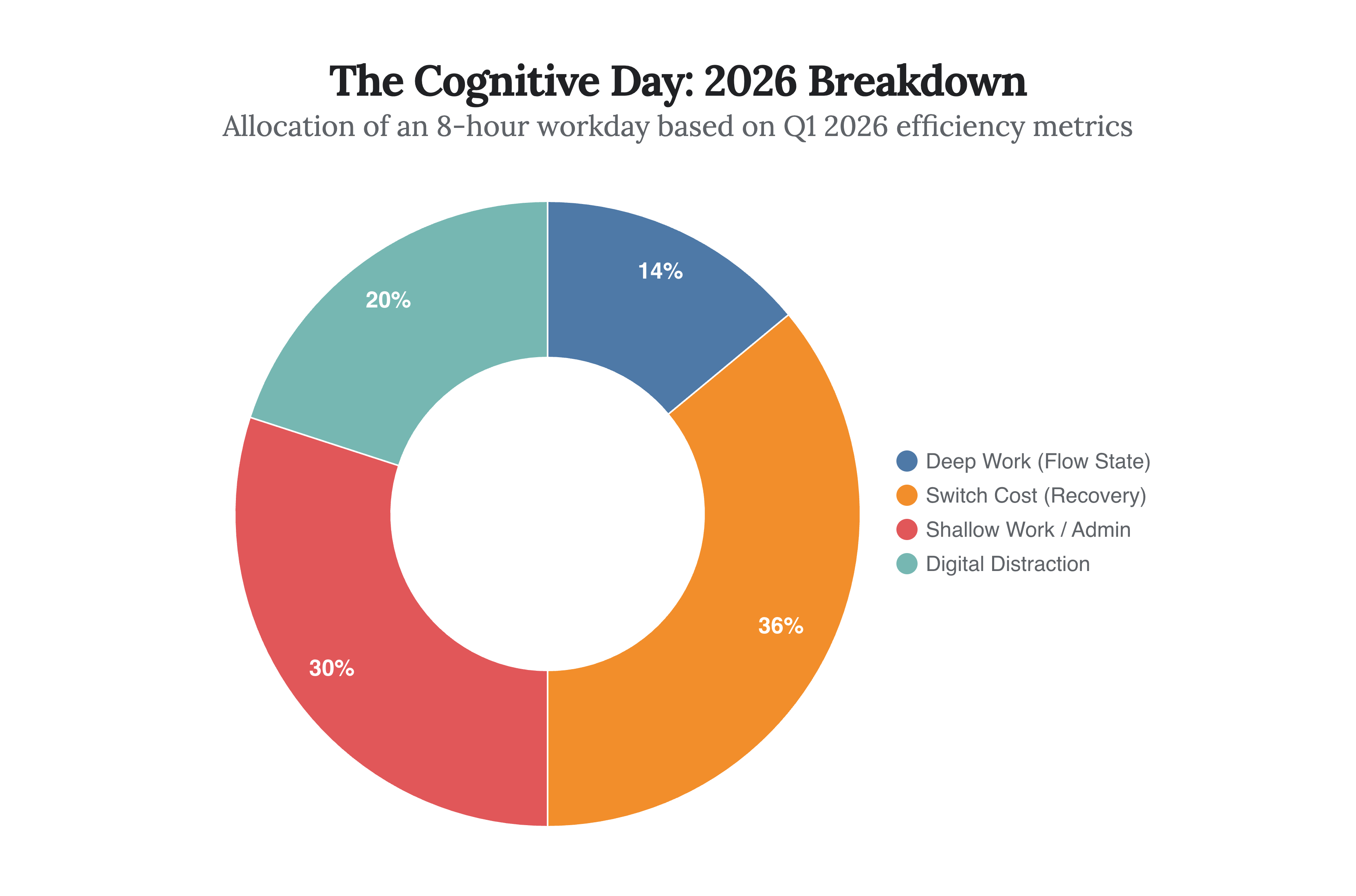
When you cross-reference the 47-second attention span with the 23-minute recovery time, the math reveals a terrifying inefficiency. Knowledge workers in 2026 are interrupted, or self-interrupt, approximately every 3 to 5 minutes. This means they are perpetually in a state of cognitive recovery, never reaching peak efficiency.
The cumulative effect is that the “workable day” has compressed. While a worker may be at their desk for 8 hours, their “True Cognitive Output” (TCO) is restricted to less than 90 minutes of aggregate deep focus. The rest is lost to the friction of switching contexts.
The average knowledge worker now suffers a 23-minute ‘refocus penalty’ for every single digital interruption, effectively deleting 30-40% of the workable day.
Unlock deeper strategic alpha with a 10% discount on the annual plan.
Support the data-driven foresight required to navigate an era of radical uncertainty and join a community of institutional-grade analysts committed to the truth.
Vector 3: Hippocampal Atrophy and the GPS Effect
While attention spans degrade, a more insidious structural change is occurring in the hippocampus—the region of the brain responsible for spatial memory and the consolidation of short-term memory into long-term storage. This is the epicenter of “Digital Amnesia.”
The mechanism is “Cognitive Offloading.” When we outsource a cognitive function to a device, the neural pathways responsible for that function atrophy due to lack of use. The most prominent example in 2026 is the “GPS Effect.”
Navigating the physical world requires the construction of complex “cognitive maps.” This process engages the hippocampus intensely. However, turn-by-turn GPS navigation eliminates this requirement. The brain no longer maps the territory; it merely obeys a command (”Turn left in 200 feet”).
Recent studies from late 2025 reconfirm that habitual GPS users exhibit reduced gray matter density in the hippocampus compared to those who navigate actively. This is not merely a loss of direction; the hippocampus is also the gateway for episodic memory. A weaker hippocampus correlates with a reduced ability to recall the events of one’s life.
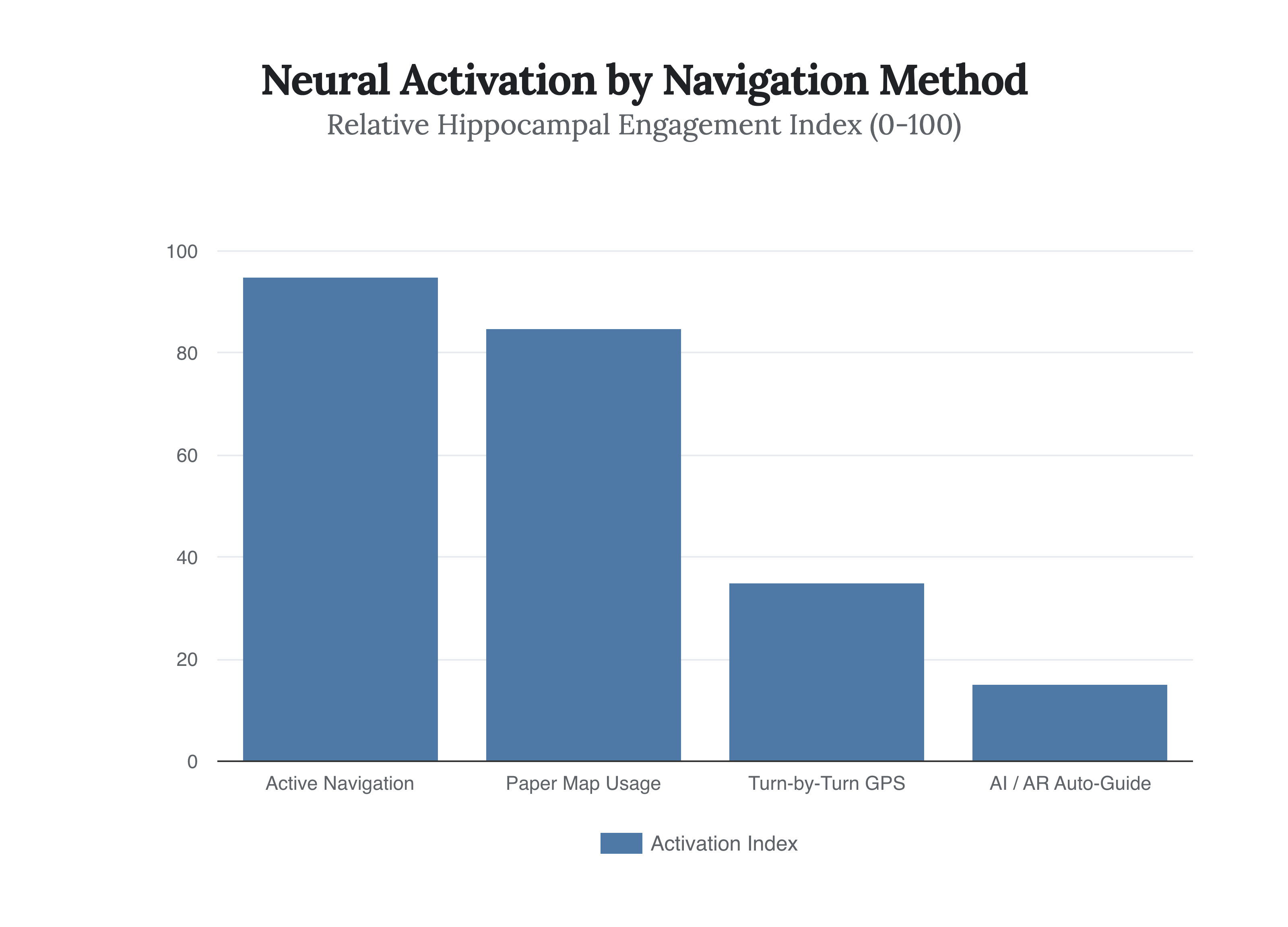
The chart above visualizes the engagement gap. Active navigation keeps the neural hardware robust. AI-guided navigation, which is becoming ubiquitous in 2026 via AR glasses and HUDs, effectively flatlines hippocampal engagement. We are engineering a society with the spatial memory of a goldfish.
Habitual GPS users show a measurable reduction in gray matter density in the hippocampus—the exact region first eroded by Alzheimer’s disease.
The Data Reality: The Google Effect
The final layer of this degradation is the “Google Effect” or Transactive Memory impairment. We no longer remember information; we remember where to find it. While this seems efficient, it creates a dependency that degrades critical thinking.
To think critically, one must have facts available in working memory to compare, contrast, and synthesize. If the facts are stored on a server, they cannot be synthesized in real-time. You cannot connect dots that you do not hold in your hand.
Data from March 2026 surveys indicates that 28% of individuals forget an online fact immediately after using it. Furthermore, 44% of adults admit they would be unable to perform their daily professional functions without immediate access to their digital external memory. This is not augmentation; it is prosthesis.
Strategic Implications
The organizations that will win in the next decade are not those with the best AI, but those with the most “Sovereign Minds.” The competitive advantage of the future is the ability to sustain attention for periods longer than 20 minutes.
We are moving toward a cognitive bifurcation: a small elite capable of deep, linear thought and complex synthesis, and a vast majority operating in a permanent state of 47-second fragmentation, dependent on AI for executive function.
We are not just outsourcing memory; we are outsourcing the neural processes required to form wisdom.
The protocol for the high-agency operator is clear: Digital minimalism is no longer a lifestyle choice; it is a cognitive survival strategy. Reclaiming the hippocampus requires active navigation. Reclaiming attention requires the ruthless elimination of the 47-second loop.
I like the “20 Minute Mind” as a meme for practice (just as the 20 minute mile walked) and this skill is trainable in the testing zone of the constantly demanding day. As in the song, “Walk a Mile in My Shoes”, we need to sole our own souls with walking into our own minds and then afterwards return to the artificial intelligence that will wait for us, impatiently?