



While Washington and Beijing are busy digging moats, a quiet coalition of nations is busy building bridges—and charging a toll to cross them. The prevailing narrative of the “Splinternet” suggests a clean bifurcation: a US-led “Clean Network” versus a China-led “Digital Silk Road.” This binary is dangerously incomplete. It ignores the rapid emergence of the Digital Non-Aligned Movement (D-NAM): a strategic cluster of geography-agnostic nations—principally Malaysia, Oman, and the UAE—that are engineering themselves into the “Switzerland” of the AI era. These are not merely passive neutral grounds; they are active “Neutral Zone” fiber hubs designed to bypass the data tariffs, export controls, and sovereignty firewalls erecting the new Iron Curtain.
The Geopolitics of the “Neutral Hop”
The Physical Layer of Non-Alignment
The geography of the internet is being redrawn by avoidance. Traditional subsea cable routes—through the contested South China Sea or the chokepoints of the Red Sea—are now viewed as single points of geopolitical failure. In response, we are witnessing the rise of the “Neutral Hop”: landing stations in politically benign territories that allow data to switch effectively between “Blue” (Western) and “Red” (Eastern) infrastructure without legally touching the soil of an adversary.
Oman has aggressively positioned its coastal city of Salalah as the primary alternative to the congested and conflict-prone Suez/Red Sea route. The launch of the SN1 carrier-neutral data center in late 2025 (a partnership between Equinix and Omantel) is not just an infrastructure project; it is a geopolitical hedge. By anchoring multiple subsea cables (including 2Africa and SEA-ME-WE 6) away from the Strait of Hormuz, Oman is selling sovereign safety.
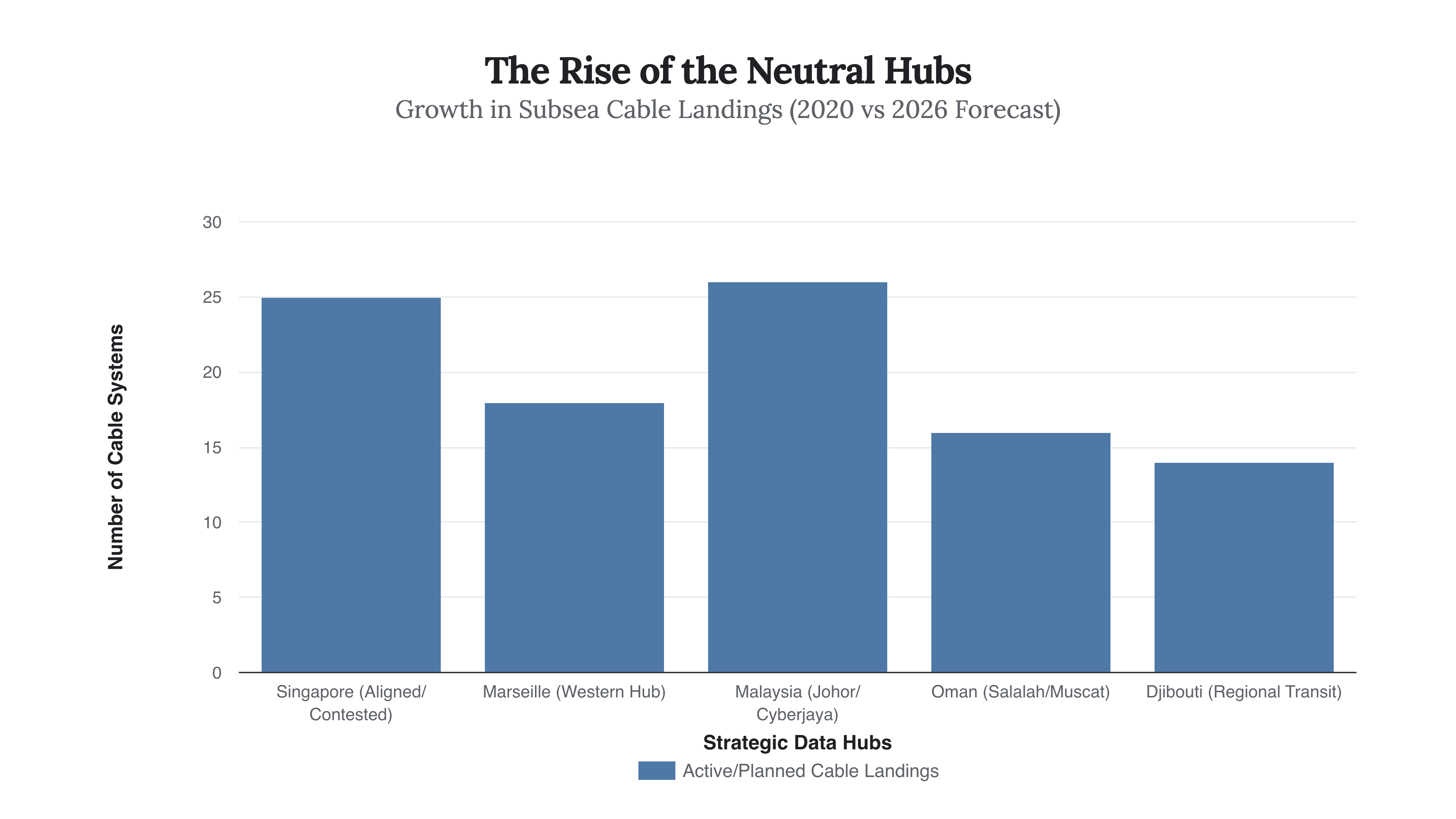
The chart above reveals a critical shift. While traditional hubs like Singapore remain dominant, their growth is plateauing due to land constraints and, crucially, geopolitical saturation. In contrast, Malaysia and Oman are seeing explosive growth in cable landings, driven by their ability to service both Chinese and Western consortia without triggering immediate regulatory hostility.
