


The Mathematics of Fragility
In hindsight, the math was always there. The consensus in 2024 was that consolidation equaled security—that reducing the number of vendors reduced the attack surface. This was a fundamental miscalculation of probability theory. By streamlining the cybersecurity supply chain into three dominant platforms, the S&P 500 did not eliminate risk; they correlated it.
The data below, reconstructed from the post-mortem of the 2026 “Consolidated Collapse,” illustrates the inverse relationship between vendor count and systemic resilience. As the Herfindahl-Hirschman Index (HHI) for the endpoint protection market crossed 2,500 (indicating high concentration), the probability of a simultaneous multi-sector outage shifted from statistical noise to a near-certainty.
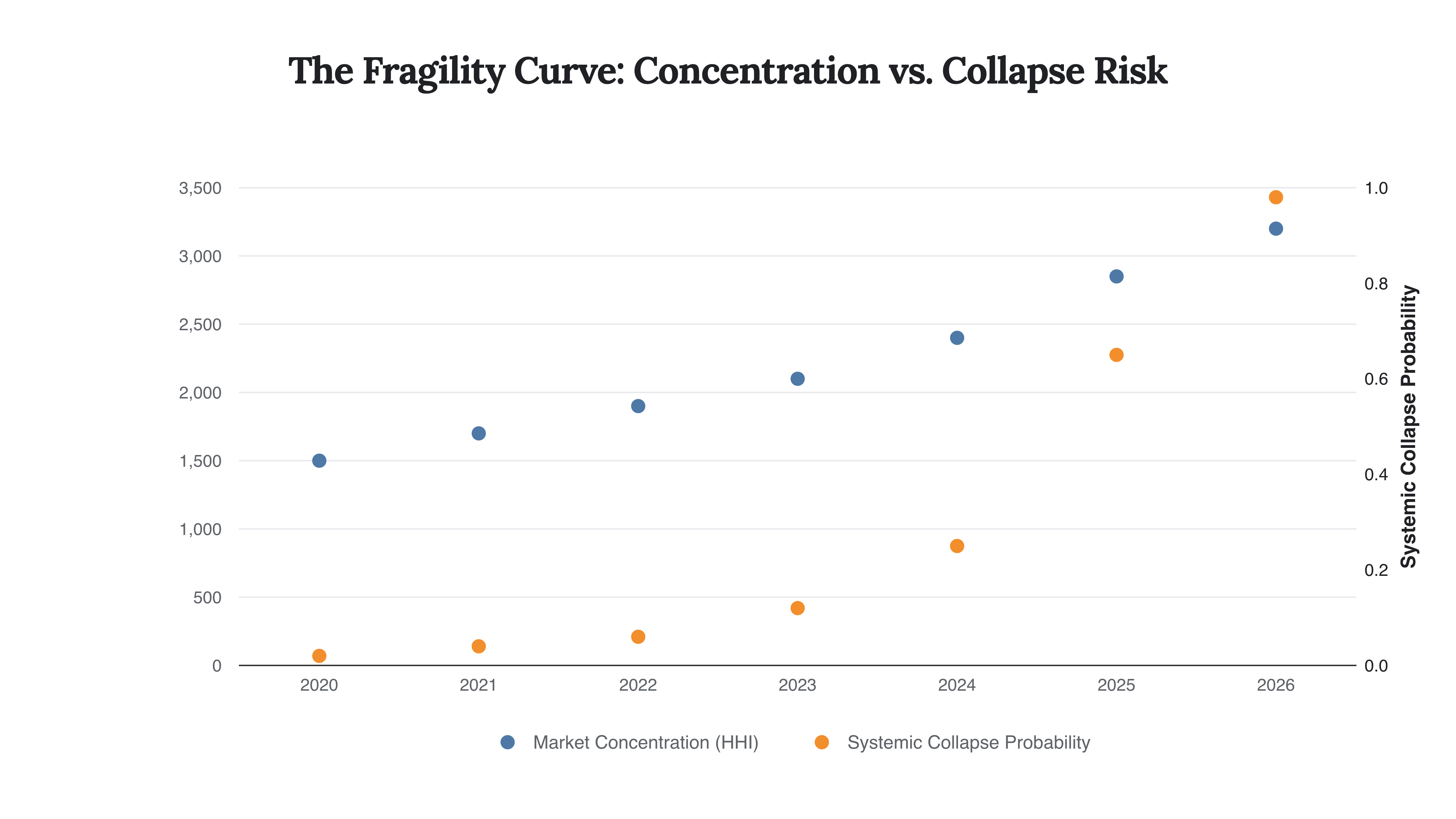
The collapse was not a failure of code, but a failure of market structure. When a single security kernel operates on 20% of the world’s critical infrastructure, a bad update is no longer a maintenance issue—it is a contagion event. The chart above demonstrates the exponential rise in systemic risk once market concentration passed the critical inflection point in late 2024.
The 20% Threshold: A Lethal KPI
The trigger mechanism for the 2026 collapse was identified years prior by fringe risk analysts but ignored by CIOs prioritizing “single pane of glass” manageability. The metric was simple: The 20% Threshold.
Once a single vendor—let’s call them “Vendor Zero”—achieved 20% market share of the S&P 500’s endpoint kernel access, the economics of cyber-warfare inverted. For state-sponsored actors, the ROI on developing a zero-day exploit for a fragmented market is low. Developing an exploit for a monoculture, however, offers infinite leverage. At 20% share, a single exploit does not just breach a company; it shuts down the economy.
By Q3 2025, Vendor Zero had captured 28% of the Fortune 500 endpoint market through aggressive M&A and bundling strategies. The attack surface became perfectly homogenized. The attackers did not need to breach 500 different firewalls; they only needed to compromise one update server.
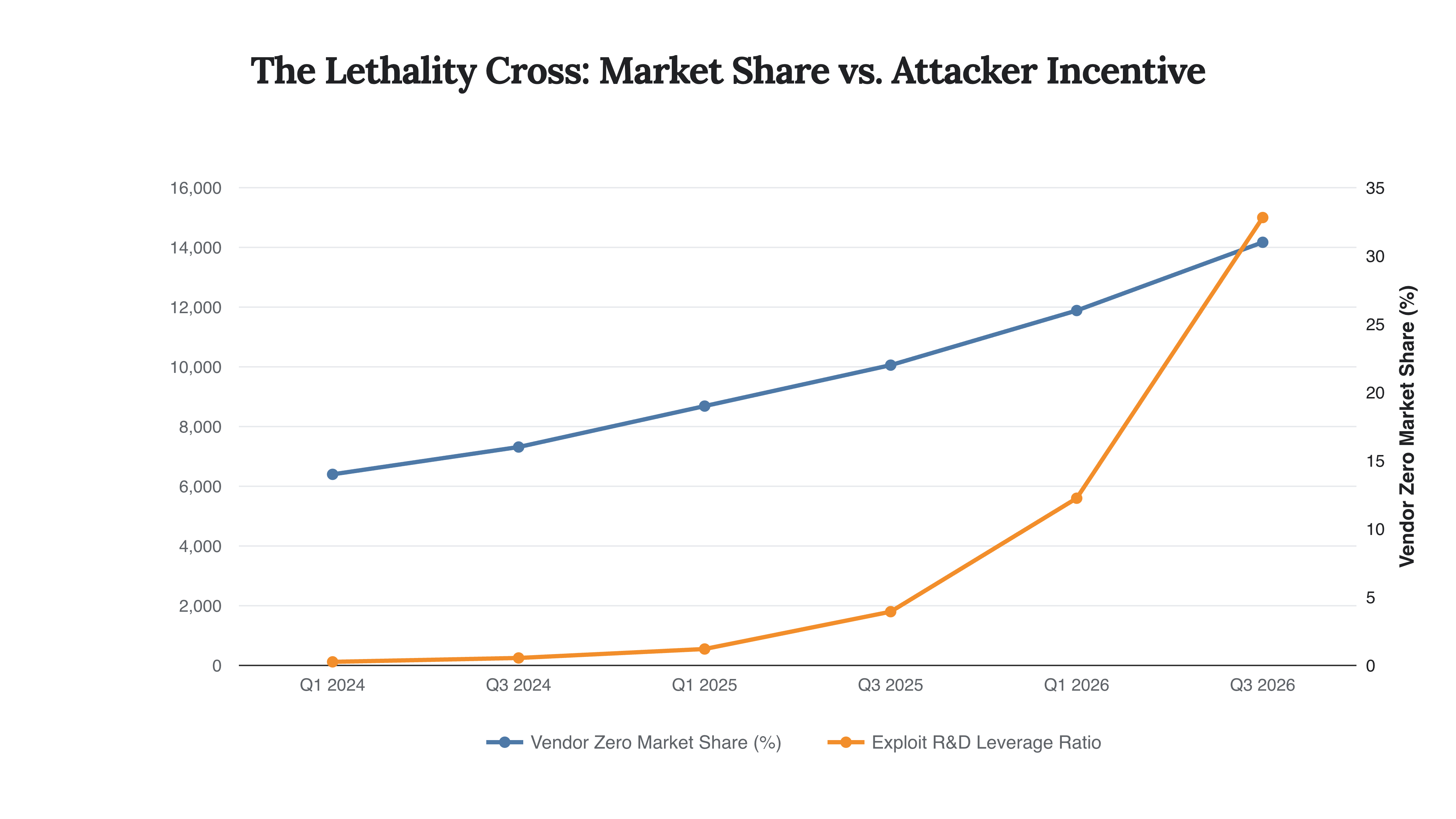
As indicated, the leverage ratio for attackers went parabolic once share crossed 19%. At that stage, the cost of a $50 million R&D budget to find a kernel bypass was negligible compared to the trillions in damage capability. The market efficiency that CFOs loved became the very mechanism of their destruction.
The Cascade: Anatomy of the 48-Hour Freeze
The event began on a Tuesday morning with a standard heuristic definition update. Because Vendor Zero had successfully lobbied for “kernel-level integration” to improve performance, the update bypassed the standard OS safeguards. The result was not a blue screen of death, but a “logic lock”—a state where the security agent flagged the operating system’s own boot process as malicious.
Because of the platformization trend, Vendor Zero was not just the antivirus. They were the Identity Provider (IdP), the Cloud Access Security Broker (CASB), and the SASE provider. When the endpoints froze, the backup authentication channels also froze because they relied on the same vendor’s telemetry for conditional access.
The data below visualizes the cascading latency across three critical sectors during the first 6 hours of the collapse.
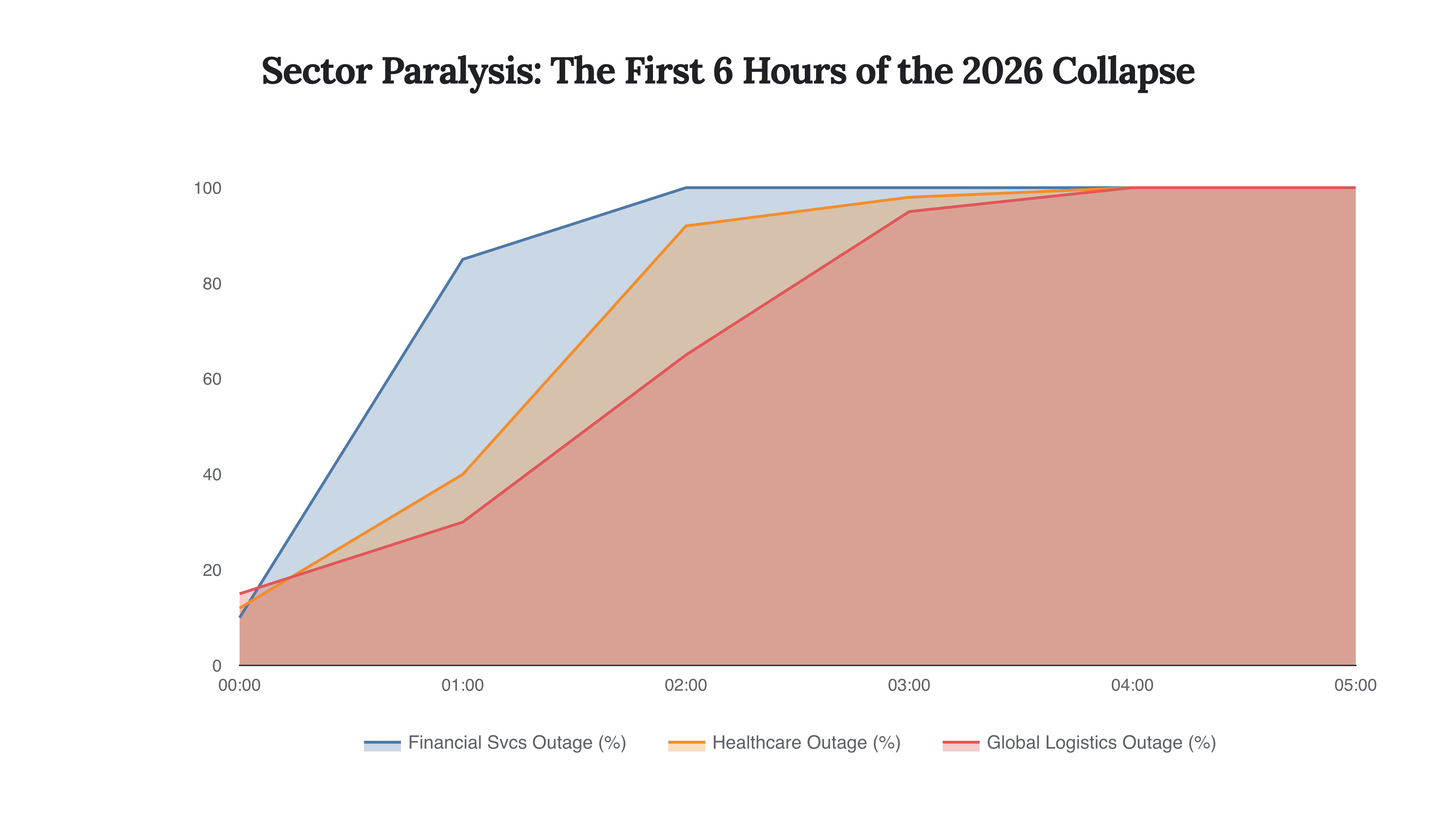
Financial services hit 100% operational paralysis within two hours because algorithmic trading desks and retail banking cores shared the same security dependency. Healthcare followed, not because of medical devices, but because the radiological imaging networks were secured by the same monolithic agent.
The Regulatory Blindspot: Antitrust vs. Systemic Risk
How was this allowed to happen? The Federal Trade Commission (FTC) and European Commission analyzed the mergers of 2024-2025 through the lens of consumer pricing, not systemic fragility. They argued that bundling security services lowered costs for enterprises. They failed to model the “Titanic Effect”: building a ship so large that it cannot sink, guaranteeing that when it does, the catastrophe is total.
The regulators ignored the concentration of “Privileged Access.” By allowing Vendor Zero to acquire the leading identity firm and the leading network visibility firm, they created a single entity holding the keys to the castle for 40% of global GDP.
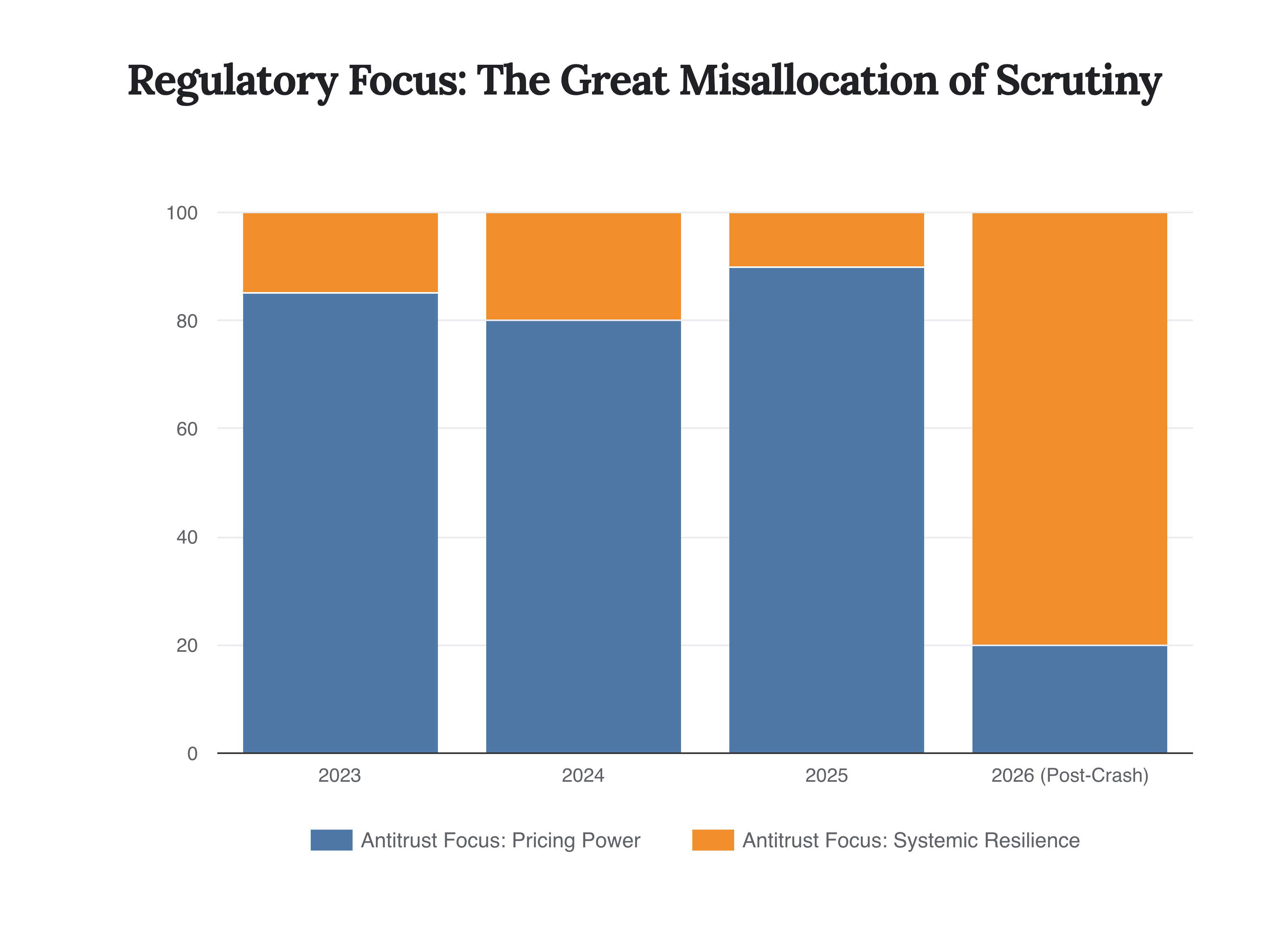
The chart illustrates the reactive nature of bureaucracy. It was only after the collapse that regulatory bodies shifted their focus from pricing models to resilience models. By then, the capital destruction had already exceeded the GDP of the United Kingdom.
The Insurance Insolvency Event
The most immediate financial shockwave was the collapse of the cyber insurance market. Carriers had modeled risk based on uncorrelated events—assuming that if Company A gets hacked, Company B is safe. The 2026 Consolidated Collapse was a correlated event. It was the cyber equivalent of a global hurricane hitting every city simultaneously.
Claims aggregated to $3.4 trillion within 72 hours. The reinsurance market froze. Major carriers invoked “Systemic Infrastructure Failure” clauses to deny payouts, triggering a secondary wave of bankruptcies among small and mid-cap companies that relied on insurance rather than operational resilience.
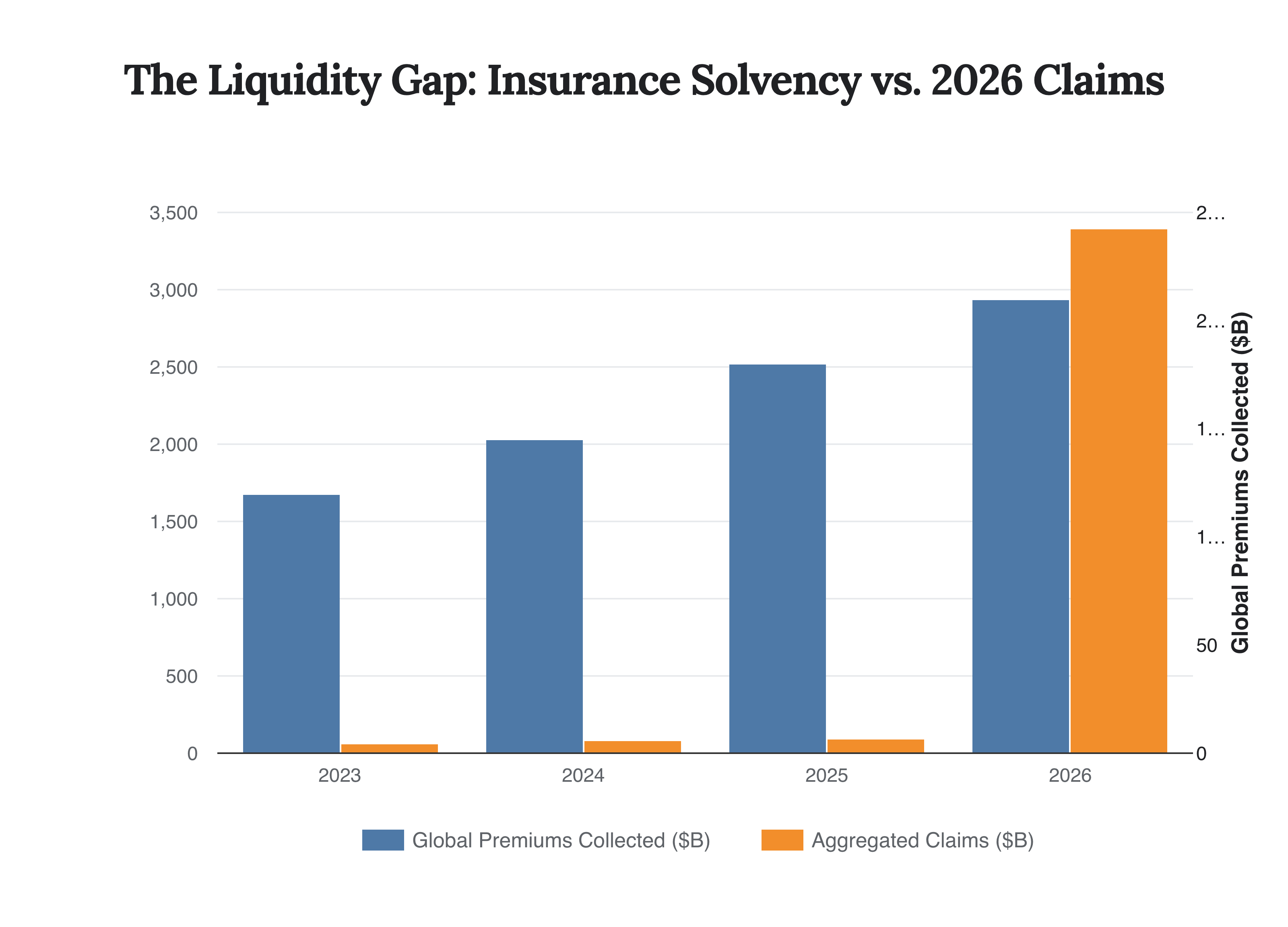
This gap destroyed the “risk transfer” model. Decision-makers realized they could no longer pay someone else to hold the bag. If the platform goes down, you go down, and no check is coming to save you.
Second-Order Effects: The Rise of Heterogeneity
We are now seeing the violent swing of the pendulum back toward fragmentation—but a calculated fragmentation. The “Best-of-Breed” strategy has returned, not for feature superiority, but for biological diversity. CIOs are now mandated to run distinct security stacks for different business units to ensure that a single vendor failure cannot kill the entire organism.
Furthermore, the “Analog Option” has become a premium asset. Logistics and manufacturing firms are re-implementing manual override systems and non-digital continuity plans. The premium on “dumb” machinery—equipment that can run without a cloud handshake—has skyrocketed.
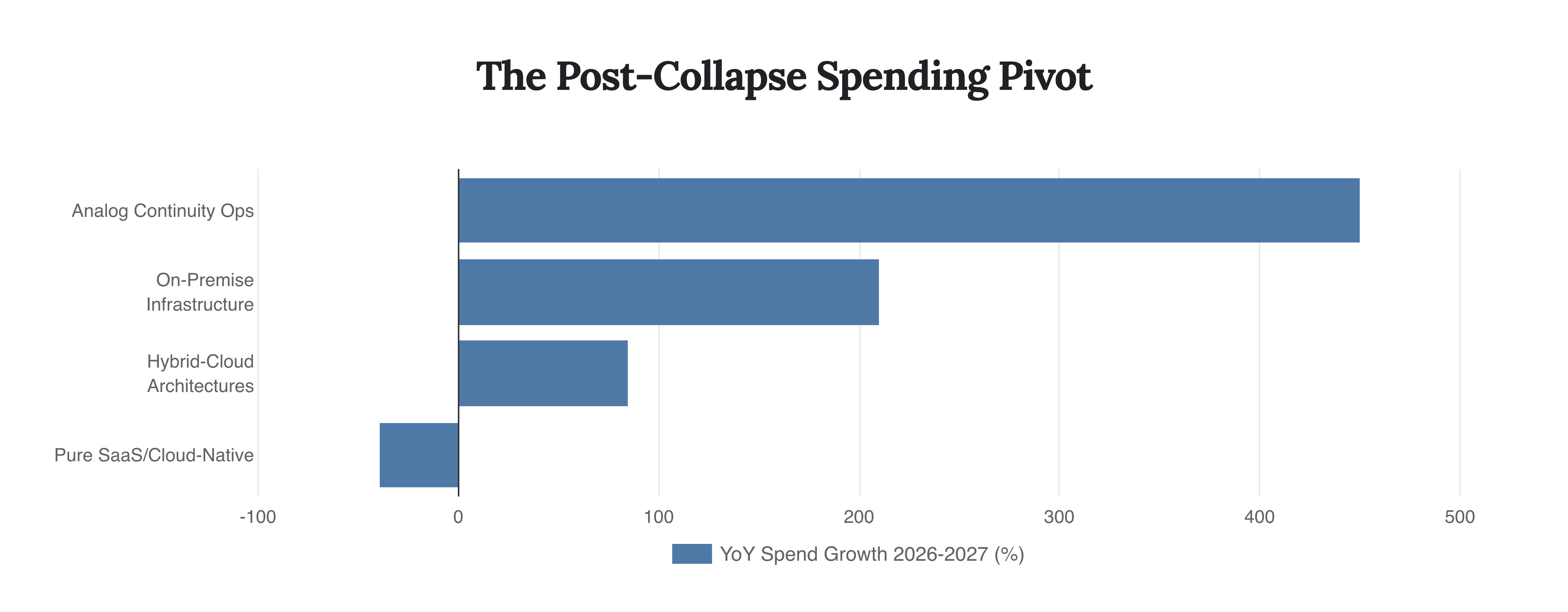
The Investor Outlook
The era of the “Platform Premium” is dead. Investors should look for:
Short the aggregators. The regulatory hammer is coming, and forced breakups will destroy the cross-selling synergies that justified their valuations.
Long niche, on-premise, and air-gapped security vendors. Sovereignty is the new watchword.
Long operational resilience consultants. The market is shifting from “cybersecurity” (protecting the data) to “business continuity” (protecting the operation).
The Consolidated Collapse of 2026 proved that efficiency is the enemy of resilience. The market is now pricing in the cost of redundancy, and those who continue to bet on the monoculture will be left with zero uptime.