


A Strategic Intelligence Briefing on the Tactical Breakthrough, Logistical Collapse, and Geopolitical Shockwaves of Russia’s Advance
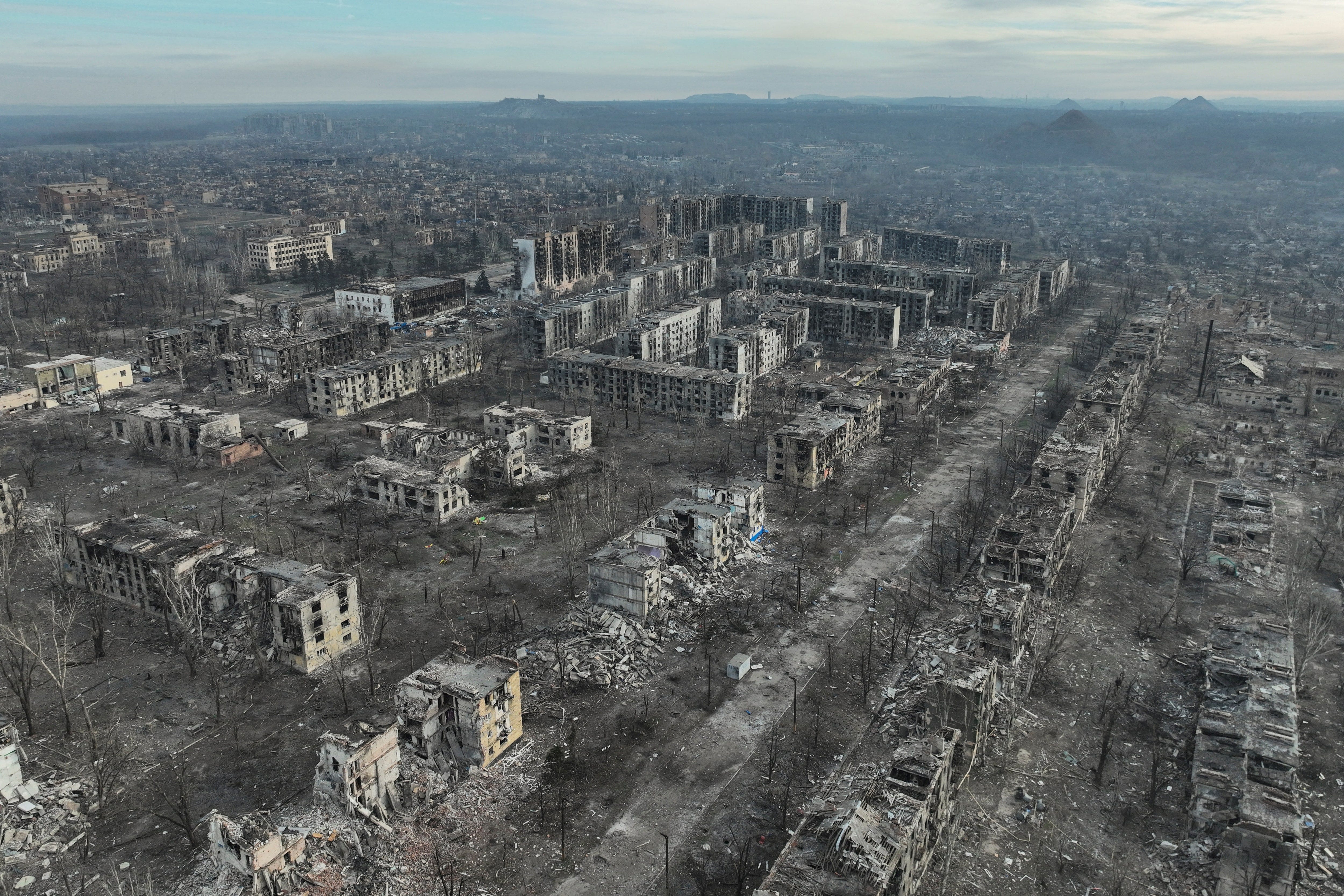
The battle for Pokrovsk, a grinding, year-long offensive, has reached its denouement. After months of attritional warfare following the capture of Avdiivka, Russian forces have successfully penetrated the city’s defenses, initiating brutal urban combat and threatening the collapse of a cornerstone of Ukraine’s eastern front. This is not merely the fall of another city; it represents a tactical, operational, and strategic inflection point. The capture of this critical logistics hub—once home to 60,000 people and a vital artery for the Ukrainian military—fundamentally alters the strategic calculus in the Donbas. It cripples Ukrainian supply lines, provides Russia a launchpad for its final push to secure the entirety of Donetsk Oblast, and sends a powerful signal to Kyiv and its Western backers about the grim realities of a protracted war of attrition. This briefing deconstructs the anatomy of the Russian breakthrough, assesses the cascading strategic consequences, and provides a forward-looking analysis of the conflict’s next phase.
The Anatomy of a Breakthrough: How Russia’s Evolved Tactics Shattered a Fortress City
The fall of Pokrovsk was not the result of a single, massive frontal assault reminiscent of the costly battle for Bakhmut. Instead, it was the culmination of a methodical, multi-axis offensive that showcased Russia’s tactical adaptation. Moscow has shifted towards a hybrid strategy that combines encirclement, relentless drone warfare, and the infiltration of small, mobile infantry units to paralyze and dislocate Ukrainian defenses from within.
The Pincer and the Infiltration
Beginning in earnest after the capture of Avdiivka in February 2024, Russian forces initiated a grinding advance, seizing a series of settlements to the east and south of Pokrovsk. This strategy aimed to create a pincer movement, gradually strangling the city and cutting its vital supply routes. By late October 2025, the city was semi-encircled, with reports indicating that all major bridges had been destroyed and logistical access was severely degraded. This creeping envelopment was paired with a new and effective infiltration tactic. Small Russian infantry groups, at times disguised as civilians, penetrated the porous front lines to sow chaos in the Ukrainian rear, targeting command posts and, critically, drone operators who formed a key part of the city’s defense. By late October, hundreds of Russian troops were operating inside Pokrovsk, engaging in fierce street-by-street fighting and establishing footholds deep within the urban area.
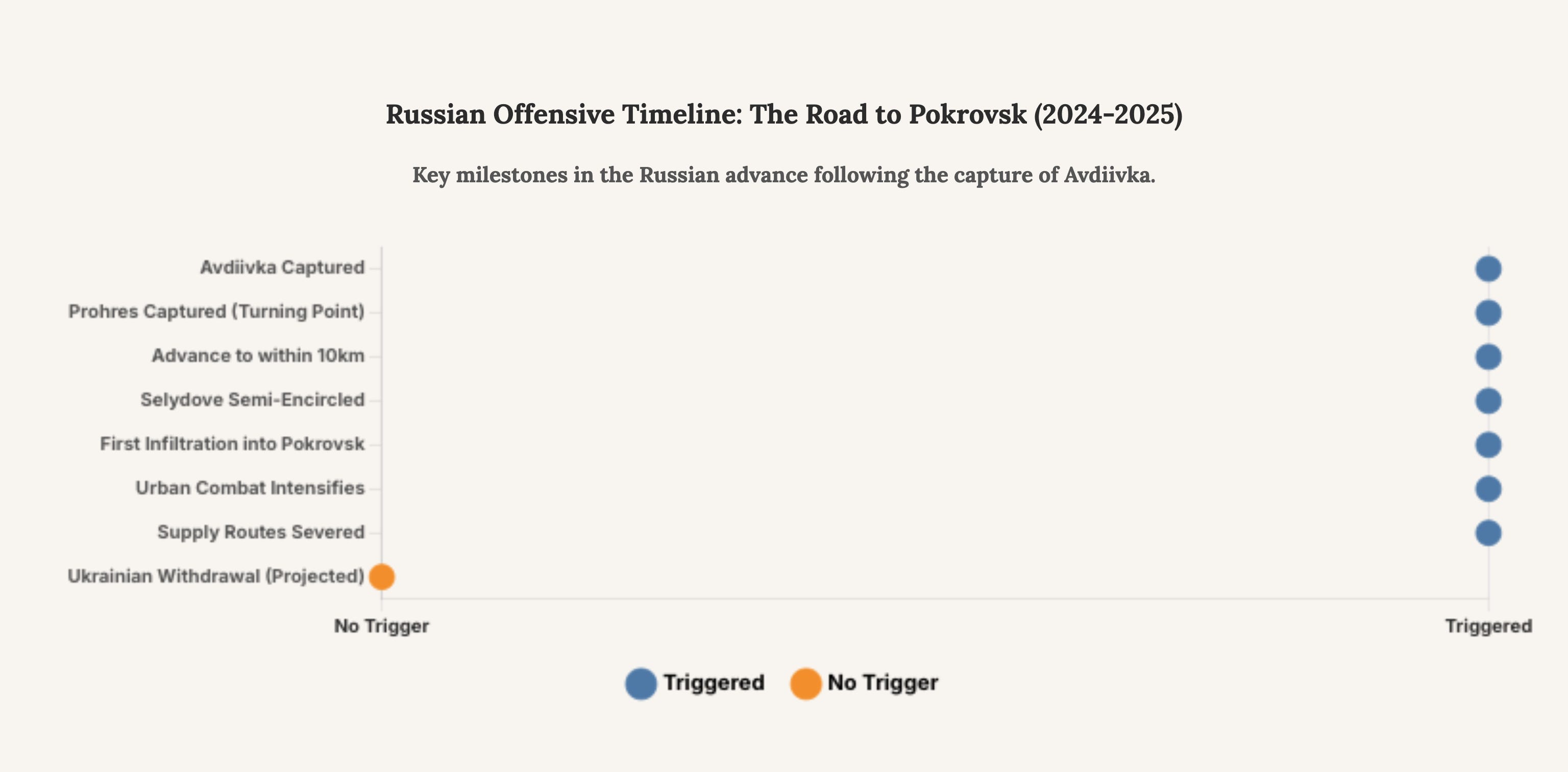
This timeline illustrates the methodical nature of the Russian offensive, which accelerated after key territorial gains like Prohres and culminated in the infiltration and severing of logistics to Pokrovsk itself.
The Manpower and Materiel Imbalance
Ukraine’s defense was ultimately hamstrung by a severe and worsening manpower crisis. President Volodymyr Zelensky stated that Ukrainian troops on the Pokrovsk front were outnumbered by a staggering eight to one, a disparity that made holding a continuous defensive line untenable. Russia, conversely, concentrated a massive force for the operation, with Ukrainian military sources estimating up to 11,000 troops deployed in the immediate effort to encircle the city. This numerical superiority allowed Russia to absorb high casualties while relentlessly pressuring Ukrainian positions, exploiting any gaps that appeared in the strained defensive lines. The attritional nature of the fighting favored Moscow’s greater human resources, a brutal reality that defined the final stages of the battle.
The Strategic Domino: Why Pokrovsk’s Fall Reorders the Eastern Front
The loss of Pokrovsk is a profound strategic blow, the consequences of which will radiate across the entire theater of operations. Its primary significance lies in its role as a logistical lynchpin and a gateway to the last major Ukrainian-controlled population centers in the Donbas.
The situation in Pokrovsk is on the verge of critical and continues to deteriorate to the point that it may be too late to fix everything.
This sentiment, shared by Ukrainian military-linked analysts, underscores the gravity of the city’s collapse.
The Collapse of the Donbas Supply Network
Pokrovsk was the nexus of a critical road and rail network that supplied Ukrainian forces from Vuhledar in the south to the Bakhmut-Horlivka sector in the north. Its capture effectively severs this artery, massively complicating Kyiv’s ability to move troops, ammunition, and equipment. The fall of the city creates a logistical crisis that will force a significant reorganization of Ukrainian defenses and could precipitate withdrawals from other fortified positions that are now difficult to sustain. The key T0504 highway, a primary supply route, is now under Russian control or direct fire, leaving Ukrainian units in nearby towns like Myrnohrad in a perilous position.
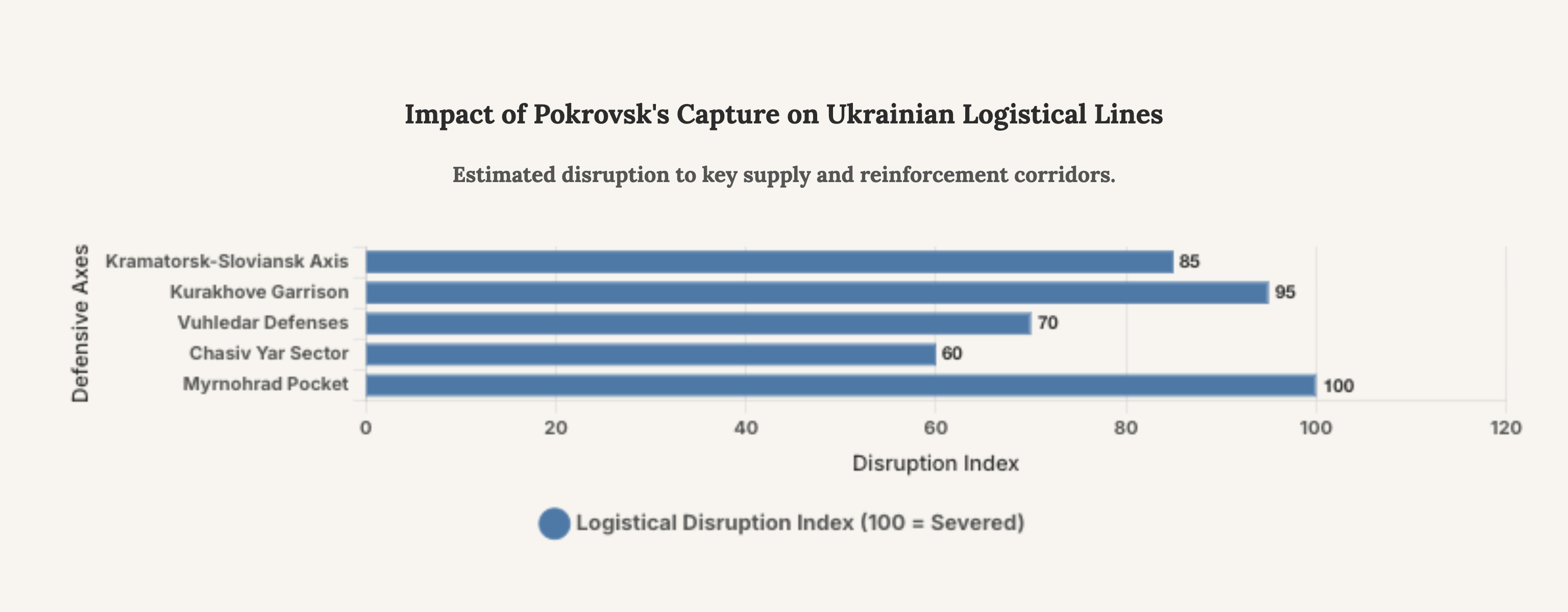
The chart highlights the severe and widespread impact on Ukraine’s ability to supply its key defensive positions across Donetsk Oblast following the loss of the Pokrovsk hub.
The Gateway to Kramatorsk and Sloviansk
With Pokrovsk secured, Russia now has a firm operational base to launch the next, and likely final, phase of its campaign to conquer Donetsk Oblast. The city serves as a direct launchpad for offensives northward toward Kramatorsk and Sloviansk, the two largest and most symbolic cities remaining under Ukrainian control in the region. The terrain west of Pokrovsk is less fortified and more open, potentially allowing for more rapid Russian advances compared to the dense defensive lines they overcame to reach this point. The capture also opens a potential vector of attack westward, threatening to push to the administrative borders of Dnipropetrovsk Oblast, expanding the conflict beyond the initially claimed territories of the Donbas.
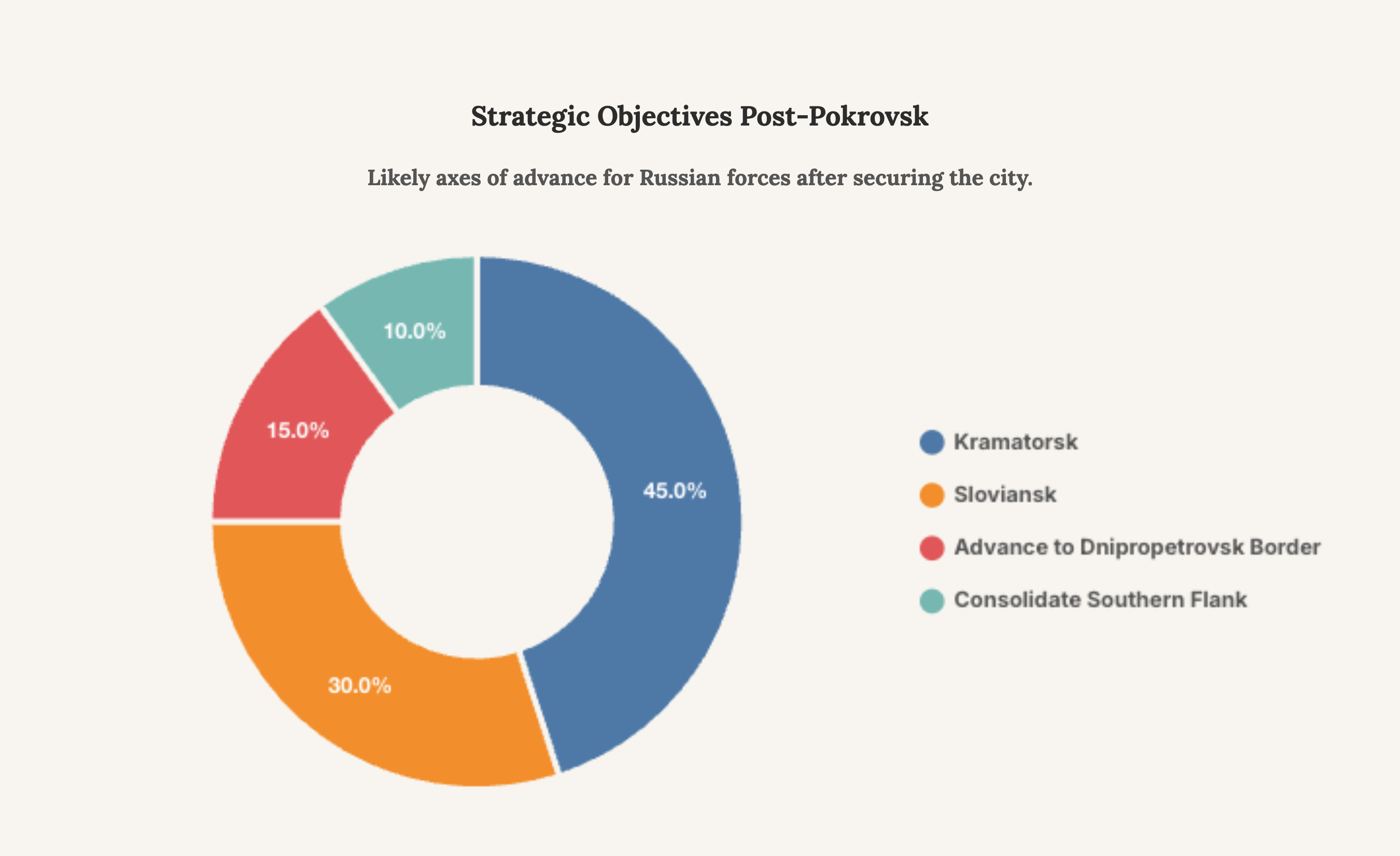
Analysis indicates the primary Russian operational focus will shift to the final major Ukrainian strongholds in Donetsk, Kramatorsk and Sloviansk, leveraging Pokrovsk as a forward base.
The View Ahead: Scenarios, Signposts, and Second-Order Effects
The fall of Pokrovsk initiates a new and dangerous phase of the war. Ukrainian forces are in a precarious position, forced to establish new defensive lines under intense pressure, while Russia holds the strategic momentum. The coming weeks will be critical in determining whether Ukraine can stabilize the front or if the Russian breakthrough will cascade into a wider collapse.
Future Scenarios
Scenario 1: A Fighting Withdrawal (Most Likely): Ukrainian forces conduct a phased withdrawal to a new defensive line, possibly anchored around the Kramatorsk-Sloviansk agglomeration. This would concede territory but preserve manpower and establish a more defensible position, albeit at a high strategic and morale cost.
Scenario 2: Cascading Collapse (Significant Risk): The logistical disruption and numerical inferiority lead to a rapid deterioration of the Ukrainian front in Donetsk. Russian forces exploit the breakthrough, achieving a faster-than-expected advance and putting Kramatorsk under siege before winter fully sets in.
Scenario 3: Stalemate and Attrition (Less Likely): Ukraine rushes significant reinforcements, potentially from other sectors, to slow the Russian advance to a crawl. This would prevent a collapse but would come at a high cost, further depleting Ukraine’s strained reserves and creating vulnerabilities elsewhere.
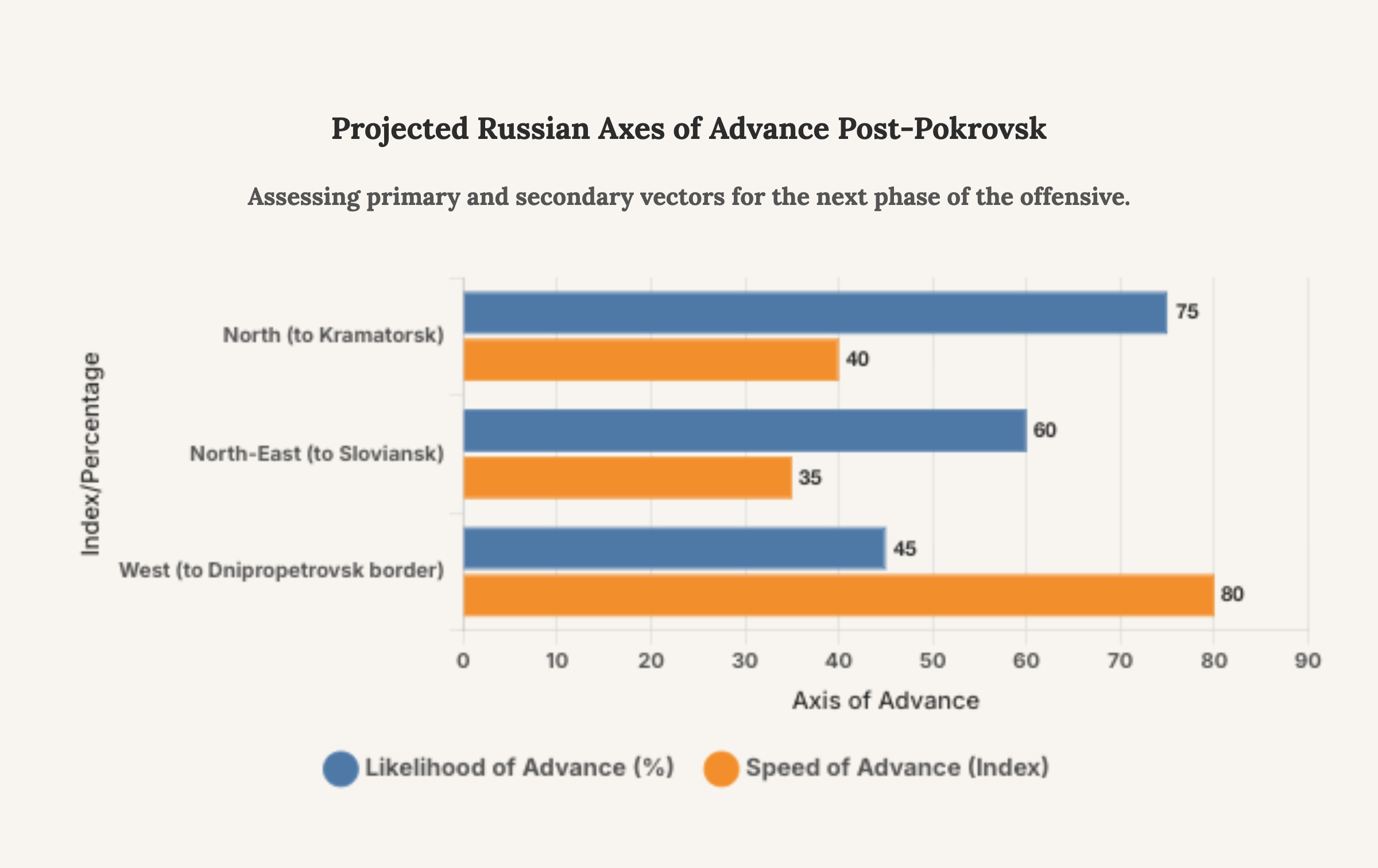
This chart models the most probable Russian courses of action, prioritizing the complete capture of Donetsk Oblast while retaining the option for a westward push should Ukrainian lines falter.
Signposts to Monitor
For policymakers and investors, several key indicators will signal the future trajectory of the conflict:
Ukrainian Reinforcement Levels: The quantity and quality of Ukrainian units redeployed to this sector will indicate Kyiv’s ability and willingness to contest the next Russian push.
Russian Operational Tempo: Whether Russia pauses to regroup and consolidate its gains in Pokrovsk or immediately presses its advantage will reveal its assessment of Ukrainian defensive capabilities.
Western Aid Announcements: Any significant new packages of military aid, particularly artillery, air defense, and engineering equipment, could impact Ukraine’s ability to establish new defensive lines.
A former U.S. intelligence official with a deep knowledge of the Soviet and Russian history of war told National Security Journal that the battle is “not quite the horror of what was seen at Stalingrad, but I am glad not to be a participant. The Ukrainians can’t afford to lose this one.”
The loss of Pokrovsk marks the failure to hold a line that many deemed essential. It is a tactical victory for Russia born from strategic adaptation and a brutal disregard for casualties. For Ukraine, it is a devastating blow that forces a painful reassessment of its defensive strategy in the face of overwhelming numbers and dwindling resources. The war in the Donbas has entered its endgame.
The fall of Pokrovsk is not just a territorial loss; it is the breaking of the logistical spine that supported Ukraine’s entire eastern defense, fundamentally shifting the balance of power in the Donbas.